
SLIDE 1
NUTRITION HEALTH SUSTAINABLE LIVING
ROYAL DSM
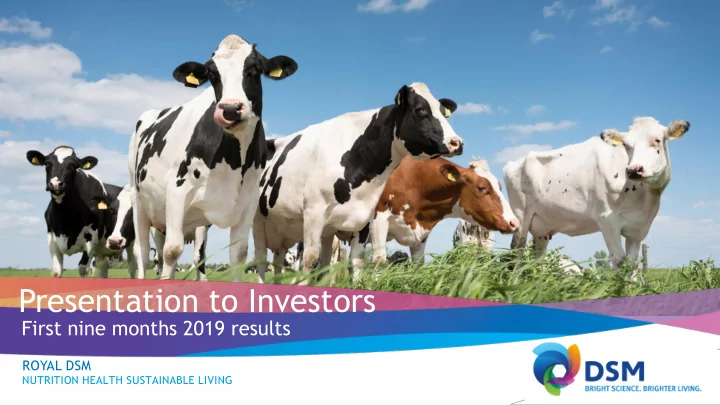
Presentation to Investors First nine months 2019 results ROYAL DSM - - PowerPoint PPT Presentation
Presentation to Investors First nine months 2019 results ROYAL DSM NUTRITION HEALTH SUSTAINABLE LIVING Quote from the CEO Feike Sijbesma I am pleased to report again a good nine -month performance, together with a solid third quarter. In
NUTRITION HEALTH SUSTAINABLE LIVING
ROYAL DSM
Page 1
“I am pleased to report again a good nine-month performance, together with a solid third quarter. In the quarter, Nutrition delivered a good performance with 4% organic growth and Adjusted EBITDA up 12%, despite some softness in Human
its end-markets, especially in China. Dyneema continued to perform
specialty Materials portfolio with a slight Adjusted EBITDA decline of 2%. We made good progress with our large innovation projects, like Veramaris, Clean Cow and Avansya. We are on track to deliver 2019 in line with our targets, and therefore maintain our full year outlook. DSM continues to be well positioned to deliver its ambitious Strategy 2021, with its growth platforms together with increased customer centricity and its large innovation projects, while at the same time remaining focused on cost control and operational excellence.” Feike Sijbesma, CEO/Chairman of the Managing Board
Page 2
▪ DSM reports good first nine months, with a solid performance in Q3 ▪ Results compared to Underlying business in first nine months 2018: ✓ Group sales +3%, Adjusted EBITDA up 11% (including 3% from IFRS 16) ✓ Nutrition: organic sales +4%, Adjusted EBITDA up 13% (including 3% from IFRS 16) ✓ Materials: organic sales –7% (-5% volume), Adjusted EBITDA flat (including 2% from IFRS 16) ▪ Total Net profit €640m, up versus first nine months 2018 of €821m when correcting for the temporary vitamin effect of €290m EBITDA ▪ Adjusted Net Operating Free Cash Flow €550m, up 4% versus first nine months 2018 which included the temporary vitamin effect of €290m EBITDA ▪ Full year outlook maintained
Page 3
▪ DSM reports a solid Q3 ▪ Results compared to Underlying business in Q3 2018: ✓ Group sales +3%, Adjusted EBITDA up 9% (including 3% impact from IFRS 16) ✓ Nutrition: organic sales +4%, Adjusted EBITDA up 12% (including 3% impact from IFRS 16) ✓ Materials: organic sales –7% (-3% volume), Adjusted EBITDA down 2% (including 2% impact from IFRS 16)
Page 4
in € million
Jan - Sept 2019 Jan – Sept 2018 % Change
Underlying1 business Temp. vitamin effect Total Group Underlying1 Organic growth FX & ‘other’1 Underlying1 total growth Temporary vitamin effect Total Group
Sales 6,858 6,644
415 7,059
0% 3% 3%
Nutrition 4,573 4,278
415 4,693
4% 3% 7%
Materials 2,114 2,215
2,215
2%
Adjusted EBITDA 1,288 1,162
290 1,452
11%
Nutrition 956 847
290 1,137
13%
Materials 391 393
393
0%
0%
Innovation 16 1
1
Corporate
EBITDA 1,239 1,124
290 1,414
Adjusted EBITDA margin 18.8% 17.5%
20.6%
1 In 2018, DSM benefitted from a temporary vitamin effect. Underlying (business) is defined as the performance measure sales and Adjusted EBITDA, corrected for DSM’s best estimate of this temporary vitamin effect. 2 Adjusted EBITDA is an Alternative Performance Measure (APM) that reflects continuing operations. 3 DSM adopted IFRS 16 as per its effective date of 1 January 2019 and has not restated 2018
Comparison with Q3 2018 YTD Underlying business
Page 5
1 In 2018, DSM benefitted from a temporary vitamin effect. Underlying (business) is defined as the performance measure sales and Adjusted EBITDA, corrected for DSM’s best estimate of this temporary vitamin effect. 2 Adjusted EBITDA is an Alternative Performance Measure (APM) that reflects continuing operations. 3 DSM adopted IFRS 16 as per its effective date of 1 January 2019 and has not restated 2018
Comparison with Q3 2018 Underlying business
in € million
Q3 2019 Q3 2018 % Change
Underlying1 business Temp. vitamin effect Total Group Underlying1 Organic growth FX & ‘other’1 Underlying1 total growth Temporary vitamin effect Total Group
Sales 2,290 2,215
50 2,265
0% 3% 3%
1%
Nutrition 1,544 1,438
50 1,488
4% 3% 7%
4%
Materials 687 723
723
2%
Adjusted EBITDA 426 391
15 406
9%
5%
Nutrition 317 283
15 298
12%
6%
Materials 129 132
132
Innovation 5 1
1
Corporate
EBITDA 416 370
15 385
Adjusted EBITDA margin 18.6% 17.7%
17.9%
Page 6
1 Over Adjusted taxable result 2 Including result attributed to non-controlling interest
Comparison with Q3 2018 YTD including temporary vitamin effect
in € million, including IFRS 16 impact, where applicable 2019 2018 % Change Q3 2019 Q3 2018 % Change Sales 6,858 7,059
2,290 2,265 1% Adjusted EBITDA 1,288 1,452
426 406 5% Adjusted EBITDA margin 18.8% 20.6% 18.6% 17.9% ROCE (%) 12.7% 18.4% Effective tax rate1 18.0% 18.0% Adjusted net profit2 659 852
244 209 17% Net profit - Total DSM2 640 821
239 188 27% Adjusted net EPS 3.68 4.82
1.36 1.18 15% Net EPS - Total DSM 3.57 4.64 1.33 1.06 Operating cash flow 941 933 1% 434 430 1% Adjusted Net Operating Free Cash Flow 550 529 4% 293 303
January - September
Page 7
1 Including IFRS 16 impact of €8 million in Q3 2019 and €22 million in the first nine months of 2019
Temporary vitamin effect
temp. vit.effect temp. vit.effect
in € million (estimated)
2018 Q3 2018 Sales 415 50 Adjusted EBITDA 290 15
Total cluster
in € million
2019 2018 % Change Q3 2019 Q3 2018 % Change Sales 4,573 4,693
1,544 1,488 4% Adjusted EBITDA1 956 1,137
317 298 6% Adjusted EBITDA margin (%)1 20.9% 24.2% 20.5% 20.0% Adjusted EBIT 687 918
225 220 2% Capital Employed 6,626 5,671 Average Capital Employed 6,251 5,546 ROCE (%) 14.6% 22.1% Total Working Capital 1,746 1,567 Average Total Working Capital as % of Sales 27.8% 24.9% January - September
in € million (estimated)
2019 2018 Q3 2019 Q3 2018 Sales 4,573 4,278 7% 1,544 1,438 7% Adjusted EBITDA1 956 847 13% 317 283 12% Adjusted EBITDA margin (%)1 20.9% 19.8% 20.5% 19.7% ROCE (%) 14.6% 15.1% January - September
▪ ‘Underlying’ business is defined as the sales and Adjusted EBITDA, corrected for the temporary vitamin effect due to exceptional supply disruptions in the industry which occurred in the first nine months of 2018. This event provided additional sales for €415 million and a corresponding Adjusted EBITDA of €290 million in the first nine months of 2018, as estimated and reported last year.
Page 8
Sales bridge | Q3 2018 YTD to Q3 2019 YTD (€m) Sales bridge | Q3 2018 to Q3 2019 (€m)
▪ Nine months 2019 sales: Nutrition realized 4% organic growth against a strong +9% in same period last year. Total sales were 7% higher compared to first nine months 2018 including 1% from the consolidation of Andre Pectin and 2% from exchange rates driven by the US dollar. ▪ Q3 2019 sales: Nutrition reported 4% organic growth, with volumes up 3% and prices +1%. Animal Nutrition sales were solid, Human Nutrition showed some softness and the other nutrition activities were strong, especially Food Specialties. ▪ Nine months 2019 Adjusted EBITDA: The Adjusted EBITDA growth was 13%, including a 3% contribution from IFRS 16 and 2% from Andre Pectin (€19 million), driven by higher volumes, lower costs and a small positive foreign exchange effect. The adjusted EBITDA margin was 20.9% (including 0.5% impact from IFRS 16) versus 19.8% in same period last year. ▪ Q3 2019 Adjusted EBITDA: Nutrition reported 12% growth in Adjusted EBITDA (including 3% from IFRS 16), in line with H1 2019, with same earnings drivers. The Q3 2019 Adjusted EBITDA margin was 20.5% (including 0.5% impact from IFRS 16) versus 19.7% in Q3 2018.
Page 9
Sales bridge | Q3 2018 YTD to Q3 2019 YTD (€m) Sales bridge | Q3 2018 to Q3 2019 (€m)
▪ Nine months 2019 sales: Animal Nutrition reported 4% organic growth, against a strong 12% in the same period last year. Volumes were up 2% and prices +2%. Total sales were 6% higher compared to first nine months 2018 including 2% positive exchange rate effect. ▪ Q3 2019 sales: Animal Nutrition delivered an organic growth of 5%, with sales volumes up 1% and prices up 4%. Volumes were impacted by the continued spread of African swine fever in China and South East Asia, with the region representing more than 50% of global pork production. The rapid spread of this condition has disrupted the global equilibrium of animal protein in the short term, and as a result DSM is currently unable to fully
production from other regions and species. Business conditions in all other species and regions remained strong. ▪ Prices were up due to positive sales mix effects, as well as price increases initiated for some ingredients earlier in the year to compensate for higher costs.
Page 10
Sales bridge | Q3 2018 YTD to Q3 2019 YTD (€m) Sales bridge | Q3 2018 to Q3 2019 (€m)
▪ Nine months 2019 sales: Organic growth was 1% against a tough comparison
and prices were down 2%. Total sales were up 5% as sales growth was supported by a 4% foreign exchange effect which was largely US dollar related. ▪ Q3 2019 sales: Human Nutrition reported minus 1% organic growth, with volumes up 2% and prices down 3%. Sales were somewhat soft in food & beverage while early life nutrition, medical nutrition and dietary supplements (especially i-Health, DSM’s business-to-consumer business), all performed well. Geographically, sales in China, North America and Europe were soft, Asia was good and Latam was strong. ▪ The minus 3% price effect resulted from lower prices for vitamin C and negative mix effects.
Page 11
▪ DSM’s other nutrition activities which include Food Specialties, Personal Care, Aroma Ingredients and Hydrocolloids, delivered a good performance with 7% organic sales growth in the first nine months 2019, with 5% organic growth in Q3. Food Specialties enjoyed good growth in enzymes and cultures in the dairy and baking segments in the quarter. ▪ Good progress was made with Avansya, the large innovation program in Food Specialties. Avansya is ready to start commercial production of its fermentative stevia at its plant in Blair, Nebraska by mid-
test markets soon.
Page 12
Sales bridge | Q3 2018 YTD to Q3 2019 YTD (€m) Sales bridge | Q3 2018 to Q3 2019 (€m)
▪ Nine months 2019 sales Organic growth was down 7%, with volumes down 5% and prices minus 2%., while margins were slightly up Total sales were down 5% as a result of a 2% positive exchange rate effect, which was largely US dollar related. ▪ Q3 2019 sales The reported organic growth was minus 7% with volumes down 3% and prices down 4%. This price decline reflected developments in input cost. ✓ DSM Engineering Plastics saw continued softness in automotive (China and Europe). Electrical & electronics (Asia) seem to have bottomed out. Business conditions in other end-segments were solid. ✓ DSM Resins & Functional Materials saw some improvement in business conditions for coating resins, while building & construction markets in Europe and North America were soft, although starting to stabilize in China. ✓ DSM Dyneema showed a strong performance once again, driven by continued high demand in personal protection. A new production line in the Netherlands was started up in the quarter, which will allow the business to continue its growth.
Page 13
▪ Nine months 2019 Adjusted EBITDA was flat compared to previous year (including 2% from IFRS 16). The slight EBITDA decline and increase in margins demonstrated the strong resilience of DSM’s portfolio in the current market circumstances. The impact from lower volumes was partly compensated by the strong performance of Dyneema. Earnings were further supported by good margin management on lower input costs, cost control and a small benefit from currencies. The Adjusted EBITDA margin was 18.5% (including 0.2% from IFRS 16) compared to 17.7% achieved in the previous year. ▪ Q3 2019 Adjusted EBITDA margin was minus 2% compared to previous year (including 2% from IFRS 16). Q3 2019 Adjusted EBITDA margin was 18.8% (including 0.3% from IFRS 16) compared to 18.3% in Q3 2018.
1 Including IFRS 16 impact of €2 million in Q3 2019 and €5 million in the first nine months of 2019
in € million
2019 2018 % Change Q3 2019 Q3 2018 % Change Sales 2,114 2,215
687 723
Adjusted EBITDA1 391 393 0% 129 132
Adjusted EBITDA margin (%)1 18.5% 17.7% 18.8% 18.3% Adjusted EBIT 285 298
92 99
Capital Employed 2,028 1,890 Average Capital Employed 1,956 1,850 ROCE (%) 19.5% 21.5% Total Working Capital 450 415 Average Total Working Capital as % of Sales 15.4% 13.2% January - September
Page 14
▪ Q3 was again a strong quarter in line with H1. Biomedical delivered good top and bottom-line growth. Bio-based Products & Services continued to benefit from the license income for yeast technologies used for bio-based fuels. Solar showed continued softness due to the subdued Chinese market. The Adjusted EBITDA increased to €16 million in the first nine months of 2019.
1 Including IFRS 16 impact of €0 million in Q3 2019 and €1 million in the first nine months of 2019
in € million
2019 2018 % Change Q3 2019 Q3 2018 % Change Sales 140 118 19% 50 43 16% Adjusted EBITDA1 16 1 5 1 Adjusted EBIT
Capital Employed 621 587 January - September
Page 15
▪ Nine months 2019 Adjusted EBITDA slightly increased compared to previous year, predominantly driven by the adoption of IFRS 16 partly offset by somewhat higher cost. EBIT was negatively impacted by some asset impairments.
1 Including IFRS 16 impact of €0 million in Q3 2019 and €1 million in the first nine months of 2019
Page 16
18.5 24.9 13.2 21.1 27.8 15.4
20.0 30.0 Total DSM Nutrition Materials
▪ Adjusted Net Operating Free Cash Flow amounted to €550 million for the three quarters in 2019 up 4% versus €529m in 2018, which included the impact from the temporary vitamin effect of €290 million EBITDA. ▪ Operating Working Capital and Total Working Capital end of September 2019 increased versus 2018 following the consolidation of acquisitions in the period and exchange rate effects. The cash outflow from working capital was €207m versus €448m in the comparable period last year. As a result, combined with some timing effects in tax payments, Working Capital as a percentage of sales increased versus last year.
Condensed Cash Flow and (Operating) Working Capital Average Total Working Capital %
in € million
2019 2018 Q3 2019 Q3 2018 Cash provided by Operating Activities 941 933 434 430
37 66 14 25
Adjusted Net Operating Free Cash Flow 550 529 293 303 Operating Working Capital 2,472 2,341 Average Operating Working Capital as % of Sales 26.3% 23.8% Operating Working Capital as % of Sales - end of period 27.0% 25.8% Total Working Capital 2,060 1,853 Average Total Working Capital as % of Sales 21.1% 18.5% Total Working Capital as % of Sales - end of period 22.5% 20.4% January - September
Page 17
Net debt ROCE (underlying business including IFRS 16) 13.6 15.1 21.5 12.7 14.6 19.5
30.0 Total DSM Nutrition Materials 113 852 500 1,000 End of Year 2018 End of Q3 2019
▪ Net debt was €852 million, up from €113 million at the end of 2018, mainly driven by the inclusion of IFRS16 and the acquisitions (including Andre Pectin and Nenter), plus the share buy-back. ▪ ROCE of underlying business is down 60bps to 13.0% versus Q3 2018, mainly driven by higher capital employed (due to IFRS16, together with FX effect, M&A and higher working capital) and higher D&A. IFRS 16 has an impact of 30 bps on the ROCE.
Page 18
▪ DSM maintains its full year outlook: DSM expects to deliver a full year 2019 high single digit increase in Adjusted EBITDA compared to prior year Underlying Adjusted EBITDA (pre-temporary vitamin effect), together with an improvement in Underlying Adjusted Net Operating Free Cash Flow in line with its Strategy 2021 targets. ▪ This outlook excludes the impact of IFRS 16.
Page 19
▪ On 1 April 2019, DSM commenced its ordinary share repurchase program of an aggregate market value of €1 billion, with the intention to reduce its issued capital, as first announced on 14 February
share-based compensation plans and the stock dividend. ▪ As per 31 October 2019, DSM has repurchased 5.3 million shares for a total consideration of €563 million; 2.6 million shares relate to the regular repurchase programs and 2.7 million shares relate to the €1 billion share buy-back program.
Page 20
This presentation may contain forward-looking statements with respect to DSM’s future performance and
information currently available to the company. DSM cautions readers that such statements involve certain risks and uncertainties that are difficult to predict and therefore it should be understood that many factors can cause actual performance and position to differ materially from these statements. DSM has no obligation to update the statements contained in this presentation, unless required by law. More details on DSM’s Q3 2019 performance can be found in the Q3 2019 results press release, published together with this presentation. A more comprehensive discussion of the risk factors affecting DSM’s business can be found in the company’s latest Annual Report, which can be found on the company's corporate website, www.dsm.com