Presentation Summaries Biography of Keynote Speaker Judy Anderson - - PDF document

presentation summaries
SMART_READER_LITE
LIVE PREVIEW

Presentation Summaries Biography of Keynote Speaker Judy Anderson - - PDF document

Presentation Summaries Biography of Keynote Speaker Judy Anderson University of Sydney Judy Anderson began her career as a secondary mathematics teacher and after completing a PhD, taught in the tertiary sector. Prior to her role at the


slide-1
SLIDE 1

Presentation Summaries

Biography of Keynote Speaker

Judy Anderson University of Sydney

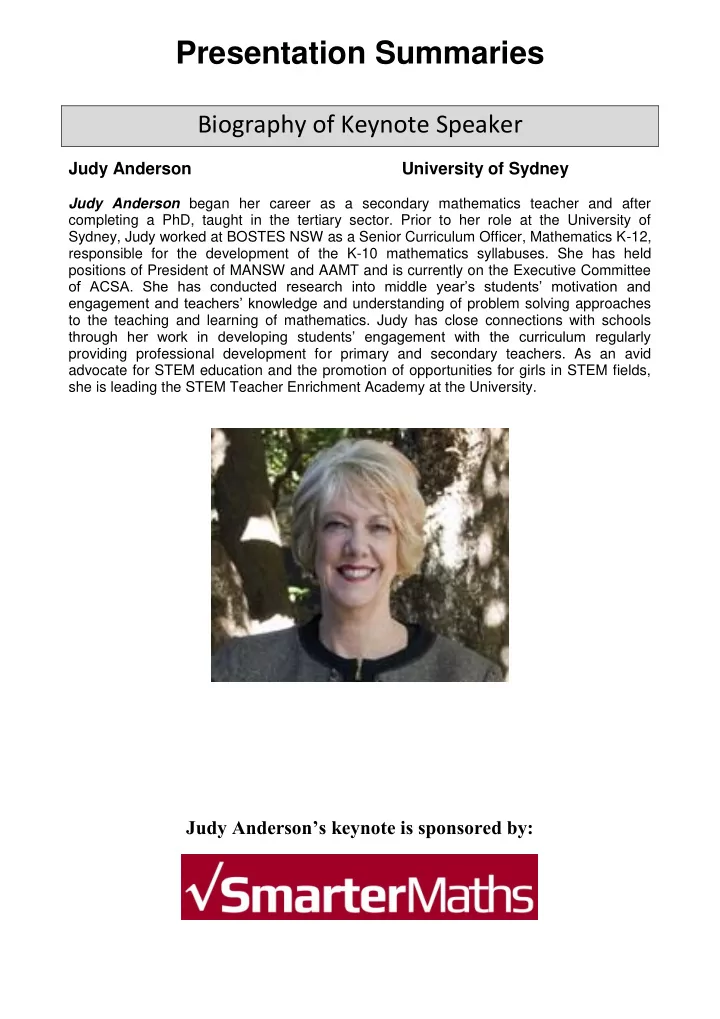
Judy Anderson began her career as a secondary mathematics teacher and after completing a PhD, taught in the tertiary sector. Prior to her role at the University of Sydney, Judy worked at BOSTES NSW as a Senior Curriculum Officer, Mathematics K-12, responsible for the development of the K-10 mathematics syllabuses. She has held positions of President of MANSW and AAMT and is currently on the Executive Committee

  • f ACSA. She has conducted research into middle year’s students’ motivation and

engagement and teachers’ knowledge and understanding of problem solving approaches to the teaching and learning of mathematics. Judy has close connections with schools through her work in developing students’ engagement with the curriculum regularly providing professional development for primary and secondary teachers. As an avid advocate for STEM education and the promotion of opportunities for girls in STEM fields, she is leading the STEM Teacher Enrichment Academy at the University.

Judy Anderson’s keynote is sponsored by:

slide-2
SLIDE 2

Presentation Summaries

Opening Plenary Wednesday 30th September, 2015 9:00am - 9:20am

Mrs Becky Lovelock (Convenor) Brigidine College St Ives Combined Semillon Rooms Opening and Welcome to Country Housekeeping issues:

  • Structure of the day
  • Your name tag is your ticket – wear it throughout the day, and each day of attendance
  • Where to find the other breakout rooms
  • Sponsors – generous companies
  • Where to find the sponsors and exhibitors
  • New scheme teachers sign-on
  • Thank you to presenters; your gift; feedback; phone in room for technology assistance
  • Evaluation is via Survey Monkey. The URL is beneath each presentation
  • End of day – President’s reception drinks

Introduction of Keynote speaker.

KEYNOTE Wednesday 30th September, 2015 9:20am - 10:30am

What I have learnt about teaching mathematics from my students (and what I did to address their concerns).

Associate Professor Judy Anderson University of Sydney Combined Semillon Rooms This presentation will examine some of the feedback I have had from students about teaching and learning

  • mathematics. This feedback was given to me as a secondary mathematics teacher, and as a researcher in

primary and secondary mathematics classrooms. To address some of the students’ concerns, I had to make changes to my practice since the textbook approach did not suit everyone. Additionally, sitting the students in small groups did not always work either. This forced me to consider new ways of teaching in mixed ability settings and new ways of using the textbook as a teaching tool. While teachers told me they were implementing problem solving in their classrooms, the students I interviewed gave me a different impression

  • f what was going on. As a class group, students are generally quite astute at judging the quality of teaching

and learning – or at least they can soon tell you whether they are learning any mathematics. We can all learn by asking them for feedback but we must then act on the advice. Feedback is at https://surveymonkey.com/r/MANSWSession001

Gold Sponsors

slide-3
SLIDE 3

Presentation Summaries

SESSION 1 Wednesday 30th September, 2015 11:00am - Noon

To be continued…

Garry Webb

Educational Consultant 7-12

Semillon 1 Continued fractions are a little-known way of representing all real numbers. In many ways they are better than decimals for representing irrational numbers. We will evaluate terminating and repeating continued fractions, see how to find a continued fraction for any irrational number, and find 'good' rational approximations to pi and other well-known irrational numbers. Feedback is at https://surveymonkey.com/r/MANSWSession011

Moving Students from Band 5 to Band 6

Susan Turnbull and Gary Davies

Hunters Hill High School, The Kings School 11-12

Semillon 2 The performance descriptions for Band 6 in the HSC Maths exams refer to students’ extensive knowledge and skills, using sophisticated reasoning and integrating topic ideas and skills to solve difficult problems. How do we prepare students to do this? This presentation considers the type of questions we need to be exposing students to in the classroom in order for them to be able to make the jump from Band 5 to Band 6, and prepare them to be sophisticated mathematicians. General Mathematics 2, Mathematics, Mathematics Extension 1 and Extension 2 will all be covered. Resources to enable teachers to extend students in this way will be provided. Feedback is at https://surveymonkey.com/r/MANSWSession012

Touching the mathematics and making the big connections – Data collection, graphing and algebraic modelling with investigative activity and interactive tools. (iPad App).

Brian Lannen

Victory Lutheran College Vic. 7-10

Semillon 3 The notion of mathematical functions is at the heart of much of the Australian Curriculum secondary Mathematics courses, but the foundation for learning this is really set in the Middle Years. Do you regularly draw a “function machine” on your whiteboard? I do and I also have my students actually work with such machines to help them make the important connections between algebraic functions, data and graphs. Linear graphs and functions will be a focus for this workshop, which draws upon interactive and interconnected features of TI-Nspire App for iPad. Feedback is at https://surveymonkey.com/r/MANSWSession013

Developmental Mathematics in 2015

Robert Yen

Cengage Learning 7-10

Chardonnay How do we reach students who don’t like maths and who achieve little success in the subject? How can we do things differently in 2015? This workshop will be an opportunity to discuss practical classroom ideas and learn ten clear strategies for improving student engagement and confidence. Discover how important it is to change the learning environment as well as to change the learning tasks. There will also be a preview of Developmental Mathematics 5th edition. This successful junior maths series that was first published in 1974 has been completely updated for the NSW syllabus and Australian curriculum. [Commercial] Feedback is at https://surveymonkey.com/r/MANSWSession014

slide-4
SLIDE 4

Presentation Summaries

SESSION 1 (cont) Wednesday 30th September, 2015 11:00pm - Noon

Pythagorean triples

Shane Scott

Trinity Grammar School 7-12

Shiraz How many Pythagorean Triples are there? You may have seen a formula to generate them, Does it generate all triples or are there more? In this workshop we will explore the derivation of the formula for generating Pythagorean Triples, investigate the relationship with the unit circle and even find a relationship between Fibonacci numbers and Pythagorean triples. Feedback is at https://surveymonkey.com/r/MANSWSession015

Using Educreations to support a "good year" of mathematical experiences in the classroom

Annie Agnew

McCarthy Catholic College Sydney K-6

Verdelho Participants will learn how to use Educreations to create resources to support students in the ongoing understanding of mathematical concepts. Educreations can also be used for students to demonstrate understanding - or to show where issues/problems/mistakes are occurring, supporting feedback and development of skills. Feedback is at https://surveymonkey.com/r/MANSWSession016

Getting through Gen Maths 2

Judy Binns

Mulwaree High School 11-12

Cellar Room 1 Do you have trouble fitting everything in with the new course? Do you struggle to teach "in the spirit of the syllabus"? This session will outline one school's attempt to present the General Maths 2 course in a way that does justice to the Focus Studies, is hopefully more interesting to the students and still covers everything in the time available. Hopefully there will be time for questions and discussion - bring your experiences with you! Feedback is at https://surveymonkey.com/r/MANSWSession017

2015 one year into the new syllabus, what have we learnt?

Katherin Cartwright

NSW Department of Education K-6

Cellar Room 2 This session will be presented by Katherin Cartwright, Maths Advisor from NSW DoE. This workshop will look at what effects the new mathematics syllabus has had on the way we teach, what we focus on and how we make meaningful connections for our students. This session will involve hands-on tasks that highlight the working mathematically areas of communicating, problem solving and reasoning and how making connections across concepts is changing the way we plan and sequence mathematics in the primary classroom. Feedback is at https://surveymonkey.com/r/MANSWSession018

slide-5
SLIDE 5

Presentation Summaries

SESSION 2 Wednesday 30th September, 2015 12:10pm - 1:10pm

Using games to develop algebra understanding

Judy Anderson

University of Sydney 7-10

Semillon 1 Using a games context helps to reinforce algebra understanding as well as develop skills and procedures. Several examples of algebra games will be presented for participants to evaluate and discuss. Feedback is at https://surveymonkey.com/r/MANSWSession021

CAS: Ten Years On

Sue Garner Ballarat Grammar 11-12 Semillon 2 Computer Algebra Systems (CAS) have been used in Victorian senior Maths classrooms since an early trial started in 2002. This presentation follows the journey of one teacher in one school in Ballarat, outlining gains and opportunities afforded by CAS in the high stakes examinations at the end of Year 12, and also problems encountered along the way. Feedback is at https://surveymonkey.com/r/MANSWSession022

C3 - The Creative, Collaborative Classroom at HSPA

Courtney Cerato

Hunter School of the Performing Arts 7-10

Semillon 3 Inspired by 21st Century Learning research, and seeking to truly engage students in their Mathematics learning, HSPA's Mathematics faculty trialled a combined learning space in 2015. Ninety students from 4 classes, with their 4 teachers gather together once a week to engage in student directed learning and a choice matrix. Attendance at this workshop will give you access to our trial units of work, allow you to see collaborative learning in action (as well as some of the products from our trial), provide a discussion focus for the pros and cons of collaborative learning, and hopefully inspire you to try something of a similar nature with your own classes! Feedback is at https://surveymonkey.com/r/MANSWSession023

Adventures in alternative assessment

Ilhea Yen

Sydney Secondary College, Leichhardt Campus

7-12 Chardonnay This year, I was involved in the STEM academy program with Sydney University and I had to push myself

  • ut of my teaching comfort zone and try new things in the classroom. Here are some alternative

assessments which I have tried and that have received really positive student feedback. For example, a mini Project Based Learning assessment and flipped classroom. I will share my experiences and reflections, with time for some discussion. Feedback is at https://surveymonkey.com/r/MANSWSession024

slide-6
SLIDE 6

Presentation Summaries

SESSION 2 (cont) Wednesday 30th September, 2015 12:10pm - 1:10pm

Learning with and from a calculator

Barry Kissane

Murdoch University 7-10

Shiraz Calculators continue to be misunderstood by many as instruments solely useful for undertaking numerical

  • computations. In this hands-on workshop, we will challenge this view by considering a four-part model to

understand how calculators might be used as tools for learning mathematics through representation, computation, exploration and affirmation. We will focus on selected aspects of all strands of the Secondary curriculum from Years 7 to 10. Feedback is at https://surveymonkey.com/r/MANSWSession025

Introducing Maths Inside - engaging materials to foster interest in maths

Mary Coupland

UTS 8-12

Verdelho Maths Inside is funded by the Federal Government under the Australian Maths and Science Partnership

  • Program. We are working with CSIRO to film scientists and mathematicians who share their enthusiasm for

maths and show how there is Maths *inside* important inventions and processes. These videos are the stimulus for classroom activities. We would like to share progress to date and collect your feedback on early drafts of our materials, to make this a Very Good Year. A similar session was given at the AAMT conference in July. Feedback is at https://surveymonkey.com/r/MANSWSession026

Essential Assessment - NSW Syllabus Assessment Made Easy

Andrew Spitty

Essential Assessment K-10

Cellar Room 1 Essential Assessment provides an easy and affordable way for NSW Primary and Secondary schools to deliver a consistent and whole school approach to numeracy assessment, curriculum and reporting. Essential Assessment delivers a whole school approach to summative and formative assessment for NSW schools and delivers a differentiated assessment and curriculum model aligned to the NSW Syllabus. The model assesses and develops student’s knowledge within each strand of the curriculum and delivers a reportable NSW common grade for each student along with differentiated curriculum for each student depending on their results. www.essentialassessment.com.au [Commercial] Feedback is at https://surveymonkey.com/r/MANSWSession027

Primes and polygons

John Silvester

King’s College London 11-12

Cellar Room 2 Which regular polygons can be constructed with ruler and compasses? Most people can manage an equilateral triangle, and a regular hexagon; and a square isn't too difficult. A regular pentagon is decidedly trickier, but possible; however a regular heptagon is impossible. Gauss, while still a teenager, was the first to discover how to construct a regular heptadecagon, and he also sorted out precisely which regular polygons can be constructed. This has to do with Fermat numbers that are prime; and Euler managed to show that not all Fermat numbers are in fact prime. All of this will be illustrated with Geometer's Sketchpad, together with just a hint of the underlying algebra, via Maple. Feedback is at https://surveymonkey.com/r/MANSWSession028

slide-7
SLIDE 7

Presentation Summaries

slide-8
SLIDE 8

Presentation Summaries

SESSION 3 Wednesday 30th September, 2015 2:15pm - 3:45pm

GeoGebra 101

Nikky Vanderhout

MANSW 7-10

Semillon 1 This hands-on workshop is for teachers who have had limited experience in using GeoGebra in their

  • classroom. A laptop with the latest version of GeoGebra installed is vital for participants wanting to gain the

most from this workshop. Beginning with files already available on GeoGebratube, participants will explore how these can be used to enhance learning outcomes for their students. Participants will then use GeoGebra to produce some very basic files that help introduce key concepts within the Stage 4 and 5 Mathematics syllabus. Participants will leave the workshop with a store of digital learning objects guaranteed to add a little ‘wow’ to their lessons. Feedback is at https://surveymonkey.com/r/MANSWSession031

Maths Comedy

Simon Pampena

Consultant K-12

Semillon 2 Starting from the Melbourne standup comedy scene in 2002, the Australian Numeracy Ambassador Simon Pampena, forged a new direction in mathematical communication. Pampena is a post-graduate in Pure Mathematics from Melbourne University. He has managed to transform a passion for maths and performance into an exciting international career as a TV presenter, reporter and full-time standup comedian. He is also the national Numeracy Ambassador, travelling all across Australian performing maths comedy for school students and the general public. While these successes are notable achievements, the drive in Pampena’s work is continual development in mathematical engagement. By combining comedy writing with mathematical pedagogy, Pampena has managed to elicit gasps of understanding in between laughs. In his talk, Pampena presents some of his material with explanations and motivations. These will be demonstrated from concept to finished work, realised with sophisticated presentation software and expert comedic timing. Feedback is at https://surveymonkey.com/r/MANSWSession032

Take a chance: probability activities that develop understanding for Stages 3 and 4

Karen McDaid

University of Western Sydney 5-8

Semillon 3 Many children think that a six is harder to throw than any other number when rolling a six-sided die, and that if you toss a coin and get three heads in a row that you must be due for a tail. This hands-on workshop aims to provide ready-to use activities using dice or spinners to introduce or reinforce the idea of fairness. It further aims to assist Stage 3 and Stage 4 students to develop a more sophisticated understanding of probability by demonstrating the mathematics underpinning the games. Feedback is at https://surveymonkey.com/r/MANSWSession033

The teacher's survival guide to using Wolfram|Alpha in the classroom

Craig Bauling

Wolfram Research 4-12

Chardonnay Wolfram|Alpha and Wolfram|Alpha Pro have become defacto products that your students are using daily in their Maths, Physical and Social Science classes. Likely, it is on most of the smart phones your students are

  • using. Being prepared to address the challenges this creates and to use this technology as a supporting tool

in your teaching is critical. This session will lead you through a deep understanding of the capabilities of the Wolfram|Alpha products and how to successfully use them to advance the learning of your students. No prior knowledge of Wolfram|Alpha nor Wolfram|Alpha Pro is needed. [Commercial] Feedback is at https://surveymonkey.com/r/MANSWSession034

slide-9
SLIDE 9

Presentation Summaries

SESSION 3 (cont) Wednesday 30th September, 2015 2:15pm - 3:45pm

Reaction times - analysing numerical univariate data

Russell Brown

Educational consultant 9-12

Shiraz This hands-on session will look at various ways of collecting data of reaction times from internet reaction timers, to the ABS Census at Schools database, to the familiar “grabbing a dropping ruler”. The data

  • btained from the various sources will be analysed using several statistical measures and univariate plot

types including parallel (multiple display) boxplots, histograms and dot plots. iPads will be available for this session. Feedback is at https://surveymonkey.com/r/MANSWSession035

Engaging Middle Years Students with Mathematics

Catherine Attard

University of Western Sydney 5-8

Verdelho The middle years of schooling is a critical time when many students form attitudes towards mathematics that

  • ften remain fixed for the rest of their school years. In this workshop participants will explore a range of

activities that promote high engagement. Pedagogical considerations such as assessment, reflection and differentiation of the activities will be explored, along with the Framework for Engagement with Mathematics. Feedback is at https://surveymonkey.com/r/MANSWSession036

New directions for teaching connections between algebra and geometry

Norman Wildberger UNSW

11-12

Cellar Room 1 We will overview some of the remarkable classical relations between algebra and geometry, and introduce teachers to new developments that can excite students and are accessible through exploration via

  • GeoGebra. These will include some rational trigonometry, some modern triangle geometry, and a bit of

relativistic geometry from a vector point of view. Feedback is at https://surveymonkey.com/r/MANSWSession037

21 century learning and financial literacy in the classroom

Colleen Blancato

State Office: Oxford Street 7-10

Cellar Room 2 This workshop will demonstrate how the ASIC MoneySmart Teaching resources can be used to develop students' skills in collaborating, communicating and problem solving in real world consumer and financial literacy contexts. Feedback is at https://surveymonkey.com/r/MANSWSession038

Silver Sponsor

slide-10
SLIDE 10

Presentation Summaries

SESSION 4 Wednesday 30th September, 2015 4:20pm - 5:20pm

Inspiring Ideas for Stage 4 Mathematics

Nagla Jebeile

Department of Education 7-12

Semillon 1 In this workshop we explore teaching activities and ideas for Stage 4 Mathematics teaching and learning programs, working mathematically, creative tasks and collaborative learning within the strands of the NSW Mathematics 7-10 Syllabus. Feedback is at https://surveymonkey.com/r/MANSWSession041

Maturing a Great Batch

Narelle McKay

Jamison High School 7-10

Semillon 2 This session is about explicitly teaching junior students to develop study notes for exams and how to transition this skill in order to then develop effective study methods as senior students. Feedback is at https://surveymonkey.com/r/MANSWSession042

From additive to multiplicative thinking

Di Siemon

RMIT 2-8

Semillon 3 The transition from additive to multiplicative thinking is one of the major barriers to learning mathematics in the middle years of schooling. This workshop will explore the key ideas and strategies involved in this process and introduce participants to some key resources that are being used to identify and address steps in the development of multiplicative thinking from Years 4 to 9 in a number of schools around Australia. Feedback is at https://surveymonkey.com/r/MANSWSession043

Cartoons, Cardboard, Calculators and Cheat Sheets

Miriam Lees

Blacktown Boys' High School 7-12

Chardonnay In 2012, I was given the task of teaching a new General 1 Mathematics class. The class consisted of 12 students who had spent the previous 11 years failing Mathematics and who had little interest in learning now. Being a new course, this also meant that I had to write the entire teaching and learning program and create the resources I would need. What an opportunity! Without the pressure of preparing for an external examination, I was able to take the class in any direction that I wanted. By throwing out the traditional, textbook teaching strategy, I watched a class of reluctant learners start to feel the thrill of solving a problem, take risks in their learning, and discover that with persistence, they could achieve more than they believed possible. Feedback is at https://surveymonkey.com/r/MANSWSession044

slide-11
SLIDE 11

Presentation Summaries

SESSION 4 (cont) Wednesday 30th September, 2015 4:20pm - 5:20pm

Touching the mathematics - Interactive teacher presentation tools paired with interactive student activities, with a focus on data & graphs. (iPad App).

Brian Lannen

Victory Lutheran College Vic. 4-6

Shiraz The increase in the use of interactive whiteboards (IWBs) has provided teachers with some interesting interactive demonstration tools, but what about the students? It’s even more important for the students to have hands-on investigative materials. Concrete manipulatives are part of the answer and now many new iPad Apps are also helping students take their investigations to a deeper level with richer connections as well as to develop the ability to easily keep a record of their work as they go. This workshop pairs IWB software with a corresponding iPad App that integrates data, graphs, geometry and calculations. Feedback is at https://surveymonkey.com/r/MANSWSession045

Challenging Perceptions and Becoming Mathematicians

Michelle Tregoning

Fairfield Public School 3-6

Verdelho “Would you hate us if we said we didn’t like maths?” was the question I was met with on my first day with my new class. This workshop will explore how perceptions of mathematics can be understood, how student interest can be used to drive learning in the curriculum, and how with hard work and determination, mindsets, perceptions, interest, and learning outcomes can be improved. Participants will explore, and participate in, a range of learning experiences drawing upon STEM, sports science, real-work applications and the 4C’s that were successful in supporting students to become mathematicians. Feedback is at https://surveymonkey.com/r/MANSWSession046

Taking the Lead: Promoting Mathematics

Sandra Rowden, Tracy Hosking, Heather Wotherspoon

Penrhos College WA 7-12

Cellar Room 1 We will look at how Penrhos College (WA) has led the way in promoting participation and excellence in

  • mathematics. Students have enthusiastically embraced the many programs on offer, such as: Maths Mentor,

Visiting Mathematician, Maths Week, Homework Club, opportunities to work in medical research and on engineering projects. The presenters will share their experience and success that have had a positive impact

  • n the students and their learning. What began at a departmental level has become the impetus for a STEM

focus across the entire College, improved results and an inaugaral internation mathematics tour to the USA. Feedback is at https://surveymonkey.com/r/MANSWSession047

Set game for instilling mathematical skills

Noroja Parandeh

Chatswood High School K-12

Cellar Room 2 Introduction to the set-game and its relevance to mathematics syllabus outcomes with online and hands-on activities for the classroom Feedback is at https://surveymonkey.com/r/MANSWSession048

End of Day 1 – 5:30pm President’s Reception for ALL conference participants.
slide-12
SLIDE 12

Presentation Summaries

The President’s Reception 5:30pm to 6:30pm For ALL conference participants In the Exhibition Space Please come and enjoy the drinks and nibbles and have a chat with

  • ur wonderful exhibitors.
slide-13
SLIDE 13

Presentation Summaries

The sponsors of the reception are: and

slide-14
SLIDE 14

Presentation Summaries

Biography of Keynote Speaker

Dianne Siemon RMIT University

Di Siemon is a Professor of Education in the School of Education at RMIT University (Bundoora) where she is involved with the preparation of pre-service teachers and the supervision of higher degree students. Di is also actively involved in the professional development of practicing teachers, particularly in relation to the development of the ‘big ideas’ in number, the teaching and learning of mathematics in the middle years, and the use of rich assessment tasks to inform teaching. She has worked extensively with State and Territory Departments of Education to support numeracy coaching initiatives and develop commissioned materials such as the Assessment for Common

  • Misunderstandings. Di has directed a number of large scale research projects including

the Building Community Capital to Support Sustainable Approaches to Numeracy Education in Remote Locations (2006-2009), the Scaffolding Numeracy in the Middle Years Project (2003-2006), and the Northern Territory Strategic Numeracy Research and Development Project (2003-2004). She is currently directing the Reframing Mathematical Futures Project, that involves 34 secondary schools nationally including 6 from Western

  • Sydney. Di was a member on the Expert Numeracy Panel for the Australian Mathematics

Curriculum and is a member of the Victorian Expert Numeracy Panel. She is a past President of the Australian Association of Mathematics Teachers and a life member of the Mathematical Association of Victoria.

Di Siemon’s keynote is sponsored by:

slide-15
SLIDE 15

Presentation Summaries

KEYNOTE Thursday 1st October, 2015 9:20am - 10:30am

Multiplicative thinking and mathematical reasoning – the keys to a STEM future

Professor Dianne Siemon RMIT University Combined Semillon Rooms Recalling facts and memorizing problem templates might work in the short term but this approach to the teaching and learning of mathematics is unlikely to develop the sort of intrinsic knowledge and confidence that is needed to sustain further study and participation in school mathematics. A deep understanding of key ideas and the connections between them is needed, along with opportunities to apply what is known in unfamiliar contexts, explore alternative solution strategies, work with multiple representations, and justify and explain one’s reasoning. This presentation will make a case for working with a small number of really big ideas to ensure students have the conceptual understanding and reasoning skills to become fluent, creative users of mathematics. In particular, it will focus on the role of multiplicative thinking and mathematical reasoning in this process, and highlight the work of the Reframing Mathematical Futures project that is exploring the efficacy of formative assessment and targeted teaching approached in 34 secondary schools around Australia including six in NSW. Feedback is at https://surveymonkey.com/r/MANSWSession002

Gold Sponsors

slide-16
SLIDE 16

Presentation Summaries

SESSION 5 Thursday 1st October, 2015 11:00am - Noon

Connect with Maths ~ How to join an online community

Renee Hoareau

AAMT

K-12 Semillon 1 Connect with Maths is a free online resource for any teacher with an interest in Mathematics education. Renee will demonstrate how to join and participate in one or all five of the Connect with Maths communities, what's in each community and how the online forums work. Connect with Maths communities comprise the Make It Count with Indigenous Learners; Early Years Learning in Mathematics; Maths in Action; Engaging All Students and Digital Learning and Mathematics communities. Feedback is at https://surveymonkey.com/r/MANSWSession051

GeoGebra for Australian secondary and senior secondary mathematics teachers

Theodosia Prodromou

University of New England

8-12 Semillon 2 The aim of this presentation/workshop is to bring together Australian mathematics teachers and reserchers who are interested in the use of GeoGebra in the teaching of secondary and senior secondary mathematics. The presentation/workshop consists of presenting new-added features of GeoGebra with content suited to classroom teachers, university faculty, and others who may have an interest in GeoGebra. Topics will include algebra, geometry, and the session will be geared to all levels, from introductory to expert. Feedback is at https://surveymonkey.com/r/MANSWSession052

Developing interactive web content - It's easier than you think

Ken Wessen

7-12

Semillon 3 At the annual conference last year (and as written up in the associated volume of Reflections) I presented The Mathenaeum (http://thewessens.net/maths) - my website for interactive mathematical exploration and learning, and suggested that maths teachers should give serious consideration to exploiting the powerful and freely available web technologies and associated tools to create their own custom content for interactive classroom use. The two main barriers faced by someone unfamiliar with these technologies, and programming in general, are how to get started and where to find answers. This workshop will help with both

  • aspects. Attendees should bring a laptop to the session in order to get maximum benefit from various hands-
  • n activities.

Feedback is at https://surveymonkey.com/r/MANSWSession053

Real world data in the palm of your hand: Putting the M into STEM

Stephen Arnold

Texas Instruments 5-12

Chardonnay The TI SensorTag is a small, inexpensive device which packs a powerful punch - it is a Bluetooth Low Energy tool with sensors for temperature, humidity, barometric pressure, accelerometer, magnetometer, gyroscope and more. Used with the iPad, students can easily collect, view and analyse a wealth of real world data for mathematics and science, from the middle years through to seniors. From building their own weather station, to exploring the mathematics and physiology of exercise and dance the opportunities for rich mathematical exploration are truly exciting. All in a tiny device that fits in your hand and costs less than $40! Come along and have a play. [Commercial] Feedback is at https://surveymonkey.com/r/MANSWSession054

slide-17
SLIDE 17

Presentation Summaries

SESSION 5 (cont) Thursday 1st October, 2015 11:00am - Noon

Spreadsheets in the Mathematics General Course

John Ley

University of Western Sydney 7-12

Shiraz This presentation will demonstrate the use of spreadsheets in the teaching of the General Mathematics course and show that the actual spreadsheets are not difficult to write and are powerful to use in the investigation of mathematical concepts. A pivot table will be developed from a table of values and demonstrated so that the participants will be able to use this valuable feature. Examples will be taken from the Oxford text and ICT4U spreadsheet book but this is not a commercial presentation and the ideas and spreadsheets can be used with any text. All attendees will receive an Oxford Insight Mathematics textbook product for their year level of choice. Feedback is at https://surveymonkey.com/r/MANSWSession055

Enriching learning through open ended tasks

Debbie Smith

Inquisitive Minds 3-8

Verdelho Attempt, discuss and design a range of investigations and open ended tasks. See how these can be used in association with hands-on materials and basic digital technology across a range of content areas to enrich and extend your students' mathematical understanding, creative thinking and interpersonal skills. Take home activities ready to use in your classroom, pus plenty of ideas for more. Feedback is at https://surveymonkey.com/r/MANSWSession056

Mathematical Association of New South Wales Incorporated

Annual General Meeting

Cellar Room 1

The annual report will be presented and in particular the president and treasurer will make specific reports. Feedback is at https://surveymonkey.com/r/MANSWSession057

Making it Count Online

Jay Quince

Parkes High School/Aurora College 7-12

Cellar Room 2 This session will cover the lessons learnt from the experience in teaching mathematics online. We will look at how this experience has formed the current practice in Aurora College - Australia's first Online Partially Selective High School. Feedback is at https://surveymonkey.com/r/MANSWSession058

Silver Sponsor

slide-18
SLIDE 18

Presentation Summaries

SESSION 6 Thursday 1st October, 2015 12:10pm - 1:10pm

GeoGebra 201

Nikky Vanderhout

MANSW 11-12

Semillon 1 If you have been looking for ways to add interest and meaning into your Stage 6 lessons, this workshop is for you! A laptop with the latest version of GeoGebra installed is vital for participants wanting to gain the most from this workshop. Sourcing or creating digital learning objects in GeoGebra can be both time-consuming and frustrating so this workshop will showcase ready-made, easily adapted files that illustrate key concepts from the calculus-based courses. Participants will also explore strategies for embedding these activities into their teaching. Participants will leave the workshop with a store of digital learning objects guaranteed to add a little ‘wow’ to their Mathematics (2U), Extension 1 and Extension 2 lessons. Warning: Your students may learn more than you ever expected! Feedback is at https://surveymonkey.com/r/MANSWSession061

Designing projects as assessments to bring out the M in STEM

Doug Vass

Newington College 7-12

Semillon 2 This is a practical how-to session on designing mathematically rich project tasks for assessment. You will walk away with rubric templates and sample projects for each year level. Feedback is at https://surveymonkey.com/r/MANSWSession062

When is a beer not a beer? An Interstate ODDyssey

Marcus Garrett

Australian Mathematical Sciences Institute K-12

Semillon 3 Comparing capacity measures for liquid refreshments between states in Australia can be a confusing enterprise - and one not without a degree of cultural embarrassment, especially when confronted by a grumpy bartender with a particularly parochial sense of state allegiance. Part of the imprimatur for the Federation back in 1901 was to gain consistency in such matters as railway line gauges and mail stamp prices; why then does something as culturally (not to mention legally) sensitive as beer glass volumes escape the regulatory rigours of nationally consistent standards? This presentation will examine some of the quirkier examples of interstate mathematical variability in Australia. Feedback is at https://surveymonkey.com/r/MANSWSession063

Assessing Working Mathematically

Barbara D’Angelo and Tina Di Sano

Monte Sant'Angelo Mercy College, North Sydney 7-10

Chardonnay In this presentation you will be provided with tasks which have been used to assess the Working Mathematically strand using criteria based marking schemes. The tasks come with marking criteria so that grades can be awarded. Discussion will be around the setting, marking and providing feedback. Feedback is at https://surveymonkey.com/r/MANSWSession064

slide-19
SLIDE 19

Presentation Summaries

SESSION 6 (cont) Thursday 1st October, 2015 12:10pm - 1:10pm

OLWs

Pete Rundle

Barker College 7-12

Shiraz One Lesson Wonders – your saving grace on a Friday afternoon! Gathered from all sorts of places over many years, I would like to share some of the serious fun lessons that are my personal favourites because they always seem to work! Some you may know already, some you may not, but each of these is a guaranteed option to pull out of your back pocket at the very last minute. Enjoy. Feedback is at https://surveymonkey.com/r/MANSWSession065

How much is a magnum? a million? or a multitude?!

Katherin Cartwright

NSW Department of Education K-6

Verdelho This session will be presented by Katherin Cartwright, Maths Advisor from NSW Department of Education. This workshop will look at big numbers and how to engage students in exploring numbers through the use of visuals, picture books and fun facts about big numbers. Participants will engage in a number of activities and problems to solve around big numbers that can be developed into lessons for use in the classroom. Feedback is at https://surveymonkey.com/r/MANSWSession066

Is perfect differentiation impossible? These teachers found a way AND save marking/prep time.

Richard Wilson

Maths Pathway 4-10

Cellar Room 1 25 students with 25 different learning needs? Catering to this properly would take a superhero teacher, and none of us can differentiate perfectly on our own. A group of Australian teachers resolved to act as side-kicks for all those heroes by building Maths Pathway. Now, hundreds of teachers are catering to diversity more easily than ever before, and are saving time in marking and preparation. Now you can try it out free. [Commercial] Feedback is at https://surveymonkey.com/r/MANSWSession067

Incorporating STEM in the “Healthy” mathematics classroom

Russell Brown

Educational consultant 10-12

Cellar Room 2 STEM stands for Science, Technology, Engineering and Mathematics and is currently being supported and encouraged by governments in many countries. In this hands-on session we will look at incorporating STEM in the middle school through to HSC Mathematics 2 Focus areas with an emphasis on the science and mathematics of Diabetes and other health related topics. iPads will be available for this session. Feedback is at https://surveymonkey.com/r/MANSWSession068

slide-20
SLIDE 20

Presentation Summaries

SESSION 7 Thursday 1st October, 2015 2:15pm - 3:45pm

Graphing tool kit….. uncorked!

Stuart Palmer

MANSW 11-12

Semillon 1 By the time students have completed Extension 1 and 2, they have encountered a wide variety of curves on the Cartesian plane and have accumulated an eclectic set of tools to assist with sketching. In this session the presenter will share some practical hands-on teaching ideas and resources that draw these together for

  • students. This may be the first and only time you will use a sheet of baking paper during a maths conference!

Feedback is at https://surveymonkey.com/r/MANSWSession071

Morsels of Proof

Thanom Shaw

SCEGGS Darlinghurst 5-10 Semillon 2

Proof is something that really sets Mathematics apart from other subjects. Following the syllabus, we might prove results before we use them and the word 'proof' gets a good work out in the topic of Geometry and of course in Extension 1 with Induction. But arguably, proof, the most fundamental of ideas of Mathematics, could do with a bit more exposure, particularly in the junior years. In this session we review some of the classic methods of proof and see how problems from the Mathematics Challenge for Young Australians can give students a taste for mathematical proof - encouraging them to convince someone else of their answers in different ways, not just with working out but with clear, logical, irrefutable, written-with-words arguments. Feedback is at https://surveymonkey.com/r/MANSWSession072

GeoGebra 301 - 3D GeoGebra

Madhu Narayanan

North Sydney Girls High School 11-12

Semillon 3 Participants will have the opportunity to become familiar with the 3D functionality in GeoGebra. Activities will include creating a 3D solid to illustrate angles between lines and planes to aid in teaching 3D trigonometry in Extension 1 and creating a solid of revolution to aid in teaching solids of revolution in Extension 1. For teachers of Extension 2, the techniques for creating a solid of revolution using the washer and/or shell method to aid in teaching volumes will be discussed. The workshop assumes basic knowledge of GeoGebra in 2D. The use of sliders, trace, selection of objects, intersecting objects, changing object properties will be

  • required. Bring your laptop and ensure that you have the latest version of GeoGebra (v 5.0).

Feedback is at https://surveymonkey.com/r/MANSWSession073

A Focus Question Approach to Teaching Mathematics

John Ley

University of Western Sydney 7-10

Chardonnay This follows on from the “Too much content too little time" presented at previous MANSW conferences, although is not necessary to have previously attended that presentation. This presentation focuses on the specifics of the questions that enable mathematical content to be taught, retaught, revised and extended efficiently through the use of 5 focus questions that will improve students’ depth of understanding of content and enable time for skill development and constant revision rather than revising for a couple of lessons, if that, before major tests. Conceptual and procedural knowledge will be discussed in relation to the questions. Specific examples from NSW K-10 syllabus and year 11 extension 1 will be demonstrated. Feedback is at https://surveymonkey.com/r/MANSWSession074

slide-21
SLIDE 21

Presentation Summaries

SESSION 7 (cont) Thursday 1st October, 2015 2:15pm - 3:45pm

Working with high-achieving students

Mike Clapper Australian Mathematics Trust

7-10

Shiraz This session is designed to assist teachers who have high-achieving students in their school who may have aspirations to compete in Olympiad programs or similar. In particular, we will discuss strategies for preparing students for the AIMO (Australian Intermediate Mathematical Olympiad) which is a gateway competition into the Olympiad program. Teachers will be encouraged to try some of the questions and to learn a few of the 'tricks of the trade' in advanced problem-solving. Feedback is at https://surveymonkey.com/r/MANSWSession075

Problem Solving: The Magnum Opus of Mathematics

Michael O’Connor

Australian Mathematical Sciences Institute K-12

Verdelho Problem Solving is seen by many as the "great work" of Mathematics. Problem Solving in Mathematics classrooms has been talked about for decades. What is it, though, that makes a good problem? How often do students need to practice problem solving in order to become proficient? How do we as teachers incorporate problem solving into the planning of our lessons and topics? And why is it so important anyway? This workshop provides teachers with some tools for answering these questions and opportunities to examine a variety of problems for use in the classroom. Feedback is at https://surveymonkey.com/r/MANSWSession076

Mastery based Adaptive Learning is the future - but how to spot the real from the fake?

Kate Lee

Mathspace 7-12

Cellar Room 1 Not all adaptive learning is created equal. Many of today’s “adaptive” solutions consist of a limited content pool with a rules-based decision tree. These products may seem adaptive but are essentially pre-determined adaptive learning — a contradiction in terms. In this presentation I will assign a hand-written adaptive diagnostic test, the test will be personalised depending on your answers, and at the end of the session in the space of 45 minutes I will tell you all your strengths and weaknesses. You just need to bring a phone or

  • tablet. Come and see why Sydney-based Mathspace is taking the US by storm with its adaptive learning

solution. [Commercial] Feedback is at https://surveymonkey.com/r/MANSWSession077

How to inspire students using Integrated Science Technology Engineering & Mathematics

Scott Sleap Maitland Grossmann High School

7-10

Cellar Room 2 There is increasing pressure to raise the STEM based literacy of students in Australia. School systems need to be making a cultural shift away from over reliance on knowledge transfer and content. We need to evolve to using 21st century teaching strategies which are at the core of STEM skill development. In this workshop participants will learn how to: Engage students with academia and industry, connect students with real-world activities, use existing time and resources to improve student engagement and produce highly skilled STEM graduates. Feedback is at https://surveymonkey.com/r/MANSWSession078

slide-22
SLIDE 22

Presentation Summaries

SESSION 8 Thursday 1st October, 2015 4:20pm - 5:20pm

Engaging Children in the Early Years

Catherine Attard and Elise Attard

UWS

K-2 Semillon 1 Engaging children during the early years of schooling is a key factor in promoting positive attitudes and success in mathematics. In this workshop, participants will explore a range of rich tasks that promote high student engagement and enrich students' mathematical understandings. Pedagogical considerations for implementing, assessing and evaluating the effectiveness of the tasks will be considered and discussed. Feedback is at https://surveymonkey.com/r/MANSWSession081

A Maths Faculty Handbook

Pete Rundle

Barker College 7-12

Semillon 2 In our busy teaching lives, it can be very difficult for everyone in your department to know what to do and when to do it. Having been the Head of a large Maths Department for over 15 years, I would like to share how I have I sought to be organised and have learned some difficult lessons -- sometimes the hard way! Feedback is at https://surveymonkey.com/r/MANSWSession082

Touching the mathematics - Interactive teacher presentation tools paired with interactive student activities, with a focus on number patterns. (iPad App).

Brian Lannen

Victory Lutheran College Vic. 4-6

Semillon 3 The increase in the use of interactive whiteboards (IWBs) has provided teachers with some interesting interactive demonstration tools, but what about the students? It’s even more important for the students to have hands-on investigative materials. Concrete manipulatives are part of the answer and now many new iPad Apps are also helping students take their investigations to a deeper level with richer connections as well as to develop the ability to easily keep a record of their work as they go. This workshop pairs IWB software with a corresponding iPad App that integrates data, graphs, geometry and calculations. Feedback is at https://surveymonkey.com/r/MANSWSession083

Components of an HSC assessment

Tessa Wigmore

St Ives High School

11-12 Chardonnay Just as there are several components to consider when assessing wine (acidity, tannin, sweetness, body…) there are two components to consider when assessing students for the HSC: A (Concepts, skills and techniques) and B (Reasoning and communication). Since 2012, these have been mandated at 50% each in school internal assessments. In this session we will try to work out exactly what are “components A and B” and how to make your assessments 50:50. We will discuss questions such as: Has the change in proportion since 2012 changed the difficulty of the exams? How does the inclusion of component B questions affect your assessments, and your teaching? Does this have an impact on Years 7−10? Feedback is at https://surveymonkey.com/r/MANSWSession084

slide-23
SLIDE 23

Presentation Summaries

SESSION 8 (cont) Thursday 1st October, 2015 4:20pm - 5:20pm

Capture the magic of your teaching, in one video, every lesson

Doug Vass

Newington College K-12

Shiraz Learn both the how and the why you should be recording those crucial lessons to save time and extend the power of your teaching beyond your classroom walls. Feedback is at https://surveymonkey.com/r/MANSWSession085

Learning with a calculator in the senior years

Barry Kissane Murdoch University 10-12 Verdelho Calculators continue to be misunderstood by many as instruments solely useful for undertaking numerical

  • computations. In this hands-on workshop, we will challenge this view by considering a four-part model to

understand how calculators might be used as tools for learning mathematics through representation, computation, exploration and affirmation. We will focus on aspects of senior mathematics, including trigonometry, sequences, complex numbers, statistics and vectors. Feedback is at https://surveymonkey.com/r/MANSWSession086

Alice - a software project to enrich Maths

Jenny Lill

Henry Kendall High School 7-12

Cellar Room 1 This is a report on a Maths enrichment project for Stage 4. The project uses the "Alice" software. This is a free download for non-profit, educational purposes from Carnegie Mellon. The students use Alice to build their own 3D world and then tell a story, make a game, explain a concept, play music or write a quiz. The project incorporates creativity, collaboration, critical thinking and communication, and enhances the students’ digital skills. The students start the project by writing a reflection on ‘what they know and what they want to know’. The project ends with the students writing a final reflection evaluating the project. In the middle, the students work either as individuals or in groups to create an Alice program on a topic of their own choice. On the whole, the students commenced the project as daily users of computers, glued to their iPods and Smartphones, but with little knowledge of how a computer works or its connection to Mathematics but very curious to find out. Feedback is at https://surveymonkey.com/r/MANSWSession087

Cambridge HOTMaths

Debra Wilson

CambridgeMATHS K-10

Cellar Room 2 This HOTmaths workshop is about getting the most from Australia’s premier online resource, Cambridge HOTmaths for users and non-users. The best tips and tricks of HOTmaths have been gathered from teachers around the country. Learn how you can diversify and enhance your HOTmaths experience including ideas from both the teacher management features and the student resources. Anyone from no experience to existing users may find this session very useful. For users this would be a good session to share best practices and ask questions of the HOTmaths team. HOTmaths covers the F-10 curriculum but this session will have a particular focus on the secondary years. [Commercial] Feedback is at https://surveymonkey.com/r/MANSWSession088

End of Day 2

6:30pm Drinks ONLY for those attending the dinner 7:00pm Conference Dinner – Red, white and bubbly

slide-24
SLIDE 24

Presentation Summaries

SESSION 9 Friday 2nd October, 2015 9:00am - 10:00am

Building 3D understanding - magnanimously!

Kerrie Faulkner

Corrimal High School 5-8

Semillon 1 Participants will experience a lesson that addressed 3D space outcomes while using elements of the Quality Teaching Framework to engage and challenge student’s thinking and that create many opportunities for substantive communication. Differentiation is easily achieved. Activities include a short clip from 'Catalyst' to provide significance; working in teams to create shapes using unifix cubes from descriptions ; writing shape descriptions; using a challenging 3D applet and relevant Naplan questions. Feedback is at https://surveymonkey.com/r/MANSWSession091

Teaching and assessing with new methodological tools (MERLO)

Theodosia Prodromou

University of New England 8-12

Semillon 2 The focus of this workshop is on an innovative tool based on equivalence of meaning across different types

  • f representations and called MERLO (Meaning Equivalence Reusable Learning Object). MERLO is used in

formative assessment activities. After a general presentation of the MERLO approach, we will focus on its application in mathematics education and the design of MERLO activities based on the ACARA curriculum for the teaching and learning of mathematics in secondary schools. Feedback is at https://surveymonkey.com/r/MANSWSession092

The role of partitioning in building fraction knowledge and confidence

Di Siemon

RMIT 2-8

Semillon 3 A significant number of students in the middle years of schooling experience considerable difficulty in understanding and applying more formal ideas related to common fractions, decimals, percent and ratio. This session will explore a range of strategies and techniques found to be useful in developing fraction knowledge and confidence at this level. In particular it will explore the important role of partitioning in bridging the gap between informal and formal fraction ideas. Feedback is at https://surveymonkey.com/r/MANSWSession093

Convergent and Divergent Thinking

Mr Mile Clapper Australian Mathematics Trust 5-10 Chardonnay This presentation is designed to assist teachers in developing enrichment programs in their school that incorporate elements of both convergent and divergent thinking in order to assist students in developing mathematical creativity. It will include exploring a very large number of activities which have been successful in the classroom. Feedback is at https://surveymonkey.com/r/MANSWSession094

slide-25
SLIDE 25

Presentation Summaries

SESSION 9 (cont) Friday 2nd October, 2015 9:00am - 10:00am

Mathematics in the Classroom using Blended Learning Strategies

Rob Costello

3P Learning K-12

Shiraz Blended learning is a term for a range of classroom strategies combining technology and various modes of

  • learning. Hear how Mathletics is facilitating these approaches, and supporting a range of approaches to

customise and enrich learning pathways, including flipping part of a course, student led learning, direct instruction, just in time assessment and on demand review. A new range of digital materials is taking this further, including a new online graphing calculator and new video materials. [Commercial] Feedback is at https://surveymonkey.com/r/MANSWSession095

Inquisitive Minds PPPP Workshop

Debbie Smith

Inquisitive Minds 7-10

Verdelho Would you like your students to improve their problem solving skills and experience the exhilaration of solving interesting and challenging mathematical problems? MANSW and Inquisitive Minds invite you to come along and try out our Hands-on 'Problems, Patterns, Pictures & Puzzles' Workshop for yourself. Enjoy some friendly competition, while seeing firsthand just how this engaging Workshop can improve your students' skills and confidence in problem solving. [Commercial] Feedback is at https://surveymonkey.com/r/MANSWSession096

Challenges and Solutions for Blending Digital Learning into your Teaching

Chris Green

Mangahigh K-10

Cellar Room 1 In a rapidly expanding digital age, why are our maths classrooms lagging so far behind in implementing what digital technology can offer? What are the challenges that teachers face when trying to blend digital learning into their classroom? And more importantly, what practical solutions are there? Chris Green has been working with digital technology in maths classrooms around the world for the last 6 years and observed how teachers and students are coming to grips with these technologies. In this presentation, Chris will address these key issues and offer up a flexible framework that all teachers can use to improve their students learning through blending digital learning into their normal teaching. [Commercial] Feedback is at https://surveymonkey.com/r/MANSWSession097

Building pre-service teacher capacity through a magnum of university and school partnerships – Making the Learning Real!

Chrissy Monteleone and Emma McAulay

Australian Catholic University, Santa Sabina K-12

Cellar Room 2 Santa Sabina’s primary campus has developed strong partnerships with the Australian Catholic University through involvement in their Community Engagement Program. This program has allowed us to provide additional one on one support for students in Mathematics and has also provided opportunities for the ACU pre-service teachers, studying a Bachelor of Education Primary, to observe the teaching and learning and be involved in a school setting. ACU pre-service teachers engage in this program after completing their final school-based field experience and whilst studying their final Mathematics Pedagogy unit. Feedback is at https://surveymonkey.com/r/MANSWSession098

slide-26
SLIDE 26

Presentation Summaries

SESSION 10 Friday 2nd October, 2015 10:05am - 11:05am

MoneySmart Rookie

Cassandra Portelli

Hunter School of the Performing Arts 10-12 Semillon 1

The MoneySmart Rookie Program has 7 modules so far: Credit and Debt, Getting a Car, First Job, Moving

  • ut of Home, Mobile Phone Deals and Plans, Online Transactions and Studying. HSPA used the program

with Year 10 who were choosing not to continue in Mathematics in senior school. Attending this presentation will allow you to engage with the free learning materials, discuss the place of Financial Literacy in the Mathematics Curriculum and identify the applications of these resources to the General Mathematics course. Feedback is at https://surveymonkey.com/r/MANSWSession101

Practical Assessment

Corrine Robinson

Penrith Christian School 7-12

Semillon 2 I would like to showcase some of my practical assessment tasks. Of particular note is the marking rubric which does not follow traditional Mathematical Marking schemes. Essentially the idea of the tasks are that they are open ended tasks. The students are marked on their use of mathematics to communicate their

  • ideas. The purpose of the tasks is to establish mathematics as having a place in real world tasks, to develop

critical thought and to reward an understanding of how to use mathematics to enhance communication and enrich discursive argument. Feedback is at https://surveymonkey.com/r/MANSWSession102

CambridgeMATHS GOLD: Connecting Stages 3 and 4

Stuart Palmer and Karen McDaid

CambridgeMATHS 7-8

Semillon 3 Cambridge is delighted to announce the release of Years 7 and 8 GOLD (Stage 3/4). These new titles have been written for students who require additional support with numeracy and mathematical literacy as they transition from Stage 3 to Stage 4 learning. CambridgeMATHS Gold is SO much more than a book! It is a fully integrated collection of teaching and learning resources designed to cater for students in Years 7 and 8 who need to revise and/or consolidate their Stage 3 learning prior to tackling Stage 4. Feedback is at https://surveymonkey.com/r/MANSWSession103

Learning Number with a calculator

Barry Kissane

Murdoch University 5-10

Chardonnay Calculators continue to be misunderstood by many as instruments solely useful for undertaking numerical

  • computations. In this hands-on workshop, we will challenge this view by considering a four-part model to

understand how calculators might be used as tools for learning mathematics through representation, computation, exploration and affirmation. We will focus on aspects of the Number curriculum from Years 5 to 10 so that both primary and secondary teachers are welcome to attend. Feedback is at https://surveymonkey.com/r/MANSWSession104

slide-27
SLIDE 27

Presentation Summaries

SESSION 10 (cont) Friday 2nd October, 2015 10:05am - 11:05am

Pop culture in Primary Maths

Brian McNally

Tuggerawong Public School 7-12

Shiraz This session will show how mathematical resources can be developed around the interests of the students. Examples of this include Harry Potter where students are encouraged to track fuel consumption in the Weasley's flying car to how many decibels produced by a Mandrake are needed to become fatal. Another possibility is the "Hunger Games" where the number of joules in coal is measured and time zones in "Panem" are calculated. For infants, resources using nursery rhymes like "Old MacDonald" have the students interacting in activities on a farm where they have been mail-merged into a story where they solve mathematical problems for the farmer. Feedback is at https://surveymonkey.com/r/MANSWSession105

These 4 visualisations make fractions easy; free resource pack

Justin Mattys

Maths Pathway 3-10

Verdelho The concept of fractions is a tough one for many students. Most find basic visual models easy enough, but fall over as soon as it becomes abstracted. Often this is because students visualise fractions in a limited way; different embodiments are more useful for building different abstractions. We discuss how these models tie together and connect with higher level fractions knowledge. Participants receive a resource pack to make it easy to implement when back at school. [Commercial] Feedback is at https://surveymonkey.com/r/MANSWSession106

The Maths textbook reimagined for less than $2 per student

Mohamad Jebara

Mathspace 7-12

Cellar Room 1 Are you still paying $60 for a Maths textbook? Stop! Mathspace ebook+ is the culmination of 5 years of content creation by our experienced teaching staff and we're giving it away for just $995 for a whole school. There are over 3000 worked example videos, 12 000 practice problems covering the entire curriculum with full worked solutions and hundreds of GeoGebra applets. And what's more it's available on any device including smartphones. Come and find out why we're giving away this comprehensive resource to schools for less than $2 per student. [Commercial] Feedback is at https://surveymonkey.com/r/MANSWSession107

Exploring the circle

Shane Scott

Trinity Grammar School 7-10

Cellar Room 2 In this workshop we will be looking at the relationships between the radius, diameter, circumference and area of a circle. This activity is dynamic and interactive. Animation and data capture are used to stimulate participant’s interests and understand the concepts. The use of interlinked apps for Geometry, Lists & Spreadsheets and Data & Statistics – which we’ll use to observe multiple variables simultaneously – will be demonstrated. Feedback is at https://surveymonkey.com/r/MANSWSession108

slide-28
SLIDE 28

Presentation Summaries

SESSION 11 Friday 2nd October, 2015 11:35am - 12:35pm

Reframing Mathematics Future Project: Scaffolding Numeracy in the Middle Years(SNMY)

Praveen Krishna

Sarah Redfern High School 5-8

Semillon 1 This Research Project is designed to be used in Middle School with Year 7 through to Year 8 in order to build learning and teaching resources to support mathematical reasoning. The goal is to improve student

  • utcomes in relation to multiplicative thinking and proportional reasoning in Years 7 to 10. Scaffolding

Numeracy in the Middle Years (SNMY) materials help us to identify student learning needs; deepen teacher knowledge in this domain; and improve teacher responsiveness to student learning needs. The Learning and Assessment Framework (LAF) is a key resource for teachers. It is a hierarchy of key ideas and strategies related to the development of multiplicative thinking, expressed in a way that is accessible and useful to teachers. Feedback is at https://surveymonkey.com/r/MANSWSession111

A flash of IMSITE

Andrew Kepert and Cassandra Portelli

University of Newcastle, Hunter School of the Performing Arts K-12+

Semillon 2 and 3 combined IMSITE (Inspiring Mathematics and Science In Teacher Education) is a 3-year OLT-funded project to improve the recruitment, training and retention of Mathematics teachers, and The University of Newcastle is

  • ne of six partners. A cross-faculty team from Education and Mathematics is working on collaborative

initiatives with teachers and students to bring an enriching view of mathematics into the training of teachers and the teaching profession. Our goal is a self-sustaining local community of Mathematics Educators, drawing inspiration from the best current knowledge of Mathematics and Education. We invite participation in

  • ur activities to enrich mathematics for students, teachers and academics.

Feedback is at https://surveymonkey.com/r/MANSWSession113

2015 A year of transition: connecting learning in mathematics across stage 3 and stage 4

Katherin Cartwright and Nagla Jebeile

NSW Department of Education 5-8

Chardonnay This session will be presented by Katherin Cartwright, Maths Advisor and Nagla Jebeile, Numeracy Advisor from NSW DoE. This workshop will look at the success of the Mathematics Transition Project conducted in a number of communities of schools in the Tamworth Educational Services area in NSW. Examples will be shared of what quality transition projects look like that focus on curriculum. The workshop will also look at the learning continuum of mathematics in our NSW syllabus across stage 3 and stage 4. Participants will have

  • pportunities to engage in classroom activities that bridge across primary and secondary school content in

mathematics and participants will take away many useful teaching ideas. Feedback is at https://surveymonkey.com/r/MANSWSession114

slide-29
SLIDE 29

Presentation Summaries

SESSION 11 (cont) Friday 2nd October, 2015 11:35am - 12:35pm

The Joy of Teaching Mathematics

Nikky Vanderhout

MANSW K-12

Shiraz What is it about teaching Mathematics that makes it enjoyable for you? This session will be a relaxed discussion where teachers can share experiences, tell stories and celebrate the joy of teaching Mathematics with others. If you just want to come along and listen, that’s fine – grab a coffee and come along for a chat about what makes Mathematics teaching special. Feedback is at https://surveymonkey.com/r/MANSWSession115

I wish that I had learned this in year 10

Bob Aus

Retired 9-12

Verdelho I will look at HSC questions from the Calculus based courses and the processes from the Stage 5 course that underpin them. I will create questions at the Stage 5 level that use these skills. I aim to provide teachers not teaching these Stage 6 courses with knowledge that they can use in Stage 5. Feedback is at https://surveymonkey.com/r/MANSWSession116

Bamboozling - learning through confusion

Ken Wessen

7-12

Cellar Room 1 One of the great challenges of mathematics education is communicating the subject's intrinsic wonder and

  • excitement. Mathematics is frequently viewed as simply confusing, and students will latch onto any process
  • r algorithm that can lead them through the confusion sufficiently well to attain some marks, at the cost of

deep understanding and very much at the cost of any true appreciation of the topic. Now, a "bamboozlement" is a planar dissection that apparently exhibits different area upon rearrangement. After presenting one such dissection to a class, and noting their engagement and response to the resolution, "bamboozlings" became a regular feature of our lessons, to great success. In this talk I wish to present my experiences using confusion, through paradoxes and problems with unexpected twists and consequences etc, to challenge students, force them into creative, imaginative thinking, and see their understanding and appreciation grow via discovery of a solution. Feedback is at https://surveymonkey.com/r/MANSWSession117

Developing Students’ Algebraic Thinking

Maria Quigley

Sydney University K-8

Cellar Room 2 Many primary students think that high school will see the beginning of their use of algebra. Little do they realise that they have already been thinking algebraically for many years. In this session we will discuss the importance of explicit teaching to students about their thinking so that they make connections between and within topics. We will look at the links between algebra and number and how students develop algebraic thinking across the stages – Early Stage 1 to Stage 4. By better understanding the continuum of learning teachers will be able to better support their students’ development of algebraic thinking. This session will include hands on activities. Feedback is at https://surveymonkey.com/r/MANSWSession118

slide-30
SLIDE 30

Presentation Summaries

Closing Plenary Friday 2nd October, 2015 12:40pm – 1:10pm

Conference Close is in Semillon 2 and 3 combined. Presentation of Prizes and Close of Conference

Conference feedback is at https://surveymonkey.com/r/MANSWSession003

End of Day 3 and Conference See you in 2016! 16 September to 18 September, 2016 Novotel Wollongong Northbeach

2015 Gold Sponsors 2015 Silver Sponsor