PRESENTATION COMMISSION OVERVIEW Intro to Agency State Overview - - PDF document

presentation
SMART_READER_LITE
LIVE PREVIEW

PRESENTATION COMMISSION OVERVIEW Intro to Agency State Overview - - PDF document

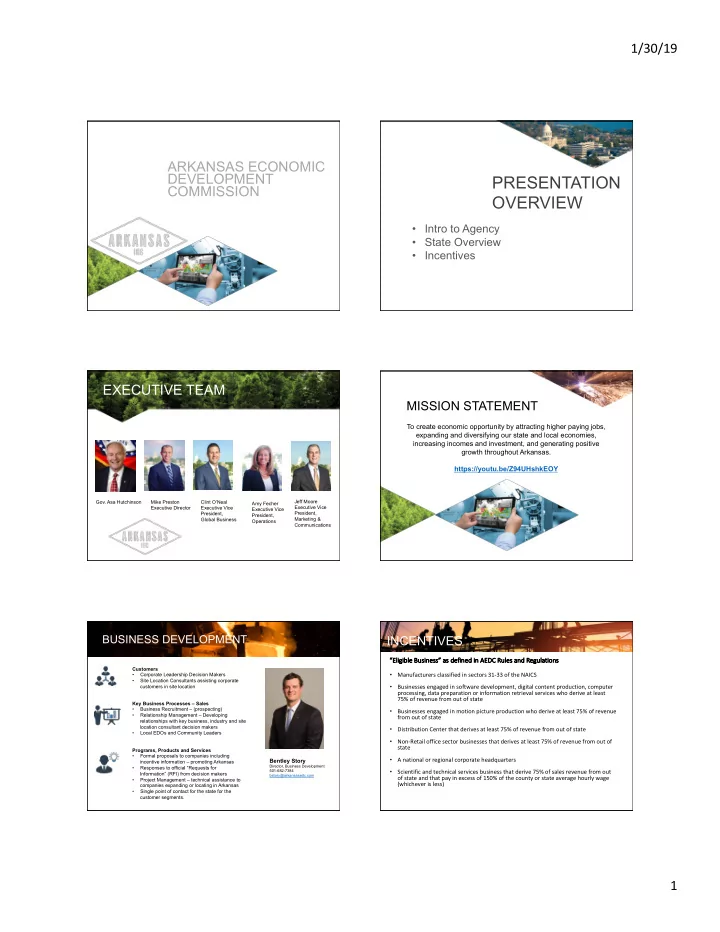
1/30/19 ARKANSAS ECONOMIC DEVELOPMENT PRESENTATION COMMISSION OVERVIEW Intro to Agency State Overview Incentives EXECUTIVE TEAM MISSION STATEMENT To create economic opportunity by attracting higher paying jobs, expanding and


slide-1
SLIDE 1

1/30/19 1 ARKANSAS ECONOMIC DEVELOPMENT COMMISSION

PRESENTATION OVERVIEW

  • Intro to Agency
  • State Overview
  • Incentives

EXECUTIVE TEAM

Mike Preston Executive Director Clint O’Neal Executive Vice President, Global Business Amy Fecher Executive Vice President, Operations Jeff Moore Executive Vice President, Marketing & Communications

  • Gov. Asa Hutchinson

MISSION STATEMENT

To create economic opportunity by attracting higher paying jobs, expanding and diversifying our state and local economies, increasing incomes and investment, and generating positive growth throughout Arkansas. https://youtu.be/Z94UHshkEOY

Customers

  • Corporate Leadership Decision Makers
  • Site Location Consultants assisting corporate

customers in site location Key Business Processes – Sales

  • Business Recruitment – (prospecting)
  • Relationship Management – Developing

relationships with key business, industry and site location consultant decision makers

  • Local EDOs and Community Leaders

Programs, Products and Services

  • Formal proposals to companies including

incentive information – promoting Arkansas

  • Responses to official “Requests for

Information” (RFI) from decision makers

  • Project Management – technical assistance to

companies expanding or locating in Arkansas

  • Single point of contact for the state for the

customer segments.

Bentley Story

Director, Business Development 501-682-7384 bstory@arkansasedc.com

BUSINESS DEVELOPMENT

INCENTIVES

  • Manufacturers classified in sectors 31-33 of the NAICS
  • Businesses engaged in software development, digital content production, computer

processing, data preparation or information retrieval services who derive at least 75% of revenue from out of state

  • Businesses engaged in motion picture production who derive at least 75% of revenue

from out of state

  • Distribution Center that derives at least 75% of revenue from out of state
  • Non-Retail office sector businesses that derives at least 75% of revenue from out of

state

  • A national or regional corporate headquarters
  • Scientific and technical services business that derive 75% of sales revenue from out
  • f state and that pay in excess of 150% of the county or state average hourly wage

(whichever is less)

“El “Eligible Bu e Busines ess” a ” as d defi fined ed i in AEDC Ru AEDC Rules es a and R Reg egulation

  • ns
slide-2
SLIDE 2

1/30/19 2

Types of Incentives

Statutory

  • Company must meet “Eligible Business”

definition

  • Must meet minimum requirements defined by

each program

  • If company meets all criteria as defined by

law, application will be approved

  • Not all programs can be used for the same

project

Business Development Incentives Overview

Dut Dutch K ch King ing Proje ject Manager 501.682.7353 501.682.7353 dking@arkansasEDC.com Discretionary

  • Company must meet “Eligible Business” definition
  • Must meet minimum requirements defined by each program
  • Programs must be approved by Executive Director and/or Governor and be
  • ffered by the AEDC in an Incentives Proposal
  • Not all programs can be used for the same project

TIER MAP

Statutory Incentives

Advantage Arkansas

  • Provides an income tax credit to eligible companies
  • Credit is based on percentage of payroll of the new employees hired
  • Credit is earned annually for a period of 5 years
  • Company can offset 50% of its income tax liability
  • Unused credits may be carried forward for 9 years

Tax Back

  • Provides a refund of sales and use tax paid on qualified expenditures (building

materials; machinery and equipment exempt)

  • Refund will consist of city, county and state taxes paid less 1% (1/8%-Conservation;

7/8%-Education)

  • Currently the state sales tax is 6.5%; therefore the refund of state taxes will be 5.5%
  • f the eligible taxable purchases
  • Company must spend at least $100,000 to qualify and obtain city and county

resolutions authorizing refund

  • The Tax Back program must be combined with Advantage Arkansas

Business Development Incentives Overview

Discretionary Incentives

Create Rebate

  • Offered from 1–10 years
  • Provides annual cash payments based on a percentage (3.9-5%) of a company’s

payroll for new employees

  • Company must create at least $2,000,000 in new annual payroll to be eligible

Upfront Cash Grants

  • Governor’s Quick Action Closing Fund or Community Development Block Grant

(CDBG)

  • AEDC grants help assist companies with the cost of infrastructure and equipment,

which can include but is not limited to site preparation, industrial access roads, sewer and water improvements, rail spurs, parking lots and necessary improvements to the facility/site.

  • The amount of assistance is dependent upon the strength of the company, number
  • f jobs, average wage, project investment and costs associated with the

expansion.

Business Development Incentives Overview

Discretionary Incentives

ArkPlus

  • Provides a state income tax credit equal to 10% of the total investment in the

project

  • Requires both minimum payroll and minimum investment, based on tiers (see

Tier Map)

  • Credits may be used to offset 50% of company’s income tax liability
  • Unused credits may be carried forward for 9 years

Business Development Incentives Overview

  • Property Tax Abatement
  • Cities and Counties are authorized to issue Industrial Revenue Bonds (IRBs) based
  • n the financial strength of the company / bonds can be tax exempt
  • Provides access to property tax reduction of up to 65% for the life of the bond

Financing

  • Bond Guaranty
  • AEDC and ADFA can “guarantee” timely payment of principal and interest of up

to $11M / guarantee provides a more attractive bond rating which lowers the effective interest rate to the company

  • Community Development Block Grants
  • Funds may be loaned to manufacturers for fixed-asset financing on projects that

create jobs for low-to-moderate income families / 7-15 year terms with competitive rates

Business Development Incentives Overview

slide-3
SLIDE 3

1/30/19 3

TRAINING

AEDC Business & Industry Training Grants

  • Customized Training Grants are flexible and highly customizable, providing

reimbursement for both on and off-site training for newly created positions related to an expansion or new location. Pre-employment training, new employee orientation,

  • n- the-job training, and/or skills upgrades for new positions qualify under this

program. Examples of eligible training expenses can include, but are not limited to the following:

  • Trainer wages or fees
  • Training materials
  • Training facilities
  • Trainer or trainee travel costs
  • Curriculum development, and
  • Other costs which are pre-approved by both the company and the AEDC

TRAINING

Office of Skills Development (OSD) is a Division of the Department of Career Education. Grants are available to support training that falls into the following categories:

  • Grow Your Own – Available to HQ’s in Arkansas with 250 or fewer employees.
  • Skills Gap – Addresses critical gaps in workforce skills, typically demanded by a

regional or industry-wide need, not a single organization.

  • Customized Technical – Typically associated with highly technical training that is

specific to or customized for a certain industry, skill or equipment.

  • Professional Development – Typically classroom training associated with soft

skills or core academic skills, as would be applicable to a large set of employees. Primary examples include those related to Microsoft Office products as well as Leadership Supervision, Conflict Resolution and Safety.

Ongoing Supportive Training Grants

1st in CNBC Lowest Cost of Doing Business 2nd Lowest Cost of Living Index 40% of the US Population Within a Day’s Drive 3.9% union membership rate – Right-to-work state 7th Ranked in Quality of Life 9th Highest % of Workforce in Manufacturing Income Tax Cut Signed in 2015 & 2017 Balanced Budget Since 1945

WHY ARKANSAS?

16

Opportunity Zone Overview

Arkansas Economic Development Commission Little Rock, Arkansas 2019

  • Signed into federal law as part of the Tax Cuts and Jobs

Act of 2017

  • Investors currently hold over $2.3 trillion in unrealized

capital gains and the Program has no appropriations cap.

  • Encourages long-term equity investments into targeted

low-income communities through Opportunity Funds, incentives are tied to the longevity of the investment.

17

Arkansas Economic Development Commission | ArkansasEDC.com

Opportunity Zone Tax Benefit

Taxpayers can get capital gains tax deferral (& more) Qualified Opportunity Funds (QOFs) for making timely investments in Qualified Projects located in Opportunity Zones which invest in

18

Opportunity Zone Tax Benefit

Arkansas Economic Development Commission | ArkansasEDC.com

slide-4
SLIDE 4

1/30/19 4

19

Arkansas Economic Development Commission | ArkansasEDC.com

Arkansas Opportunity Zones

  • Any individual, corporation, or trust, whether foreign or

domestic

  • Can defer an unlimited amount of capital gain from the sale or

exchange of any property (stock, business assets, personal assets, or any other property) to an unrelated person

  • by investing part or all of the proceeds from such sale or

exchange in a ‘‘qualified opportunity fund,’’ during the 180-day period beginning on the date of the sale or exchange

  • Only capital gains realized in sales or exchanges on or before

December 31, 2026, can be deferred under this program

20

Opportunity Fund Investors

Arkansas Economic Development Commission | ArkansasEDC.com

Any corporation or partnership organized for the purpose of investing in qualified opportunity zone property Opportunity Fund self certifies (no approval or action by the IRS is required.) by completing a form and attaches that form to the taxpayer’s federal income tax return for the taxable year. Fund must invests at least 90% of its assets into eligible Opportunity Zone property. Financial penalties for not meeting 90% test

21

Arkansas Economic Development Commission | ArkansasEDC.com

What are Opportunity Funds?

Must hold at least 90% of assets in QOZP, determined by the average of the percentage of QOZP held on: The last day of the first six month period of the fund’s taxable year, and The last day of the fund’s taxable year

22 JAN FEB MAR APR MAY JUN JUL AUG SEPT OCT NOV DEC

June 30th December 31st

Qualified Opportunity Fund – Asset Test

Arkansas Economic Development Commission | ArkansasEDC.com

23

Commercial Real Estate Development and Renovation in Opportunity Zones Opening New Businesses in Opportunity Zones Expansion of Existing Businesses into Opportunity Zones Large Expansions of Businesses already within Opportunity Zones Arkansas Economic Development Commission | ArkansasEDC.com

Investment in Opportunity Zones

  • To qualify as an Opportunity Zone Business:
  • substantially all of the tangible assets (70%) of the

business must be used in an Opportunity Zone

  • at least 50% of the gross income earned by the

business must be from the active conduct of a business in the Opportunity Zone

  • and the business can hold only a limited amount of

investment assets

24

Arkansas Economic Development Commission | ArkansasEDC.com

Opportunity Zone Business

slide-5
SLIDE 5

1/30/19 5

  • Apart from the exclusion of a few “sin” businesses, the

activities and projects Opportunity Funds can finance are broad.

  • A Qualified Opportunity Zone Business cannot engage in

any of the following “sin” businesses: any private or commercial golf course, country club, massage parlor, hot tub facility, suntan facility, racetrack or other facility used for gambling, or any store the principal business of which is the sale of alcoholic beverages for consumption off premises.

  • Note: It is also assumed by many third party professionals

that medial marijuana related facilities would be included in this definition.

25

Arkansas Economic Development Commission | ArkansasEDC.com

Ineligible Opportunity Zone Business

  • Tangible property used in a trade or business if such property
  • (i) was acquired by purchase after December 31, 2017
  • (ii) the original use of such property in the QO Zone

commences with the QO Fund or the QO Fund substantially improves the property

  • (iii) substantially all of the use of such property was in a QO

Zone during substantially all of the QO Fund’s holding period for the property. QOZBP will be treated as substantially improved by a QO Fund only if during the 30 month period beginning after the date of acquisition, the additions to the basis of such property in the hands of the QO Fund exceed the adjusted basis of such property at the beginning of the 30 month period

26

Arkansas Economic Development Commission | ArkansasEDC.com

Qualified Opportunity Zone Property Partial Forgiveness and Forgiveness of Additional Gains

27

SALE INVESTMENT Basis increased by 10% of the deferred gain Up to 90% taxed HELD FOR 5 YEARS Basis increased by 5% of the deferred gain Up to 85% taxed HELD FOR 7 YEARS Basis is equal to Fair Market Value Forgiveness of gains on appreciation of investment Requires an election HELD FOR 10 YEARS 2018 2019 2020 2021 2023 2024 2025 2026 2027 2028 2022 Arkansas Economic Development Commission | ArkansasEDC.com

Opportunity Zone Business

2018 2019 2020 2021 2022 2023

  • Jan. 2, 2018

Taxpayer enters into a sale that generates $1M of capital gain June 30, 2018 (Within 180 days), Taxpayer contributes entire $1M of capital gain to a Qualified Opportunity Fund

  • Taxpayer is deemed to have a $0

basis in its QOF investment

  • QOF Invests the $1MM in Qualified

Opportunity Zone Property

28

Arkansas Economic Development Commission | ArkansasEDC.com

Sample Investment

2023 2024 2025 2026 2027 2028 June 30, 2023 (After 5 years), Taxpayer’s basis in investment in QOF increases from $0 to $100k June 30, 2025 (After 7 years), Taxpayer’s basis in investment in QOF increases from $100k to $150k

  • Dec. 31, 2026

$850K of the 1MM

  • f deferred capital

gains are taxed and the basis in QOF investment increases to $1MM. June 30, 2028 (after 10 years) , Taxpayer sells its investment for $2.0MM. Basis in the investment is deemed to be FMV. The effect is no tax

  • n appreciation in

investment.

29

Arkansas Economic Development Commission | ArkansasEDC.com

Sample Investment

  • Opportunity Zone benefits increase if states conform to the Federal Law
  • Some states piggy-back off of the current Federal Law but could decouple from OZs
  • New York decided not to decouple
  • Hawaii decided to decouple
  • North Carolina released a draft bill that would decouple
  • Some states do not conform to Federal Law but could add OZs at the state level
  • Colorado is considering a bill to add the OZ benefit at the state level
  • Some states do not have a state income tax (e.g. Alaska, Florida, Nevada, South

Dakota, Texas, Washington, and Wyoming)

  • State Tax Implications of an single OZ transaction may include multiple states
  • State where original gain was realized
  • State (s) where the opportunity fund has nexus
  • Some states are tying other State incentives to opportunity zones
  • Missouri proposed increased cap for state historic credits for properties in OZs
  • California introduced a bill to exempt projects in OZs from the CA Environmental

Quality Act

30

Arkansas Economic Development Commission | ArkansasEDC.com

State Tax Implications