Presentation Outline Supporting high-ne Su needs ds scho hools: - - PDF document

presentation outline
SMART_READER_LITE
LIVE PREVIEW

Presentation Outline Supporting high-ne Su needs ds scho hools: - - PDF document

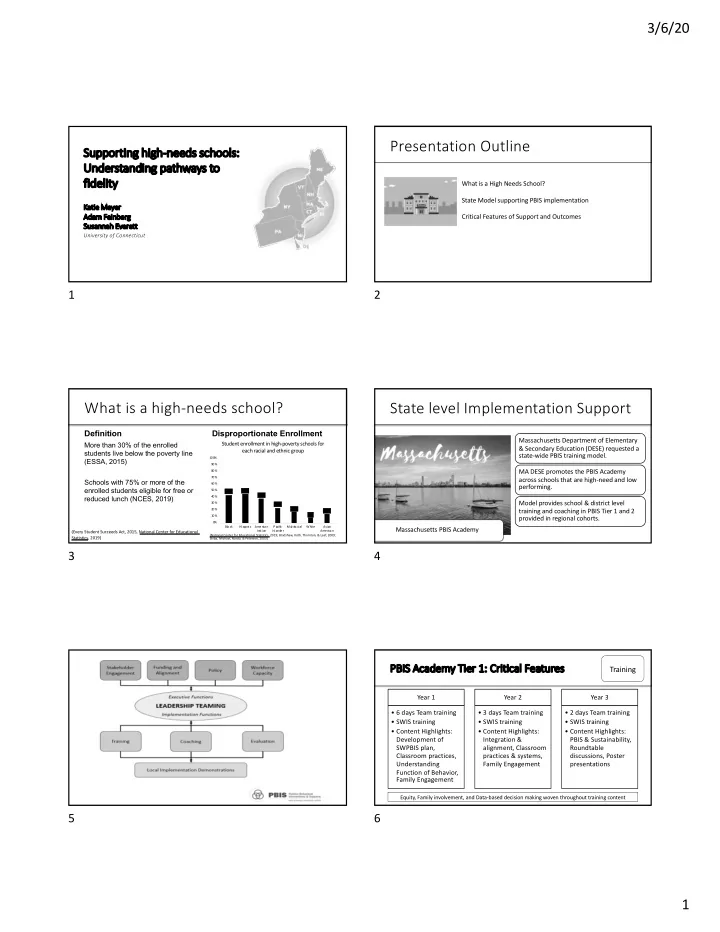
3/6/20 Presentation Outline Supporting high-ne Su needs ds scho hools: Un Understanding pathways to fi fidelity What is a High Needs School? State Model supporting PBIS implementation Katie Meyer Ka Ad Adam Feinberg Critical


slide-1
SLIDE 1

3/6/20 1

Su Supporting high-ne needs ds scho hools: Un Understanding pathways to fi fidelity

Ka Katie Meyer Ad Adam Feinberg Su Susan annah ah Everett

University of Connecticut

1

Presentation Outline

What is a High Needs School? State Model supporting PBIS implementation Critical Features of Support and Outcomes

2

What is a high-needs school?

Definition

44% 45% 38% 24% 17% 8% 14% % 1 0 % 2 0 % 3 0 % 4 0 % 5 0 % 6 0 % 7 0 % 8 0 % 9 0 % 1 0 0 % Bl a ck Hisp a n ic Ame ri ca n In dian P acifi c Island e r Mu lti ra cial Wh ite Asian Ame ri ca n

Student enrollment in high-poverty schools for each racial and ethnic group

Disproportionate Enrollment

More than 30% of the enrolled students live below the poverty line (ESSA, 2015) Schools with 75% or more of the enrolled students eligible for free or reduced lunch (NCES, 2019)

(Every Student Succeeds Act, 2015, National Center for Educational Statistics, 2019)

(National Center for Educational Statistics, 2019; Bradshaw, Koth, Thornton, & Leaf, 2009; Skiba, Michael, Nardo, & Peterson, 2003)

3

State level Implementation Support

Massachusetts PBIS Academy Massachusetts Department of Elementary & Secondary Education (DESE) requested a state-wide PBIS training model. MA DESE promotes the PBIS Academy across schools that are high-need and low performing. Model provides school & district level training and coaching in PBIS Tier 1 and 2 provided in regional cohorts.

4 5

PB PBIS S Acad ademy Ti Tier r 1: Cri ritical al Features

Training

Year 1

  • 6 days Team training
  • SWIS training
  • Content Highlights:

Development of SWPBIS plan, Classroom practices, Understanding Function of Behavior, Family Engagement Year 2

  • 3 days Team training
  • SWIS training
  • Content Highlights:

Integration & alignment, Classroom practices & systems, Family Engagement Year 3

  • 2 days Team training
  • SWIS training
  • Content Highlights:

PBIS & Sustainability, Roundtable discussions, Poster presentations

Equity, Family involvement, and Data-based decision making woven throughout training content

6

slide-2
SLIDE 2

3/6/20 2

PB PBIS Acad ademy Ti Tier 1: Criti tical al Featu tures

Coaching

Year 1

  • 3 days Coaches

training

  • 1 day on-site TA

Year 2

  • 3 days Coaches

training

  • 1 day on-site TA

Year 3

  • 2 days Coaches

training

  • 1 day on-site TA

Advanced skill building especially on Data-based decision making, Equity, Understanding Function of Behavior

7

PB PBIS S Acad ademy Ti Tier r 1: Cri ritical al Features

District Leadership Capacity

District Systems Fidelity Inventory Completed 1x per year

Tiered Fidelity Inventory (TFI)

Trainer & Team assessment of PBIS Implementation Completed 1x per year

Team Implementation Checklist (TIC)

Team assessment of PBIS Implementation Completed 2-3x per year

School Outcome Data

Office discipline referrals (ODRs) – some schools In school suspension Out of school suspension

Social Validity Data

Training evaluation data

Evaluation

8

PB PBIS Acad ademy Ti Tier 1: Criti tical al Featu tures

Year 1

  • 2 half day

District Trainings

  • 3 brief District

Capacity sessions

  • 1 day District

Team TA Year 2

  • 2 half day

District Trainings

  • 3 brief District

Capacity sessions

  • 1 day District

Team TA Year 3

  • 2 half day

District Trainings

  • 1 day District

Team TA

DISTRICT LEADERSHIP TEAMING

9

MA MA PBIS Academy: Participants

Cohort 1

12 districts 30 schools

Cohort 2

17 Districts 28 schools

Cohort 3

9 Districts 21 schools

Cohort 4

13 Districts 20 schools

Cohort 5

17 Districts 24 schools

Cohort 6

14 Districts 29 schools 53 total districts across all cohorts

10 PBIS Academy Evaluation:

What impact does the PBIS Academy have on school level implementation fidelity? What areas of implementation are currently effective? What areas may need some enhancement?

11

100% 97% 100% 86% 89% 100% 98% 74% 95% 98% 97% 96% 93% 82% 95% 91% 95% 98% 88% 78% 88% 93% 91% 97%

% 1 0 % 2 0 % 3 0 % 4 0 % 5 0 % 6 0 % 7 0 % 8 0 % 9 0 % 1 0 0 % 1 1 . My kno wle d g e

  • f P

BIS i ncre ase d

  • v e

r th e co urse

  • f

thi s tra i nin g . 9 . Ou r te am has a d e taile d pl a n to c o ll e ct and u s e d a ta to guid e imple me n ta ti

  • n
  • f

sc h

  • l-

wid e

  • r d

istrict-wid e PB IS . 8 . As a r e sul t of a tte nd in g this tra i nin g ,

  • u

r te a m h a s a d e tail e d and do a b le ac ti

  • n

pl a n to guid e imple me n ta ti

  • n.

7 . T he con c e pts a n d co nte nt co v e re d in th e tra i nin g a re imp

  • rtant to

my work in

  • ur

scho

  • l/d

istrict. 6 . I a m re a d y to use m y kn

  • wle

dge

  • f

imple me n ta tio n

  • f

S cho

  • l
  • Wid

e PB IS to supp

  • rt

m y scho

  • l.

5 . I a m re a d y to use m y kn

  • wle

dge

  • f

fou nd a tio ns

  • f Scho
  • l-

Wid e PB IS to s u pp

  • rt

m y scho

  • l.

Co ho rt 1 Co ho rt 2 Co ho rt 3 Co ho rt 4

Soci Social al Val alidity y Data: a: Trai aining Eval aluation

  • ns

12

slide-3
SLIDE 3

3/6/20 3

TFI Results Cohorts 1-4

40% 70% 77% 75% 46% 73% 75% 39% 62% 41% % 1 0 % 2 0 % 3 0 % 4 0 % 5 0 % 6 0 % 7 0 % 8 0 % 9 0 % 1 0 0 % Y e ar 1 Y e ar 2 Y e ar 3 Y e ar 4

Tiered Fidelity Inventory: Tier 1 Scale

Co ho rt 1 Co ho rt 2 Co ho rt 3 Co ho rt 4

13

TFI Item Analysis: Cohort 2, End of Year 3 TFI Tier 1

14

100% 97% 100% 86% 89% 100% 98% 74% 95% 98% 97% 96% 93% 82% 95% 91% 95% 98% 88% 78% 88% 93% 91% 97%

% 1 0 % 2 0 % 3 0 % 4 0 % 5 0 % 6 0 % 7 0 % 8 0 % 9 0 % 1 0 0 % 1 1 . My kno w l e d g e

  • f P

BIS i ncre ase d

  • ve

r the cou rse

  • f th

is train ing. 9 . Ou r te am has a d e taile d plan to c o lle ct and use data to g u id e i m p le m e ntatio n o f scho

  • l
  • wid

e

  • r d

istrict-wid e P BI S . 8 . As a re sul t of a tte nd in g this t r ain in g ,

  • u

r te a m h a s a d e taile d a n d doabl e a ctio n plan to guid e imple me n ta tio n. 7 . T he con c e pts a n d co nte nt cove re d in th e train ing are impo rta n t to m y wo rk in

  • u

r schoo l/d istrict. 6 . I a m re a d y to use m y kno wle dge

  • f i

m p le m e ntatio n o f Scho

  • l-W

id e P BI S to su pp

  • rt my

schoo l. 5 . I a m re a d y to use m y kno wle dge

  • f f
  • un

datio ns o f Schoo l-W ide P BIS to sup po rt my schoo l. Co ho rt 1 Co ho rt 2 Co ho rt 3 Co ho rt 4

Social Validity Data: Training Evals

15

Adjustments to Support Fidelity

  • Modifications made to training content for

teams and coaches in response to fidelity data: – Discipline procedures – Data-based decision making – Family engagement

  • Revised and formalized action planning review

process highlighting key items on the TFI

16