
SLIDE 1
1
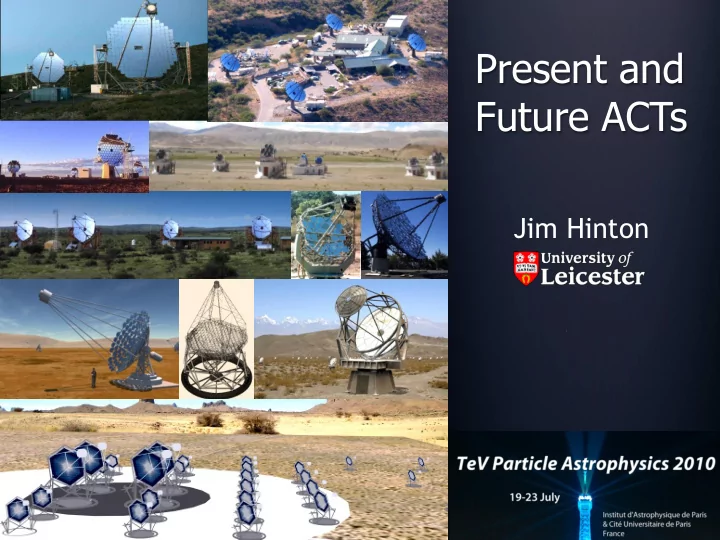
Present and Future ACTs Jim Hinton 2 Contents ACT - - PowerPoint PPT Presentation
1 Present and Future ACTs Jim Hinton 2 Contents ACT results/potential discussed in many talks T. Bringmann, W. Benbow, M. Kachelriess, Y. Gallant, S. Casanova, D. Giannios, M. Dalton, M. Vivier, R. Mukherjee, S. Sarkar, G. Morlino, S.
1
2 Contents
3 High Energy Sensitivity
Space-based instruments only
UV | X-ray | g-ray | VHE g-ray
10-11 10-12 10-13 10-14 10-15 10-16
More sensitive
nFn (erg cm-2 s-1)
1 eV 1 PeV 1 TeV 1 GeV 1 MeV 1 keV Energy IACTs Fermi GST Integral HST XMM
4 High Energy Sensitivity
Space-based instruments only
UV | X-ray | g-ray | VHE g-ray
10-11 10-12 10-13 10-14 10-15 10-16
More sensitive
nFn (erg cm-2 s-1)
1 eV 1 PeV 1 TeV 1 GeV 1 MeV 1 keV Energy IACTs Fermi GST Integral XMM HST
5 High Energy Sensitivity
Space-based instruments only
UV | X-ray | g-ray | VHE g-ray
10-11 10-12 10-13 10-14 10-15 10-16
More sensitive
nFn (erg cm-2 s-1)
1 PeV 1 TeV 1 GeV 1 MeV Energy IACTs Fermi GST Integral XMM HST
6
~ 120 m
Primary g-ray Particle Shower ~ 10 km
› g → e+ e-
› e- + (g) → e- + g
7
› g → e+ e-
› e- + (g) → e- + g
~ 120 m
Primary g-ray Particle Shower ~ 100 m ~ 10 km
8
Primary g-ray
~ 120 m
Particle Shower ~ 100 m ~ 10 km
Collection area ~105 m2
9
Primary g-ray
~ 120 m Focal Plane
Particle Shower Image Analysis gives Shower Energy Background rejection Shower Direction ~ 100 m ~ 10 km
Collection area ~105 m2 Energy resolution ~ 20%
10
~ 120 m Focal Plane
Particle Shower Image Analysis gives Shower Energy Background rejection Shower Direction Stereoscopic views Improved angular / energy resolution & background rejection ~ 100 m ~ 10 km Primary g-ray
11 Current ACTs
Apologies if you have a currently operating ACT that I have missed!
HESS MAGIC VERITAS TACTIC HAGAR CANGAROO-III Whipple 10m
12 Current ACTs
TACTIC HAGAR CANGAROO-III Whipple 10m
Non-imaging array 771 m Altitude 4300 m Sensitivity ~35% Crab
3.5 m imaging telescope Altitude 1300m Sensitivity ~70% Crab
Sensitivity ~15% Crab
Operating with 2 telescopes Sensitivity ~15% Crab.
(note that reanalysis of CANGAROO-I data clears up many old disagreements on southern sources ApJ 702, 631 (2009)
13 Current ACTs
VERITAS
HESS MAGIC
14 VERITAS
3.5° Field of View
Moved 1 telescope Improved alignment 1% 0.7% Crab sen.
Higher QE PMs (35%
Improved trigger Funded – complete
Crab detected in ~70 s (~90 hrs in 1989 !)
15 MAGIC
Energy & Angular res › ~30% better: <0.1° above 600 GeV Sensitivity 1% Crab
16 HESS Status
4 12m telescopes In Namibia, 5° FoV 0.7% Crab sens. (NB NGC 253, 0.3% Crab in 120 h) recoating underway to restore original reflectivity
A single giant (30 m) telescope under construction
Construction on hold – changing contractor
17 What are ACTs good for?
Long-timescale variability/monitoring › Sparsely sampled light-curves (moon, sun, weather) Very extended emission (>> 1°, limited FoV) Precision measurements at <<100 GeV (shower fluc.) Fermi can do these things better <100 GeV HAWC will (hopefully) do them > a few TeV *Current IACT arrays have factor ~2 better E-res and ang-res at 1 TeV than at 100 GeV
18 Angular resolution
SF+JH sims.
1’
MILAGRO HAWK
Limit (WH)
0.1° 0.01° 1°
19 Source Numbers
Fermi ?
Adapted from Tadashi Kifune
Ground-based VHE g-ray obs. HE g-ray Satellites X-ray Satellites
10000 1000 100 10 1
Year
1960 1970 1980 1990 2000 2010
Sources
20
July 2010: 113 TeV sources 109 ACT discoveries 72 Gal. / 41 EG
21 The High Energy Sky
22
Supernova SNR shell No acceleration expected until…
e.g. RX J1713
Molecular cloud Massive star
23
Binary PWN Composite SNR Binary? Compact companion? Neutron star companion? Massive companion? Radio jets? Nearby accelerator? Active cloud Passive cloud In cluster? Collective wind interactions Supernova Neutron star remains? SNR shell
PWN outlasts or escapes SNR
PWN No acceleration expected until…
e.g. HESS J1825 e.g. PSR B1259-63 (e.g. EGRET galactic clouds) e.g. RX J1713 e.g. Sagittarius B e.g. G 21.5-0.9 e.g. Westerlund 2?
No No Yes Yes Yes Yes No Yes Yes No Yes No No Yes Molecular cloud
(e.g. Eta Carinae) e.g. LS 5039?
Colliding wind sys. Microquasar Massive star
24
Binary PWN Composite SNR Binary? Compact companion? Neutron star companion? Massive companion? Radio jets? Nearby accelerator? Active cloud Passive cloud In cluster? Collective wind interactions Supernova Neutron star remains? SNR shell
PWN outlasts or escapes SNR
PWN No acceleration expected until…
e.g. HESS J1825 e.g. PSR B1259-63 (e.g. EGRET galactic clouds) e.g. RX J1713 e.g. Sagittarius B e.g. G 21.5-0.9 e.g. Westerlund 2?
No No Yes Yes Yes Yes No Yes Yes No Yes No No Yes Molecular cloud
(e.g. Eta Carinae) e.g. LS 5039?
Colliding wind sys. Microquasar Massive star
25 Supernova Remnants
Tycho (VERITAS) HESS J1731-347A › New shell-like TeV SNR (1st VHE Discovery) New SNR/cloud
› G22.7-0.2 (HESS) › g-Cygni (VERITAS)
26 Starburst Galaxies
VERITAS Discovery 2009 HESS Discovery 2009
27 Blazars
Can be used to constrain Lorenz Invariance Violation – but not
quite as good as Fermi GRBs (need more distant/faster objects)
Crab Nebula Flux
HESS 28th July 2006 (see also MAGIC Mrk 501 flare, VERITAS Mrk 421)
Crab Nebula Flux
×10-9
Quiescent Flux
28 A flood of new VHE AGN
29 ACTs + Fermi
w.r.t EGRET
For strong TeV sources
BEG lower limit
› Neronov & Vovk (2010)
Blazars
› PKS 2155-302, PG 1553+113
› MAGIC/HESS/VERITAS +Fermi collaborations
Binaries, PWN, SNR
› LS I +61303 › Vela X › RX J1713-3946
Crab Nebula
30 TeV Astronomy: Highlights
31 Photon Statistics
0.01 0.1 1 10 100 Energy (TeV)
RX J1713-3946
Background limited Signal limited
10
10
10
HESS
32 Photon Statistics
0.01 0.1 1 10 100 Energy (TeV)
RX J1713-3946
Background limited Signal limited
10
10
10
10 photons in: 10 km2 hours 100 km2 hours 1 km2 hour
HESS
33 Photon Statistics
0.01 0.1 1 10 100 Energy (TeV)
RX J1713-3946
10
10
10
10 photons in: 10 km2 hours 100 km2 hours 1 km2 hour 1 m2 year
HESS Fermi
34 Toy Model Sensitivity
35 Toy Model Sensitivity
Fmin (1+(src / PSF)2)
2
36 Toy Model Sensitivity
~1/t ~ const. ~1/t
37 Toy Model Sensitivity
38 The Gamma-ray Horizon
100 TeV 10 TeV 1 TeV 100 GeV 10 GeV 1 EeV 100 PeV 10 PeV 1 PeV 10 EeV 100 EeV
10 kpc 100 kpc 1 Mpc 10 Mpc 100 Mpc 1 Gpc GC Cen A
Mrk 421
z=1 M 31 z=5
Mean Free Path
3C 279
39 The Gamma-ray Horizon
100 TeV 10 TeV 1 TeV 100 GeV 10 GeV 1 EeV 100 PeV 10 PeV 1 PeV 10 EeV 100 EeV
10 kpc 100 kpc 1 Mpc 10 Mpc 100 Mpc 1 Gpc GC Cen A
Mrk 421
z=1 M 31 z=5
Mean Free Path
3C 279
Whole universe visible Beamed sources, time variability Precision study of local EG sources, resolved morphology Precision study
sources, up to the knee
40 Future ACTs
5@5 (Large telescopes at high alt. - 5 GeV @ 5 km alt.),
(Timing explorers – systematics limited for long exposures)
5 GeV 0.5 PeV 50 TeV 5 TeV 0.5 TeV 50 GeV
TenTen
AGIS
CTA
41 MACE
42 TenTen
220 m a.s.l. (Australia)
6m telescopes 8° FoV 0.24° pixels 500 m squares + central
E.g. VERITAS movie 0.05-0.1° res. above 10 TeV
43 AGIS
US led – 22 institutes
Use e.g. MAPMTs ~6mm 0.05° 8° FoV is <1 m
44 The Cherenkov Telescope Array
Plus - much wider energy coverage, substantially better
angular and energy resolution & wider field of view
100 institutes in 22 countries signed MoU Design 2008-2011, Prototyping 2011-13, Construction 2013-18 Baseline: 50-100 Cherenkov telescopes Two sites (full energy coverage only for southern hemisphere)
45 The Cherenkov Telescope Array
EU funded - €5.2M Preparatory Phase 7/2010 – 7/2013
Plus - much wider energy coverage, substantially better
angular and energy resolution & wider field of view
100 institutes in 22 countries signed MoU Design 2008-2011, Prototyping 2011-13, Construction 2013-18 Baseline: 50-100 Cherenkov telescopes Two sites (full energy coverage only for southern hemisphere)
46
47 CTA Technology
48
Crab 1% Crab
Fermi HESS
10
10
10
10
10 100 1000 10
4
10
5
E x F(>E) [TeV/cm
2s]
E [GeV]
1 year/5 50 h/5
49 Precision
Average Telescope Multiplicity Angular Resolution 20 5 10 15 0.01o 0.1o 25
1 TeV Limit
CTA
(all energies)
50 Science Potential
» “Current instruments have passed the critical sensitivity threshold and reveal a rich panorama, but this is clearly only the tip of the iceberg » Broad and diverse program for future ACTs, combining guaranteed astrophysics with significant discovery potential”
Distance kpc Mpc Gpc
Blazars SNR/PWN Binaries Radio Gal. Pulsed Starbursts Clusters
adapted from Horan & Weekes 2003
Colliding Winds
Flux
Current Future Sensitivity +Dark Matter +UHECR Sig. GRBs
Hofmann 2006
51 The Variable Universe
1 min 1 hour 100 hours 1 year 10 years 1 min 1 hour 100 hours Energy (GeV) Huge Opportunity for short-timescale phenomena: GRBs, AGN/Microquasar flares, ... No systematics
52 Conclusions
Current generation instruments are still going
(just ask for more details/plots)