SLIDE 1
¡ Saundra ¡Yancy ¡McGuire, ¡Ph.D. ¡ Re5red ¡Asst. ¡Vice ¡Chancellor ¡& ¡Professor ¡of ¡Chemistry ¡ Director ¡Emerita, ¡Center ¡for ¡Academic ¡Success ¡ Louisiana ¡State ¡University ¡ ¡ ¡
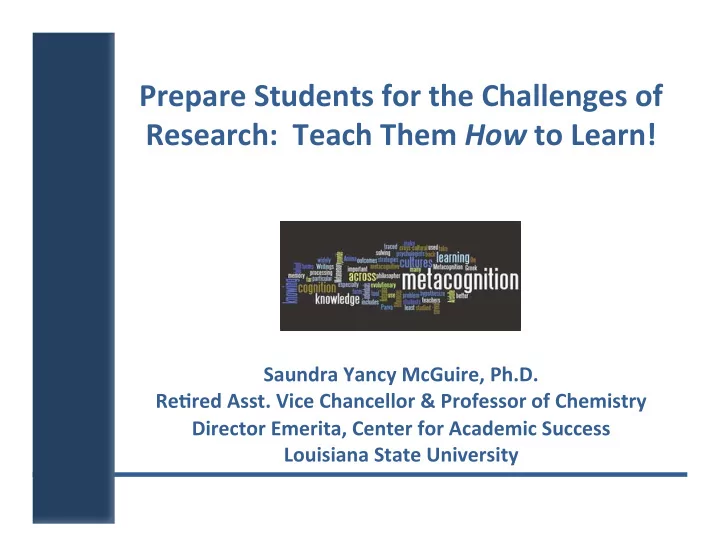
Prepare ¡Students ¡for ¡the ¡Challenges ¡of ¡ Research: ¡ ¡Teach ¡Them ¡How ¡to ¡Learn! ¡
SLIDE 2
Why ¡is ¡Research ¡Challenging? ¡
It ¡requires ¡many ¡skills ¡in ¡different ¡domains ¡
¡ § Cogni5ve ¡ ¡-‑ ¡Thinking ¡Skills ¡ ¡ ¡ ¡-‑ ¡Informa5on ¡Processing ¡ ¡ ¡ ¡-‑ ¡Problem ¡Solving ¡ ¡ § Affec5ve ¡– ¡AOtudes ¡and ¡Feelings ¡ ¡ ¡Confidence ¡ ¡ ¡ ¡ ¡ ¡ ¡Curiosity ¡ ¡ ¡ ¡Enthusiasm ¡ § Psychomotor ¡– ¡manual ¡or ¡physical ¡skills ¡ ¡ ¡Performing ¡Laboratory ¡Procedures ¡ ¡ ¡ ¡Handling ¡Instruments ¡ ¡
SLIDE 3
Cogni5ve ¡Skills ¡Needed ¡for ¡Research* ¡
§ Deep ¡and ¡broad ¡knowledge ¡base ¡ § Ability ¡to ¡read, ¡comprehend, ¡and ¡evaluate ¡ research ¡literature ¡ § Ability ¡to ¡cri5cally ¡evaluate ¡experiments ¡ and ¡results ¡ § Crea5vity ¡and ¡Imagina5on ¡ ¡ § Ability ¡to ¡interpret ¡and ¡ques5on ¡data ¡ § Ability ¡to ¡pose ¡ques5ons ¡and ¡propose ¡ studies ¡to ¡answer ¡the ¡ques5ons ¡
*From ¡survey ¡of ¡LSU ¡research ¡mentors, ¡ ¡March ¡2008 ¡
SLIDE 4 But ¡many ¡students ¡have ¡not ¡ developed ¡these ¡abili5es ¡
Arum, ¡Richard ¡and ¡Roksa, ¡Josipa. ¡2011. ¡Academically ¡Adri/: ¡Limited ¡Learning ¡on ¡ College ¡Campuses. ¡Chicago: ¡University ¡of ¡Chicago ¡Press. ¡
SLIDE 5
But ¡they ¡can ¡develop ¡them ¡if ¡we… ¡ ¡ ¡
§ Teach ¡students ¡how ¡to ¡learn ¡ § Help ¡them ¡develop ¡the ¡right ¡mindset ¡
SLIDE 6 Metacogni5on: ¡The ¡Key ¡ ¡ to ¡Improving ¡Cogni5ve ¡Skills ¡
The ¡ability ¡to: ¡ § think ¡about ¡one’s ¡own ¡thinking ¡ § be ¡consciously ¡aware ¡of ¡oneself ¡as ¡a ¡ problem ¡solver ¡ § monitor, ¡plan, ¡and ¡control ¡one’s ¡mental ¡ processing ¡(e.g. ¡“Am ¡I ¡understanding ¡this ¡ material, ¡or ¡just ¡memorizing ¡it?”) ¡ § accurately ¡judge ¡one’s ¡level ¡of ¡learning ¡
¡
¡
Flavell, ¡J. ¡H. ¡(1976). ¡Metacogni5ve ¡aspects ¡of ¡problem ¡solving. ¡In ¡L. ¡B. ¡ Resnick ¡(Ed.), ¡The ¡nature ¡of ¡intelligence ¡(pp.231-‑236). ¡Hillsdale, ¡NJ: ¡Erlbaum ¡ ¡
SLIDE 7
Why ¡haven’t ¡most ¡students ¡ developed ¡metacogni5ve ¡skills? ¡
SLIDE 8 According ¡to ¡data ¡from ¡the ¡ ¡ entering ¡class ¡of ¡2011...* ¡
- It ¡wasn’t ¡necessary ¡in ¡high ¡school ¡
¡-‑ ¡ ¡60.5% ¡of ¡2011 ¡(down ¡from ¡63% ¡in ¡2010) ¡ ¡entering ¡first ¡year ¡students ¡spent ¡less ¡ ¡than ¡six ¡hours ¡per ¡week ¡doing ¡homework ¡in ¡ ¡12th ¡grade. ¡ ¡ ¡-‑ ¡49.7% ¡of ¡these ¡students ¡said ¡they ¡graduated ¡ ¡from ¡high ¡school ¡with ¡an ¡“A” ¡average.* ¡ ¡
- Students’ ¡confidence ¡level ¡is ¡high ¡
¡-‑ ¡ ¡70.9 ¡% ¡believe ¡their ¡academic ¡ability ¡is ¡ ¡above ¡average ¡or ¡in ¡the ¡highest ¡10 ¡percent ¡ ¡among ¡people ¡their ¡age ¡ ¡ ¡ ¡ ¡ ¡ ¡ ¡ ¡ ¡ ¡ ¡ ¡ ¡ ¡ ¡ ¡ ¡ ¡ ¡ ¡ ¡ ¡ ¡ ¡ ¡ ¡ ¡ ¡*2011 ¡Higher ¡Educa5on ¡Research ¡Ins5tute ¡Study ¡
SLIDE 9
¡ ¡ ¡ ¡
Help ¡students ¡iden5fy ¡and ¡close ¡“the ¡gap” ¡ ¡ ¡ current ¡behavior ¡ ¡ ¡ ¡ ¡ ¡ ¡ ¡ ¡ ¡current ¡results ¡ ¡ ¡ ¡ ¡ ¡ ¡ ¡ ¡ ¡ ¡ ¡ ¡ ¡ ¡ ¡ ¡ ¡ ¡ produc5ve ¡behavior ¡ ¡desired ¡results ¡
Faculty ¡Must ¡Help ¡Students ¡ ¡ Make ¡the ¡TransiCon ¡to ¡College ¡
SLIDE 10 Reflec5on ¡Ques5ons ¡
- What’s ¡the ¡difference, ¡if ¡any, ¡between ¡
studying ¡and ¡learning? ¡
- For ¡which ¡task ¡would ¡you ¡work ¡harder? ¡
¡ ¡ ¡ ¡A. ¡ ¡Make ¡an ¡A ¡on ¡the ¡test ¡ ¡ ¡ ¡ ¡B. ¡ ¡Teach ¡the ¡material ¡to ¡the ¡class ¡
SLIDE 11
The ¡Story ¡of ¡Two ¡Students ¡
§ Travis, ¡junior ¡psychology ¡student ¡ ¡ ¡ ¡ ¡47, ¡52, ¡82, ¡86 ¡ ¡ ¡ ¡ ¡ ¡ ¡B ¡in ¡course ¡ ¡ ¡ § Dana, ¡first ¡year ¡physics ¡student ¡ ¡ ¡ ¡ ¡80, ¡54, ¡91, ¡97, ¡90 ¡(final) ¡ ¡ ¡ ¡ ¡A ¡in ¡course ¡ ¡
SLIDE 12
Travis, junior psychology student 47, 52, 82, 86
Problem: Reading Comprehension Solution: Preview text before reading* Develop questions* Read one paragraph at a time and paraphrase information *Develop anticipatory set
SLIDE 13 First ¡Voyage ¡of ¡Christopher ¡Columbus ¡
WITH ¡HOCKED ¡GEMS ¡FINANCING ¡HIM/ ¡OUR ¡ HERO ¡BRAVELY ¡DEFIED ¡ALL ¡SCORNFUL ¡ LAUGHTER/ ¡THAT ¡TRIED ¡TO ¡PREVENT ¡HIS ¡ SCHEME/ ¡YOUR ¡EYES ¡DECEIVE/ ¡HE ¡HAD ¡SAID/ ¡AN ¡ EGG/ ¡NOT ¡A ¡TABLE/ ¡CORRECTLY ¡TYPIFIES ¡THIS ¡ UNEXPLORED ¡PLANET/ ¡NOW ¡THREE ¡STURDY ¡ SISTERS ¡SOUGHT ¡PROOF/ ¡FORGING ¡ALONG ¡ SOMETIMES ¡THROUGH ¡CALM ¡VASTNESS/ ¡YET ¡ MORE ¡OFTEN ¡OVER ¡TURBULENT ¡PEAKS ¡AND ¡ VALLEYS/ ¡DAYS ¡BECAME ¡WEEKS/ ¡AS ¡MANY ¡ DOUBTERS ¡SPREAD ¡FEARFUL ¡RUMORS ¡ABOUT ¡ THE ¡EDGE/ ¡AT ¡LAST/ ¡FROM ¡NOWHERE/ ¡ WELCOME ¡WINGED ¡CREATURES ¡APPEARED/ ¡ SIGNIFYING ¡MOMENTOUS ¡SUCCESS ¡
Dooling, ¡J.D. ¡and ¡Lachman, ¡R. ¡ ¡Effects ¡of ¡Comprehension ¡on ¡Reten5on ¡of ¡Prose, ¡ Journal ¡of ¡Experimental ¡Psychology, ¡ ¡(1971), ¡Vol. ¡88, ¡No. ¡2, ¡216-‑222 ¡
SLIDE 14
An5cipatory ¡set ¡CAN ¡interfere! ¡ ¡
Let’s ¡look ¡ ¡at ¡the ¡car ¡on ¡the ¡next ¡slide… ¡
SLIDE 15
Is ¡this ¡a ¡2-‑door ¡or ¡4-‑door ¡car? ¡
SLIDE 16
Dana, first year physics student 80, 54, 91, 97, 90 (final)
Problem: Memorizing formulas and using www.cramster.com Solution: Solve problems with no external aids and test mastery of concepts
SLIDE 17
Why ¡the ¡Fast ¡and ¡Drama5c ¡ Increase? ¡ It’s ¡all ¡about ¡the ¡strategies, ¡and ¡ gejng ¡them ¡to ¡engage ¡their ¡brains! ¡
SLIDE 18 Coun5ng ¡Vowels ¡in ¡45 ¡seconds ¡
¡ How ¡accurate ¡are ¡you? ¡
Count ¡all ¡the ¡vowels ¡ ¡ in ¡the ¡words ¡on ¡the ¡next ¡slide.
¡
SLIDE 19
Dollar ¡Bill ¡ Dice ¡ Tricycle ¡ Four-‑leaf ¡Clover ¡ Hand ¡ Six-‑Pack ¡ Seven-‑Up ¡ Octopus ¡ Cat ¡Lives ¡ Bowling ¡Pins ¡ Football ¡Team ¡ Dozen ¡Eggs ¡ Unlucky ¡Friday ¡ Valen5ne’s ¡Day ¡ Quarter ¡Hour ¡
SLIDE 20
How ¡many ¡words ¡or ¡phrases ¡ ¡ do ¡you ¡remember? ¡
SLIDE 21
Let’s ¡look ¡at ¡the ¡words ¡again… ¡
What ¡are ¡they ¡arranged ¡ ¡ according ¡to? ¡
SLIDE 22
Dollar ¡Bill ¡ Dice ¡ Tricycle ¡ Four-‑leaf ¡Clover ¡ Hand ¡ Six-‑Pack ¡ Seven-‑Up ¡ Octopus ¡ Cat ¡Lives ¡ Bowling ¡Pins ¡ Football ¡Team ¡ Dozen ¡Eggs ¡ Unlucky ¡Friday ¡ Valen5ne’s ¡Day ¡ Quarter ¡Hour ¡
SLIDE 23
NOW, ¡how ¡many ¡words ¡or ¡phrases ¡ do ¡you ¡remember? ¡
SLIDE 24
- 2. ¡ ¡We ¡knew ¡how ¡the ¡informa5on ¡ ¡
¡ ¡ ¡ ¡ ¡ ¡was ¡organized ¡ What ¡were ¡two ¡major ¡differences ¡ ¡ between ¡the ¡two ¡asempts? ¡
- 1. ¡ ¡We ¡knew ¡what ¡the ¡task ¡was ¡
SLIDE 25 Bransford, ¡J.D., ¡Brown, ¡A.L., ¡Cocking, ¡R.R. ¡(Eds.), ¡2000. ¡ ¡How ¡people ¡learn: ¡ ¡Brain, ¡ Mind, ¡Experience, ¡and ¡School. ¡ ¡Washington, ¡DC: ¡ ¡Na5onal ¡Academy ¡Press. ¡
Excellent ¡Resource ¡
SLIDE 26 What ¡we ¡know ¡about ¡learning ¡
¡
- Ac5ve ¡learning ¡is ¡more ¡las5ng ¡than ¡passive ¡learning ¡
¡ ¡ ¡ ¡ ¡ ¡ ¡-‑-‑ ¡Passive ¡learning ¡is ¡an ¡oxymoron* ¡ ¡
- Thinking ¡about ¡thinking ¡is ¡important ¡
– Metacogni5on** ¡ ¡
- The ¡level ¡at ¡which ¡learning ¡occurs ¡is ¡important ¡ ¡
– ¡Bloom’s ¡Taxonomy*** ¡
*Cross, ¡Patricia, ¡“Opening ¡Windows ¡on ¡Learning” ¡League ¡for ¡Innova5on ¡in ¡the ¡ Community ¡College, ¡June ¡1998, ¡p. ¡21. ¡ ** ¡Flavell, ¡John, ¡ ¡“Metacogni5on ¡and ¡cogni5ve ¡monitoring: ¡A ¡new ¡area ¡of ¡cogni5ve– developmental ¡inquiry.” ¡ ¡American ¡Psychologist, ¡Vol ¡34(10), ¡Oct ¡1979, ¡906-‑911. ¡ *** ¡Bloom ¡Benjamin. ¡S. ¡(1956). ¡Taxonomy ¡of ¡EducaAonal ¡ ¡ObjecAves, ¡Handbook ¡I: ¡ The ¡CogniAve ¡Domain. ¡New ¡York: ¡David ¡McKay ¡Co ¡Inc. ¡ ¡
SLIDE 27 Bloom’s ¡Taxonomy
Anderson & Krathwohl, 2001
http://projects.coe.uga.edu/epltt/index.php?title=Bloom's_Taxonomy
SLIDE 28 Creating Evaluating Analyzing Applying Understanding Remembering
Pujng ¡elements ¡together ¡to ¡ form ¡a ¡coherent ¡or ¡func5onal ¡ whole; ¡reorganizing ¡elements ¡ into ¡a ¡new ¡parern ¡or ¡structure ¡ through ¡genera5ng, ¡ planning, ¡or ¡producing. Making ¡judgments ¡based ¡on ¡ criteria ¡and ¡standards ¡ through ¡checking ¡and ¡ cri5quing. Carrying ¡out ¡or ¡using ¡a ¡ procedure ¡through ¡execu5ng, ¡
Construc5ng ¡meaning ¡ from ¡oral, ¡wriren, ¡and ¡ graphic ¡messages ¡through ¡ interpre5ng, ¡exemplifying, ¡ classifying, ¡summarizing, ¡ inferring, ¡comparing, ¡and ¡ explaining. Retrieving, ¡recognizing, ¡ and ¡recalling ¡relevant ¡ knowledge ¡from ¡ long-‑term ¡memory.
Bloom’s Taxonomy
hsp://www.odu.edu/educ/llschult/blooms_taxonomy.htm Breaking ¡material ¡into ¡ cons5tuent ¡parts, ¡ determining ¡how ¡the ¡ parts ¡relate ¡to ¡one ¡ another ¡and ¡to ¡an ¡
This pyramid depicts the different levels of thinking we use when learning. Notice how each level builds on the foundation that precedes it. It is required that we learn the lower levels before we can effectively use the skills above.
SLIDE 29
When ¡we ¡teach ¡students ¡ about ¡Bloom’s ¡Taxonomy… They ¡GET ¡it!
SLIDE 30 How students answered (2008) At ¡what ¡level ¡of ¡Bloom’s ¡did ¡you ¡have ¡to ¡operate ¡ to ¡make ¡A’s ¡or ¡B’s ¡in ¡high ¡school? ¡
1 2 3 4 5 6
21% 35% 3% 3% 13% 25%
- 1. Knowledge ¡
- 2. Comprehension ¡
- 3. Applica5on ¡
- 4. Analysis ¡
- 5. Synthesis ¡
- 6. Evalua5on ¡
SLIDE 31 At ¡what ¡level ¡of ¡Bloom’s ¡did ¡you ¡have ¡to ¡
- perate ¡to ¡make ¡A’s ¡or ¡B’s ¡in ¡high ¡school? ¡
1 2 3 4 5 6
44% 29% 2% 0% 4% 21%
- 1. Knowledge
- 2. Comprehension
- 3. Application
- 4. Analysis
- 5. Synthesis
- 6. Evaluation
How students answered (2013)
SLIDE 32 How students answered (in 2008) At ¡what ¡level ¡of ¡Bloom’s ¡do ¡you ¡think ¡you’ll ¡need ¡ to ¡be ¡to ¡make ¡an ¡A ¡in ¡Chem ¡1201? ¡
1 2 3 4 5 6
7% 6% 15% 23% 35% 14%
- 1. Knowledge ¡
- 2. Comprehension ¡
- 3. Applica5on ¡
- 4. Analysis ¡
- 5. Synthesis ¡
- 6. Evalua5on ¡
SLIDE 33 How students answered (in 2013) At ¡what ¡level ¡of ¡Bloom’s ¡do ¡you ¡think ¡you’ll ¡need ¡ to ¡be ¡to ¡make ¡an ¡A ¡in ¡Chem ¡1201? ¡
- 1. Knowledge ¡
- 2. Comprehension ¡
- 3. Applica5on ¡
- 4. Analysis ¡
- 5. Synthesis ¡
- 6. Evalua5on ¡
1 2 3 4 5 6
6% 9% 11% 11% 40% 23%
SLIDE 34 How ¡do ¡we ¡teach ¡students ¡to ¡move ¡ higher ¡on ¡Bloom’s ¡Taxonomy? ¡ ¡ Teach ¡them ¡the ¡Study ¡Cycle*
*adapted from Frank Christ’s PLRS system ¡
SLIDE 35 4 ¡ Reflect ¡ 4 ¡ Reflect ¡ 3 ¡ Review ¡ ¡ ¡
The Study Cycle
1 ¡
Set ¡a ¡Goal ¡ 1-‑2 ¡min ¡ Decide ¡what ¡you ¡want ¡to ¡accomplish ¡in ¡your ¡study ¡session ¡ ¡
2 ¡
Study ¡with ¡Focus ¡ 30-‑50 ¡min ¡ Interact ¡with ¡material-‑ ¡organize, ¡concept ¡map, ¡summarize, ¡process, ¡re-‑read, ¡fill-‑in ¡notes, ¡reflect, ¡etc. ¡ ¡ ¡
3 ¡
Reward ¡Yourself ¡ 10-‑15 ¡min ¡ Take ¡a ¡break– ¡call ¡a ¡friend, ¡play ¡a ¡short ¡game, ¡get ¡a ¡snack ¡
4 ¡
Review ¡ 5 ¡min ¡ Go ¡over ¡what ¡you ¡just ¡studied ¡
Intense ¡Study ¡Sessions ¡ ¡ ¡
Arend ¡ Review ¡ Study ¡
AJend ¡class ¡– ¡GO ¡TO ¡CLASS! ¡Answer ¡and ¡ask ¡ques5ons ¡and ¡take ¡meaningful ¡notes. ¡ ¡ ¡ Preview ¡before ¡class ¡– ¡Skim ¡the ¡chapter, ¡note ¡headings ¡and ¡boldface ¡words, ¡review ¡ summaries ¡and ¡chapter ¡objec5ves, ¡and ¡come ¡up ¡with ¡ques5ons ¡you’d ¡ ¡like ¡the ¡lecture ¡ to ¡answer ¡for ¡you. ¡ ¡ Review ¡aver ¡class ¡– ¡As ¡soon ¡ater ¡class ¡as ¡possible, ¡read ¡notes, ¡fill ¡in ¡gaps ¡and ¡note ¡any ¡
Assess ¡your ¡Learning ¡– ¡Periodically ¡perform ¡reality ¡checks ¡
- Am ¡I ¡using ¡study ¡methods ¡that ¡are ¡effec5ve? ¡
- Do ¡I ¡understand ¡the ¡material ¡enough ¡to ¡teach ¡it ¡to ¡others? ¡
Preview ¡
Center for Academic Success
B-31 Coates Hall ▪ 225.578.2872 ▪www.cas.lsu.edu
Assess ¡
Study ¡– ¡Repe55on ¡is ¡the ¡key. ¡ ¡Ask ¡ques5ons ¡such ¡as ¡‘why’, ¡‘how’, ¡and ¡‘what ¡if’. ¡
- Intense ¡Study ¡Sessions* ¡-‑ ¡3-‑5 ¡short ¡study ¡sessions ¡per ¡day ¡
- Weekend ¡Review ¡– ¡Read ¡notes ¡and ¡material ¡from ¡the ¡week ¡to ¡make ¡connec5ons ¡
SLIDE 36 Concept ¡maps ¡can ¡develop ¡ability ¡ ¡to ¡think ¡cri5cally ¡ And ¡there ¡are ¡many ¡different ¡forms ¡
SLIDE 37 Chapter/Paper ¡Map ¡
Title of Chapter/Paper Primary Headings Subheadings Secondary Subheadings
SLIDE 38 Compare ¡and ¡Contrast ¡
Thermodynamic Control ¡ Kinetic Control
How are they similar? How are they different?
SLIDE 39 Dweck, ¡Carol, ¡2006. ¡ ¡ ¡ Mindset: ¡The ¡New ¡Psychology ¡ ¡
- f ¡Success. ¡ ¡New ¡York: ¡ ¡ ¡
Random ¡House ¡Publishing ¡
¡
Help ¡Students ¡Develop ¡the ¡Right ¡Mindset ¡
¡ ¡
Shenk, ¡David, ¡2010. ¡The ¡Genius ¡in ¡All ¡of ¡ Us: ¡Why ¡Everything ¡You've ¡Been ¡Told ¡ About ¡GeneCcs, ¡Talent, ¡and ¡IQ ¡Is ¡
- Wrong. ¡ ¡New ¡York: ¡ ¡Doubleday ¡ ¡
¡
SLIDE 40 Mindset* ¡is ¡Important!
§ Fixed ¡Intelligence ¡Mindset ¡
¡Intelligence ¡is ¡sta5c ¡ ¡You ¡have ¡a ¡certain ¡amount ¡of ¡it ¡ § ¡ ¡Growth ¡Intelligence ¡Mindset ¡ ¡Intelligence ¡can ¡be ¡developed ¡ ¡You ¡can ¡grow ¡it ¡with ¡ac5ons ¡
¡ Dweck, ¡Carol ¡(2006) ¡Mindset: ¡ ¡The ¡New ¡Psychology ¡of ¡Success. ¡ New ¡York: ¡ ¡Random ¡House ¡Publishing ¡
SLIDE 41
Responses ¡to ¡Many ¡Situa5ons ¡ ¡ are ¡Based ¡on ¡Mindset ¡
Fixed ¡Intelligence ¡ Mindset ¡Response ¡ Growth ¡Intelligence ¡ Mindset ¡Response ¡ Challenges ¡ Avoid ¡ Embrace ¡ Obstacles ¡ Give ¡up ¡easily ¡ Persist ¡ Tasks ¡requiring ¡effort ¡ Fruitless ¡to ¡Try ¡ Path ¡to ¡mastery ¡ Cri5cism ¡ Ignore ¡it ¡ Learn ¡from ¡it ¡ Success ¡of ¡Others ¡ Threatening ¡ InspiraAonal ¡
SLIDE 42 “…Personally, I am not so good at chemistry and
unfortunately, at this point my grade for that class is reflecting exactly that. I am emailing you inquiring about a possibility of you tutoring me.” April 6, 2011
- “I made a 68, 50, (50), 87, 87, and a 97 on my final. I
ended up earning a 90 (A) in the course, but I started with a 60 (D). I think what I did different was make sidenotes in each chapter and as I progressed
- nto the next chapter I was able to refer to these
- notes. I would say that in chemistry everything
builds from the previous topic. May 13, 2011 Semester GPA: 3.8
Email from a Spring 2011 Chem 1201 student
SLIDE 43
What ¡happens ¡when ¡we ¡teach ¡ metacogni5ve ¡learning ¡strategies, ¡ Bloom’s ¡Taxonomy, ¡and ¡the ¡Study ¡Cycle ¡ to ¡an ¡en5re ¡class, ¡not ¡just ¡individuals? ¡
SLIDE 44 Performance ¡in ¡Gen ¡Chem ¡I ¡in ¡2011 ¡ Based ¡on ¡One ¡Learning ¡Strategies ¡Session ¡
¡ ¡ ¡ ¡ ¡ ¡ ¡ ¡ ¡ ¡ ¡ ¡ ¡Arended
¡ ¡Absent ¡ Exam ¡1 ¡Avg.: ¡ ¡ ¡ ¡ ¡ ¡ ¡ ¡ ¡71.65% ¡ ¡70.45% ¡ ¡ ¡ Exam ¡2 ¡Avg.: ¡ ¡ ¡ ¡ ¡ ¡ ¡ ¡ ¡ ¡77.18% ¡ ¡68.90% ¡ ¡ Final ¡course ¡Avg: ¡ ¡ ¡ ¡ ¡ ¡ ¡ ¡ ¡81.60% ¡ ¡70.43% ¡
Final ¡Course ¡Grade: ¡ ¡ ¡ ¡ ¡ ¡B
¡ ¡ ¡ ¡ ¡ ¡C ¡
The ¡one ¡50-‑min ¡presenta5on ¡on ¡study ¡and ¡learning ¡strategies ¡ resulted ¡in ¡an ¡improvement ¡of ¡one ¡full ¡leser ¡grade! ¡
SLIDE 45 Metacogni5on: ¡An ¡Effec5ve ¡Tool ¡to ¡Promote ¡Success ¡ ¡ in ¡College ¡Science ¡Learning* ¡
Ninfeng ¡ ¡Zhao1, ¡Jeffrey ¡Wardeska1, ¡Saundra ¡McGuire2, ¡Elzbieta ¡Cook2 ¡ ¡1Department ¡of ¡Chemistry, ¡East ¡Tennessee ¡State ¡University ¡ ¡2Department ¡of ¡Chemistry, ¡Louisiana ¡State ¡University ¡ ¡ *Accepted ¡for ¡publica5on ¡April ¡2013 ¡
SLIDE 46
Sharing Strategies that Have Worked for Others Can Be Very Motivational
SLIDE 47 Before and After
Meaningful ¡Learning ¡ ¡ ¡ ¡ ¡ ¡ ¡ ¡ ¡ ¡ ¡ ¡ ¡Rote ¡Learning
§ Robert, ¡freshman ¡chemistry ¡student ¡ ¡ ¡ ¡ ¡ ¡ ¡42, ¡ ¡100, ¡100, ¡100 ¡ ¡A ¡in ¡course ¡ § Michael, ¡senior ¡pre-‑med ¡organic ¡student ¡ ¡30, ¡ ¡28, ¡ ¡80, ¡ ¡91 ¡ ¡ ¡B ¡in ¡course ¡ § Miriam, ¡freshman ¡calculus ¡student ¡ ¡37.5, ¡83, ¡93 ¡ ¡ ¡ ¡B ¡in ¡course ¡ § Ifeanyi, ¡sophomore ¡thermodynamics ¡ student ¡ ¡67, ¡54, ¡68, ¡95 ¡ ¡ ¡ ¡B ¡in ¡course ¡ § Terrence, ¡junior ¡Bio ¡Engineering ¡student ¡ ¡ ¡ ¡ ¡ ¡GPA ¡1.67 ¡cum, ¡3.54 ¡(F ¡03), ¡3.8 ¡(S ¡04) ¡ ¡ ¡ ¡ ¡
SLIDE 48 Top ¡5 ¡Reasons ¡Folks ¡Did ¡Not ¡Do ¡Well ¡ ¡
- n ¡Test ¡1 ¡in ¡General ¡Chemistry* ¡
§ 1. ¡ ¡Didn’t ¡spend ¡enough ¡5me ¡on ¡the ¡material ¡ § 2. ¡ ¡Started ¡the ¡homework ¡too ¡late ¡ § 3. ¡ ¡Didn’t ¡memorize ¡the ¡informa5on ¡I ¡needed ¡ ¡to ¡memorize ¡ § 4. ¡ ¡Did ¡not ¡use ¡the ¡book ¡ § 5. ¡ ¡Assumed ¡I ¡understood ¡informa5on ¡that ¡I ¡ ¡had ¡read ¡and ¡re-‑read, ¡but ¡had ¡not ¡ ¡applied ¡ ¡*McGuire’s ¡Survey ¡of ¡General ¡Chemistry ¡Students ¡
SLIDE 49 Top ¡5 ¡Reasons ¡Students ¡Made ¡an ¡A ¡ ¡
§ 1. ¡ ¡Did ¡preview-‑review ¡for ¡every ¡class ¡ § 2. ¡ ¡Did ¡a ¡lirle ¡of ¡the ¡homework ¡at ¡a ¡5me ¡ § 3. ¡ ¡Used ¡the ¡book ¡and ¡did ¡the ¡suggested ¡ ¡problems ¡ § 4. ¡ ¡Made ¡flashcards ¡of ¡the ¡informa5on ¡to ¡ ¡ ¡ ¡be ¡memorized ¡ § 5. ¡ ¡Prac5ced ¡explaining ¡the ¡informa5on ¡to ¡ ¡others ¡
SLIDE 50
At ¡the ¡end ¡of ¡a ¡60 ¡minute ¡learning ¡strategies ¡ presentaCon ¡by ¡the ¡professor, ¡students ¡were ¡given ¡a ¡ survey ¡to ¡determine ¡their ¡self-‑assessment ¡of ¡whether ¡ they ¡were ¡using ¡or ¡not ¡using ¡the ¡strategies. ¡ ¡The ¡ average ¡scores ¡of ¡the ¡different ¡groups ¡on ¡the ¡first ¡two ¡ exams ¡are ¡shown ¡below. ¡ ¡ ¡ ¡
¡ ¡ ¡
Email ¡from ¡ENG ¡Professor ¡at ¡New ¡Mexico ¡State ¡Univ. ¡
Received ¡on ¡10/22/2013 ¡
Reported ¡Use ¡of ¡Strategies ¡ ¡ Exam ¡1 ¡ Exam ¡2 ¡ Did ¡not ¡use ¡the ¡strategies ¡ ¡ 58 ¡ 54 ¡ Used ¡metacogni5ve ¡strategies ¡ ¡ 95 ¡ 80 ¡
SLIDE 51
Cogni5ve ¡Skills ¡Needed ¡for ¡Research* ¡
§ Deep ¡and ¡broad ¡knowledge ¡base ¡ § Ability ¡to ¡read, ¡comprehend, ¡and ¡evaluate ¡ research ¡literature ¡ § Ability ¡to ¡cri5cally ¡evaluate ¡experiments ¡ and ¡results ¡ § Crea5vity ¡and ¡Imagina5on ¡ ¡ § Ability ¡to ¡interpret ¡and ¡ques5on ¡data ¡ § Ability ¡to ¡pose ¡ques5ons ¡and ¡propose ¡ studies ¡to ¡answer ¡the ¡ques5ons ¡
*From ¡survey ¡of ¡LSU ¡research ¡mentors, ¡ ¡March ¡2008 ¡
SLIDE 52
Top ¡5 ¡Reasons ¡Students ¡Flounder ¡ ¡ in ¡Research ¡Environments* ¡
§ 1. ¡ ¡Don’t ¡spend ¡enough ¡5me ¡understanding ¡ ¡the ¡basic ¡science ¡ ¡ § 2. ¡ ¡Don’t ¡cri5cally ¡read ¡research ¡papers ¡ § 3. ¡Are ¡opera5ng ¡at ¡lower ¡levels ¡of ¡Bloom’s ¡ § 4. ¡Don’t ¡accurately ¡predict ¡the ¡amount ¡of ¡ ¡5me ¡needed ¡for ¡experiments ¡ § 5. ¡ ¡Have ¡a ¡fixed ¡intelligence ¡mentality ¡and ¡ ¡avoid ¡challenges, ¡expend ¡minimal ¡effort, ¡ ¡and ¡give ¡up ¡when ¡things ¡get ¡difficult ¡
¡ *McGuire’s ¡observa5ons ¡ ¡
SLIDE 53
Top ¡5 ¡Reasons ¡Students ¡Excel ¡ ¡in ¡ Research ¡ ¡Environments ¡
§ 1. ¡ ¡Review ¡and ¡master ¡the ¡basics ¡ § 2. ¡ ¡Understand ¡how ¡their ¡project ¡fits ¡into ¡the ¡ ¡larger ¡research ¡picture ¡in ¡their ¡field ¡ § 3. ¡ ¡Operate ¡at ¡the ¡higher ¡levels ¡of ¡Bloom’s ¡ § 4. ¡ ¡Understand ¡the ¡“culture” ¡of ¡the ¡group ¡ ¡and ¡of ¡the ¡greater ¡research ¡community ¡ § 5. ¡ ¡Have ¡a ¡growth ¡intelligence ¡mindset ¡and ¡ ¡embrace ¡challenges, ¡expend ¡effort, ¡and ¡ ¡persist ¡through ¡difficul5es ¡
SLIDE 54 LSU ¡Analy5cal ¡Chemistry ¡Graduate ¡Student’s ¡ Cumula5ve ¡Exam ¡Record ¡
2004 – 2005 9/04 Failed 10/04 Failed 11/04 Failed 12/04 Failed 1/05 Passed 2/05 Failed 3/05 Failed 4/05 Failed 2005 – 2006 10/05 Passed 11/05 Failed 12/05 Passed best in group 1/06 Passed 2/06 Passed 3/06 Failed 4/06 Passed last one! 5/06 N/A
Began work with CAS and the Writing Center in October 2005
SLIDE 55
- Dr. Algernon Kelley, December 2009
SLIDE 56
Hello Dr. Kelley. … I am struggling at Xavier and I REALLY want to succeed, but everything I've tried seems to end with a "decent" grade. I’m not the type of person that settles for decent. What you preached during the time you were in Dr. Privett's class last week is still ringing in my
- head. I really want to know how you were able to do really well
even despite your circumstances growing up. I was hoping you could mentor me and guide me down the path that will help me realize my true potential while here at Xavier. Honestly I want to do what you did, but I seriously can't find a way how to. Can I please set up a meeting with you as soon as you’re available so I can learn how to get a handle grades and classes?
Hey Dr. Kelley, I made an 84 on my chemistry exam (compared to the 56
- n my first one) using your method for 2 days (without prior intense
studying). Thanks for pointing me in the right direction. I’ll come by your
- ffice Friday and talk to you about the test.
Nov 3, 2011
Hey Dr. Kelley! I have increased my Bio exam grade from a 76% to a 91.5% using your system. Ever since I started your study cycle program, my grades have significantly improved. I have honestly gained a sense of hope and confidence here at Xavier. My family and I are really grateful that you have taken time to get me back on track.
From a Xavier University student to Dr. Kelley in Fall 2011
SLIDE 57 Teaching ¡and ¡Learning ¡Strategies ¡That ¡Work ¡ ¡ ¡SCIENCE ¡, ¡VOL ¡325 ¡ ¡
4 ¡SEPTEMBER ¡2009
www.sciencemag.org
ROALD HOFFMANN1* AND SAUNDRA Y. MCGUIRE2
1Department ¡of ¡Chemistry ¡and ¡Chemical ¡Biology, ¡Cornell ¡
University, ¡Baker ¡Laboratory, ¡Ithaca, ¡NY ¡14853, ¡USA. ¡ ¡
2Center ¡for ¡Academic ¡Success ¡and ¡Department ¡of ¡Chemistry, ¡
Louisiana ¡State ¡University, ¡Baton ¡Rouge, ¡LA ¡70803, ¡USA. ¡
SLIDE 58
MARGINALIA ¡
¡
Learning ¡and ¡Teaching ¡Strategies ¡
¡ Roald ¡Hoffmann ¡and ¡Saundra ¡Y. ¡McGuire ¡
September-‑October ¡2010 ¡ Volume ¡98, ¡Number ¡5 ¡ ¡ ¡
SLIDE 59 Excellent ¡Resource ¡for ¡Students ¡
Feibelman, ¡Peter ¡J, ¡2011. ¡ ¡A ¡PhD ¡Is ¡Not ¡Enough! ¡New ¡York: ¡Basic ¡Books ¡
SLIDE 60
We ¡can ¡significantly ¡increase ¡ students’ ¡prepara5on ¡for ¡research! ¡
§ We ¡must ¡teach ¡students ¡the ¡learning ¡ process ¡and ¡provide ¡specific ¡strategies ¡ § We ¡must ¡not ¡judge ¡student ¡poten5al ¡on ¡ ini5al ¡performance ¡ § We ¡must ¡encourage ¡students ¡to ¡persist ¡in ¡ the ¡face ¡of ¡ini5al ¡failure ¡ § We ¡must ¡encourage ¡the ¡use ¡of ¡ metacogni5ve ¡tools ¡
SLIDE 61 Special ¡Note ¡
Please ¡visit ¡the ¡CAS ¡website ¡at ¡www.cas.lsu.edu. ¡
¡ ¡ ¡We ¡have ¡on-‑line ¡workshops ¡that ¡will ¡introduce ¡ you ¡and ¡your ¡students ¡to ¡effec5ve ¡metacogni5ve ¡
- strategies. ¡ ¡Please ¡feel ¡free ¡to ¡contact ¡me ¡at ¡
smcgui1@lsu.edu. ¡ ¡ ¡ ¡Have ¡fun ¡teaching ¡your ¡students ¡powerful ¡ metacogni5ve ¡strategies! ¡
Saundra McGuire
SLIDE 62 Useful Websites
- www.cas.lsu.edu
- www.howtostudy.org
- www.vark-learn.com
- www.drearlbloch.com
- Searches on www.google.com
SLIDE 63 Additional References
- Bransford, J.D., Brown, A.L., Cocking, R.R. (Eds.), 2000.
How people learn: Brain, Mind, Experience, and School. Washington, DC: National Academy Press.
- Christ, F. L., 1997. Seven Steps to Better Management of Your
Study Time. Clearwater, FL: H & H Publishing
- Cromley, Jennifer, 2000. Learning to Think, Learning to Learn:
What the Science of Thinking and Learning Has to Offer Adult
- Education. Washington, DC: National Institute for Literacy.
- Ellis, David, 2006. Becoming a Master Student*. New York:
Houghton-Mifflin.
- Hoffman, Roald and Saundra Y. McGuire. (2010). Learning
and Teaching Strategies. American Scientist , vol. 98, pp. 378-382.
- Nilson, Linda, 2004. Teaching at It’s Best: A Research-Based
Resource for College Instructors. Bolton, MA: Anker Publishing Company. *Excellent student reference