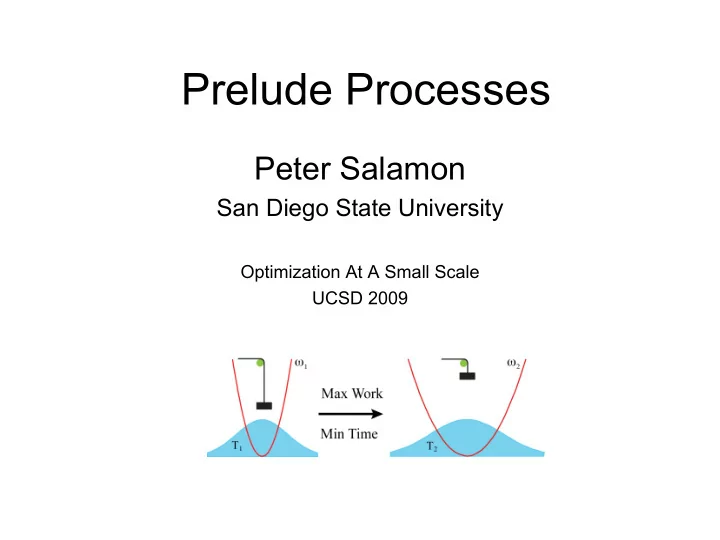
SLIDE 1 Prelude Processes
Peter Salamon
San Diego State University
Optimization At A Small Scale UCSD 2009
SLIDE 2 Questions of Finite Time Thermodynamics
- What is the maximum power that can be delivered by
a heat engine in finite time?
- Given Ainit, Afinal, and τ , what is the minimum entropy
that must be produced in changing the state of system A from Ainit to Afinal in time τ ?
- Given Ainit and Afinal, what is the minimum time for
changing the state of system A from Ainit to Afinal?
- How fast can we approach T=0?
∆ Su > L2/2n
SLIDE 3 "The Quantum Refrigerator: The quest for absolute zero",
- Y. Rezek, P. Salamon, K.H. Hoffmann, and R. Kosloff,
Europhysics Letters, 85, 30008 (2009) "Maximum Work in Minimum Time from a Conservative Quantum System", P.Salamon, K.H. Hoffmann, Y. Rezek, and R. Kosloff,
- Phys. Chem. Chem. Phys., 11, 1027-1032 (2009)
QuickTime and a decompressor are needed to see this picture.
SLIDE 4
Definition
A prelude process is a reversible process performed as a prelude to a thermal process.
SLIDE 5
Ensemble of Independent Harmonic Oscillators Sharing a Controlled Frequency ω
Cool atoms in an optical lattice. Lattice created by lasers and having an easily controlled ω .
SLIDE 6 The Heat Engine
- Contact with T=TH at ω = ω 1.
- Adiabatic change from ω = ω 1 to ω = ω 2.
- Contact with T=TC at ω = ω 2.
- Adiabatic change from ω = ω 2 to ω = ω 1.
Controls: It’s all in the timing. Time for thermal contacts and rate at which ω changes on adiabats. ω T Rate Limiting Step
SLIDE 7 Finite-time Third Law
The second law limits the rate of cooling
For a cycle operating between Tc and Th and exchanging heat, the net entropy production rate is For bounded this rearranges to give
SLIDE 8
The working fluid: Quantum Harmonic Oscillator
Hamiltonian Lagrangian
C is needed to close the Lie algebra
Correlation
SLIDE 9
Heisenberg Representation
adiabats thermal contacts with Lindblad operator
SLIDE 10 Dynamics on Adiabats
Sudden adiabats not optimal due to quantum friction.
SLIDE 11
Fixed omega dynamics
SLIDE 12 Dynamics for Heat Exchange
where
Heat bath = coherence decay
SLIDE 13
Quantum Entropy
where P=diag(ρ E) and ρ E is the density matrix in an energy basis. The Von Neumann entropy is conserved. Effective entropy in contact with the heat bath is the energy entropy
SLIDE 14
Quantum Friction
Problem: Changing ω at a finite rate or jumping from creates “extra” entropy by increasing SE. During a heat exchange, the energy in the LC oscillation becomes heat. This is Feldmann & Kosloff’s quantum friction. ω
SLIDE 15
Adiabatic Switching
Sets energy minimum Thermal equilibrium at L=C=0
If we change ω infinitely slowly, we can keep SVN constant.
SLIDE 16
Optimal Control
Easier and more powerful calculus of variations. The Problem: The Tool: The Optimality Conditions:
SLIDE 17
Optimal Adiabats
Problem: How to choose ω(t)? augment with Optimal control Hamiltonian Linear in u!!!
SLIDE 18
Singular Control Problems
σ = switching function σ > 0; u=uMax σ < 0; u=uMin σ ≡ 0; u=? This structure usually leads to turnpike theorems.
Theorem: Optimal control of the harmonic oscillator is bang-bang. Singular branches are never used.
SLIDE 19 Best Adiabat
ω f ω i ω t1 t2 t3 Total time on the order
SLIDE 20 The Magic
- Fast(est) adiabatic switching.
- Can only extract the full maximum work
available from the change if time > min time else must create parasitic oscillations.
- - New type of finite-time Availability
- Time limiting branch in a heat cycle to cool
system toward T=0.
– Implies
SLIDE 21