Predicting Performance and Cost of Serverless Computing Functions - - PDF document

predicting performance and cost of serverless computing
SMART_READER_LITE
LIVE PREVIEW

Predicting Performance and Cost of Serverless Computing Functions - - PDF document

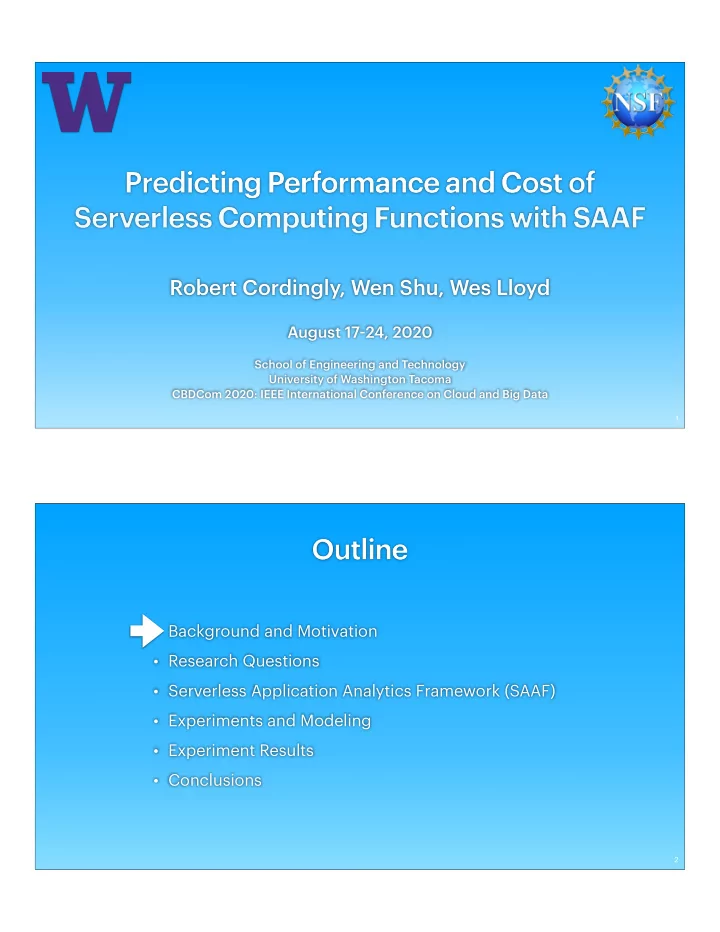
Predicting Performance and Cost of Serverless Computing Functions with SAAF Robert Cordingly, Wen Shu, Wes Lloyd August 17 - 24, 2020 School of Engineering and Technology University of Washington Tacoma CBDCom 2020: IEEE International


slide-1
SLIDE 1

Predicting Performance and Cost of Serverless Computing Functions with SAAF

August 17-24, 2020

School of Engineering and Technology University of Washington Tacoma CBDCom 2020: IEEE International Conference on Cloud and Big Data

Robert Cordingly, Wen Shu, Wes Lloyd

1

Outline

  • Background and Motivation
  • Research Questions
  • Serverless Application Analytics Framework (SAAF)
  • Experiments and Modeling
  • Experiment Results
  • Conclusions

2

slide-2
SLIDE 2

3

Serverless: Function-as-a-Service

  • Developers deploy small applications called

micro-services

  • Cloud providers automatically scale and manage

cloud infrastructure instead of developers

  • Can scale from zero users to thousands instantly
  • Guarantee high availability and fault tolerance

4

slide-3
SLIDE 3

The cost of FaaS vs VMs

The cost of VMs:

  • (Number of VMs) x (Uptime) x (Price)
  • Billed for entire VM uptime even when idle.

λ

The cost of FaaS:

  • (Function Runtime) x (Memory Setting) x (Price)
  • Billed only for runtime used.

5

Performance Variation in FaaS

  • Many factors can

contribute to variation in FaaS performance.

λ

  • (Application Runtime) x (Memory Setting) x (Price)

6

slide-4
SLIDE 4

Outline

  • Background and Motivation
  • Research Questions
  • Serverless Application Analytics Framework (SAAF)
  • Experiments and Modeling
  • Experiment Results
  • Conclusions

7

Research Questions

RQ-1: (Performance Variance) What factors are responsible for performance variation on FaaS platforms? RQ-2: (FaaS Runtime Prediction) When leveraging Linux CPU time accounting principles and regression modeling, what is the accuracy

  • f FaaS function runtime predictions for deployments to different

memory settings or CPUs? RQ-3: (Assessing Workload Predictability) How effective are system metrics at evaluating reliability of performance predictions?

8

slide-5
SLIDE 5

Outline

  • Background and Motivation
  • Research Questions
  • Serverless Application Analytics Framework (SAAF)
  • Experiments and Modeling
  • Experiment Results
  • Conclusions

9

Serverless Application Analytics Framework

(SAAF)

10

slide-6
SLIDE 6

FaaS Runner and Hardware Distribution

Cloud Intel Xeon CPU VM % AWS E5-2680v2 @ 2.8 GHz, 10 core c3 67.5 AWS E5-2676v3 @ 2.4 GHz, 12 core m4 19.9 AWS E5-2686v4 @ 2.3 GHz, 18 core r4 12.5 IBM E5-2683v3 @ 2.0 GHz, 14 core n/a 18.4 IBM E5-2683v4 @ 2.1 GHz, 16 core b1 66.1 IBM E5-2650v4 @ 2.2 GHz, 12 core u1 3.8 IBM E5-2690v4 @ 2.6 GHz, 14 core c1 7.2 IBM Gold 6140 @ 2.3 GHz, 18 core n/a 4.5

11

AWS CPUs IBM CPUs

Outline

  • Background and Motivation
  • Research Questions
  • Serverless Application Analytics Framework (SAAF)
  • Experiments and Modeling
  • Experiment Results
  • Conclusions

12

slide-7
SLIDE 7

Calcs Service Workloads

Name Definition NMT1 Fixed # of Calcs, No Memory Stress, 1 Thread, concurrent calls MT1 Fixed # of Calcs, Memory Stress, 1 Thread, concurrent calls NMT2-seq Fixed # of Calcs, No Memory stress, 2 Threads, Sequential calls NMT2 Fixed # of Calcs, No Memory Stress, 2 Threads, concurrent calls MT2 Fixed # of Calcs, Memory Stress, 2 Threads, concurrent calls SCNMT1 Scaling Calcs, No Memory Stress, 1 Thread, concurrent calls SCMT1 Scaling Calcs, Memory Stress, 1 Thread, concurrent calls SCNMT2 Scaling Calcs, No Memory Stress, 2 Threads, concurrent calls SCMT2 Scaling Calcs, Memory Stress, 2 Threads, concurrent calls SCSMT2 Scaling Calcs, Scaling Memory Stress, 2 Threads, concurr. calls Name Calculations Memory Stress Threads Tenancy NMT1 40 million No 1 n MT1 40 million array=1 million 1 n NMT2-seq 40 million No 2 1 NMT2 40 million No 2 n MT2 40 million array=1 million 2 n SCNMT1 30-60m step 3m No 1 n SCMT1 30-60m step 3m array=1 million 1 n SCNMT2 30-60m step 3m No 2 n SCMT2 30-60m step 3m array=1 million 2 n SCSMT2 30-60m step 3m 1-1m, step 100k 2 n

a × b ÷ c

13

  • Calc Service on GitHub: github.com/wlloyduw/CalcsService

Variation Caused By Multitenancy

14

slide-8
SLIDE 8

FaaS Pricing and Performance Obfuscation

AWS vs IBM

15

IBM Cloud Functions

  • Price (USD):

Runtime (s) x Memory (GBs) x $0.000017

  • Does not scale performance with memory setting.
  • Tenancy has a massive impact on performance.
  • For infrequently invoked functions, the minimum

memory setting is always the best choice.

AWS Lambda

  • Price (USD):

Runtime (s) x Memory (GBs) x $0.0000166667

  • Scales performance with memory setting.
  • Tenancy has a small impact on performance.
  • For our workloads, a mid range memory setting

512-1024 MBs provides the best price to performance ratio. (cpuUsr + cpuKrn + cpuIdle + cpuIOWait + cpuIntSrvc + cpuSftIntSrvc) (# of cores) Runtime =

16

slide-9
SLIDE 9

Making Predictions Across More Configurations

CPU:

256 MBs a1 → a2 256 MBs a1 → a3 256 MBs a2 → a3 512 MBs a1 → a2 512 MBs a1 → a3 512 MBs a2 → a3 1024 MBs a1 → a2 1024 MBs a1 → a3 1024 MBs a2 → a3 2048 MBs a1 → a2 2048 MBs a1 → a3 2048 MBs a2 → a3

Memory:

a1 256MBs → 512MBs a1 256MBs → 1024MBs a1 256MBs → 2048MBs a2 256MBs → 512MBs a2 256MBs → 1024MBs a2 256MBs → 2048MBs a3 256MBs → 512MBs a3 256MBs → 1024MBs a3 256MBs → 2048MBs

Platform:

256MBs a1 → i1 1024MBs a1 → i1 256MBs a1 → i2 1024MBs a1 → i2 256MBs a1 → i3 1024MBs a1 → i3 256MBs a1 → i4 1024MBs a1 → i4 512MBs a1 → i1 2048MBs a1 → i1 512MBs a1 → i2 2048MBs a1 → i2 512MBs a1 → i3 2048MBs a1 → i3 512MBs a1 → i4 2048MBs a1 → i4

CPU Aliases:

a1: Amazon Intel Xeon E5-2680v2 a2: Amazon Intel Xeon E5-2676v3 a3: Amazon Intel Xeon E5-2686v4 i1: IBM Intel Xeon E5-2683v3 i2: IBM Intel Xeon E5-2683v4 i3: IBM Intel Xeon E5-2650v4 i4: IBM Intel Xeon E5-2690v4

Repeat for SCNMT2, SCMT2, and SCSMT2 Workloads

17

Outline

  • Background and Motivation
  • Research Questions
  • Serverless Application Analytics Framework (SAAF)
  • Experiments and Modeling
  • Experiment Results
  • Conclusions

18

slide-10
SLIDE 10

Workloads for Predictions

Name Definition NMT1 Fixed # of Calcs, No Memory Stress, 1 Thread, concurrent calls MT1 Fixed # of Calcs, Memory Stress, 1 Thread, concurrent calls NMT2-seq Fixed # of Calcs, No Memory stress, 2 Threads, Sequential calls NMT2 Fixed # of Calcs, No Memory Stress, 2 Threads, concurrent calls MT2 Fixed # of Calcs, Memory Stress, 2 Threads, concurrent calls SCNMT1 Scaling Calcs, No Memory Stress, 1 Thread, concurrent calls SCMT1 Scaling Calcs, Memory Stress, 1 Thread, concurrent calls SCNMT2 Scaling Calcs, No Memory Stress, 2 Threads, concurrent calls SCMT2 Scaling Calcs, Memory Stress, 2 Threads, concurrent calls SCSMT2 Scaling Calcs, Scaling Memory Stress, 2 Threads, concurr. calls Name Calculations Memory Stress Threads Tenancy NMT1 40 million No 1 n MT1 40 million array=1 million 1 n NMT2-seq 40 million No 2 1 NMT2 40 million No 2 n MT2 40 million array=1 million 2 n SCNMT1 30-60m step 3m No 1 n SCMT1 30-60m step 3m array=1 million 1 n SCNMT2 30-60m step 3m No 2 n SCMT2 30-60m step 3m array=1 million 2 n SCSMT2 30-60m step 3m 1-1m, step 100k 2 n

a × b ÷ c

19 20

slide-11
SLIDE 11

21 22

slide-12
SLIDE 12

23 24

slide-13
SLIDE 13

Outline

  • Background and Motivation
  • Research Questions
  • Serverless Application Analytics Framework (SAAF)
  • Experiments and Modeling
  • Experiment Results
  • Conclusions

25

Conclusions - RQ-1

RQ-1: (Performance Variance) What factors are responsible for performance variance on FaaS platforms?

26

CPU Heterogeneity ~7.4x Multi-tenancy ~2.7x

slide-14
SLIDE 14

Conclusions - RQ-2

RQ-2: (FaaS Runtime Prediction) When leveraging Linux CPU time accounting principles and regression modeling, what is the accuracy

  • f FaaS function runtime predictions for deployments

with different memory settings or CPUs?

27

Workload 
 Prediction Type Number of Models Workload
 CV MAPE Average Cost Error Average Workload Cost SCNMT2 – CPU 12 21% 0.51% $0.36 $70.27 SCMT2 – CPU 12 23% 2.52% $5.15 $204.23 SCSMT2 – CPU 12 32% 5.10% $8.86 $173.64 SCNMT2 – Memory 9 20% 0.59% $0.45 $76.30 SCMT2 – Memory 9 22% 3.83% $9.07 $236.88 SCSMT2 – Memory 9 36% 10.5% $19.99 $190.80 SCNMT2 - IBM 14 18% 3.55% $4.24 $119.38 Overall Average 77 (sum)

  • 3.49%

$6.46 $150.45

Conclusions - RQ-3

RQ-3: (Assessing Workload Predictability) How effective are system metrics at evaluating reliability of performance predictions?

28

cpuSteal freeMemory

slide-15
SLIDE 15

Thank You for Watching

This research is supported by NSF Advanced Cyberinfrastructure Research Program (OAC-1849970), NIH grant R01GM126019, and the AWS Cloud Credits for Research program.

29

Questions or comments? Please email: rcording@uw.edu or wlloyd@uw.edu Download SAAF and FaaS Runner github.com/wlloyduw/saaf