SLIDE 1
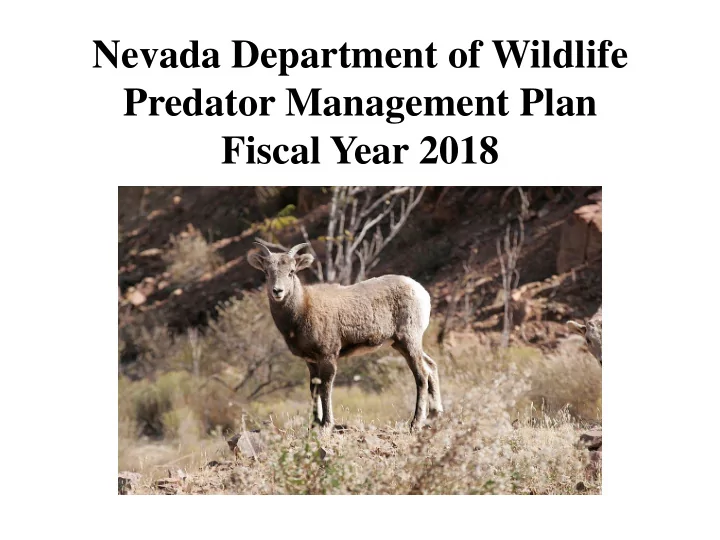
Nevada Department of Wildlife Predator Management Plan Fiscal Year 2018
SLIDE 2 Summary on Plans and Reports
- Just reported on FY 2016
- Currently in FY 2017
- About to present on FY 2018
- All available at www.ndow.org
- Scheduled to present plan to PARC on Feb 15
- Department faces challenges with AB 78
SLIDE 3 NRS 502.253 (predator fee)
- ~$550,000 generated annually
- $14,000 admin support Dept of Agriculture
- Predator plan projects
- Staff salary
- Reserve remains available for future years
SLIDE 4 Changes in uses of NRS 502.253
- 1. Management of predatory wildlife
- 2. Research on lethal control
techniques of predatory wildlife
- 3. Protection of sensitive species
SLIDE 5 AB 78
- Mandates that 80% of revenues from most
recent fiscal year from which we have complete accounting to be spent on lethal removal
- Includes monitoring of effects from lethal
removal efforts
SLIDE 6 Current Challenges
- Nevada USDA Wildlife Services settlement
agreement with WildEarth Guardians
- No fixed wing aircraft support since December
- Nevada WS shares a helicopter with Utah WS
- Coordinating lion removal on test range
SLIDE 7 Budget Summary
- $595,107 revenues from FY 2016 (last year with
complete accounting, still receiving revenue in FY 2017)
- $595,107 x 0.8 = $476,085.60 (80% mandate)
- $719,000 allocated to lethal removal in FY 2018 plan
SLIDE 8
Project Recommended for Continuation
SLIDE 9
Project 21: Greater Sage-Grouse Protection (Raven Removal)
Project Type: Implementation and Experimental Management
SLIDE 10 Project 21: Greater Sage-Grouse Protection (Common Raven Removal)
- Protect Greater Sage-grouse populations
- Lethally remove common ravens
SLIDE 11 Project 21: Greater Sage-Grouse Protection (Common Raven Removal)
Budget:$100,000
- Wildlife Services administers corvicide (DCR-
1339)
- 11 eggs gone=1 removed common raven
- Surveys to determine common raven densities
across Nevada
SLIDE 12 Monitoring
Response Variable
- Point counts before, during,
and after to determine changes in raven densities Level of Monitoring
SLIDE 13
Project 21-02: Common Raven Removal to Enhance Greater Sage- Grouse Nest Success Project Type: Implementation and Experimental
Management
SLIDE 14 Project 21-02: Common Raven Removal and Greater Sage-Grouse Nest Success
Budget: $25,000
- Document effect of raven removal
- Wildlife Services conducts avicide application
- USGS has conducted telemetry, camera, and
lek surveys
SLIDE 15 Monitoring
Response Variable
- Sage grouse nest success
- Brood survival
Level of Monitoring
- Intermediate (funding not
from predator fee)
SLIDE 16
Project 22-01: Mountain Lion Removal to Protect California Bighorn Sheep Project Type: Implementation
SLIDE 17 Project 22-01: Mountain Lion Removal to Protect California Bighorn Sheep
Budget: $90,000
- Establish self-sustaining population of bighorn
sheep, subset of population is currently collared
- Wildlife Services and private contractors are
proactively removing lions entering area
- Wildlife Services or others may respond
reactively with dogs after a sheep mortality
SLIDE 18 Monitoring
Response Variable
- Number of collared bighorn
sheep killed by mountain lions Level of Monitoring
- Standard to intermediate*
SLIDE 19 Population Dynamics
- Populations estimated at 40-50 individuals in
both 011 and 013
Action Bighorn Sheep Population Monitor bighorn population, conduct removal on case by case basis > 80 Remove lions that consume bighorn sheep* 60 - 80 Remove all lions in area < 60
SLIDE 20
Project 22-074: Mountain Lion Removal for the Protection of Rocky Mountain Bighorn Sheep
Project Type: Implementation and Experimental Management
SLIDE 21 Project 22-074: Monitor Rocky Mountain Bighorn Sheep for Mountain Lion Predation
Budget: $90,000
- Establish self-sustaining population of bighorn
sheep
- Monitor bighorn sheep populations with GPS
collars
- Remove mountain lions consuming bighorn sheep
SLIDE 22 Monitoring
Response Variable
- Number of collared bighorn
sheep killed by mountain lions Level of Monitoring
- Standard to intermediate*
SLIDE 23 Population Dynamics
- The population estimate is approximately 15
individuals in area 074
Action Bighorn Sheep Population Monitor bighorn population, conduct removal on case by case basis > 15 Remove lions that consume bighorn sheep* 10 - 15 Remove all lions in area < 10
SLIDE 24
Project 32: Mountain Lion, Black Bear, and Mule Deer Interactions
Project Type: Experimentation
SLIDE 25 Project 32: Mountain Lion, Black Bear, and Mule Deer Interactions
- Increase understanding of black bear and
mountain lion interactions
- Determine if mountain lions kill more deer in
areas occupied by black bears
- Determine if mountain lion conflicts increase
where black bears are present
SLIDE 26 Lackey et al. 2012
SLIDE 27 Project 32: Mountain Lion, Black Bear, and Mule Deer Interactions
Budget: $160,000 (40k from $3 predator fee)
- Mark 18 black bears, 18 mountain lions, and
60 mule deer with GPS collars
- Monitor kill sites of mountain lions, determine
if bears take over kill sites
- Monitor movements of mountain lions, black
bears, and mule deer in close proximity
SLIDE 28 Monitoring
Response Variable
experimental project Level of Monitoring
SLIDE 29
Project 37: Big Game Protection- Mountain Lions
Project Type: Implementation
SLIDE 30 Predator Removal Indices
Species Annual Adult Survival Rates Fall Young: Female Ratios Spring Young: Female Ratios Adult Female Annual Survival Rates California Bighorn Sheep < 90% < 40:100
Sheep < 90% < 40:100
< 90% < 30:100
< 80% Pronghorn < 90% < 40:100
SLIDE 31 Project 37: Big Game Protection- Mountain Lions
Budget: $125,000
- Addressing mountain lion predation that has a
negative influence on game populations
- Work will be conducted by Wildlife Services,
private houndsmen, and/or private trappers
- Problematic mountain lions will be identified
through GPS collar locations, trail cameras, and kill sites
SLIDE 32 Monitoring
Response Variable
- Reduction of mountain lion
induced mortalities
- Reduction of mountain lion
densities or sign
- Removal of known
- ffending individual
- Response variable may not
be collected Level of Monitoring
SLIDE 33
Project 38: Big Game Protection- Coyotes
Project Type: Implementation
SLIDE 34 Project 38: Big Game Protection- Coyotes
Budget: $125,000
- Addressing coyote predation that has a negative
influence on game populations
- Removal of coyotes in winter range and fawning
areas in certain situations
- Work will be conducted by Wildlife Services and
private contractors
SLIDE 35 Monitoring
Response Variable
inducted mortalities
individuals
- Reduction in coyote sign
- Response variable may not
be collected Level of Monitoring
SLIDE 36
Project 40: Coyote Removal to Complement Multi-faceted Management in Eureka County
Project Type: Implementation
SLIDE 37 Project 40: Coyote Removal to Complement Multi-faceted Management in Eureka County
Budget: $100,000
- Coyote removal will complement previously
conducted feral horse removal, habitat improvement, and past predator removal efforts
SLIDE 38 Monitoring
Response Variable
- Fawn to doe ratios in the
Diamonds and/or in Unit 144 Level of Monitoring
SLIDE 39
Project 41: Common Raven Management and Experimentation
Project Type: Experimentation
SLIDE 40 Project 41: Common Raven Management and Experimentation
Budget: $400,000 (100k from $3 predator fee)
- Develop a protocol to estimate common raven
populations
- Increase the understanding of common raven
density and distribution
- Increase the understanding of how human
subsidies affect common raven movements and space use
SLIDE 41 Monitoring
Response Variable
experimental project Level of Monitoring
SLIDE 42
Project 42: Assessing Mountain Lion Harvest in Nevada
Project Type: Experimentation
SLIDE 43 Project 42: Assessing Mountain Lion Harvest in Nevada
Budget: $10,000 (2,500k from $3 predator fee)
- Develop a model that predicts the number of
lions that may be removed
- Identify gaps in data
- Determine what data is necessary to increase
NDOWs understanding of mountain lions statewide
SLIDE 44 Monitoring
Response Variable
experimental project Level of Monitoring
SLIDE 45
Project 43: Mesopredator removal to protect waterfowl, turkeys, and pheasants on Wildlife Management Areas
Project Type: Implementation
SLIDE 46 Project 43: Mesopredator Removal to Protect Waterfowl, Turkeys, and Pheasants on Wildlife Management Areas
Budget: $50,000
- To occur on Overton and Mason Valley WMAs
- Coyotes, striped skunks, and raccoons will be
lethally removed
SLIDE 47 Monitoring
Response Variable
clutches
- Number of young per clutch
Level of Monitoring
SLIDE 48
Questions?