
SLIDE 1
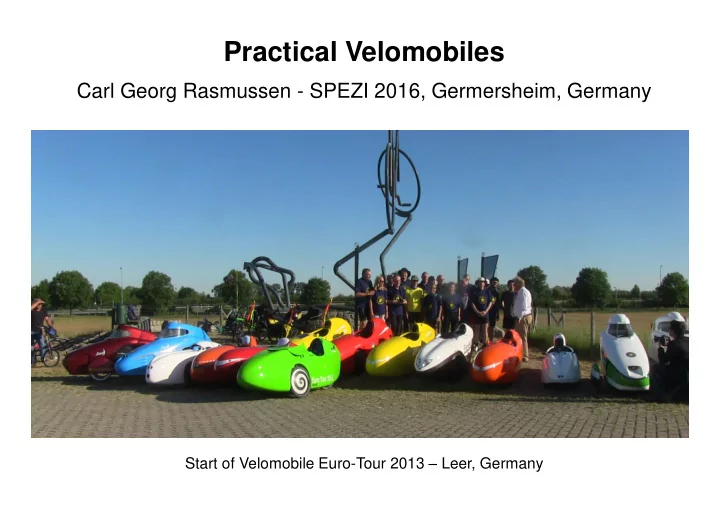
Practical Velomobiles
Carl Georg Rasmussen - SPEZI 2016, Germersheim, Germany
Start of Velomobile Euro-Tour 2013 – Leer, Germany
Practical Velomobiles Carl Georg Rasmussen - SPEZI 2016, - - PowerPoint PPT Presentation
Practical Velomobiles Carl Georg Rasmussen - SPEZI 2016, Germersheim, Germany Start of Velomobile Euro-Tour 2013 Leer, Germany 2000-2015 The diversified and expanding market About the turn of the millennium the development of commercial
Carl Georg Rasmussen - SPEZI 2016, Germersheim, Germany
Start of Velomobile Euro-Tour 2013 – Leer, Germany
2000-2015 The diversified and expanding market
About the turn of the millennium the development of commercial velomobiles gained momentum, first of all thanks to groups of very dedicated and determined bicycle designers in the Netherlands and Germany. Speed became the ultimate design goal and competition parameter, resulting in very low, aerodynamic monocoque models with minimum cross section. Consequently, lower priority was given to manoeuvrability, visibility, luggage capacity and easy access to get in and
necessary to keep some characteristics
generation of vehicles for commuting and long distance traveling. Mango Velomobiel.nl Strada Velomobiel.nl Quest Velomobiel.nl Orca from Flevobike
In the first 10 years of this millennium, two new German companies joined the velomobile market, both located in the Hannover area. The Leiba belongs to the category of practical velomobile, with room for luggage and easy access, while the Milan, from Räderwerk, is an extremely low high speed racer, based on Eggert Bülk’s many years
More German professionals
Leiba Leiba X-Stream XXL Milan
New generations: Go-One and Cab-Bike The original ”Bubble” Go-One has been followed by new models, with higher speed as primary design goal. The Cab-Bike was adopted by the American company Blue
The Cab-Bike became popular in the USA. Below is Mary Arneson and Dale Hammerschmidt in Minneapolis, Minnesota in 2003.
Prototypes
fitted with optional child seat
DIY design
The last 5 years has been a period with high activity by homebuilders and DIY (Do-It-Yourself) designers. The velomobile is now a very popular design object in schools, clubs, or for individual inventors and
materials have been taken into use in order to make a practical velomobile more affordable, lighter, easier to maintain and suitable for a specific purpose. Individual styling creates identity, and that is part of the fun by the design
crowded by DIY-projects and open source design, CAD-designs and even programs for 3-D printing. MEUFL, design with PE-foam by Harald Winkler. Dutch Plywood. Danish nylon fabric. The French Mosquito. Super light designs:
Industrial production method
Little correlation between height and leg length
1. 2. 3. 4. 5. 6.
Votes cast: 49 (from audience at SPEZI 2016, so already interested in recumbents / velomobiles)
14% 47% 2% 12% 18% 6%
Audience preference (%, rounded to nearest whole number)
1. 2. 3. 4. 5. <50 cm 50-65 cm 65-80 cm 80-100 cm >100 cm
16% 20% 31% 16% 16%
Votes cast: 49 (from audience at SPEZI 2016, so already interested in recumbents / velomobiles)
Audience preference (%, rounded to nearest whole number)
1. 2. 3. 4. 5. <4 m 4-5 m 5-7 m 7-10 m >10 m
25% 21% 19% 17% 19%
Votes cast: 48 (from audience at SPEZI 2016, so already interested in recumbents / velomobiles)
Audience preference (%, rounded to nearest whole number)
Votes cast: 49 (from audience at SPEZI 2016, so already interested in recumbents / velomobiles)
Audience preference (%, rounded to nearest whole number)
10% 27% 47% 6% 10%
1. 2. 3. 4. 5. 60-70 cm 70-80 cm 80-90 cm 90-100 cm >100 cm
13% 41% 22% 22% 2%
Votes cast: 46 (from audience at SPEZI 2016, so already interested in recumbents / velomobiles)
Audience preference (%, rounded to nearest whole number)
1. 2. 3. 4. 5. <4,000 € 4,000-6,000 € 6,000-8,000 € 8,000-10,000 € >10,000 €
10% 44% 38% 4% 4%
Votes cast: 48 (from audience at SPEZI 2016, so already interested in recumbents / velomobiles)
Audience preference (%, rounded to nearest whole number)