
Practical aspects of prediction in multistate models
Bendix Carstensen
Steno Diabetes Center, Gentofte, Denmark
& Department of Biostatistics, University of Copenhagen
bxc@steno.dk http://BendixCarstensen.com FRIAS, Freiburg Germany, 21–23 September 2016 http://BendixCarstensen/AdvCoh/Frias-2016
1/ 26
ARTICLE
Years of life gained by multifactorial intervention in patients with type 2 diabetes mellitus and microalbuminuria: 21 years follow-up on the Steno-2 randomised trial
Peter Gæde1,2 & Jens Oellgaard1,2,3 & Bendix Carstensen3 & Peter Rossing3,4,5 & Henrik Lund-Andersen3,5,6 & Hans-Henrik Parving5,7 & Oluf Pedersen8
Received: 7 April 2016 /Accepted: 1 July 2016 # The Author(s) 2016. This article is published with open access at Springerlink.com
Abstract Aims/hypothesis The aim of this work was to study the poten- tial long-term impact of a 7.8 years intensified, multifactorial pharmacological approaches. After 7.8 years the study contin- ued as an observational follow-up with all patients receiving treatment as for the original intensive-therapy group. The pri-
Diabetologia DOI 10.1007/s00125-016-4065-6
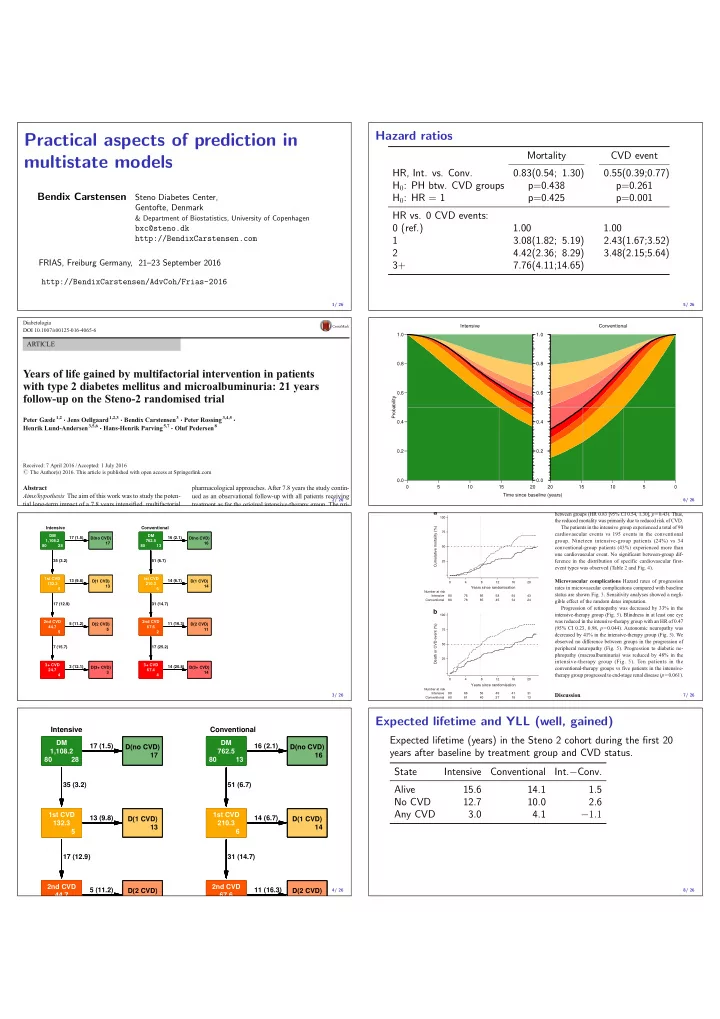
2/ 26 DM 1,108.2 80 28 1st CVD 132.3 5 2nd CVD 44.7 5 3+ CVD 24.7 4 D(no CVD) 17 D(1 CVD) 13 D(2 CVD) 5 D(3+ CVD) 3 35 (3.2) 17 (1.5) 17 (12.9) 13 (9.8) 7 (15.7) 5 (11.2) 3 (12.1) DM 1,108.2 80 28 1st CVD 132.3 5 2nd CVD 44.7 5 3+ CVD 24.7 4 D(no CVD) 17 D(1 CVD) 13 D(2 CVD) 5 D(3+ CVD) 3 DM 1,108.2 80 28 1st CVD 132.3 5 2nd CVD 44.7 5 3+ CVD 24.7 4 D(no CVD) 17 D(1 CVD) 13 D(2 CVD) 5 D(3+ CVD) 3 Intensive DM 762.5 80 13 1st CVD 210.3 6 2nd CVD 67.6 2 3+ CVD 67.4 4 D(no CVD) 16 D(1 CVD) 14 D(2 CVD) 11 D(3+ CVD) 14 51 (6.7) 16 (2.1) 31 (14.7) 14 (6.7) 17 (25.2) 11 (16.3) 14 (20.8) DM 762.5 80 13 1st CVD 210.3 6 2nd CVD 67.6 2 3+ CVD 67.4 4 D(no CVD) 16 D(1 CVD) 14 D(2 CVD) 11 D(3+ CVD) 14 DM 762.5 80 13 1st CVD 210.3 6 2nd CVD 67.6 2 3+ CVD 67.4 4 D(no CVD) 16 D(1 CVD) 14 D(2 CVD) 11 D(3+ CVD) 14 Conventional 3/ 26
DM 1,108.2 80 28 1st CVD 132.3 5 2nd CVD 44.7 D(no CVD) 17 D(1 CVD) 13 D(2 CVD) 5 35 (3.2) 17 (1.5) 17 (12.9) 13 (9.8) 5 (11.2) DM 1,108.2 80 28 1st CVD 132.3 5 2nd CVD 44.7 D(no CVD) 17 D(1 CVD) 13 D(2 CVD) 5 DM 1,108.2 80 28 1st CVD 132.3 5 2nd CVD 44.7 D(no CVD) 17 D(1 CVD) 13 D(2 CVD) 5 Intensive DM 762.5 80 13 1st CVD 210.3 6 2nd CVD 67.6 D(no CVD) 16 D(1 CVD) 14 D(2 CVD) 11 51 (6.7) 16 (2.1) 31 (14.7) 14 (6.7) 11 (16.3) DM 762.5 80 13 1st CVD 210.3 6 2nd CVD 67.6 D(no CVD) 16 D(1 CVD) 14 D(2 CVD) 11 DM 762.5 80 13 1st CVD 210.3 6 2nd CVD 67.6 D(no CVD) 16 D(1 CVD) 14 D(2 CVD) 11 Conventional
4/ 26
Hazard ratios
Mortality CVD event HR, Int. vs. Conv. 0.83(0.54; 1.30) 0.55(0.39;0.77) H0: PH btw. CVD groups p=0.438 p=0.261 H0: HR = 1 p=0.425 p=0.001 HR vs. 0 CVD events: 0 (ref.) 1.00 1.00 1 3.08(1.82; 5.19) 2.43(1.67;3.52) 2 4.42(2.36; 8.29) 3.48(2.15;5.64) 3+ 7.76(4.11;14.65)
5/ 26 5 10 15 20 0.0 0.2 0.4 0.6 0.8 1.0 Probability 0.0 0.2 0.4 0.6 0.8 1.0 Intensive 20 15 10 5 Conventional Time since baseline (years) 6/ 26
between groups (HR 0.83 [95% CI 0.54, 1.30], p=0.43). Thus, the reduced mortality was primarily due to reduced risk of CVD. The patients in the intensive group experienced a total of 90 cardiovascular events vs 195 events in the conventional
- group. Nineteen intensive-group patients (24%) vs 34
conventional-group patients (43%) experienced more than
- ne cardiovascular event. No significant between-group dif-
ference in the distribution of specific cardiovascular first- event types was observed (Table 2 and Fig. 4). Microvascular complications Hazard rates of progression rates in microvascular complications compared with baseline status are shown Fig. 3. Sensitivity analyses showed a negli- gible effect of the random dates imputation. Progression of retinopathy was decreased by 33% in the intensive-therapy group (Fig. 5). Blindness in at least one eye was reduced in the intensive-therapy group with an HR of 0.47 (95% CI 0.23, 0.98, p=0.044). Autonomic neuropathy was decreased by 41% in the intensive-therapy group (Fig. 5). We
- bserved no difference between groups in the progression of
peripheral neuropathy (Fig. 5). Progression to diabetic ne- phropathy (macroalbuminuria) was reduced by 48% in the intensive-therapy group (Fig. 5). Ten patients in the conventional-therapy groups vs five patients in the intensive- therapy group progressed to end-stage renal disease (p=0.061). Discussion
a
25 50 75 100 Cumulative mortality (%) 80 78 65 45 34 24 Conventional 80 76 66 58 54 43 Intensive Number at risk 4 8 12 16 20 Years since randomisation
b
25 50 75 100 Death or CVD event (%) 80 61 40 27 18 13 Conventional 80 66 56 49 41 31 Intensive Number at risk 4 8 12 16 20 Years since randomisation
7/ 26
Expected lifetime and YLL (well, gained)
Expected lifetime (years) in the Steno 2 cohort during the first 20 years after baseline by treatment group and CVD status. State Intensive Conventional Int.−Conv. Alive 15.6 14.1 1.5 No CVD 12.7 10.0 2.6 Any CVD 3.0 4.1 −1.1
8/ 26