Pr Prot otec ectio tion: n: Est Establishme blishment nt of - - PowerPoint PPT Presentation

pr prot otec ectio tion n
SMART_READER_LITE
LIVE PREVIEW

Pr Prot otec ectio tion: n: Est Establishme blishment nt of - - PowerPoint PPT Presentation

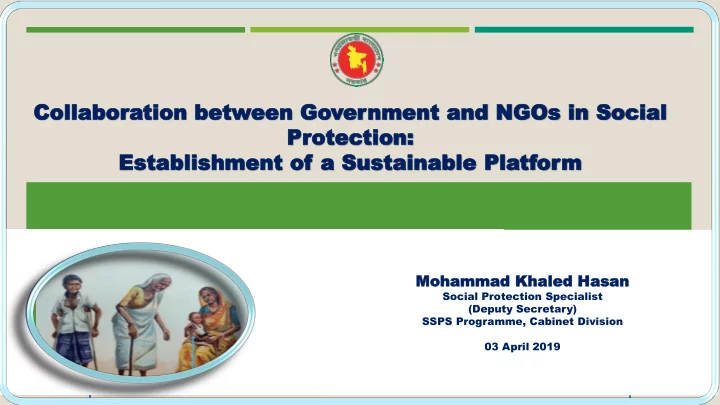
Colla Collabo boration tion be betw twee een n Go Gover ernme nment nt an and d NGOs NGOs in in Soc Social ial Pr Prot otec ectio tion: n: Est Establishme blishment nt of of a Sust a Sustaina ainable ble Pla Platf


slide-1
SLIDE 1

Colla Collabo boration tion be betw twee een n Go Gover ernme nment nt an and d NGOs NGOs in in Soc Social ial Pr Prot

  • tec

ectio tion: n: Est Establishme blishment nt of

  • f a Sust

a Sustaina ainable ble Pla Platf tfor

  • rm

Moha Mohammad mmad Khaled Khaled Hasa Hasan

Social Protection Specialist (Deputy Secretary) SSPS Programme, Cabinet Division 03 April 2019

slide-2
SLIDE 2

1970s

  • Poor

Relief 1980s

  • Disaster

response

  • Human

Dev 1990s

  • Cash

transfer 2000s

  • Social

Safety Nets

  • Ladder

2015

  • nward
  • Strategic

Planning

Evolution of Social Security in Bangladesh

A Paradigm Shift

slide-3
SLIDE 3

National Social Security Strategy (NSSS)

Build an inclusive Social Security System (SSS) for all deserving Bangladeshis that effectively tackles and prevents poverty and inequality and contributes to broader human development, employment and economic growth.

slide-4
SLIDE 4

Objectives of GO – NGO Collaboration

To provide a forum for coordination and collaboration between government and non-government

  • rganizations having activities in

social security programmes for implementing a lifecycle based inclusive social security system in Bangladesh as envisaged in NSSS; To enhance better governance in social protection service delivery system including identification of the genuine beneficiaries; To create a system of tracking the contribution of the NGOs in social protection programmes reflecting it in the total social protection spending in the country while reducing probable duplication and double dipping problems.

slide-5
SLIDE 5

Social Protection Spending

12% of GDP is spent in Developed world 6.8% of GDP is spent globally Bangladesh govt spends 2.53% of GDP in social protection

Charity and Jakats Assistance from relatives SP Programmes by NGOs

Informal social protection spending What is total social protection spending in Bangladesh?

slide-6
SLIDE 6

Non poor Near poor 46% Poor 21% Ultra poor 11% Food poor 4%

Social Protection Tk 66,000 Crore 5 Crore People

Inclusion and Exclusion Errors

More than 20% leakage and inclusion errors More than 36% exclusion errors

slide-7
SLIDE 7

Targeting Methods and NGO Roles

Categorical targeting Self- targeting Community- based targeting Household Assessments

Means Test (income and expenditure and the wealth

  • f a household
  • r individual is

considered) Proxy Means Test (PMT) (the economic conditions are assessed based

  • n statistical

estimate of the probability of a household being poor.)

NSSS recommends using PMT scores. PMT method has least errors, but it is still around 30% Community validation is taken for reducing errors NSSS suggests using LGI and NGOs for validation

slide-8
SLIDE 8

8

NSSS Reforms of Delivery System

Integrated MIS

Single Registry Programme MISs Fiscal MIS Government to Person (G2P) Cash Transfer Grievance Redress System (GRS) Result Based M&E

NGOs will have contribution and involvement in four major components

  • f social protection delivery

mechanism

slide-9
SLIDE 9

Collaboration in Delivery of Social Security Services/Benefits

Some of the government programmes are being contracted out the NGOs NSSS stipulates that the Government will continue, and where necessary, deepen the partnership with NGOs Collaboration will be deeper in delivery of benefits to the marginalized or vulnerable social group.

slide-10
SLIDE 10

Collaboration in GRS

The NSSS suggests for a GRS so that all citizens have recourse to appeal decisions on selection Mitigate grievances about instances of misconduct and failures in the delivery of the promised benefits. The Cabinet Division has been given the responsibility of managing a central GRS While the local government institutions have also been given some role for GRS implementation. In addition to that the NGOs and CSOs have been recommended to be involved in grievance mechanism and play vital role in stopping leakages

slide-11
SLIDE 11

Collaboration in Monitoring and Evaluation (M&E)

Emphasis on M&E is placed in order to ensure that best results are obtained from the resources spent on Social Security. It is, therefore, important that there are well-specified mechanisms for disseminating the findings of the M&E. All information needs to be readily available to stakeholders including Ministries/Divisions and NGOs involved

slide-12
SLIDE 12

12

Programme Reforms

Streamlining

  • f major

lifecycle programmes Consolidation

  • f smaller

programmes Reduce duplication

  • verlapping

Enhance efficiency

New Programmes Up-scalable Programmes Unchanged Programmes

slide-13
SLIDE 13

New Programmes

Child benefit scheme (0-4 yrs)

  • Unemployment, accident, sickness and maternity insurance under

NSIS National Social Insurance Scheme (NSIS) Private voluntary pension Formulation of policy for maintenance of abandoned children

slide-14
SLIDE 14

Up-Scalable Programmes

Primary and Secondary Stipend Immunization, child healthcare, nutrition, water and sanitation Strengthen education and training Strengthen workfare programmes Strengthen Vulnerable Women Benefit programme Childcare across formal and informal employment Old age allowance Strengthening programmes for people with disability

slide-15
SLIDE 15

Unchanged Programmes

Orphan’s programme School meals programme Maternal health care Training programme (for women) Government service pension

slide-16
SLIDE 16

Coordination Mechanism

Upazila Management Committees District Management Committee Divisional Management Committee Thematic Clusters (5) Central Management Committee under Cabinet Division

Where is the position of NGOs?

slide-17
SLIDE 17

Where in the Thematic Clusters to Fit NGOs

Central Management Committee (CMC) Social Allowance Food Security & Disaster Assistance Social Insurance Labour/ and Livelihood Intervention Human Development & Social Empowerment

slide-18
SLIDE 18

Utilizing P4D Project

Platforms for Dialogue (P4D) is a project of Cabinet Division, funded by the European Union and implemented through the British Council. The objective of the project is to enhance an enabling environment for the effective participation of the citizens and civil society in decision making process and accountability mechanism P4D works in 21 Districts with grassroots level CSO’s at this stage. It promotes the constructive engagement between citizens and civil society with local government at Union and Upazilla levels. P4D has already been an important forum for collaboration between GO and NGOs, though its scopes are far wider than the purpose of the proposed platform for GO and NGO collaboration in social protection. The SSPS Programme has a number of areas common with the P4D Project creating scopes for working together.

slide-19
SLIDE 19

Formation of Coordination Committee (Proposed)

Secretary (Coordination and Reforms), Cabinet Division Chair

Additional Secretary (Coordination), CD Member

Additional Secretary (Reforms), CD Member

Social Protection Focal Point (MOSW/LGD/MODMR/MOWCA/MOF/MOPME) Members

Joint Chief, GED and Project Manager, SSPS Programme Member

Representatives from NGOs (BRAC, MJF, ASA, CARE, PKSF, and similar Organizations which participated in the social security conference) Members

Deputy Secretary, GRS, Cabinet Division Member

Deputy Secretary, Social Protection, Cabinet Division, Member Secretary (Alternatively, an NGO Representative selected for two years by rotation may provide secretarial support. It may be discussed. If agreed the first NGO may be selected by consensus)

slide-20
SLIDE 20

Terms of Reference (ToR) (Proposed)

To identify major social protection programmes of the NGOs and Civil Society Organizations and examine the possibility of consolidation of the programmes in accordance with the lifecycle based programmes as envisaged in the NSSS; To create and maintain a repository of major social protection programmes of both Government and NGOs with information about objectives, target groups, budget size, thematic areas and geographic location for spotting overlapping of programmes and recommend for bringing similar programmes under wider umbrellas; To calculate the total amount of resources spent by the NGO/CSOs in social protection with a view to assessing its volume in terms of GDP; To explore scopes of social protection programmes of the government which can be contracted out or delegated to NGOs considering the inaccessibility of geographic location of beneficiaries or their being socially excluded; To find out modalities of involving the NGOs and local government institutes in the filed levels for beneficiary selection by validating or complementing the Proxy Means Data (PMT) which are under process of creation; To analyse and recommend how the NGOs can play roles in facilitating social protection related GRS to mitigate grievances of people and reduce exclusion errors and leakages; To explore possibilities of engaging the NGOs for M&E of the social protection programmes, particularly for impact evaluation; To find out modalities of cooperation between NGOs and Divisional, District and Upazila Management Committees on social protection; The committee would meet at least four times in a year and can co-opt any member if deemed necessary.

slide-21
SLIDE 21
slide-22
SLIDE 22