Post Traumatic Growth Tools for Spiritual Care Finding personal - - PDF document

post traumatic growth tools for spiritual care
SMART_READER_LITE
LIVE PREVIEW

Post Traumatic Growth Tools for Spiritual Care Finding personal - - PDF document

6/4/2020 Post Traumatic Growth Tools for Spiritual Care Finding personal strength, closer relationships, greater appreciation for life, new possibilities, and spiritual development after trauma. --presented by Beth Reece, MDiv, BCC


slide-1
SLIDE 1

6/4/2020 1

Post Traumatic Growth Tools for Spiritual Care

Finding personal strength, closer relationships, greater appreciation for life, new possibilities, and spiritual development after trauma.

  • -presented by

Beth Reece, MDiv, BCC Manager, Spiritual Care, Shirley Ryan AbilityLab

  • Dr. Therese Lysaught, Ph.D.

Professor, Loyola University, Chicago

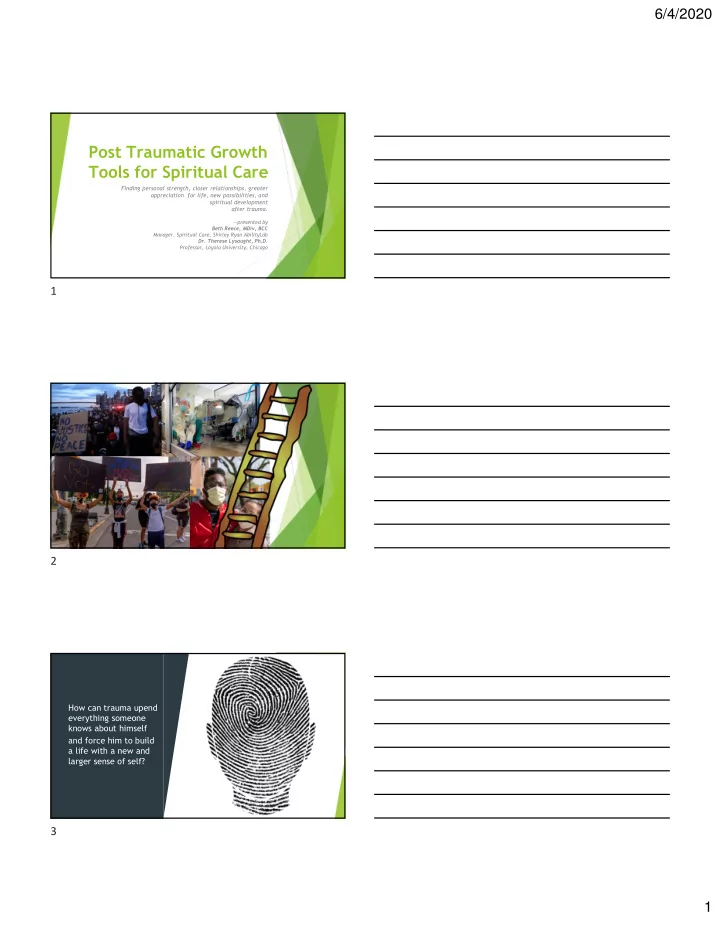
How can trauma upend everything someone knows about himself and force him to build a life with a new and larger sense of self?

1 2 3

slide-2
SLIDE 2

6/4/2020 2

4 5 6

slide-3
SLIDE 3

6/4/2020 3

post traumatic growth

Their work showed that 80 per cent of people could achieve one or more of the positive changes, and more than 50 percent could achieve all five!

This Photo by Unknown Author is licensed under CC BY-SA-NC

7 8 9

slide-4
SLIDE 4

6/4/2020 4

disconnection

Trauma disconnects victims from those aspects of their being that can connect with life. The primary would of trauma is one of disconnection—from self, body, other, life and God. –Dr. Groopman, The Anatomy of Hope

Who am I now?

10 11 12

slide-5
SLIDE 5

6/4/2020 5

grief work

► Acknowledging loss and pain ► Expressing feelings ► Moving through change and

transition

► Meaning making ► Saying goodbye to the past Celeste Roberge

13 14 15

slide-6
SLIDE 6

6/4/2020 6

Your story is yours alone

—Arthur Frank, The Wounded Storyteller

This Photo by Unknown Author is licensed under CC BY-NC-ND

16 17 18

slide-7
SLIDE 7

6/4/2020 7

restitution

“Yesterday I was healthy, today I’m sick, but tomorrow I’ll be healthy again.”

This Photo by Unknown Author is licensed under CC BY-NC

chaos

“Life is never getting better.”

This Photo by Unknown Author is licensed under CC BY-NC-ND

19 20 21

slide-8
SLIDE 8

6/4/2020 8

quest

The patient can begin to see her story as a

  • journey. She can place

this experience within her larger story and find a way to move forward.

This Photo by Unknown Author is licensed under CC BY-NC-ND

natural resource

“I am convinced that love and social connection matter more than anything else in life.” -–Peter Marty in The

Christian Century

Our injuries do not occur in a vacuum, so our healing cannot occur in one either. Our hurts and losses need to be repaired interpersonally. We cannot heal alone.” --Arielle

Schwartz , PhD

22 23 24

slide-9
SLIDE 9

6/4/2020 9

25 26 27

slide-10
SLIDE 10

6/4/2020 10

28 29 30

slide-11
SLIDE 11

6/4/2020 11

growing hope

31 32 33

slide-12
SLIDE 12

6/4/2020 12

AMEN*

AFFIRM: validate his or her position: “Ms. X, I am hopeful, too.” MEET: meet the patient or family member where they are: “I join you in hoping (or praying) for a miracle.” EDUCATE: “And I want to speak to you about some medical issues.” NO MATTER WHAT: assure the patient and family you are committed to them: “No matter what happen, I will be with you every step of the way.”

*Cooper, Ferguson, Bodurtha, Smith, Johns Hopkins, Baltimore, MD.

This Photo by Unknown Author is licensed under CC BY-NC-ND

# 4 creativity

Creativity and the demand for transformation are embedded in the very fabric of our universe. Separation, transition, and incorporation are cycles seen in nature, death and rebirth, decay and renewal, growth and harvest. The liminal space for the patient, between trauma and recovery, can be a place of great regeneration.

34 35 36

slide-13
SLIDE 13

6/4/2020 13

37 38 39

slide-14
SLIDE 14

6/4/2020 14

40 41 42

slide-15
SLIDE 15

6/4/2020 15

faith

Faith is anticipating and trusting in something not visible yet, often accompanied by hope, grounded in the reality of the past.

43 44 45

slide-16
SLIDE 16

6/4/2020 16 faith and growth

A number of studies have found a HIGH CORRELATION

BETWEEN RELIGIOUS FAITH AND GROWTH.

Researchers found that those who reported the most positive changes also reported that they used religion as a way of coping with their cancer. One large review of 103 studies of post- traumatic growth found that religious coping was more often correlated with growth than most other attributes including community support or optimism—though those were not too far

  • behind. -–Rendon, Upside

the journey

► It takes us beyond our old beliefs ► It becomes something alive ► It reveals to us the wisdom of God ► It offers guidance ► We learn to trust ► We learn to relax ► We can experience ► Out of being comes a new doing

This Photo by Unknown Author is licensed under CC BY-SA-NC

46 47 48

slide-17
SLIDE 17

6/4/2020 17

49 50 51

slide-18
SLIDE 18

6/4/2020 18

transformation

Transformation requires a willingness to challenge your basic beliefs about who you

  • are. We must have the faith

to trust responses and sensations that we can’t fully

  • understand. Traumatized

people must let go of all kinds of beliefs and preconceptions in order to complete the journey… —Peter Levine

52 53 54

slide-19
SLIDE 19

6/4/2020 19

Discuss

► How have you seen one or more of these tools play

  • ut in your context?

► What facilitated it? ► Which one might be the most difficult to utilize in

your context and why?

► What steps might you be able to take to integrate

these tools into your practice?

55 56 57