- + positive negative How is the atom arranged? Why is it - - PDF document

positive negative how is the atom arranged why is it
SMART_READER_LITE
LIVE PREVIEW

- + positive negative How is the atom arranged? Why is it - - PDF document

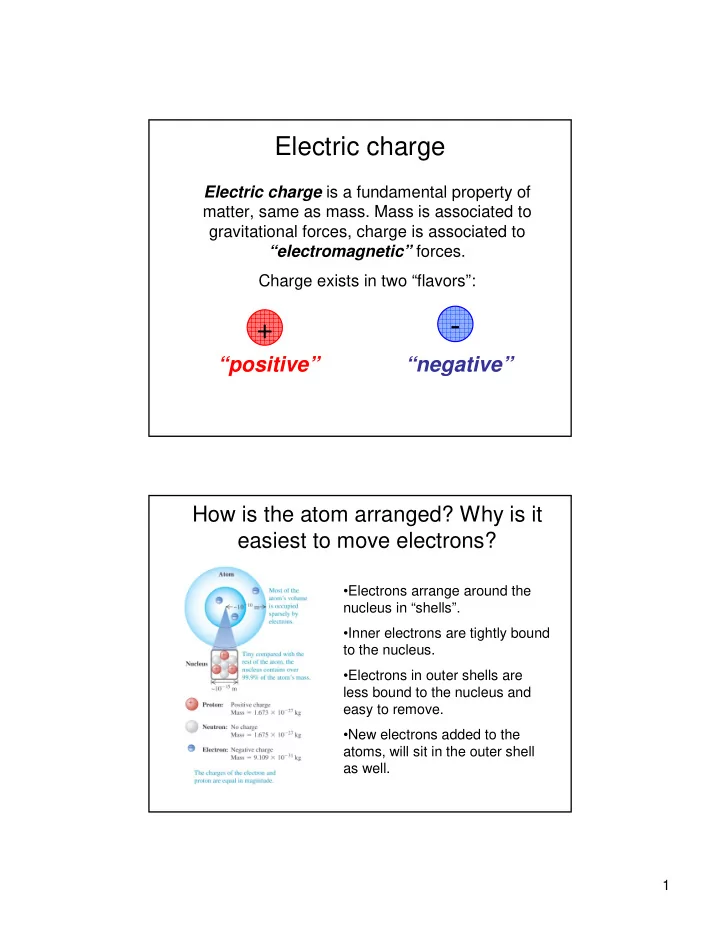
Electric charge Electric charge is a fundamental property of matter, same as mass. Mass is associated to gravitational forces, charge is associated to electromagnetic forces. Charge exists in two flavors: - + positive


slide-1
SLIDE 1

1

Electric charge

Electric charge is a fundamental property of matter, same as mass. Mass is associated to gravitational forces, charge is associated to “electromagnetic” forces. Charge exists in two “flavors”:

+

  • “positive”

“negative”

How is the atom arranged? Why is it easiest to move electrons?

  • Electrons arrange around the

nucleus in “shells”.

  • Inner electrons are tightly bound

to the nucleus.

  • Electrons in outer shells are

less bound to the nucleus and easy to remove.

  • New electrons added to the

atoms, will sit in the outer shell as well.

slide-2
SLIDE 2

2

Lithium as a cation, an anion, and a neutral atom

  • Let’s study the subatomic arrangement of lithium with all charges

balanced and the way only electrons move to make the atom an ion (+

  • r −).

Charge is “quantized”

Charge can only exist in “packets” formed by an integer number of “elementary or fundamental charges”, the charge of the electron (or proton)

C 10 60217653 . 1

19 −

× = e

This number is so small, that the charge can be considered to vary continuously in practice

The unit of charge is the “Coulomb”

Charge is conserved

slide-3
SLIDE 3

3

Electric charge

http://www.youtube.com/watch?v=F6v8wm7_vdQ http://www.youtube.com/watch?v=Zo6I6rvtu2g&feature=related http://www.youtube.com/watch?v=pJ36EtABLAk&feature=related

Electric charge

Glass rods, plastic tubes, silk, and fur can be used to demonstrate the movement of electrons and how their presence or absence make for powerful forces of attraction and repulsion.

slide-4
SLIDE 4

4

Charging by conduction

  • Materials that allow

easy passage of charge are called conductors.

  • Materials that resist

electronic flow are called insulators.

  • The motion of electrons

through conducts and about insulators allows us to observe “opposite charges attract” and “like charges repel.”

http://www.youtube.com/watch?v=Dz_vvw_fsTo&feature=related

Electrons move freely and charges may be induced

slide-5
SLIDE 5

5

Polarizing an insulator

  • The motion of static charges about a plastic comb and light bits
  • f paper can cause attractive forces strong enough to overcome

the weight of the paper.

http://www.youtube.com/watch?v=VhWQ-r1LYXY&NR=1

Charles Coulomb determined the electrostatic force law

slide-6
SLIDE 6

6

Coulomb’s law

2 2 1

| | 4 1 r q q F πε =

  • The force on the particles has the same

magnitude but opposite direction

  • They can be attractive (charges with
  • pposite sign), or repulsive (charges with

equal sign)

  • It is directly proportional to the charges,

and inversely proportional to the square

  • f the inter-charge distance
  • It does not depend on the mass!!!

Coulomb’s law

2 2 1

| | 4 1 r q q F πε =

If the charges are 1C and the distance 1m, the force would be 9x10⁹N!!! This is about 1 million tons!!! Typical values of charge are in micro/nano-C 2 2 9 2 2 12

C / Nm 10 . 9 4 1 /Nm C 10 854 . 8 × = × =

πε ε

slide-7
SLIDE 7

7

Electric vs. gravitational force

2 2

4 1 r q Fe πε =

Let us assume two point particles (alpha particles =nucleus of helium atom) with mass m=6.64x10⁻²⁷ kg and charge q=3.2x10⁻¹⁹ C

2 2

r m G Fg =

35 2 2

10 1 . 3 4 1 × = = m q G F F

g e

πε

Remember: Gravity is always attractive!!!

Superposition of forces (I)

We consider the charges as point-size

  • bjects

∑ ∑

= =

i i i i i q q q

r n q q F F

i

2

  • n
  • n

Total

4 πε

slide-8
SLIDE 8

8

Superposition of forces (II)

+ +

  • d

2d 3 2 1 3

1

F r

2

F r

2 3 2 2 2 3 1 1

| | 4 1 | | ) 2 ( | | 4 1 | | d q q F d q q F πε πε = =

| | 4 | |

1 2

F F = →

Superposition of forces (III)

+ + 1 2 3 3

1

F r

2

F r

+

2 1

F F r r +

α

) sin( ) cos(

1 1 1 1

α α F F F F

y x

− = = ) ( | | 4 1

2 2 3 1 1

y x q q F + = πε

α