
SLIDE 1
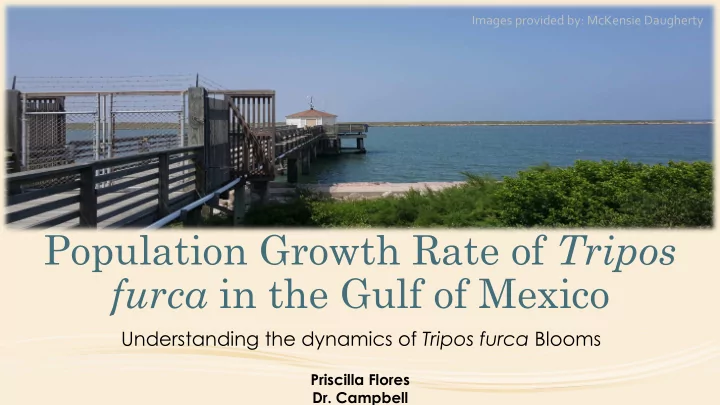
Population Growth Rate of Tripos furca in the Gulf of Mexico
Understanding the dynamics of Tripos furca Blooms
Priscilla Flores
- Dr. Campbell
Images ¡provided ¡by: ¡McKensie ¡Daugherty ¡
Population Growth Rate of Tripos furca in the Gulf of Mexico - - PowerPoint PPT Presentation
Images provided by: McKensie Daugherty Population Growth Rate of Tripos furca in the Gulf of Mexico Understanding the dynamics of Tripos furca Blooms Priscilla Flores Dr. Campbell Tripos furca FWC Fish and
Understanding the dynamics of Tripos furca Blooms
Priscilla Flores
Images ¡provided ¡by: ¡McKensie ¡Daugherty ¡
http://toast.tamu.edu/IFCB7/dashboard/http://toast.tamu.edu/IFCB7/D20130616T094005_IFCB007 ¡
FWC ¡Fish ¡and ¡Wildlife ¡Research ¡Institution ¡ ¡
Images ¡provided ¡by: ¡McKensie ¡Daugherty ¡
technology to capture images of nano- and microplankton
every 20 minutes
associated with each image
species level
¡ ¡
Dinophysis ¡
Fig.5 Campbell et al. 2010
and that the peak of division occurs after midnight.
from classified files of Tripos furca over a 24hr cycle.
http://toast.tamu.edu/IFCB7/dashboard/http://toast.tamu.edu/IFCB7/D20130616T094005_IFCB007 ¡
¡
0 ¡ 20 ¡ 40 ¡ 60 ¡ 80 ¡ 100 ¡ 120 ¡ 140 ¡ 160 ¡ 180 ¡ 200 ¡ 0 ¡ 1 ¡ 2 ¡ 3 ¡ 4 ¡ 5 ¡ 6 ¡ 7 ¡ 8 ¡ 9 ¡ 10 ¡ 11 ¡ 12 ¡ 13 ¡ 14 ¡ 15 ¡ 16 ¡ 17 ¡ 18 ¡ 19 ¡ 20 ¡ 21 ¡ 22 ¡ 23 ¡
Dividing ¡cells ¡ Hours ¡a;er ¡midnight ¡ ¡
𝜈=ln(1+𝑔↓𝑛𝑏𝑦 ) ¡ 𝜈=1/𝑜𝑢↓𝑒 ∑𝑗=1↑𝑜▒𝑚𝑜 (1+𝑔↓𝑗 ) ¡
Campbell et al. 2010
Cells·√ ¡mL-‑1 ¡ Day ¡ ¡Growth ¡rate ¡per ¡day ¡ ¡ ¡ Velocity ¡out ¡of ¡estuary ¡(m ¡·√ ¡s ¡-‑1) ¡
Fig.4 Henrichs et al. 2011
rate?
highest growth rate.
Tripos furca over a bloom. This will be done using MATLAB program scripts written by Heidi Sosik.
http://toast.tamu.edu/IFCB7/dashboard/http://toast.tamu.edu/IFCB7/D20130616T094005_IFCB007 ¡
0.00 ¡ 0.20 ¡ 0.40 ¡ 0.60 ¡ 0.80 ¡ 1.00 ¡ 1.20 ¡ 1.40 ¡ 1.60 ¡ 1.80 ¡ 0.00 ¡ 0.10 ¡ 0.20 ¡ 0.30 ¡ 0.40 ¡ 0.50 ¡ 0.60 ¡ 0.70 ¡ 0.80 ¡ 0.90 ¡ 1.00 ¡ 1 ¡ 2 ¡ 3 ¡ 4 ¡ 5 ¡ 6 ¡ 7 ¡ 8 ¡ 9 ¡ 10 ¡ 11 ¡ 12 ¡ 13 ¡ 14 ¡ 15 ¡ 16 ¡ 17 ¡ 18 ¡ 19 ¡
cells·ml-1
¡
Growth rate (d-1) Days
Growth ¡rate ¡ Abundance ¡
1.5 ¡ 3.5 ¡ 5.5 ¡ 7.5 ¡ 9.5 ¡ 11.5 ¡ 13.5 ¡
0 ¡ 0.5 ¡ 1 ¡ 1.5 ¡ 2 ¡ 2.5 ¡
cells·ml-1 Tidal Height June 14th through 19th
Tide Velocity Cells per mL
1 3 5 7 9 11 25 27 29 31 33 35 37
cell per mL salinity June 14th through 19th Salinity ¡ cells·√ml-‑1 ¡
I would like to thank the Campbell lab for all of their support and guidance throughout the summer.
McKensie Daugherty Darcie Ryan Lipan Apache Tribe of Texas REU participants