Poor IAQ 350 Building IAQ Study by NIOSH Problem Buildings Can - - PowerPoint PPT Presentation

poor iaq
SMART_READER_LITE
LIVE PREVIEW

Poor IAQ 350 Building IAQ Study by NIOSH Problem Buildings Can - - PowerPoint PPT Presentation

Jim Newman, Newman Consulting Group 6/9/2020 Content IAQ - Whats It All About? How It Affects Health, Productivity What Can Be Done About It? Water Issues Indoor Air Quality (IAQ), Productivity, Proper Cleaning and


slide-1
SLIDE 1

Jim Newman, Newman Consulting Group 6/9/2020 1 Indoor Air Quality (IAQ), Productivity, Health, and Legal Liability OR - HVAC Implications Since COVID-19

Jim Newman, CEM, LEED AP, ASHRAE OPMP & BEAP - June 2020

Content

  • IAQ - What’s It All About?
  • How It Affects Health, Productivity
  • What Can Be Done About It?
  • Water Issues
  • Proper Cleaning and Disinfection –

HVAC/Other Surfaces

  • What’s the Legal Liability?

Poor IAQ

Can Have Many Origins – Some Indoor, Some Outdoor

3

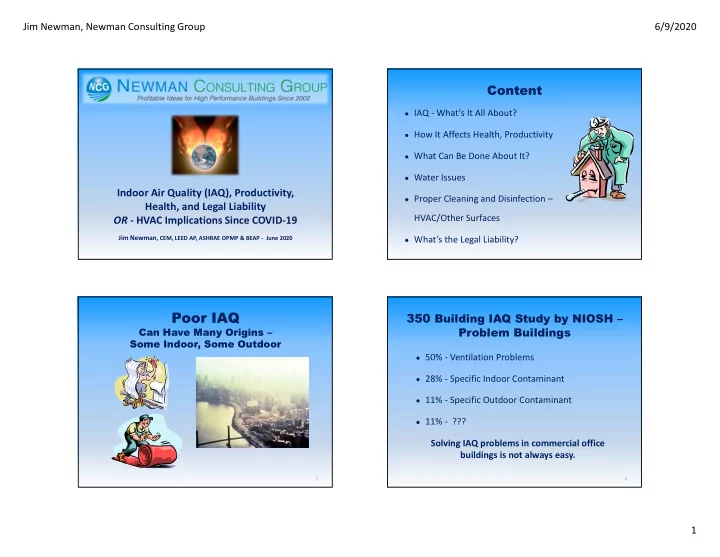
350 Building IAQ Study by NIOSH –

Problem Buildings

  • 50% - Ventilation Problems
  • 28% - Specific Indoor Contaminant
  • 11% - Specific Outdoor Contaminant
  • 11% - ???

4

Solving IAQ problems in commercial office buildings is not always easy.

slide-2
SLIDE 2

Jim Newman, Newman Consulting Group 6/9/2020 2

5

Liability/Litigation

  • Building Owners
  • Architects & Engineers
  • Building Contractors & Suppliers
  • Building Management, Maintenance Personnel
  • Real Estate Brokers
  • Landlords & Tenants
  • Employers

Who is Blamed for Poor IAQ?

What Happens to HVAC Systems as Time Passes?

Green Green Green Green

Gray Gray Gray Gray

IAQ Problems

  • Humidity – too high/too low
  • Mold or mildew growth due to condensation

—Interior surfaces of walls near thermal bridges —Carpeting on cold floors —Locations where humidity promotes condensation

  • Not enough outdoor/indoor air – or unhealthy OA
  • Water intrusion – outdoor/indoor

7

How to Know if There Are IAQ Problems

Communicate with the people in your building.

slide-3
SLIDE 3

Jim Newman, Newman Consulting Group 6/9/2020 3

IAQ Problem: Winter Humidity

As Low As 15% In Many Buildings!

9

10 20 30 40 50 60 Optimum Winter

Humidity %

10

Optimum Relative Humidity for Health

Bacteria Viruses Fungi Mites Allergic rhinitis and asthma Respiratory infections Chemical interactions Ozone production 1 10 20 30 40 50 60 70 80 90 Optimum Zone Per cent relative humidity
  • 1. Insufficient data above
50 per cent R.H. E.M. Sterling, Criteria for Human Exposure to Humidity in Occupied Buildings, 1985 ASHRAE

30 40 50 60 Optimum Zone 30 40 50 60 Optimum Zone

  • Bacteria
  • Viruses
  • Fungi
  • Mites
  • Allergic Rhinitis and Asthma
  • Respiratory Infections

Optimum Humidity is 40-60%

IAQ Problems: Mold and Mildew

11

IAQ Problems: HVAC System

  • A source of biological contaminants
  • Surface Contamination by molds, bacteria, viruses
  • Interior ductwork
  • Odors

12

slide-4
SLIDE 4

Jim Newman, Newman Consulting Group 6/9/2020 4

IAQ Problems: HVAC Unit

  • Drain Pans
  • Improper Damper Operation
  • Surface Contamination
  • Coils
  • Air Filters

13

Dried-Up “Goop”

(Engineering Term)

From Drain Pan in Air Handling Unit

14

Poorly Maintained Dampers

15

Poor (or No) Filter Maintenance

16

slide-5
SLIDE 5

Jim Newman, Newman Consulting Group 6/9/2020 5

Poor Filter Maintenance Goes To Worse – This Is What Happens

17

These Are Permanent, Cleanable Filters

18

Improper Filter Installation or Replacement

19

IAQ Problems – HVAC Filters

20

slide-6
SLIDE 6

Jim Newman, Newman Consulting Group 6/9/2020 6

Potential IAQ Problems: Outdoor

21

Potential IAQ Problems: Outdoor

22

Energy Recovery Makeup Air Unit to Hospital O.R.

IAQ Problems: What Else?

  • Mold spores on final filters
  • Legionella from cooling towers
  • Biofilm on heat

transfer surfaces

  • Bacteria
  • Viruses
23 24

What Is Biofilm?

  • Aggregates of predominantly bacterial cells attached

to and growing on a surface (Costerton J.W. and Stewart, P.S., 2001

Battling Biofilms. Sci. Am., 285:74-81.)

  • Bacteria excrete slimy, sticky substance that allows

them to adhere to surfaces

  • Extracellular polymeric substance (EPS) increases

resistance to antimicrobial agents, heat/cold, cleaners

From, Jeff Seippel, BIOMIK

slide-7
SLIDE 7

Jim Newman, Newman Consulting Group 6/9/2020 7

Biofilm Effects

  • Bacteria - in/on coils and fins
  • Lowers HVAC system efficiency
  • Irritating odors – health issues

Biofilm Cleaning Challenge

Close-up of coil after conventional cleaning (note: black tar like substance is biofilm) Close-up of coil after cleaning using engineered EFM after conventional cleaning

Solution to Bio-Film

Step 1: Proper Cleaning

  • Use environmentally-friendly surfactants

– Enzymes – Environmentally Friendly Microorganisms (EFM) – Break down biofilm and release trapped dirt

  • Clean at the microscopic level

27

Solution to Bio-Film (cont.)

Step 2: After Cleaning

  • Restore and maintain a healthy balance of EFM

– Automatic delivery tied into the HVAC system controls

  • Return HVAC systems to “like new” condition
  • Continuously deactivate bacteria and viruses

– Bi-polar ionization – UV-C

28

slide-8
SLIDE 8

Jim Newman, Newman Consulting Group 6/9/2020 8

The Real Result

  • Improve heat transfer of coil and system

– Coil functions more efficiently – Chiller (or compressor) functions more efficiently – Can reduce chilled water flow – Can increase chilled water temperature – Can reduce fan speed (energy varies as power cubed)

Conserve energy and save money

Other Environmental Stressors

Poor IEQ (Indoor Environmental Quality)

  • Lighting – Glare
  • Noise – Too much or not enough
  • Vibration
  • Ergonomic Stress
  • Psycho-social Factors

30 31

What To Do With an IAQ Problem – Real or Perceived

  • Respond Immediately!!
  • If you don’t, 1 goes to 2, 2 goes to 4, etc., until

you have “Mass Psychogenic Illness”

  • Remember, “Perception Is Reality” to the person

with the perception

  • Identify Problem (if there is one)
  • Make Necessary Corrections as Needed

When Should Owner Seek Outside Assistance for IAQ Mitigation?

  • Cannot identify the problem
  • Mitigation efforts have been unsuccessful
  • Air sampling is required
  • Mistakes or delays could be serious
  • Management feels that an independent

investigation is more credible

32

slide-9
SLIDE 9

Jim Newman, Newman Consulting Group 6/9/2020 9

Summary: Why Be Concerned About Good IAQ?

  • Overall Health of Employees and Tenants
  • Reduced Absenteeism
  • Increased Productivity
  • Increased Profitability (cost of employee vs. operating

costs)

  • Minimized Litigation Risk
  • Saves Money & Makes Money

33

How to Maintain Sustainability? Proper Operation & Maintenance

  • Best designs and construction – doomed to

failure without proper and ongoing maintenance

  • Commissioning and re-commissioning
  • Retro-commissioning to return to original design

concepts and operation

  • On-going Commissioning
  • BE AWARE!

34 35

Owner Defensive Strategies (1)

  • Avoid Potentially Offensive Building and

Maintenance Materials

  • Fully Commission Mechanical Systems Prior to

Occupancy

  • Understand Liability Insurance Coverage and

Operate Within its Limits

  • Document Everything

36

Owner Defensive Strategies (2)

  • Operate with Adequate Ventilation
  • Operate Cooling & Heating Systems

Conservatively

  • Toward the center of the Thermal Comfort Zone, see

ASHRAE Standard 55

  • Clean and Maintain Equipment Properly
  • Operate Systems As Designed
slide-10
SLIDE 10

Jim Newman, Newman Consulting Group 6/9/2020 10

37

Owner Defensive Strategies (3)

  • Periodically Check For:
  • Sensor stress: Auditory, Visual, Olfactory
  • Psychologically Stressful Conditions
  • Ask “Would I want to work/live there?”
  • Periodically Check Occupant Satisfaction
  • Re-Commission Systems Every Year To Ensure

Proper Operation

Basic Conclusions

  • IAQ - a large issue – not a simple issue
  • IAQ - a part of IEQ
  • HVAC - a large part of IAQ issues
  • Proper Cleaning and Disinfection – HVAC/Other

Surfaces

  • Owners need assistance to avoid liability

Coronavirus & COVID-19

  • Definition/Background
  • Concerns
  • HVAC
  • Relative Humidity
  • Filtration
  • The Disease: COronaVIrus Disease, 2019 (COVID-19)
  • The Virus: Severe Acute Respiratory Syndrome

COronaVirus 2 (SARS-CoV-2)

  • Related to:

SARS – China, 2003, Korea, Africa MERS – Middle East Respiratory Syndrome: Jordan, Saudi Arabia in 2012, then Africa, Asia, Europe, Korea in 2015

  • Risks:
  • Person-to-person transmission
  • Airborne spread
  • Contaminates surfaces

What Is COVID-19

slide-11
SLIDE 11

Jim Newman, Newman Consulting Group 6/9/2020 11

How COVID-19 Spreads

  • Directly through aerosols

– Infected people breathing, coughing, sneezing – Touching an infected person’s hand or face

  • Indirect Contact

– Touching surfaces like doorknobs, elevator buttons, railings, handles, etc. then touching your eyes, nose or mouth

COVID-19 Concerns

What are the facts? We’re still learning!

  • “Social” Distancing – Really “Physical” Distancing

‒ 6’ not enough ‒ Aerosols, droplets, etc. – Breathe, Speak, Sing, Yell, Cough, Sneeze: 4’-20’

  • Face Masks

‒ Yes? Why, When ‒ No? Why, When

  • Symptomatic vs. Asymptomatic

‒ 14 days? ‒ 28 days?

  • Vaccine

‒ When?

Requirements - HVAC

  • Flush with Outside Air

– 100%? Or less?

  • Humidification

– 40-60% Relative Humidity (RH)

  • Biofilm

Requirements – HVAC (cont.)

  • Filtration

– MERV 13,14 Filters (Minimum Efficiency Reporting Value) – HEPA filters (High Efficiency Particulate Air) – Electrostatic filters – Carbon filters – Ultraviolet

  • UV-C
  • GUV (Germicidal Ultraviolet)

– Ionization

  • Needle Point
  • PCO (Photo Catalytic Oxidation)
  • Bi-Polar (BPI)
slide-12
SLIDE 12

Jim Newman, Newman Consulting Group 6/9/2020 12

Comparing IAQ Systems

Bi-Polar Ionization Needlepoint Ionization Media Filtration UV PCO Carbon Filters Electronic Air Cleaner Scent Generators Reduces Contaminants "in the Space" at their source Yes No No Yes* Yes No No No Reduces Odors Yes No No Yes No Yes No Yes Reduces VOCs Yes Yes No Yes No Yes No No Reduces Particles Yes No Yes No No Yes Yes No Effective on Bacteria and Germs Yes Yes No Yes Yes No No No Effective on Viruses Yes Yes No Yes Yes No No No Produces Ozone No No No No** No No Yes No Low Pressure Drop Yes Yes No Yes Yes No Yes Yes Maintenance Requirements Every 2 years When needles wear out Quarterly Yearly Yearly Monthly Monthly Monthly Requires Re-engineering of HVAC system No No Maybe No Maybe Yes Yes No Reduces Energy Costs Yes Yes No Yes Yes No Yes No Contaminants Must Travel Through Filtration System No No Yes Yes No Yes Yes N/A Produces Chemicals or Byproducts No No No No Yes Yes No Yes Tested Contaminant Re- ductions in Occupied Space Yes No No Yes` No No No N/A **UVV (Vacuum UV), UV-A and UV-B typically produce ozone. Properly designed UV-C does not. *When used in the space.

Bi-Polar Ionization (BPI)

  • Greater

aerosol transmission Increased survival and virulence of pathogens Evasion from surface cleaning through resuspension

Pathogen infectivity is high when RH < 40%

Pathogen Transmission

From Dr. Stephanie Taylor, M.D., M. Arch., CIC

Influenza A virus is more infectious when RH is below 40% (Taylor)

Highly infectious Non- infectious

7 23 33 38 43 57 74

10 20 30 40 50 60 70 80 90 10 20 30 40 50 60 70 80

Virus-Viability (%)

(%) (%) (%) RH RH RH RH (%)

Noti 2007

Role of Relative Humidity

slide-13
SLIDE 13

Jim Newman, Newman Consulting Group 6/9/2020 13

100 10 1 0.1 0.01 0% 20% 40% 50% 60% 80% 100% RH

viable viruses [%]

fast inactivation longstanding viability longstanding viability

20% 50% 80%

4°C, 20°C, 40°C the inactivation rate is fastest in intermediate humidity of 50% RH.

50% RH inactivated Coronavirus particles in air and on surfaces – true for all temps. (Taylor)

Pathogen Transmission

100 10 3 0.5 1 41 hours – 21 days 6 seconds 1.5 hours

Droplet diameter in microns (um) Float time

10m+ 1m Distance travelled:

Infectious droplets shrink, travel far and evade surface cleaning when the air is dry. (Taylor)

Infectious Droplets

With healthy RH of 40%–60%, infectious droplets settle out of the airborne environment. (Taylor)

  • Disinfection benefits of proper air hydration:

‒ Bedrails and other frequently touched surfaces cleaned more effectively ‒ Hand hygiene is maintained ‒ Settled infectious droplets are not re-suspended

Role of Relative Humidity

  • Both bacteria and viruses thrive in a biofilm environment.

90% of all pathogens live in biofilms.

  • Biofilm is difficult to penetrate even with harsh chemicals and

sanitizing methods.

  • Microbes have different life spans on different surfaces.
  • Sanitizers alone do not work. Proper cleaning is imperative.
  • Biosurfactant and water will deactivate COVID 19.
  • Testing to verify results is critical.

Viruses vs Surfactants

  • Seippel
slide-14
SLIDE 14

Jim Newman, Newman Consulting Group 6/9/2020 14

“Viruses are like tiny grease balls. Therefore, scrubbing with surfactant and water is the most effective solution for deactivating unprotected virus!”

Viruses vs Surfactants

  • Seippel

Requirements - Water

  • Flush and disinfect after long shutdown

– Bacteria grows quickly in stagnant water – Chlorine loses its effectiveness – Must disinfect and flush properly – Rest Rooms

  • Sensor-operated faucets, toilets
  • Air Dryers or Paper Towels?

Sources of Contamination in Building Water Systems

From “Flushing Procedures for Building Re-Occupancy” Ron George, CPD, Plumb-Tech Design & Consulting Services LLC, 734-755-1908

56

Resources

Pandemic Resources: NewmanConsultingGroup.us/web-sites Government & Industry Resources:

  • AIA Committee on the Environment - www.aia.org
  • ASHRAE - www.ashrae.org
  • Building Owners &Managers Association - www.boma.org
  • CDC – Indoor Environmental Quality - www.cdc.gov/niosh
  • EPA – Indoor Air Quality - www.epa.gov
  • IAQA – Indoor Air Quality Association - www.iaqa.org
  • US Green Building Council - www.usgbc.org
  • World Green Building Council - www.wgbc.org
slide-15
SLIDE 15

Jim Newman, Newman Consulting Group 6/9/2020 15 “The greatest challenge we face today is failure to adapt to change”

Tim Wentz, ASHRAE President, 2016-17

For Further Information: James L. (Jim) Newman

  • JimN@NewmanConsultingGroup.us
  • www.newmanconsultinggroup.us
  • +1-248-626-4910

James L. Newman, CEM, CSDP, LEED AP BD+C, ASHRAE OPMP & BEAP

ASHRAE

  • Co-Chair, IAQ Subcommittee for new Chapter on Climate Change

in 2021 Handbook of Fundamentals

  • Member, COVID-19 Committee (Local)
  • Distinguished Lecturer since 2010
  • Former Member, now Corresponding Member, Air-to-Air Energy Recovery

Technical Committee (TC), Operations and Maintenance TC

  • Past Vice-Chair, Industrial Air Conditioning TC
  • Member, Energy Position Committee, 2008
  • Past Board Member (Local)

BUILDING OWNERS & MANAGERS ASSOCIATION (BOMA)

  • Immediate Past Chair, Sustainability for Savings Committee (Local)
  • Trainer, High Performing Building Certification

ENGINEERING SOCIETY OF DETROIT (ESD)

  • Past Chair, Council of Affiliated Organizations

U.S. GREEN BUILDING COUNCIL (USGBC)

  • Founding Member, Detroit Regional Chapter
  • Past Chair, Public Policy/Advocacy Committee (Local)
  • Past Board Member (Local)

AMERICAN INSTITUTE OF ARCHITECTS (AIA)

  • Member, Committee on the Environment (COTE)

URBAN LAND INSTITUTE (ULI)

  • Member, Technology and Real Estate Council