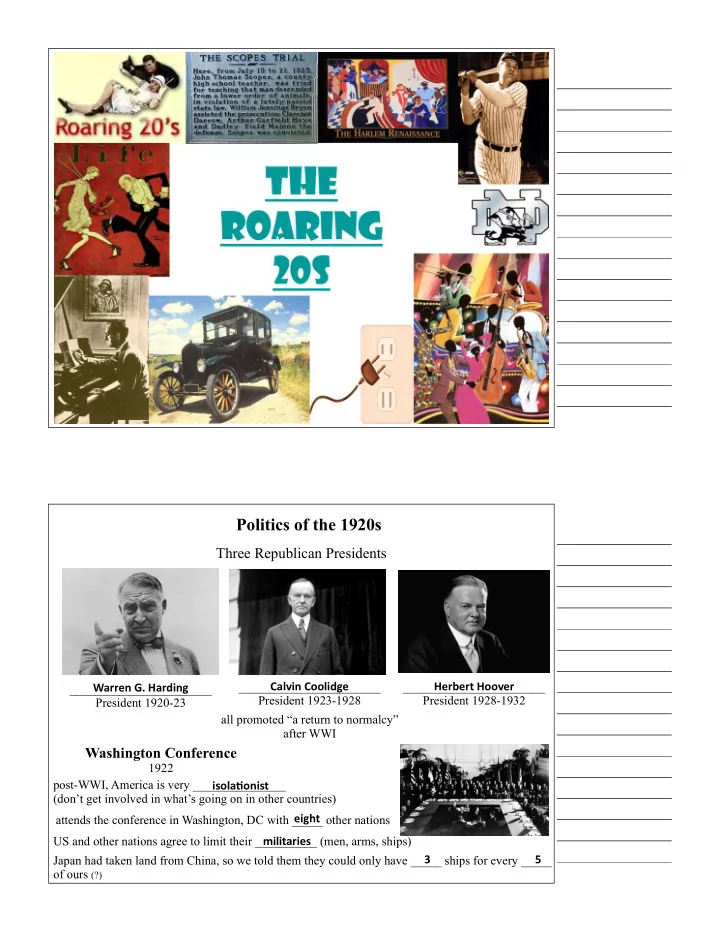
Politics of the 1920s Three Republican Presidents Calvin Coolidge - - PDF document

politics of the 1920s
SMART_READER_LITE
LIVE PREVIEW

Politics of the 1920s Three Republican Presidents Calvin Coolidge - - PDF document

Politics of the 1920s Three Republican Presidents Calvin Coolidge Herbert Hoover Warren G. Harding _______________________ _______________________ _______________________ President 1923-1928 President 1928-1932 President


slide-1
SLIDE 1

Politics of the 1920s

_______________________ President 1920-23 _______________________ President 1928-1932 all promoted “a return to normalcy” after WWI _______________________ President 1923-1928

Three Republican Presidents Washington Conference

1922 US and other nations agree to limit their __________ (men, arms, ships) Japan had taken land from China, so we told them they could only have _____ ships for every _____

  • f ours (?)

post-WWI, America is very _______________ (don’t get involved in what’s going on in other countries) attends the conference in Washington, DC with _____ other nations Warren ¡G. ¡Harding Calvin ¡Coolidge Herbert ¡Hoover isola4onist eight militaries 3 5

slide-2
SLIDE 2

Red Scare

_____________ _____________

  • A. Mitchell Palmer arrested

about 6,000 people; some were _____________ (sent out of the country) (he slowed down a bit after a bomb blew up his house) a fear of foreigners and _____________ emerged from 1919–1921 natives were worried that immigrants would take their _____________ natives didn’t like immigrants’ differences: religion, dress, food, etc. communism jobs A=orney General deported came about from anti-foreign sentiment and religious crusading against “demon rum” in 1919, the _____________ _____________ was passed prohibiting (_____________) alcohol many violated or ignored the prohibition laws there were positive results: bank savings _____________ and absences at work _____________

The Prohibition “Experiment”

18th Amendment

  • utlawing

increased decreased

slide-3
SLIDE 3

prohibition created an entire industry for organized crime: _____________ _____________ gangs were born and staked out their territories for selling alcohol in their "_____________" bars

The “Golden Age” of Gangsterism

_____________ had the greatest number and strongest gangs "_____________” Al Capone was the biggest and the baddest of the crime bosses the “G-men” (_____________ men = federal police) named him "Public _____________ Number One" although never convicted of mob-related activities, he was put in jail for _____________ _____________ guests of a speakeasy had to know a _____________ to enter liquor distribu4on speakeasy password Chicago Scarface Government Enemy tax evasion _____________ _____________ Act (1921) cut the umber of people admitted to the US to 3% of the total number of people in any group already living in the US in 1910 _____________ _____________ of 1924 (1924) cut down to 2% of a group's U.S. population in 1890: New Immigrants v. Old Immigrants NO _____________ immigrants

Restricting Immigration

Emergency Quota Immigra4on Act Japanese

slide-4
SLIDE 4
slide-5
SLIDE 5

________________ _________________

An _____________-_____________ arts movement (writing, music, and art) in the 1920s that centered on Harlem. Notable Harlem Renaissance Artists: Langston Hughes, Author Louis Armstrong, Jazz Musician Duke Ellington, Jazz Musician Marian Anderson, Singer Billie Holiday, Singer African American

Harlem ¡ ¡ ¡ ¡ ¡ ¡ ¡ ¡ ¡ ¡ ¡ ¡Renaissance

In his many poems and novels of the 1920s, Langston Hughes creatively suggested the idea that black culture should be celebrated.

Langston Hughes

The Weary Blues (1925) Droning a drowsy syncopated tune, Rocking back and forth to a mellow croon, I heard a Negro play. Down on Lenox Avenue the other night By the pale dull pallor of an old gas light He did a lazy sway . . . He did a lazy sway . . . To the tune o' those Weary Blues. With his ebony hands on each ivory key He made that poor piano moan with melody. O Blues! Swaying to and fro on his rickety stool He played that sad raggy tune like a musical fool. Sweet Blues! Coming from a black man's soul. O Blues! In a deep song voice with a melancholy tone I heard that Negro sing, that old piano moan— "Ain't got nobody in all this world, Ain't got nobody but ma self. I's gwine to quit ma frownin' And put ma troubles on the shelf." Thump, thump, thump, went his foot on the floor. He played a few chords then he sang some more— "I got the Weary Blues And I can't be satisfied. Got the Weary Blues And can't be satisfied— I ain't happy no mo' And I wish that I had died." And far into the night he crooned that tune. The stars went out and so did the moon. The singer stopped playing and went to bed While the Weary Blues echoed through his head. He slept like a rock or a man that's dead.
slide-6
SLIDE 6

New Orleans native Louis Armstrong moved to New York City in 1924, where he played the clubs and on Broadway, helping to spread the sound of jazz to a larger audience. By forming a band, moving to New York City in the early 1920s and playing at exclusively white clubs like the Cotton Club, Duke Ellington impacted the way that Jazz developed as an artform during the Harlem Renaissance. Songstress Marian Anderson made her contralto voice heard as an

  • pera singer who performed at

Carnegie Hall in 1928 and at the New York Metropolitan Opera House in the 1930s, the first black performer to ever do so. Billie Holiday moved her career forward into becoming

  • ne of the most influential

jazz singers in history after performing in the Apollo Theater in Harlem.

slide-7
SLIDE 7

KKK membership reached its peak during the 20's to about ____ _____________ members they used fear, _____________, and intimidation to gain and keep their power

Hooded Hoodlums of the KKK

membership in the Ku Klux Klan _____________ dramatically during the 1920s although started as an anti- black group, in the 20's it was also opposed to Catholics, Jewish, pacifists, communists, internationalists, revolutionists, bootleggers, gambling, adultery, and birth control

(basically, the KKK was pro-white Anglo-Saxon Protestant - "WASP" - and anti-everything else)

increased million 5 lynchings The _____________ of a _____________,1915 silent film directed by D. W. Griffith based on the novel and play The Clansman, by Thomas Dixon, Jr. many Americans believed it was true, including President _____________!

Birth of A Nation excerpt

Birth Na4on Wilson

slide-8
SLIDE 8

The first daylight Ku Klux Klan parade in the US and the first Klan parade in New England took place in Milo, ME on September 3, 1923. In the 1920s the Klan had as many as 20,000 members throughout Maine. The Ku Klux Klan impacted Maine politics in 1923 when over 7,000 of their number rallied to change the Portland city government structure from having an elected mayor to hiring a city manager. The Klan had a huge headquarters complex on Forest Avenue. The Klan's Maine director, F. Eugene "Doc" Farnsworth, spoke against Catholics, Jews and immigrants.

Ku Klux Klan procession, Portland, ca. 1923

slide-9
SLIDE 9

A Ku Klux Klansman and horse in full regalia lead a motorcade of members to the Brownville Centennial Pageant Grounds in 1924. Civic leaders had put up $500 to celebrate 100 years as a town. The Piscataquis County community

  • f 1,743 people was experiencing divisive labor problems

and some residents struck out at arriving Catholic Franco-Americans. Planes were used a little in WWI - for spying, dog fighting each other, and bombing After WWI planes were used for air mail - __________________ airmail started from New York to San Francisco in 1920 in 1927 _____________ _____________ was the first to fly solo across the Atlantic Ocean in 33 1/2 hours

Humans Develop Wings

_____________ and _____________ _____________ flew for the first time on December 17, 1903 for 12 seconds at Kitty Hawk, N.C. Wilbur Orville Wright transcon4nental Charles Lindbergh

slide-10
SLIDE 10

Henry Ford’s _____________ line produced a new car every 10 seconds

The Automobile Revolution

by 1929, there were 26 _____________ registered cars - 1 car for every 4.9 people America cars created 6 million new jobs (making cars and gas stations, roads, etc.)

(now it’s 1 for every 3 people)

assembly million

Replica of the Benz Patent Motorwagen (1886) France, Germany, Austria (1890s) internal combustion engine: expanding power of burning gas to drive pistons Karl Benz's "Velo" model (1894) entered the first automobile race

slide-11
SLIDE 11

The original Ford Model A, also called the Fordmobile, was the first car produced by Ford Motor Company, beginning production in 1903. Ford Model T, 1927, regarded as the first affordable automobile.

slide-12
SLIDE 12

Ford’s Model T and Model A cars were _____________ for almost any working person cars brought _____________ to young people who "dated" in them America began to reshape itself by spreading

  • ut into _____________

affordable independence suburbs

young modern women in the 20's visited speakeasies, drank alcohol, dressed in short dresses, “bobbed” their hair danced to the _____________

“Flappers”

Charleston

slide-13
SLIDE 13

1926 A.A. Milne Publishes Winnie-the-Pooh Houdini Dies After Being Punched 1927 Babe Ruth Makes Home-Run Record The First Talking Movie, The Jazz Singer Lindbergh Flies Solo Across the Atlantic Sacco and Venzetti Executed 1928 Bubble Gum Invented First Mickey Mouse Cartoon First Oxford English Dictionary Published Kellogg-Briand Treaty Outlaws War Penicillin Discovered Sliced Bread Invented 1929 Car Radio Invented First Academy Awards The Great Depression Begins Stock Market Crashes

Some of the Many Other American Events and People of the Roaring 20s

1920 First Commercial Radio Broadcast Aired League of Nations Established Women Granted the Right to Vote in US 1921 Lie Detector Invented 1922 Insulin Discovered The Reader's Digest Published 1923 Talking Movies Invented Time Magazine Founded 1924 First Olympic Winter Games

  • J. Edgar Hoover Appointed FBI Director

1925 Flapper Dresses in Style The Scopes (Monkey) Trial