
SLIDE 1
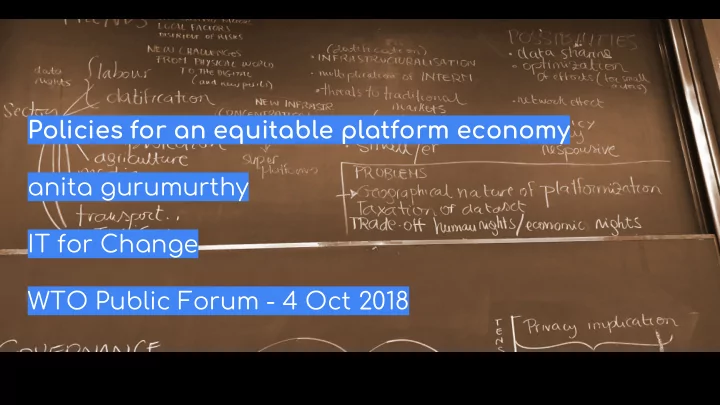
Policies for an equitable platform economy anita gurumurthy IT for - - PowerPoint PPT Presentation
Policies for an equitable platform economy anita gurumurthy IT for Change WTO Public Forum - 4 Oct 2018 Fintech: transforms financial transactions VoD: disrupts E-commerce r content emakes the production global and Tourism &
Tourism & hospitality: remodels local economic and cultural autonomy Agritech and grocery e-tail: Reengineers the value chain E-commercer emakes the global marketplace Ride-hailing: restructures mobility infrastructure Care/gig work : reconfigures work and labor relations VoD: disrupts content production and consumption Fintech: transforms financial transactions
Sectoral transformations
platformization make old regulation approaches inefficient and
Current approaches to regulating the digital lead to economic and social injustice Global trade paradigms continue to privilege global North interests and undermine economic justice Data governance frameworks lack thinking around data’s economic value Governing the platform economy: a multi-level policy challenge for developing states
The The The The The The The
Platform governance Regulating the platform economy Agritech and grocery e-tail Agriculture E-commerce Trade, FDI Online rentals amd bookings Tourism and hospitality VoD Media Fintech Finance and Banking Ride-hailing Transport Competition Taxation Anti-trust safeguards SME incentivization Labor Worker rights Livelihood protection and guarantees Consumer rights Data Governance Citizen privacy Data localization Data sharing Citizen rights
Revamping macro-economic frameworks Data-governance for economic sovereignty Establishing a level playing field Ensuring livelihood security Reframing global justice Creating policy spaces for alternatives
Protecting citizen rights
Revamping macro-economic frameworks - creating a strategic policy road-map
Reframing policies in traditional socio-economic sectors Differentiated policies for data Institutional mechanisms for social audit of platforms Enhancing educational curriculum to optmize platform participation for citizens Updating capacities of officials in public systems
Data governance for economic sovereignty - towards data as a public good Digitizing legacy data sets to build digital intelligence solutions with due attention to privacy, transparency and accountability safeguards Mandating data sharing by private platforms in key sectors. Building public digital infrastructure that can contribute to the aggregation of data and the creation
solutions.
Create domain agnostic competition laws that have clear and comprehensive enforceability Foster domestic innovation through incentivizing startups and MSMEs Create tax-compliance policies to ensure local economies benefit from the presence and operations
Establishing a level playing field
Social protection and traditional employment benefits for platform workers -- employment benefits and collective bargaining rights Systems of liability for platforms to hold them accountable Targeted approaches that promote equal participation of women and marginalized communities in the gig economy, with due attention to their rights Ensuring livelihood security
Frameworks of data privacy must maximize real choice for citizens and take into account group/community right to data Governments should enforce quotas for local, indigenous and independent content in the catalogues of VoD platforms. Consumer rights frameworks should be updated to apply to digital platforms. Guaranteeing citizen rights in a datafied society
Reframing global economic justice- a way forward Developing countries should work through regional blocs to better protect their interests Developing countries need to regulate their capital markets by drawing up strategic Foreign Direct Investment (FDI) regulation. Digital TNCs need to be brought into the binding treaty for TNCs being negotiated now.
Enabling environments that formally recognize and support alternative platforms Provisioning of public goods - digital and non digital to lay the ground for a culture of innovation. Promoting innovative national policy pathways through applied research Creating policy spaces for alternatives - towards a solidarity economy Creating city/local level led platforms that function as a public good
Meituan-Dianping - Chinese super platform
Diverse market places - independent platforms
Thank you