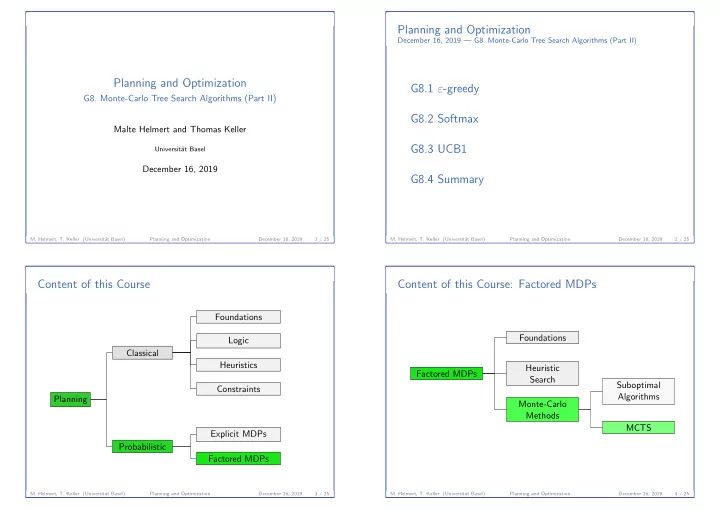
Planning and Optimization December 16, 2019 G8. Monte-Carlo Tree - - PowerPoint PPT Presentation

planning and optimization
SMART_READER_LITE
LIVE PREVIEW

Planning and Optimization December 16, 2019 G8. Monte-Carlo Tree - - PowerPoint PPT Presentation

Planning and Optimization December 16, 2019 G8. Monte-Carlo Tree Search Algorithms (Part II) Planning and Optimization G8.1 -greedy G8. Monte-Carlo Tree Search Algorithms (Part II) G8.2 Softmax Malte Helmert and Thomas Keller G8.3 UCB1


slide-1
SLIDE 1

Planning and Optimization

  • G8. Monte-Carlo Tree Search Algorithms (Part II)

Malte Helmert and Thomas Keller

Universit¨ at Basel

December 16, 2019

  • M. Helmert, T. Keller (Universit¨

at Basel) Planning and Optimization December 16, 2019 1 / 25

Planning and Optimization

December 16, 2019 — G8. Monte-Carlo Tree Search Algorithms (Part II)

G8.1 ε-greedy G8.2 Softmax G8.3 UCB1 G8.4 Summary

  • M. Helmert, T. Keller (Universit¨

at Basel) Planning and Optimization December 16, 2019 2 / 25

Content of this Course

Planning Classical Foundations Logic Heuristics Constraints Probabilistic Explicit MDPs Factored MDPs

  • M. Helmert, T. Keller (Universit¨

at Basel) Planning and Optimization December 16, 2019 3 / 25

Content of this Course: Factored MDPs

Factored MDPs Foundations Heuristic Search Monte-Carlo Methods Suboptimal Algorithms MCTS

  • M. Helmert, T. Keller (Universit¨

at Basel) Planning and Optimization December 16, 2019 4 / 25

slide-2
SLIDE 2
  • G8. Monte-Carlo Tree Search Algorithms (Part II)

ε-greedy

G8.1 ε-greedy

  • M. Helmert, T. Keller (Universit¨

at Basel) Planning and Optimization December 16, 2019 5 / 25

  • G8. Monte-Carlo Tree Search Algorithms (Part II)

ε-greedy

ε-greedy: Idea

◮ tree policy parametrized with constant parameter ε ◮ with probability 1 − ε, pick one of the greedy actions

uniformly at random

◮ otherwise, pick non-greedy successor uniformly at random

ε-greedy Tree Policy π(a | d) =

  • 1−ǫ

|Lk

⋆(d)|

if a ∈ Lk

⋆(d) ǫ |L(d(s))\Lk

⋆(d)|

  • therwise,

with Lk

⋆(d) = {a(c) ∈ L(s(d)) | c ∈ arg minc′∈children(d) ˆ

Qk(c′)}.

  • M. Helmert, T. Keller (Universit¨

at Basel) Planning and Optimization December 16, 2019 6 / 25

  • G8. Monte-Carlo Tree Search Algorithms (Part II)

ε-greedy

ε-greedy: Example

d c1

ˆ Q(c1) = 6

c2

ˆ Q(c2) = 12

c3

ˆ Q(c3) = 6

c4

ˆ Q(c4) = 9

Assuming a(ci) = ai and ε = 0.2, we get:

◮ π(a1 | d) = 0.4 ◮ π(a2 | d) = 0.1 ◮ π(a3 | d) = 0.4 ◮ π(a4 | d) = 0.1

  • M. Helmert, T. Keller (Universit¨

at Basel) Planning and Optimization December 16, 2019 7 / 25

  • G8. Monte-Carlo Tree Search Algorithms (Part II)

ε-greedy

ε-greedy: Asymptotic Optimality

Asymptotic Optimality of ε-greedy

◮ explores forever ◮ not greedy in the limit

not asymptotically optimal asymptotically optimal variant uses decaying ε, e.g. ε = 1

k

  • M. Helmert, T. Keller (Universit¨

at Basel) Planning and Optimization December 16, 2019 8 / 25

slide-3
SLIDE 3
  • G8. Monte-Carlo Tree Search Algorithms (Part II)

ε-greedy

ε-greedy: Weakness

Problem: when ε-greedy explores, all non-greedy actions are treated equally d c1

ˆ Q(c1) = 8

c2

ˆ Q(c2) = 9

c3

ˆ Q(c3) = 50

. . . cl+2

ˆ Q(cl+2) = 50

aaaaaaaaaaaaaaaaaaaaaaaaaaaaaaaaaaaaa

  • ℓ nodes

Assuming a(ci) = ai, ε = 0.2 and ℓ = 9, we get:

◮ π(a1 | d) = 0.8 ◮ π(a2 | d) = π(a3 | d) = · · · = π(a11 | d) = 0.02

  • M. Helmert, T. Keller (Universit¨

at Basel) Planning and Optimization December 16, 2019 9 / 25

  • G8. Monte-Carlo Tree Search Algorithms (Part II)

Softmax

G8.2 Softmax

  • M. Helmert, T. Keller (Universit¨

at Basel) Planning and Optimization December 16, 2019 10 / 25

  • G8. Monte-Carlo Tree Search Algorithms (Part II)

Softmax

Softmax: Idea

◮ tree policy with constant parameter τ ◮ select actions proportionally to their action-value estimate ◮ most popular softmax tree policy uses Boltzmann exploration ◮ ⇒ selects actions proportionally to e

− ˆ Qk (c) τ

Tree Policy based on Boltzmann Exploration π(a(c) | d) = e

− ˆ Qk (c) τ

  • c′∈children(d) e

− ˆ Qk (c′) τ

  • M. Helmert, T. Keller (Universit¨

at Basel) Planning and Optimization December 16, 2019 11 / 25

  • G8. Monte-Carlo Tree Search Algorithms (Part II)

Softmax

Softmax: Example

d c1

ˆ Q(c1) = 8

c2

ˆ Q(c2) = 9

c3

ˆ Q(c3) = 50

. . . cl+2

ˆ Q(cl+2) = 50

aaaaaaaaaaaaaaaaaaaaaaaaaaaaaaaaaaaaa

  • ℓ nodes

Assuming a(ci) = ai, τ = 10 and ℓ = 9, we get:

◮ π(a1 | d) = 0.49 ◮ π(a2 | d) = 0.45 ◮ π(a3 | d) = . . . = π(a11 | d) = 0.007

  • M. Helmert, T. Keller (Universit¨

at Basel) Planning and Optimization December 16, 2019 12 / 25

slide-4
SLIDE 4
  • G8. Monte-Carlo Tree Search Algorithms (Part II)

Softmax

Boltzmann Exploration: Asymptotic Optimality

Asymptotic Optimality of Boltzmann Exploration

◮ explores forever ◮ not greedy in the limit:

◮ state- and action-value estimates converge to finite values ◮ therefore, probabilities also converge to positive, finite values

not asymptotically optimal asymptotically optimal variant uses decaying τ, e.g. τ =

1 log k

careful: τ must not decay faster than logarithmically (i.e., must have τ ≥ const

log k ) to explore infinitely

  • M. Helmert, T. Keller (Universit¨

at Basel) Planning and Optimization December 16, 2019 13 / 25

  • G8. Monte-Carlo Tree Search Algorithms (Part II)

Softmax

Boltzmann Exploration: Weakness

a1 a2 a3 cost P a1 a2 a3 cost P

◮ Boltzmann exploration and ε-greedy only

consider mean of sampled action-values

◮ as we sample the same node many times, we can also gather

information about variance (how reliable the information is)

◮ Boltzmann exploration ignores the variance,

treating the two scenarios equally

  • M. Helmert, T. Keller (Universit¨

at Basel) Planning and Optimization December 16, 2019 14 / 25

  • G8. Monte-Carlo Tree Search Algorithms (Part II)

UCB1

G8.3 UCB1

  • M. Helmert, T. Keller (Universit¨

at Basel) Planning and Optimization December 16, 2019 15 / 25

  • G8. Monte-Carlo Tree Search Algorithms (Part II)

UCB1

Upper Confidence Bounds: Idea

Balance exploration and exploitation by preferring actions that

◮ have been successful in earlier iterations (exploit) ◮ have been selected rarely (explore)

  • M. Helmert, T. Keller (Universit¨

at Basel) Planning and Optimization December 16, 2019 16 / 25

slide-5
SLIDE 5
  • G8. Monte-Carlo Tree Search Algorithms (Part II)

UCB1

Upper Confidence Bounds: Idea

◮ select successor c of d that minimizes ˆ

Qk(c) − E k(d) · Bk(c)

◮ based on action-value estimate ˆ

Qk(c),

◮ exploration factor E k(d) and ◮ bonus term Bk(c).

◮ select Bk(c) such that

Q⋆(s(c), a(c)) ≤ ˆ Qk(c) − E k(d) · Bk(c) with high probability

◮ Idea: ˆ

Qk(c) − E k(d) · Bk(c) is a lower confidence bound

  • n Q⋆(s(c), a(c)) under the collected information
  • M. Helmert, T. Keller (Universit¨

at Basel) Planning and Optimization December 16, 2019 17 / 25

  • G8. Monte-Carlo Tree Search Algorithms (Part II)

UCB1

Bonus Term of UCB1

◮ use Bk(c) =

  • 2·ln Nk(d)

Nk(c)

as bonus term

◮ bonus term is derived from Chernoff-Hoeffding bound:

◮ gives the probability that a sampled value (here: ˆ

Qk(c))

◮ is far from its true expected value (here: Q⋆(s(c), a(c))) ◮ in dependence of the number of samples (here: Nk(c))

◮ picks the optimal action exponentially more often ◮ concrete MCTS algorithm that uses UCB1 is called UCT

  • M. Helmert, T. Keller (Universit¨

at Basel) Planning and Optimization December 16, 2019 18 / 25

  • G8. Monte-Carlo Tree Search Algorithms (Part II)

UCB1

Exploration Factor (1)

Exploration factor E k(d) serves two roles in SSPs:

◮ UCB1 designed for MAB with reward in [0, 1]

⇒ ˆ Qk(c) ∈ [0; 1] for all k and c

◮ bonus term Bk(c) =

  • 2·ln Nk(d)

Nk(c)

always ≥ 0

◮ when d is visited,

◮ Bk+1(c) > Bk(c) if a(c) is not selected ◮ Bk+1(c) < Bk(c) if a(c) is selected

◮ if Bk(c) ≥ 2 for some c, UCB1 must explore ◮ hence, ˆ

Qk(c) and Bk(c) are always of similar size ⇒ set E k(d) to a value that depends on ˆ V k(d)

  • M. Helmert, T. Keller (Universit¨

at Basel) Planning and Optimization December 16, 2019 19 / 25

  • G8. Monte-Carlo Tree Search Algorithms (Part II)

UCB1

Exploration Factor (2)

Exploration factor E k(d) serves two roles in SSPs:

◮ E k(d) allows to adjust balance

between exploration and exploitation

◮ search with E k(d) = ˆ

V k(d) very greedy

◮ in practice, E k(d) is often multiplied with constant > 1 ◮ UCB1 often requires hand-tailored E k(d) to work well

  • M. Helmert, T. Keller (Universit¨

at Basel) Planning and Optimization December 16, 2019 20 / 25

slide-6
SLIDE 6
  • G8. Monte-Carlo Tree Search Algorithms (Part II)

UCB1

Asymptotic Optimality

Asymptotic Optimality of UCB1

◮ explores forever ◮ greedy in the limit

asymptotically optimal However:

◮ no theoretical justification to use UCB1 for SSPs/MDPs

(MAB proof requires stationary rewards)

◮ development of tree policies active research topic

  • M. Helmert, T. Keller (Universit¨

at Basel) Planning and Optimization December 16, 2019 21 / 25

  • G8. Monte-Carlo Tree Search Algorithms (Part II)

UCB1

Symmetric Search Tree up to depth 4

full tree up to depth 4

  • M. Helmert, T. Keller (Universit¨

at Basel) Planning and Optimization December 16, 2019 22 / 25

  • G8. Monte-Carlo Tree Search Algorithms (Part II)

UCB1

Asymmetric Search Tree of UCB1

(equal number of search nodes)

  • M. Helmert, T. Keller (Universit¨

at Basel) Planning and Optimization December 16, 2019 23 / 25

  • G8. Monte-Carlo Tree Search Algorithms (Part II)

Summary

G8.4 Summary

  • M. Helmert, T. Keller (Universit¨

at Basel) Planning and Optimization December 16, 2019 24 / 25

slide-7
SLIDE 7
  • G8. Monte-Carlo Tree Search Algorithms (Part II)

Summary

Summary

◮ ε-greedy, Boltzmann exploration and UCB1 balance

exploration and exploitation

◮ ε-greedy selects greedy action with probability 1 − ε

and another action uniformly at random otherwise

◮ ε-greedy selects non-greedy actions with same probability ◮ Boltzmann exploration selects each action proportional to its

action-value estimate

◮ Boltzmann exploration does not take confidence of estimate

into account

◮ UCB1 selects actions greedily w.r.t. upper confidence bound

  • n action-value estimate
  • M. Helmert, T. Keller (Universit¨

at Basel) Planning and Optimization December 16, 2019 25 / 25