Plan Demos ! Project: Due ! Next next Wednesday Demos Demos - - PDF document

plan demos
SMART_READER_LITE
LIVE PREVIEW

Plan Demos ! Project: Due ! Next next Wednesday Demos Demos - - PDF document

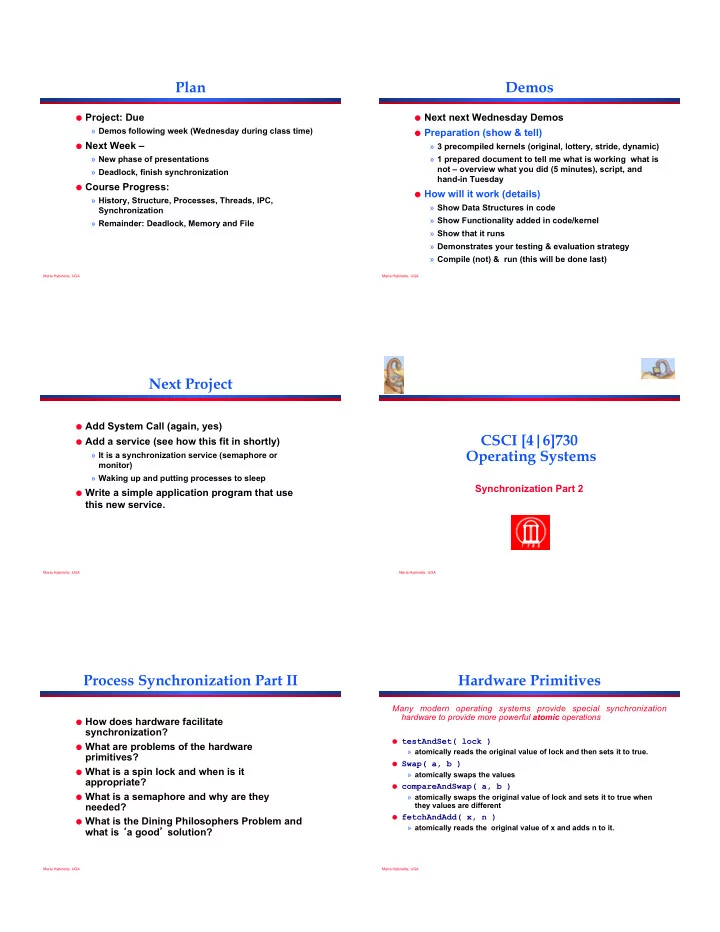
Plan Demos ! Project: Due ! Next next Wednesday Demos Demos following week (Wednesday during class time) ! Preparation (show & tell) ! Next Week 3 precompiled kernels (original, lottery, stride, dynamic) New phase of presentations


slide-1
SLIDE 1

Maria Hybinette, UGA

Plan

! Project: Due

» Demos following week (Wednesday during class time)

! Next Week –

» New phase of presentations » Deadlock, finish synchronization

! Course Progress:

» History, Structure, Processes, Threads, IPC, Synchronization » Remainder: Deadlock, Memory and File

Maria Hybinette, UGA

Demos

! Next next Wednesday Demos ! Preparation (show & tell)

» 3 precompiled kernels (original, lottery, stride, dynamic) » 1 prepared document to tell me what is working what is not – overview what you did (5 minutes), script, and hand-in Tuesday

! How will it work (details)

» Show Data Structures in code » Show Functionality added in code/kernel » Show that it runs » Demonstrates your testing & evaluation strategy » Compile (not) & run (this will be done last)

Maria Hybinette, UGA

Next Project

! Add System Call (again, yes) ! Add a service (see how this fit in shortly)

» It is a synchronization service (semaphore or monitor) » Waking up and putting processes to sleep

! Write a simple application program that use

this new service.

Maria Hybinette, UGA

CSCI [4|6]730 Operating Systems

Synchronization Part 2

Maria Hybinette, UGA

Process Synchronization Part II

! How does hardware facilitate

synchronization?

! What are problems of the hardware

primitives?

! What is a spin lock and when is it

appropriate?

! What is a semaphore and why are they

needed?

! What is the Dining Philosophers Problem and

what is ‘a good’ solution?

Maria Hybinette, UGA

Hardware Primitives

Many modern operating systems provide special synchronization hardware to provide more powerful atomic operations

! testAndSet( lock )

» atomically reads the original value of lock and then sets it to true.

! Swap( a, b )

» atomically swaps the values

! compareAndSwap( a, b )

» atomically swaps the original value of lock and sets it to true when they values are different

! fetchAndAdd( x, n )

» atomically reads the original value of x and adds n to it.

slide-2
SLIDE 2

Maria Hybinette, UGA

Hardware: testAndSet();

boolean testAndSet ( boolean *lock ) { boolean old_lock = lock ; lock = true; return old_lock; }

! If someone has the lock (it returns TRUE) and wait

until it is available (until some-one gives it up, sets it to false).

! Atomicity guaranteed - even on multiprocessors

// initialization lock = false ; // shared -- lock is available void deposit( int amount ) { // entry to critical section - get the lock while( testAndSet( &lock ) == true ) {} ; balance += amount // critical section // exit critical section - release the lock lock = false; }

Maria Hybinette, UGA

Hardware: Swap();

void Swap( boolean *a, boolean *b ) { boolean temp = *a ; *a = *b; *b = temp; }

! Two Parameters: a global and local (when lock is

available (false) get local key (false)).

! Atomicity guaranteed - even on multiprocessors ! Bounded waiting?

» No! How to provide?

// initialization lock = false ; // global shared -- lock is available void deposit( int amount ) { // entry critical section - get local variable key key = true; // key is a local variable while( key == true ) Swap( &lock, &key ); balance += amount // critical section // exit critical section - release the lock lock = false; }

Maria Hybinette, UGA

Hardware with Bounded Waiting

! Need to create a waiting line. ! Idea: “Dressing Room” is the critical section,

  • nly one person can be in the room at one time,

and one waiting line outside dressing room that serves customer first come first serve.

» waiting[n] : Global shared variable » lock: Global shared variable

! Entry get a local variable ‘key’ and check via

testAndSet() if someone is ‘in’ the dressing room

Maria Hybinette, UGA

Hardware with Bounded Waiting

// initialization lock = false ; // shared -- lock is available waiting[0.. n-1] = {false} ; // shared -- no one is waiting void deposit( int amount ) { // entry to critical section waiting[tid] = true; // signal tid is waiting key = true; // local variable while( ( waiting[tid] == true ) and ( key == true ) ) key = testAndSet( &lock ); waiting[tid] = false; // got lock done waiting balance += amount // critical section // exit critical section - release the lock j = (tid + 1) mod n; // j is possibly waiting next in line while( ( j != tid ) and ( waiting[j] == false ) ) j = (j + 1) mod n; // check next if waiting if( j == tid ) // no one is waiting unlock room lock = false; else waiting[j] = false // hand over the key to j }

Maria Hybinette, UGA

Hardware Solution: Proof “Intuition”

! Mutual Exclusion:

» A thread enters only if it is waiting or if the dressing room is unlocked

– First thread to execute testAndSet( &lock )gets the lock all

  • thers will wait

– Waiting becomes false only if the thread with the lock leaves its CS and only one waiting is set to false. ! Progress:

» Since an exiting thread either unlocks the dressing room

  • r hands the ‘lock’ to another thread progress is

guaranteed because both allow a waiting thread access to the dressing room

! Bounded Waiting:

» Leaving threads scans the waiting array in cyclic order thus any waiting thread enters the critical section within n-1 turns.

Maria Hybinette, UGA

Synchronization Layering

! Build higher-level synchronization primitives in OS

» Operations that ensure correct ordering of instructions across threads

! Motivation: Build them once and get them right

» Don’t make users write entry and exit code

Monitors! *Semaphores! Condition Variables! *Locks! Loads! Stores! Test&Set! Disable Interrupts!

slide-3
SLIDE 3

Maria Hybinette, UGA

Locks

! Goal: Provide mutual exclusion (mutex) » The other criteria for solving the critical section problem may be violated ! Three common operations:

Allocate and Initialize

pthread_mutex_t mylock; mylock = PTHREAD_MUTEX_INITIALIZER;

Acquire

Acquire exclusion access to lock; Wait if lock is not available

pthread_mutex_lock( &mylock ); Release

Release exclusive access to lock

pthread_mutex_unlock( &mylock );

Maria Hybinette, UGA

Lock Examples

! After lock has been allocated and initialized

void deposit( int amount ) { pthread_mutex_lock( &my_lock ); balance += amount; // critical section pthread_mutex_unlock( &my_lock ); } void deposit( int account_tid, int amount ) { pthread_mutex_lock( &locks[account_tid] ); balance[account_tid] += amount; // critical section pthread_mutex_unlock( &locks[account_tid] ); }

! One lock for each bank account (maximize

concurrency)

Maria Hybinette, UGA

Implementing Locks: Atomic loads and stores

! Disadvantage: Two threads only

typedef struct lock_s bool lock[2] = {false, false}; int turn = 0; void acquire( lock_s *lock ) lock->lock[tid] = true; turn = 1-tid; while( lock->lock[1-tid] && lock->turn ==1-tid ) void release( lock_s lock ) lock->lock[tid] = false;

Maria Hybinette, UGA

Implementing Locks: Hardware Instructions (now)

! Advantage: Supported on multiple processors ! Disadvantages:

» Spinning on a lock may waste CPU cycles » The longer the CS the longer the spin

– Greater chance for lock holder to be interrupted too! typedef boolean lock_s; void acquire( lock_s *lock ) while( true == testAndSet( theLock ) ) {} ; // wait void release( lock_s lock ) lock = false;

Maria Hybinette, UGA

Implementing Locks: Disable/Enable Interrupts

! Advantage: Supports mutual exclusion for many

threads (prevents context switches)

! Disadvantages:

» Not supported on multiple processors, » Too much power given to a thread (may not release lock_ » May miss or delay important events

void acquire( lock_s *lock ) disableInterrupts(); void release( lock_s lock ) enableInterrupts();

Maria Hybinette, UGA

Spin Locks and Disabling Interrupts

! Spin locks and disabling interrupts are useful only for

short and simple critical sections (not computational

  • r I/O intensive):

» Wasteful otherwise » These primitives are primitive -- don’t do anything besides mutual exclusion (doesnʼt ʻsolveʼ the critical section problem).

! Need a higher-level synchronization primitives that: – Block waiters – Leave interrupts enabled within the critical section

» All synchronization requires atomicity

– So we’ll use our “atomic” locks as primitives to implement them

slide-4
SLIDE 4

Maria Hybinette, UGA

Semaphores

! Semaphores are another data structure that

provides mutual exclusion to critical sections

» Described by Dijkstra in the THE system in 1968 » Key Idea: A data structure that counts number of “wake-ups” that are saved for future use.

– Block waiters, interrupts enabled within CS ! Semaphores have two purposes:

» Mutual Exclusion: Ensure threads don’t access critical section at same time » Scheduling constraints (ordering) Ensure thhat threads execute in specific order (implemented by a waiting queue).

Maria Hybinette, UGA

Blocking in Semaphores

! Idea: Associated with each semaphore is a queue of

waiting processes (typically the ones that want to get into the critical section)

! wait() tests (probes) the semaphore (DOWN) (wait to get

in).

» If semaphore is open, thread continues » If semaphore is closed, thread blocks on queue

! signal() opens (verhogen) the semaphore (UP): (lets

  • thers in)

» If a thread is waiting on the queue, the thread is unblocked » If no threads are waiting on the queue, the signal is remembered for the next thread (i.e., it stores the “wake-up”).

– signal() has history – This ‘history’ is a counter

Maria Hybinette, UGA

Semaphore Operations

! Allocate and Initialize

» Semaphore contains a non-negative integer value » User cannot read or write value directly after initialization – sem_t sem; – int sem_init( &sem, is_shared, init_value );

! wait() ! or test or sleep or probe or down (block) or decrement.

» P() for “test” in Dutch (proberen) also down() » Waits until semaphore is open (sem>0) then decrement sem value – int sem_wait( &sem );

! signal() ! or wakeup or up or increment or post. (done)

» V() for “increment” in Dutch (verhogen) also up(), signal() » Increments value of semaphore, allow another thread to enter – int sem_post(&sem);

Maria Hybinette, UGA

A Classic Semaphore

! S->value = 0 indicates all resources are exhausted/used. » Note that S->value is never negative here (it spins), this is the classic definition of a semaphore ! Assumption: That there is atomicity between all instructions

within the semaphore functions and across (incrementing and the waking up – i.e., you can’t perform wait() and signal () concurrently.

typedef struct { int value; // Initialized to #resources available }semaphore; sem_wait( semaphore *S ) // Must be executed atomically while S->value <= 0; S->value--; sem_signal( semaphore *S ) // Must be executed atomically S->value++;

Maria Hybinette, UGA

Semaphore Implementation (that avoids busy waiting) System V & Linux Semaphores

typedef struct { int value; queue tlist; // blocking list of ‘waiters’ } semaphore; sem_wait( semaphore *S ) // Must be executed atomically S->value--; if( S->value < 0 ) add this process to S->tlist; block(); sem_signal( semaphore *S ) // Must be executed atomically S->value++; if( S->value <= 0 ) // Threads are waiting remove thread t from S->tlist; wakeup(t);

Maria Hybinette, UGA

Semaphore Example

! Observations?

! sem value is negative (what does the magnitude mean)?

– Number of waiters on queue

» sem value is positive? What does this number mean, e.g., What is the largest possible value of the semaphore?

– Number of threads that can be in critical section at the same time typedef struct { int value; /* initialize to 2 */ queue tlist; } semaphore; sem_wait( semaphore *S ) S->value--; if (S->value < 0) add calling thread to S->tlist; block(); sem_signal( semaphore *S ) S->value++; if (S->value <= 0) remove a thread t from S->tlist; wakeup(t);

What happens when sem.value is initialized to 2? Assume three threads call sem_wait( &sem )

slide-5
SLIDE 5

Maria Hybinette, UGA

Mutual Exclusion with Semaphores

! Previous example with locks:

void deposit( int amount ) { pthread_mutex_lock( &my_lock ); balance += amount; // critical section pthread_mutex_unlock( &my_lock ); } void deposit( int amount ) { sem_wait( &sem ); balance += amount; // critical section sem_post( &sem ); }

! Example with Semaphore:

What value should sem be initialized to provide ME?

Maria Hybinette, UGA

Beware: OS Provided Semaphores

! Strong Semaphores: Order in semaphore is

specified (what we saw, and what most OSs use). FCFS.

! Weak Semaphore: Order in semaphore

definition is left unspecified

! Something to think about:

» Do these types of semaphores solve the Critical Section Problem? Why or Why not?

Maria Hybinette, UGA

Danger Zone Ahead

Maria Hybinette, UGA

Dangers with Semaphores

! Deadlock:

» Two or more threads are waiting indefinitely for an event that can be caused by only one of the waiting processes

! Example:

» Two threads: Maria and Tucker » Two semaphores: semA, and semB both initialized to 1

sem_wait( semA ) sem_wait( semB ) sem_post( semA ); sem_post( semB ); sem_wait( semB ) sem_wait( semA ) sem_post( semB ); sem_post( semA );

Thread Maria Thread Tucker

Maria Hybinette, UGA

Semaphore Jargon

! Binary semaphore is sufficient to provide

mutual exclusion (restriction)

» Binary semaphore has boolean value (not integer) » bsem_wait(): Waits until value is 1, then sets to 0 » bsem_signal(): Sets value to 1, waking one waiting process

! General semaphore is also called counting

semaphore.

Maria Hybinette, UGA

Semaphore Verdict

! Advantage:

» Versatile, can be used to solve any synchronization problems!

! Disadvantages:

» Prone to bugs (programmers’ bugs) » Difficult to program: no connection between semaphore and the data being controlled by the semaphore

! Consider alternatives: Monitors, for example,

provides a better connection (data, method, synchronization)

slide-6
SLIDE 6

Maria Hybinette, UGA

! Next will look at:

» synchronization problems & » start on deadlock

Maria Hybinette, UGA

Classes of Synchronization Problems (Thu)

! Uniform resource usage with simple scheduling constraints

» No other variables needed to express relationships » Use one semaphore for every constraint » Examples: producer/consumer

! Complex patterns of resource usage

» Cannot capture relationships with only semaphores » Need extra state variables to record information » Use semaphores such that

– One is for mutual exclusion around state variables – One for each class of waiting ! Always try to cast problems into first, easier type

Maria Hybinette, UGA

Classical Problems: Readers Writers

! Idea:

» While data structure is updated (write) often necessary to bar other threads from reading

! Basic Constraints (Bernstein’s Condition):

» Any number of readers can be in CS simultaneously » Writers must have exclusive access to CS

! Some Variations:

» First Readers: No reader kept waiting unless a writer already in CS - so no reader should wait for other readers if a writer is waiting already (reader priority) » Second Readers: Once a writer is ready the writer performs write as soon as possible (writer priority) Set of problems where data structures, databases or file systems are read and modified by concurrent threads

Maria Hybinette, UGA

First Readers: Initialization

! Reader priority ! First readers: simplest reader/writer problem

» requires no reader should wait for other readers to finish even if there is a writer waiting. » Writer is easy – it gets in if the room is available

! Two semaphores both initialized to 1

» Protect a counter » Keep track whether a “room” is empty or not

int reader = 0 // # readers in room sem_t mutex; // 1 available - mutex to protect counter sem_t roomEmpty; // 1 (true) if no threads and 0 otherwise int sem_is_shared = 0; // both threads accesses semaphore sem_init( &mutex, sem_is_shared, 1 ); sem_init( &roomEmpty, sem_is_shared, 1 );

Maria Hybinette, UGA

First Reader: Entrance/Exit Writer

! Writer can go if the room is empty (unlocked)

void enterWriter() sem_wait (&roomEmpty) void exitWriter() sem_post( &roomEmpty );

Maria Hybinette, UGA

First Reader: Entrance/Exit Reader

! Only ONE reader is queued on roomEmpty, but

several writers may be queued

! When a reader signals roomEmpty no other

readers are in the room (the room is empty, key unlocked)

void enterReader() sem_wait(&mutex); reader++; if( reader == 1 ) sem_wait( &roomEmpty ); // first in locks sem_post( &mutex ); void exitReader() sem_wait(&mutex) ; reader--; if( reader == 0 ) sem_post( &roomEmpty ); // last out unlocks sem_post( &mutex );

slide-7
SLIDE 7

Maria Hybinette, UGA

Evaluation: First Reader

! Only one reader is queued on roomEmpty ! When a reader signals roomEmpty no other readers

are in the room

! Writers Starve? Readers Starve? Both?

void enterReader() sem_wait(&mutex) reader++; if( reader == 1 ) sem_wait( &roomEmpty ); // first on in locks sem_post( &mutex ); void exitReader() sem_wait(&mutex) reader--; if( reader == 0 ) sem_post( &roomEmpty ); // last unlocks sem_post( &mutex ); void enterWriter() sem_wait(&roomEmpty) void exitWriter() sem_post(&roomEmpty);

Maria Hybinette, UGA

Food for though

! How would you implement Second Reader?

Maria Hybinette, UGA

Classical Problems: Dining Philosophers

! Problem Definition Statement:

» N Philosophers sit at a round table » Each philosopher shares a chopstick (a shared resource) with neighbor » Each philosopher must have both chopsticks to eat » Immediate Neighbors can’t eat simultaneously » Philosophers alternate between thinking and eating

void philosopher( int i ) while(1) think() take_chopstick(i); eat(); put_chopstick(i);

Classic Multiprocess synchronization that stemmed from five computers competing for access to five shared tape drive peripherals.

Maria Hybinette, UGA

Beware of the Imposters!

Aristotle Plato Socrates René Descartes Frances Bacon

Who is who? Answers next slide:

Maria Hybinette, UGA

Beware of the Imposters

Aristotle Plato Socrates René Descartes Frances Bacon

Maria Hybinette, UGA

Dining Philosophers

! Two neighbors can’t use chopstick at same time ! Must test if chopstick is there and grab it atomically

» Represent EACH chopstick with a semaphore » Grab right chopstick then left chopstick » sem_t chopstick[5]; // Initialize each to 1

put_chopstick( int i ) sem_post( &chopstick[i] ); sem_post( &chopstick[(i+1) % 5] ); take_chopstick( int i ) sem_wait( &chopstick[i] ); sem_wait( &chopstick[(i+1) % 5] ); ! Guarantees no two neighbors eats simultaneously ! Does this work? Why or Why Not? ! What happens if all philosophers wants to eat and grabs the left

chopstick (at the same time)?

! Is it efficient? – (assuming we are lucky and it doesn’t deadlock)?

void philosopher( int i ) while(1) think() take_chopstick(i); eat(); put_chopstick(i);

slide-8
SLIDE 8

Maria Hybinette, UGA

Dining Philosophers: Attempt 2 Serialize

! Add a mutex to ensure that a philosopher gets both

chopsticks.

! Problems?

» How many philosophers can dine at one time? » How many should be able to eat?

void philosopher( int i ) while(1) think() sem_wait( &mutex ); take_chopstick(i); eat(); put_chopstick(i); sem_post( &mutex ) put_chopstick( int i ) sem_post( &chopstick[i] ); sem_post( &chopstick[(i+1) % 5] ); take_chopstick( int i ) sem_wait( &chopstick[i] ); sem_wait( &chopstick[(i+1) % 5] );

Maria Hybinette, UGA

Dining Philosophers: Common Approach

! Grab lower-numbered chopstick first, then higher-numbered ! Problems?

» Safe: Deadlock? Asymmetry avoids it – so it is safe

! Performance (concurrency?)

» P0 and P4 grabs chopstick simultaneously - assume P0 wins » P3 can now eat but P0 and P1 are not eating even if they don’t share a chopstick with P3 (so it is not as concurrent as it could be)

take_chopstick( int i ) if( i < 4 ) sem_wait( &chopstick[i] ); //* Right sem_wait( &chopstick[(i+1)] ); //* Left else sem_wait( &chopstick[0] ); //* Left sem_wait( &chopstick[4] ); //* Right

c1 c0 c2 c3 c4 p0 p1 p2 p3 p4

Eats Got one fork Out in the cold: No forks

Maria Hybinette, UGA

What Todo: Ask Dijkstra?

! Want to eat the cake too: Guarantee two goals:

» Safety (mutual exclusion): Ensure nothing bad happens (don’t violate constraints of problem) » Liveness (progress) : Ensure something good happens when it can (make as much progress as possible)

! Introduce state variable for each philosopher i » state[i] = THINKING, HUNGRY, or EATING ! Safety: No two adjacent philosophers eat simultaneously (ME) » for all i: !(state[i]==EATING && state[i+1%5] == EATING) ! Liveness: No philosopher is HUNGRY unless one of his neighbors is

eating (actually eating)!

» ! - Not the case that :

– a philosopher is hungry and his neighbors are not eating -- ! » for all i: !(state[i]==HUNGRY && (state[i+4%5]!=EATING && state[i+1%5]!=EATING))

Maria Hybinette, UGA

What Todo: Ask Dijkstra?

! Guarantees the two goals (helps to solve the problem):

» Safety (mutual exclusion): Ensure nothing bad happens (don’t violate constraints of problem) » Liveness (progress) : Ensure something good happens when it can (make as much progress as possible)

! Introduce a state variable for each philosopher i » state[i] = THINKING, HUNGRY, or EATING ! Safety: No two adjacent philosophers eat simultaneously

(ME)

» for all i: !(state[i]==EATING && state[i+1%5] == EATING) ! Liveness: No philosopher is HUNGRY unless one of his neighbors

is eating!

» Not the case that a philosopher is hungry and his neighbors are not eating -- !

» for all i: !(state[i]==HUNGRY && (state[i+4%5]!=EATING && state[i+1%5]!=EATING))

Maria Hybinette, UGA

Dining Philosophers: Dijkstra

sem_t mayEat[5] = {0}; // permission to eat (testSafety will grant) sem_t mutex = {1} ; // how to init int state[5] = {THINKING}; take_chopsticks(int i) sem_wait( &mutex ); // enter critical section state[i] = HUNGRY; testSafetyAndLiveness(i); // check for permission sem_post( &mutex ); // exit critical section sem_wait(&mayEat[i]); put_chopsticks(int i) sem_wait(&mutex); // enter critical section state[i] = THINKING; testSafetyAndLiveness(i+1 %5); // check if left neighbor can run now testSafetyAndLiveness(i+4 %5); // check if right neighbor can run now sem_post(&mutex); // exit critical section testSafetyAndLiveness(int i) if( state[i]==HUNGRY && state[i+4%5]!= EATING&&state[i+1%5]!= EATING ) state[i] = EATING; sem_post( &mayEat[i] );

Maria Hybinette, UGA

Yum!

Aristotle Plato Socrates René Descartes http://users.erols.com/ziring/diningAppletDemo.html Frances Bacon http://www.doc.ic.ac.uk/~jnm/book/book_applets/Diners.html

slide-9
SLIDE 9

Maria Hybinette, UGA

! http://www.doc.ic.ac.uk/~jnm/concurrency/

classes/Diners/Diners.html

Maria Hybinette, UGA

Monitors make things easier!

! Motivation:

» Users can inadvertently misuse locks and semaphores (e.g., never unlock a mutex)

! Idea:

» Languages construct that control access to shared data » Synchronization added by compiler, enforced at runtime

! Monitor encapsulates

» Shared data structures » Methods

– that operates on shared data structures

» Synchronization between concurrent method invocations

! Protects data from unstructured data access ! Guarantees that threads accessing its data through its

procedures interact only in legitimate ways