Place: Experiences and Lessons Learnt towards Sustainability - - PowerPoint PPT Presentation

place experiences and lessons
SMART_READER_LITE
LIVE PREVIEW

Place: Experiences and Lessons Learnt towards Sustainability - - PowerPoint PPT Presentation

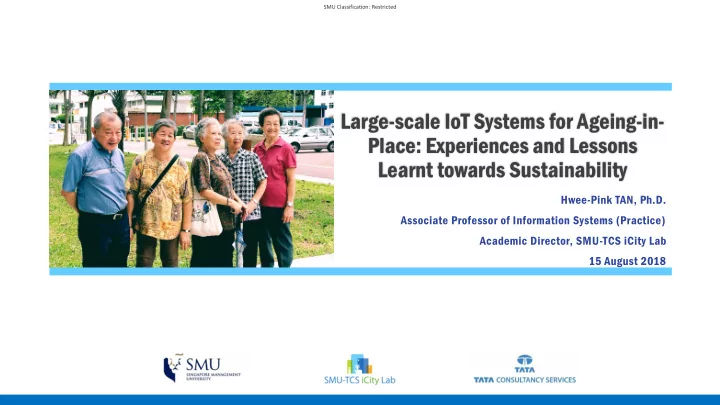
SMU Classification: Restricted Large-scale IoT Systems for Ageing-in- Place: Experiences and Lessons Learnt towards Sustainability Hwee-Pink TAN, Ph.D. Associate Professor of Information Systems (Practice) Academic Director, SMU-TCS iCity Lab


slide-1
SLIDE 1

SMU Classification: Restricted

Large-scale IoT Systems for Ageing-in- Place: Experiences and Lessons Learnt towards Sustainability

Hwee-Pink TAN, Ph.D. Associate Professor of Information Systems (Practice) Academic Director, SMU-TCS iCity Lab 15 August 2018

slide-2
SLIDE 2

SMU Classification: Restricted

2

About the SMU-TCS iCity Lab

  • Track record in executing large

transformation projects for governments

  • Digital reimagination with social

media, mobile, big data analytics and IoT

  • Focused on integrating

computing, management and social science

  • Multi-disciplinary expertise on

smart city solutions

  • State-of-the-art city campus in

Singapore ideal for piloting solutions

  • Established in August

2011 to explore and pursue new research areas in Smart t Citie ties to provide long-term competitive advantage to TCS

  • i = {intelligent,

integrated, inclusive, innovative}

slide-3
SLIDE 3

SMU Classification: Restricted

3

iCity Lab’s research focus

vs Phase 1 (2011-2014) From thought leadership to smart aging

Citizen engagement and services aspects Community with special needs

Phase 2 (2014-2017) Citizen-centric community care for ageing-in-place

Application of IoT through social- behavioural lens Partnership with key stakeholders Deployments at scale with caregivers

Phase 3 (2017-2020) Citizen as a producer for resilient cities

Citizen as consumer and producer

  • f services
slide-4
SLIDE 4

SMU Classification: Restricted

4

Meeting the needs of seniors living alone

Source: The Straits Times, 12 April 2012

“Can non-intrusive technologies be used to better enable person son-cent centric ric comm mmuni unity ty care re for me to age-in-place?”

  • Mr Lim, 73yo, living alone, beneficiary
  • Elderly living alone need community support to

ensure their

  • Safety
  • Physical wellbeing
  • Social wellbeing

2x

More likely to die prematurely

2x

More likely to feel depressed “Can the system compl plem emen ent, instead of burden, ou

  • ur

r team am to provide targeted, as- needed and timely care for the elderly to age- in-place?”

  • Ms Tan, 45yo, community caregiver, user &

beneficiary

slide-5
SLIDE 5

SMU Classification: Restricted

5

Data-driven Community Eldercare Platform

dashboard OTT messaging In-home sensing Data management Analytics

INSIGHT IGHT & AC ACTION TION ENABLER BLER DA DATA A COLLE LECT CTION ION Modular by design, extensibility by choice

Surveys and

  • bservations

Aging-related Policy Enablers Community Care Enablers Technology Enablers Community Dwelling Elderly

slide-6
SLIDE 6

SMU Classification: Restricted

6

Needs of key ecosystem partners

“Can I maximize the reli liability ity of the system and minimize the need for predictive maintenance?”

  • Mr Ong, 43yo,
  • CTO, Tech4Elderly Pte Ltd

“Are our HDB town wns sufficiently age-friendl riendly where seniors living alone can remain physically, socially and mentally well and safe?”

  • Ms Lee, 35yo,
  • Urban Planning Group,
  • Urban Redevelopment Authority

“Is there evidence that data-driven community care can improve the wellbei llbeing

  • f seniors living alone through both reactive

and preventive care”

  • Dr Ho, 50yo,
  • Ageing Planning Office,
  • Ministry of Health

“Is it economi

  • mical

cally ly viable e and useful to have in-home monitoring technologies that can improve the safety and wellbeing of seniors living alone?”

  • Mr Yap, 40yo,
  • Technology Research,
  • Housing Development Board
slide-7
SLIDE 7

SMU Classification: Restricted

7

Year

  • Reactive care for 48 elderly {help button & prolonged inactivity}
  • Preventive care for 48 elderly {social, cognitive and physical wellbeing)

Community partner # elderly beneficiaries (living alone) 2015 2016 2017 Marine Parade (>36 months) Care for 17 elderly for irregular medication patterns, help button and prolonged inactivity Bedok South (>12 months) 2018

Over 200 elderly reached with ~90 ‘live’ homes

  • Reactive care for 50 elderly {help

button & prolonged inactivity)

  • Preventive care (social wellbeing)

5 estates (>12 months) Identifying cognitive impairment among 48 elderly through passive sensing and wearables Multiple estates (<2 months)

  • VWO/NOK care for 6

elderly

  • Call centre care for 22

elderly (Yellow Flag) Bukit Merah / Tampines / Bedok North (< 12 months)

slide-8
SLIDE 8

SMU Classification: Restricted

8

What our users & beneficiaries say?

“…For

  • r a layp

yper erso son li like ke me, me, it it wa was ea easy sy to to se see and inter terpret

  • ret. I didn’t have to ask too much questions for confirmation and we

we managed ed to to save the senior

  • r.”
  • Senior Case Worker 1, MontfortCare

“……from

  • m a new

ew wor worker ers per erspecti spective, e, to to be be able to to se see all ll th the inf informatio

  • rmation on
  • n th

the scre screen en is is ver ery hel elpful and it’s ver very ea easy sy for

  • r

people to to respond

  • nd."
  • Senior Case Worker 2, MontfortCare

“….one other things I thought this was good, it gives s elderl rly y some e form rm of securit ity to know that they are being monitored, specially those are frail, that they are not left alone in the community”

  • Case Worker 2, THK Moral Society

“In In general, l, I feel positiv ive about the sensor

  • r syste

tem. If something happens to me, someone will know…”

  • Elderly, Mdm Khoo, 77 – Marine Terrace

“I feel that it is beneficial for me as I am getting old too. I’m slightly more fragile and I think with age, it’s a bit harder to do certain things like heavy household chores. ……. It helps me feel l a s sense e of securit ity”

  • Elderly, Mdm Teng, 88 – Bedok South
slide-9
SLIDE 9

SMU Classification: Restricted

9

In-home unobtrusive monitoring system

Moti tion

  • n Sensor

sor Door Contact Legend: Gateway Sensorized medication box Help/fr p/friend endshi ship butt tton Beacon

  • n
slide-10
SLIDE 10

SMU Classification: Restricted

10

Evolution of In-Home Monitoring System

Vendor A system

  • Built in-house
  • Proprietary comms

standards

  • 2G system
  • No ack with help button

Vendor B system

  • Proprietary gateway with
  • ff-the-shelf z-wave

sensors

  • Unused UI indicates

power consumption

Open, reliable and extensible system

  • Fully-based on off-the-

shelf devices

  • Open comms standards
  • Extensible
  • ACK with help button
  • Full system monitoring
  • Senior-centric design
  • Minimal disruption to their lives
  • Maximum dependability
slide-11
SLIDE 11

SMU Classification: Restricted

11

Technology-enabled Personalized & Timely Reactive Community Care

Medication non- adherence Data analysis & anomaly detection Help / friendship request Prolonged away duration Prolonged inactivity (Door) Prolonged inactivity @ home Anomaly-triggered Alert (Person-centric) Person-centric Response protocol Care execution & evaluation Community Care Model Refinements Provide timely care and intervention Person-centric rules Elderly Living Alone Community Caregivers Community Volunteers VWO/Call Centre/NOK

slide-12
SLIDE 12

SMU Classification: Restricted

12

Prolonged inactivity / dwell time @ home

Challenge: enge: How w to to set t th the ri right t alert rt th thre reshol

  • ld for

r different erent elderly erly with th different erent daily ro routi tines es

A A period of prolonged inactivity at home / zonal dwell time can indicate trouble for the elderly resident When this duration exceeds a threshold, trigger an alert to caregivers

slide-13
SLIDE 13

SMU Classification: Restricted

13

Data-driven alert threshold personalization

Aunty Tan Stays home mostly Frail, fall history Socializes infrequently, with few visitors Aunty Chan Daily exercise routine Generally fit Socializes frequently

Historical Inactivity Data Methods

Exceedance-based Day/Night Threshold

Early 80s High blood pressure, diabetes and high cholesterol

Pers rson

  • nali

lize zed Alert ert Th Thre resh shol

  • ld
slide-14
SLIDE 14

SMU Classification: Restricted

14

Balancing needs of elderly and caregiver

15 15 Sep – 31 Dec ‘15 1 J Jan an – 31 Dec ‘16

Daytime Threshold (Average) 8 hours 5.7 hours Nighttime Threshold (Average) 8 hours 4.9 hours False se Alarm rm Rate e Due to Threshol reshold Exceeda eedance ce* 5 False se Alarms arms / 3.5 Mo Months ths = 1.4 Per r Month th 63 63 False se Alarms arms / 12 12 Mo Months ths = = 5.3 Per r Month th Overall False Alarm Rate 43 False Alarms / 3.5 Months = 12.3 Per Month 121 False Alarms / 12 Months = 10.1 Per Month Event of stress detected faster! Within tolerable fatigue limit!

slide-15
SLIDE 15

SMU Classification: Restricted

15

Technology-enabled Personalized Reactive Community Care (Medication regularity)

Zone Marine ine Pa Parade Bedok

  • k South

th HDB type Rental Rental Total l no of elderl erly 10 14 Senior ior profil ile Generally healthy and socially active Vulnerable and frequently admitted to hospital #Medicati ication

  • n types

es 4 to 10 1 to 15 Medicati ication

  • n intake

e frequenc ency 1 to 3 1 to 4 Period riod Jul 15 - Apr 16 Jul 16 - Feb 18 Careg egiv iver er MontfortCare Neighbours for Active Living St Study type Observational Interventional

slide-16
SLIDE 16

SMU Classification: Restricted

16

Understanding elderlies’ needs & wellbeing

Social-demographic profile, family support, financial status Physical health, mental health, medication, sleep patterns and quality, activities of daily living Social function, overall happiness and wellbeing, liveability, technology Routines and unusual events (hospitalization, faint spells, family visits etc)

Psychosocial Surveys & Regular Ground Observations

slide-17
SLIDE 17

SMU Classification: Restricted

17

Care for Inferred Non-medication adherence

Non-adherence leads to adverse health complications Existing solutions are costly and cannot be tailored to elderly’s habits Real-time monitoring allows for timely care and personalized intervention

~60% of elderly store

medication in

plastic bags or containers ~80% of elderly have no packing assistance ~87.5% of elderly are

  • n daily medication
slide-18
SLIDE 18

SMU Classification: Restricted

18

User-centric approach to real-time monitoring

Existing Medication Packing Habits Sensor-Enabled Medication Box

Moti tion

  • n Sensor

sor Door Contact Legend: Gateway Sensorized medication box Help/fr /frien endsh ship ip butt tton Beacon

  • n
slide-19
SLIDE 19

SMU Classification: Restricted

19

Irregular medication behavior is common

Very few elderly exhibit consistent medication behaviors

slide-20
SLIDE 20

SMU Classification: Restricted

20

Data-driven care for irregular medication

Real-time monitoring data Categorization of adhering vs non-adhering elderly Community care and intervention

slide-21
SLIDE 21

SMU Classification: Restricted

21

Evolution of Caregiver Notification Interface

Mobile app A

  • Difficult to navigate from

alert to resident activity

  • OS and device dependent

performance

  • Missing alert delivery

Mobile app B

  • Presents glut of

unactionable information

  • Primarily targeted at savvy

users

  • Plenty of user-

configuration needed

Unified interface

  • Inactivity,

help/friendship, yellow flag and medication

  • Context-rich alert
  • Enables group

collaboration and response

  • Caregiver-centric design
  • Complements, instead of burdens
  • Ease of use, and when-needed use
slide-22
SLIDE 22

SMU Classification: Restricted

22

Intervention improves medication regularity

Improved medication regularity after intervention in Sep 2016 (medication reconciliation) Early 60s

  • Polypharmacy
  • Wheelchair-bound
  • Live-in daughter is primary

caregiver

slide-23
SLIDE 23

SMU Classification: Restricted

23

Personalized Preventive Care to meet wellbeing needs

Elderly Living Alone Community Caregiver Activity level @ bedroom Multi-modal Data analysis Activity level @ kitchen Going out Activity level @ bathroom Overall activity level @home

Poor / declining wellbeing level?

Personalized care plan Care execution & evaluation Community Care Model Refinements

Wellbeing indices

  • Loneliness

Loneliness/S /Social

  • cial

Isola lati tion

  • n
  • Physical frailty
  • Sleep Quality

Provide care and intervention

slide-24
SLIDE 24

SMU Classification: Restricted

24

Preventive Care (Social Isolation)

Emotional loneliness Social loneliness Social network Social Isolation Score Average daily going out duration

  • 0.22

(0.144)

  • 0.38*

.38* (0.0 .011) 0.31* 1* (0.0 .037) 7)

  • 0.42*

.42* (0.0 .005*) *) Going out count 0.13 (0.392)

  • 0.10

(0.503)

  • 0.07

(0.656) 0.08 (0.606) Napping duration

  • 0.08

(0.597) 0.32 32* (0.038)

  • 0.26

(0.101)

  • 0.05

(0.777) Night time sleep duration

  • 0.12

(0.448) 0.24 (0.133)

  • 0.14

(0.373)

  • 0.16)

(0.297 Average time spent in the living room 0.31* 1* (0.0 .049)

  • 0.01

(0.973)

  • 0.23

(0.149) 0.17 (0.292) Kitchen activity

  • 0.11

(0.48) 0.03 (0.854) 0.03 (0.852) 0.10 (0.508)

P values are in parenthesis *** p < 0.001, ** p < 0.01, * p < 0.05

AWAY DURATION, NAPPING DURATION and TIME SPENT IN THE LIVING ROOM are correlated with social isolation dimensions

Sensor- derived features Survey-derived indices

Source: “Sensor-Driven Detection of Social Isolation in Community-Dwelling Elderly”, N. Goonawardene et. al., Human Aspects of IT for the Aged Population, July 2017
slide-25
SLIDE 25

SMU Classification: Restricted

25

Effective socialising

  • Chronic conditions do not predict socializing
  • Elderly with high social network but still feels lonely needs attention
  • Findings can provide useful recommendations for value-added personalized eldercare planning

Source: “Employing In-Home Sensor Technology to explore Elderly needs and Community Participation: Implications on Personalising Community Elder Care”, M. Huang et al, 8th APRU Population Aging Conference, Oct 2017, Singapore

slide-26
SLIDE 26

SMU Classification: Restricted

26

Preventive Care (Early detection of frailty)

Frail Robust

Generic model Daytime model Away duration

5 4

Napping duration

1 2

Night time sleep duration

3 NA

Time spent in the bedroom

2 NA

Kitchen activity level

4 NA

Kitchen usage duration

7 NA

Transitions

6 NA

Time spent in the bedroom (daytime)

NA 3

Door open count (daytime)

NA 1

Feature ranking (Logistic Regression) Correlation (Sensor-derived features, Frailty Index) ROC curve (Generic vs Daytime Features) Napping duration can tell us if an elderly is frail!

Source: “Unobtrusive Detection of Frailty in Older Adults”, N. Goonawardene et. al., Human Aspects of IT for the Aged Population, July 2018

slide-27
SLIDE 27

SMU Classification: Restricted

27

Preventive Care (Mild Cognitive Impairment)

Can information derived from in-home sensing differentiate cognitively healthy (HC) elderly from those with and mild cognitive impairment (MCI)?

In-home activity Going out patterns Medication adherence Appliance usage Sleep quality Forgetfulness Physical health Physical activity

slide-28
SLIDE 28

SMU Classification: Restricted

28

Promising Preliminary Results

12 elderly with MCI, 5 with Healthy Cognition MCI participants also had

  • More outings
  • Longer total sleep duration

Source: “In-Home Sensors for Assessment of Cognitive & Psychological Health of Older Adults: A Pilot Study”, I. Rawtaer et. al., World Psychiatric Assoc Thematic Congress, Feb 2018

slide-29
SLIDE 29

SMU Classification: Restricted

29

Detecting poor sleep quality in elderly

{Bedroom,

  • utside_bedroom}

duration Good sleep quality (PSQI<5) Poor sleep quality (PSQI>5)

Wake-up time Going to bed time

Feature extraction & model verification

1)

  • Min. Activity level

2) Xth % of activity levels and diff 3) Std (activity level) 4) Est sleep duration 5) Est sleep efficiency

80% accuracy with 25% false positive

Source: “Identifying Elderly with Poor Sleep Quality using Unobtrusive In-home Sensors for Early Intervention”, X. Ma et. al., Submitted to GoodTechs 2018

slide-30
SLIDE 30

SMU Classification: Restricted

30

1 10 100 1,000 10,000 100,000

2015 2018 2021 2030

≥ 65yo living alone; 80/20%: Low/middle income, rental/purchased flat, community care

Elderly segment

SMU-TCS iCity Lab R&D Team

Mechanism

Can non-intrusive in-home technologies keep the elderly safe, and physically, mentally and socially well? Can technologies assist community (non-health) caregivers to provide as-needed care for elderly to age-in-place?

Key challenges

Usable, dependable and vendor-neutral system for detecting and responding to help / friendship requests, prolonged inactivity (home; main door; medication) Multi-modal data analysis to early detect social isolation and cognitive impairment

Capabilities demonstrated Partners

≥ 50yo living alone; 60/40%: Low/middle income, rental/purchased flat, hybrid care SMU-TCS iCity Lab Tech Translation/commercialization Team Can sustainable community sensing keep the elderly safe, and physically, mentally and socially well? Can technologies assist integrated (health and non-health) community caregivers to provide as- needed care for elderly to age-in-place? Can AI be used for the system to extract more value for self-care that will result in improved wellbeing in fee-paying (middle-income) clients? What kind of partnership ecosystem can enable smart and sustainable ageing-in-place?

???

slide-31
SLIDE 31

SMU Classification: Restricted

Thank you for your attention

Hwee-Pink TAN, Ph.D. hptan@smu.edu.sg icity.smu.edu.sg