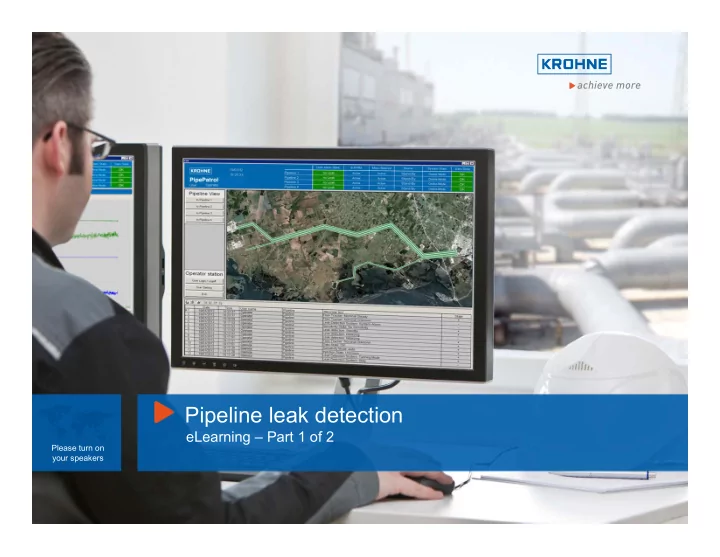
Pipeline leak detection eLearning Part 1 of 2 Please turn on your - - PowerPoint PPT Presentation

pipeline leak detection
SMART_READER_LITE
LIVE PREVIEW

Pipeline leak detection eLearning Part 1 of 2 Please turn on your - - PowerPoint PPT Presentation

Pipeline leak detection eLearning Part 1 of 2 Please turn on your speakers Historical development Leak detection system requirements Causes of leaks Leak detection options Non-continuous leak detection Continuous external leak detection


slide-1
SLIDE 1

Pipeline leak detection

eLearning – Part 1 of 2

Please turn on your speakers
slide-2
SLIDE 2

Title here again in Arial 24 max. one line

Agenda

Pipeline leak detection

Historical development Leak detection system requirements Causes of leaks Leak detection options Non-continuous leak detection Continuous external leak detection Continuous internal leak detection

slide-3
SLIDE 3

Title here again in Arial 24 max. one line

Agenda

Pipeline leak detection

Leak localization Human Machine Interface Additional functions in leak detection Typical applications of leak detection systems

slide-4
SLIDE 4

Introduction

Historical development

3 | Pipeline leak detection

3000 BC 500 BC 400 BC

Copper pipes for water transport First transport of hydrocarbons Supplying Peking with natural gas

slide-5
SLIDE 5

Factors influencing the construction of pipelines: Discovery of crude oil Development of refineries Dependency of oil transport Invention of the automobile

Introduction

Historical development

4 | Pipeline leak detection

19th century

slide-6
SLIDE 6

Introduction

Current situation

| Pipeline leak detection 5

Oil, crude oil, refined products, natural gases, condensate, process gases, water and salt water

slide-7
SLIDE 7

Title Contents of requirement

Leak detection system requirements

Official requirements

7 | Pipeline leak detection

TRFL Technical Rules for Pipelines API 1130 Computational Pipeline Monitoring for Liquids API 1149 Pipeline variable uncertainties and their effects

  • n leak detection

API 1155 (replaced by API 1130) Performance criteria for leak detection systems CSA Z662 Oil and gas pipelines 49 CFR 195 Transport of hazardous liquids via pipeline

slide-8
SLIDE 8

Leak detection system requirements

Performance criteria

8

PipePatrol E-RTTM

8 | Pipeline leak detection

Label Description Reliability

  • Avoid false alarms
  • Reliably detect leaks

Accuracy

  • Accurate localisation of leaks

Robustness

  • Detect failing sensors
  • Fall-back strategies in the event of sensor

failure Sensitivity

  • Minimum detectable leak rate
  • Detection time
slide-9
SLIDE 9

F

Causes of leaks

9 | Pipeline leak detection

In Out

Fatigue cracks Stress corrosion Hydrogen indexing Material manufacturing errors External influence

slide-10
SLIDE 10

Leak detection options

10 | Pipeline leak detection

Non-continuous Continuous External systems

  • Fibre optic cable
  • Acoustic systems
  • Sensor hoses
  • Video monitoring

Internal systems

  • Pressure point analysis
  • Mass balance method
  • Statistical systems
  • RTTM-based systems
  • E-RTTM
  • Inspection by helicopter
  • Smart pigging
  • Tracking dogs

Leak detection systems

slide-11
SLIDE 11

Non-continuous leak detection

Inspection by helicopter

Leak detection methods: Laser Infrared camera Leak sniffer Usage conditions: Detecting small gas leaks Accuracy depends on weather conditions Poor weather conditions make helicopter flight difficult

11 | Pipeline leak detection

slide-12
SLIDE 12

Non-continuous leak detection

Smart pigging

12 | Pipeline leak detection

Types of pigging:

  • Cleaning pigs
  • Batching pigs

Smart pigs

  • Magnetic flux leakage method
  • Testing using the principle of ultrasonic
slide-13
SLIDE 13

Non-continuous leak detection

Smart pigging

13 | Pipeline leak detection

Usage conditions: Detecting existing and potential leaks Zero or baseline pigging Pipeline must be piggable Accuracy of measurement depends on the pig velocity 1 - 5 m/s

slide-14
SLIDE 14

Non-continuous leak detection

Tracking dogs

Trained to smell certain

  • dorant

Usage conditions: Short pipelines, segments Containment of leak sites Certification difficult

14 | Pipeline leak detection

slide-15
SLIDE 15

External leak detection

Fiber optic cable

Usage conditions: Accurate localisation of leaks Limited length possible

15 | Pipeline leak detection

Laser s °C

Many reflections required Cable position must be selected according to the medium

Gas Liquids L

slide-16
SLIDE 16

Usage conditions: Acoustic sensors directly on the pipeline or with steel rods for underground pipelines

16 | Pipeline leak detection

s L A A A A A A

  • Large number of sensors for

longer pipelines Difficult to detect small leaks

dB A

External leak detection

Acoustic systems

slide-17
SLIDE 17

External leak detection

Video monitoring

17 | Pipeline leak detection

Usage conditions: Short distances Continuous leak detection may be possible

slide-18
SLIDE 18

Pump

External leak detection

Sensor hoses

Usage conditions: Monitoring short pipelines Small leaks detectable Cable position must be selected according to the medium

18 | Pipeline leak detection

Gas detector Pump time Gas concentration

slide-19
SLIDE 19

Internal leak detection

19 | Pipeline leak detection

PL TL P0 T0

slide-20
SLIDE 20

Internal leak detection

Overview of the systems

Extended-RTTM Volume comparison method Statistical systems RTTM-based P T P T Pressure point analysis

20 | Pipeline leak detection

slide-21
SLIDE 21

t dp/dt

Internal leak detection

Pressure point analysis

21 | Pipeline leak detection

In

P

Out

Upper threshold Lower threshold

slide-22
SLIDE 22

Internal leak detection

Mass balance method

22 | Pipeline leak detection

30 25 20 15 10 5 30 25 20 15 10 5 Difference

Uncompensated mass balance

In/Out In Out

Out In

slide-23
SLIDE 23

Internal leak detection

Statistical systems

23 | Pipeline leak detection

In Out Leak No leak

Alarm

Probability Statistical variable

slide-24
SLIDE 24

Internal leak detection

RTTM

Conservation of Mass

Real-Time Transient Model

Conservation of Momentum Conservation of Energy In Out

L

slide-25
SLIDE 25

PL

Internal leak detection

RTTM

25 | Pipeline leak detection

TL P0 T0

F0 FL ∆ Change in pipe contents

Change in pipe contents

RTTM-compensated mass balance

t

= compensated leak rate

slide-26
SLIDE 26

Internal leak detection

E-RTTM

26 | Pipeline leak detection

PL TL P0 T0

F0 ∆

Residual x ≡ F0 – F0 Residual y ≡ FL – FL

∆ FL F0 FL

slide-27
SLIDE 27

Internal leak detection

E-RTTM

27 | Pipeline leak detection

PL TL T0 P0

F0 FL F0 FL ∆

s Residual x ≡ F0 – F0 Residual y ≡ FL – FL

Residuals x and y are used by the system as decision values

Leak signature x

slide-28
SLIDE 28

Internal leak detection

Capabilities of internal systems

Method Typical min. detectable leak rate Time to detect leak (liquids) Time to detect leak (gases) Detectable types of leak False alarm frequency Accuracy of leak localisation Pressure point analysis > 5% Short Long Spontaneous leaks High High with additional pressure sensors, dependent on sampling rate Mass balance method > 1% Long Very long Spontaneous and creeping leaks High Average with additional pressure sensors Statistical methods > 0.5% Long Very long Spontaneous and creeping leaks Slight Average with additional pressure sensors RTTM > 1% Short Short Spontaneous and creeping leaks Average High E-RTTM > 0.5% Very short Short Spontaneous and creeping leaks Slight High

slide-29
SLIDE 29

Leak localization

Overview

Possibility of combining methods Improving accuracy Reducing problems in localizing

3 | Pipeline leak detection

Gradient Intersection Method s p Wave Propagation Method t s Extended Wave Propagation Method t s

slide-30
SLIDE 30

Leak localisation

Gradient Intersection Method

4 | Pipeline leak detection

p s L sLeak

In

P

Out

P p0 pL

Advantages

  • Localising: spontaneous, creeping leaks
  • Good accuracy with stationary operation

Disadvantages

  • Accuracy depends on length of pipeline
  • Pipeline geometry must be taken into consideratio
slide-31
SLIDE 31

Leak localisation

Wave Propagation Method

5 | Pipeline leak detection

t s L sLeak p0 pL tLeak

Δt

In

P

Out

P

Advantages

  • Good accuracy

Disadvantages

  • No localizing of creeping or small leaks
  • Fast sampling required
  • Can be used during operation and pauses
slide-32
SLIDE 32

Leak localisation

Extended Wave Propagation Method

6 | Pipeline leak detection

t s L sLeak p0 pL tLeak

In

P

Out

P

  • Good accuracy

P P p2 p3

slide-33
SLIDE 33

HMI (Human Machine Interface)

7 | Pipeline leak detection

slide-34
SLIDE 34

HMI (Human Machine Interface)

8 | Pipeline leak detection

slide-35
SLIDE 35

Added functions in leak detection

Efficiency analysis

9 | Pipeline leak detection

87% efficiency 100% efficiency

slide-36
SLIDE 36

Inventory calculation Operator training Theft detection Hydraulic profiles

10 | Pipeline leak detection

Added functions in leak detection

slide-37
SLIDE 37

Added functions in leak detection

Batch tracking

11 | Pipeline leak detection

Batch tracking Tracking products and mixing zones Batch scheduling Scheduling arrival times and capacities Scheduling of delivery Reducing waste

slide-38
SLIDE 38

Typical applications

12 | Pipeline leak detection

slide-39
SLIDE 39

Typical applications

FPSO to refinery

13 | Pipeline leak detection

  • Long pipelines with large diameters
  • Substation measurements impossible
slide-40
SLIDE 40

Typical applications

Oil field to refinery

14 | Pipeline leak detection

  • Long pipelines with large diameters
  • Changes in viscosity and density
  • Elevation and temperature differences
slide-41
SLIDE 41

Typical applications

Offshore drilling rig to refinery

15 | Pipeline leak detection

  • Changes in viscosity and density
  • Substation measurements impossible
  • Large diameter
slide-42
SLIDE 42

Typical applications

Refinery to tank farms

16 | Pipeline leak detection

Several products with various densities

slide-43
SLIDE 43

Typical applications

Gas field to refinery

19 | Pipeline leak detection

  • Long pipelines with large diameters
  • Elevation and temperature differences
slide-44
SLIDE 44

Typical applications

Chemical plant to chemical plant

21 | Pipeline leak detection

Heavily transient operation of pipelines

slide-45
SLIDE 45

Typical applications

Sea to city

22 | Pipeline leak detection

Long pipelines with large diameters

slide-46
SLIDE 46

Choosing the right leak detection system

No leak detection system is the perfect choice for every application Selection of the system depends on: Desired results Costs Installation conditions Individual adaptation leads to optimal performance

23 | Pipeline leak detection

What requirements are placed on the application?

slide-47
SLIDE 47

Title here again in Arial 24 max. one line

Summary

Pipeline leak detection

  • 1. Historical development
  • 2. Leak detection system requirements
  • 3. Causes of leaks
  • 4. Leak detection options
  • 5. Non-continuous leak detection
  • 6. Continuous external leak detection
  • 7. Continuous internal leak detection
slide-48
SLIDE 48

Title here again in Arial 24 max. one line

Summary

Pipeline leak detection

  • 8. Leak localization
  • 9. Human Machine Interface
  • 10. Additional functions in leak detection
  • 11. Typical applications of leak detection systems
slide-49
SLIDE 49

Thank you for your attention.