Pimlico Community Development Authority Meeting Summary January 31, - - PDF document

pimlico community development authority meeting summary
SMART_READER_LITE
LIVE PREVIEW

Pimlico Community Development Authority Meeting Summary January 31, - - PDF document

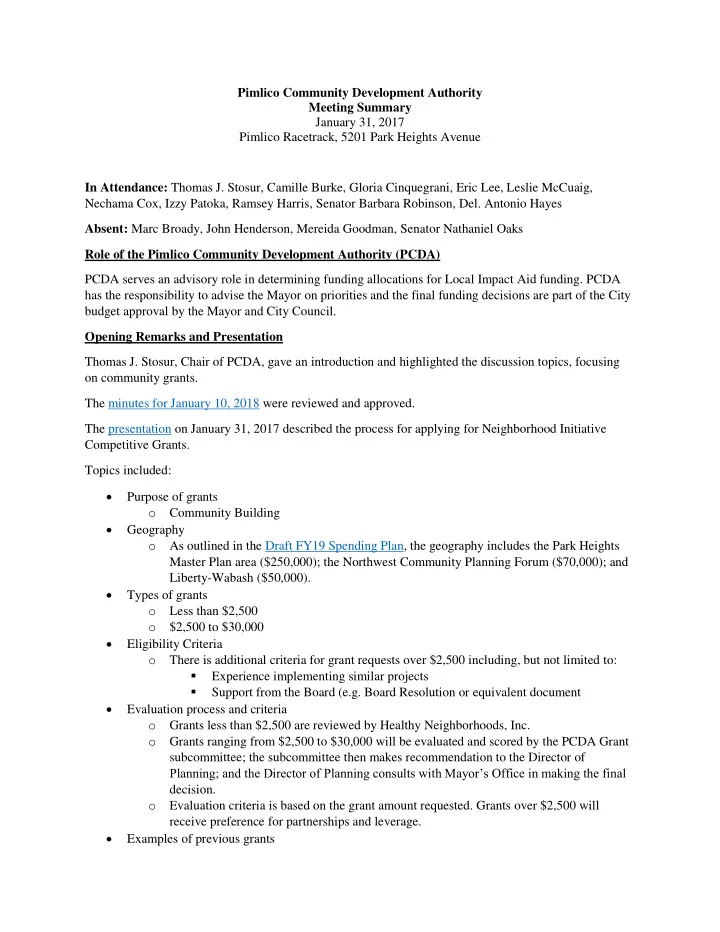
Pimlico Community Development Authority Meeting Summary January 31, 2017 Pimlico Racetrack, 5201 Park Heights Avenue In Attendance: Thomas J. Stosur, Camille Burke, Gloria Cinquegrani, Eric Lee, Leslie McCuaig, Nechama Cox, Izzy Patoka, Ramsey


slide-1
SLIDE 1

Pimlico Community Development Authority Meeting Summary January 31, 2017 Pimlico Racetrack, 5201 Park Heights Avenue In Attendance: Thomas J. Stosur, Camille Burke, Gloria Cinquegrani, Eric Lee, Leslie McCuaig, Nechama Cox, Izzy Patoka, Ramsey Harris, Senator Barbara Robinson, Del. Antonio Hayes Absent: Marc Broady, John Henderson, Mereida Goodman, Senator Nathaniel Oaks Role of the Pimlico Community Development Authority (PCDA) PCDA serves an advisory role in determining funding allocations for Local Impact Aid funding. PCDA has the responsibility to advise the Mayor on priorities and the final funding decisions are part of the City budget approval by the Mayor and City Council. Opening Remarks and Presentation Thomas J. Stosur, Chair of PCDA, gave an introduction and highlighted the discussion topics, focusing

  • n community grants.

The minutes for January 10, 2018 were reviewed and approved. The presentation on January 31, 2017 described the process for applying for Neighborhood Initiative Competitive Grants. Topics included:  Purpose of grants

  • Community Building

 Geography

  • As outlined in the Draft FY19 Spending Plan, the geography includes the Park Heights

Master Plan area ($250,000); the Northwest Community Planning Forum ($70,000); and Liberty-Wabash ($50,000).  Types of grants

  • Less than $2,500
  • $2,500 to $30,000

 Eligibility Criteria

  • There is additional criteria for grant requests over $2,500 including, but not limited to:
  • Experience implementing similar projects
  • Support from the Board (e.g. Board Resolution or equivalent document

 Evaluation process and criteria

  • Grants less than $2,500 are reviewed by Healthy Neighborhoods, Inc.
  • Grants ranging from $2,500 to $30,000 will be evaluated and scored by the PCDA Grant

subcommittee; the subcommittee then makes recommendation to the Director of Planning; and the Director of Planning consults with Mayor’s Office in making the final decision.

  • Evaluation criteria is based on the grant amount requested. Grants over $2,500 will

receive preference for partnerships and leverage.  Examples of previous grants

slide-2
SLIDE 2
  • Beautification projects (e.g. community gardens)
  • Community signs
  • Project Pneuma Yoga
  • Music and Unity festivals
  • Community Resource Events
  • Academic Enrichment at Elementary Schools (e.g. culinary arts class)
  • Gardner/Coordinator at Elementary Schools (e.g. classes and garden setup)

 Grant process

  • Healthy Neighborhoods, Inc. is available to assist with the following: Grant Applications;

Grant Agreement; Technical Assistance; Fiscal Agent; and meeting City requirements such as insurance.

  • Grant guidelines:
  • Award amounts: Grant award amounts may differ from amounts requested in

grant applications.

  • Grant Agreement: Once funding is approved and grant agreement is completed,

projects may begin.

  • Administration: No more than 10% of the total grant award for large grants

($2,500-$30,000) can be used for administrative costs or fees.

  • Project completion: As a general rule, all grant-funded projects should be

complete, with grant funds expended, within one calendar year of the grant award

  • date. If it is anticipated that a time frame longer than one year is needed for

project completion, an explanation along with a full project schedule should be provided in the application.

  • Payment documentation: At the completion of any awarded project all payment

documentation must be submitted to Healthy Neighborhoods, Inc. within 60 days from the day of completion.

  • Payment procedures: Payment procedures to grant awardees will be determined
  • n a case-by-case basis. A draw schedule can be created. No future draw requests

will be considered until all previous draws are accounted for with payment documentation (i.e., receipts).

  • Reporting: Grant recipients are required to submit quarterly reports and photos

highlighting their efforts. In order to qualify for funding, a final report is required at the completion of the project.

  • Insurance: Insurance may be required.

 Technical Assistance

  • Grant Application Available: Spring 2018/Summer 2018
  • Technical assistance for Neighborhood Competitive Grants: Spring 2018/Summer 2018
  • Grant Writing Workshop: Spring 2018/Summer 2018

Questions and Comments  Will the grant calendar be on the city fiscal year? The city 2019 fiscal year begins July 1, 2018. There is a one year timeline from award.  Technical assistance will be provided on the grant process.  Can grantees apply for neighborhood initiative competitive grants and other RFPs? Yes.  Any advances and/or upfront cash? Any information sessions or individual assistance?

  • Healthy Neighborhoods, Inc. (HNI) will assist with getting money out and spent

according to grant guidelines.

slide-3
SLIDE 3
  • Money is available on a reimbursable basis. When a project is ready, sometimes

HNI writes checks directly to a supplier.

  • Record keeping and reports are very important.
  • Examples: Ashburton sign was built in 1.25 years and the stakeholders worked

with HNI to accomplish the project; $400 for an apple press at an event; Baltimore Terps football program (they needed lights and asked for help renting lights, which were then funded).

  • HNI will review full contracts, construction projects, and ensure the end result is

that the project gets completed.

  • There will be informational sessions helping participants understand the application and

you can reach out to Healthy Neighborhoods directly with questions. Individual help is also available.

  • HNI contact information:

Mark Sissman E-mail: msissman@healthyneighborhoods.org Phone: 410-332-0387 ext. 161  If a community is going after money to fund a project and they’ve maxed out what they’re eligible for, is there a list of additional funders? All additional funders are welcome to compliment PCDA funds and provide additional leverage.  Are there any projects that would get an automatic no? Yes, those that didn’t submit an application.

  • What if there is a need for painting a building or dance teams? Please apply.
  • The grant must be used for a public purpose.
  • Synagogues and churches are the most complicated to implement. The funds must be

available to the general public.  Can this money be used on a city building such as the police training facility?

  • It could be, but it depends on what type of project. The scale of replacing windows is not

within the scale of these community grants.

  • The grants could be used for open space and beautification projects such as enhancing an

entryway to the neighborhood.  Where could we apply for a huge project like the windows?

  • You could submit a comment on the spending plan that the windows should be

considered.

  • Capital Budget. Projects are proposed for the Police Training Academy building, but

currently not the windows.

  • Capital Improvement Plan (CIP): city agencies have submitted their requests and

then they become part of budget. Here is a link describing the process, which includes the Planning Commission approval of recommended CIP in February/March.

  • These funds are not intended to relieve the city of its responsibility. Some requests may

be beyond Pimlico Local Impact Aid funding. A project such as a community sign would be an eligible use.  Guidelines include that a non-profit must be in good standing and have a valid bank account in name of organization, but you can’t open up an account if you’re not in good standing in MD.

  • HNI’s goal is to get grantees paid and if they’re not in good standing, HNI will find a

relevant entity who is.

slide-4
SLIDE 4
  • If you’re not a 501c3 but you’re in good standing and if you’re partnered with a 501c3 to

be the fiscal agent and if that non-profit is not in good standing, HNI will help you find

  • ne that is.

 Senator Robinson encouraged individuals to pursue entrepreneurship and become small

  • businesses. It may be necessary to take workshops on entrepreneurship and her office is happy to

help folks that want to do that. Participants can take courses to learn how to become small businesses.  Funding for youth programming?

  • In 2010/11, Sisters Saving the city worked hard to make sure funding for youth

programming was available.

  • Now, the funding is all in one pot. This has been very detrimental to her programming,

which has served over 200 youth (ages 14-21). The new arrangement cut the programming by 60%. Please be consistent and when you take away resources, the participants don’t believe that we care. Consistent funding is crucial. One of her young people was killed the night before the 3rd anniversary of her son’s death and when you’re making these decision about how these funds are allocated, think about how serious it is

  • ut here. We went 5 years without shootings, now it’s on-going. She will also put this in

writing.

  • Senator Robinson shared that as funding is gone, please contact her. She is excited to see

people of color (especially women) starting a business. If you have a non-profit, it’s important to start learning how to be self-sufficient. This way, if the money is taken away, then you won’t lose your program. For example, she starting in your basement with an unemployment check, and turning that into a multi-million dollar corporation. You can use that as your starting point and then diversify and start a for-profit entity. When 8A (fed government) is taken away, individuals that depend on that lose their

  • business. These are examples as why these funds are the starting point.

 Melissa Wells from the Baltimore/Washington, D.C. construction trade unions spoke and shared that she is looking to partner around apprenticeships and predevelopment activities.  The draft FY19 spending plan contains $750,000 for development incentives around Arlington Elementary School.

  • The 21st century program only covers the school itself. The INSPIRE program focuses on

the neighborhoods immediately surrounding each of the modernized schools that are part

  • f the 21st Century program, specifically the quarter-mile surrounding each school.
  • In FY18, $750,000 available in slots funding was available for development incentives

around Pimlico Elementary/Middle School.

  • How are the development incentives paid for in communities not supported by slots

funding?

  • INSPIRE has some bond funds that are being used to help with primary walking

routes to make sure kids get safely to and from school. This is happening in Pimlico and Arlington as well. The development incentives are going above and beyond that to look at vacants and development opportunities surrounding the newly modernized schools.

  • There are communities that don’t have the benefit of being in the area w/ slots.

What is this in addition to?  Walking route improvements average about $250,000 per school, but it also depends on the condition of the existing infrastructure and sidewalks.

slide-5
SLIDE 5

 Pimlico EMS received a safe routes to school grant, which you can read more about on page 35 of the INSPIRE plan for Pimlico EMS.  How to leverage slots money to supplement vs. supplant? The development incentives are supplementing existing initiatives, not supplanting.  The spending plan should be updated to including more background on the INSPIRE bond funding or other special funds.  Izzy Patoka disclosed that he is a board member of Neighborhoods United. He shared that George Mitchell is leading by example and filling a gap that has existed in Park Heights for a long time and that he is doing it on a shoestring. Izzy commended him for his heart to make Park Heights a better place.  Senator Robinson shared the importance of Cybersecurity training. She also requested that the feasibility study for the library in Park Heights consider the Langston Hughes site as a potential location.  Delegate Hayes shared the importance of considering all the improvements and investments that need to get done and to consider the totality of what investments PCDA is going to make with slots funding.  Comments and questions for competitive grants and additional clarification:

  • Experience implementing similar projects. Asking for experience can result in the same

people getting the same funding. What additional criteria can be used? For example, how prepared are they to implement the project? There are lots of organizations that have good, innovative ideas and this could be the tool used to make an impact on the community

  • Is there a limit a number of grants an organization can apply for?
  • That has not been clarified yet.
  • This is important, especially since you are looking at multiple award periods.
  • If you’re not awarded, will the organization be called in to discuss why your organization

didn’t get the grant?

  • PCDA sub-committee agreed this is a good idea. Feedback can be given either in

writing or by having the opportunity to meet with the subcommittee to get feedback.

  • This would provide organizations to learn and not repeat the same mistake.
  • Is there a timeframe after review so you know why it was refused?
  • Clarification was requested for commitments the city is already making at Langston
  • Hughes. Langston Hughes is a city-owned facility. Is the building considered an in-kind

donation? What investments has the city already made at Langston Hughes? Is funding being leveraged the funding we have here to help enhance funding that is already going

  • n?

 After the discussion of the community grants, participants were given the opportunity to comment

  • n the spending plan.

 February 9 is the deadline for comments on the draft spending plan and the expected date for spending plan release is April 2019. Applicants have until midnight on February 9 to submit comments.