Phases of Programming SI 413 Overview of compilation Programming - - PDF document

phases of programming
SMART_READER_LITE
LIVE PREVIEW

Phases of Programming SI 413 Overview of compilation Programming - - PDF document

Unit 1 Phases of Programming SI 413 Overview of compilation Programming Languages What does programming actually involve? About this course Write a program Execute the program Note: an interpreter essentially does compilation and


slide-1
SLIDE 1

Unit 1 SI 413 Overview of compilation Programming Languages About this course

Phases of Programming

What does programming actually involve?

  • Write a program
  • Execute the program

Note: an interpreter essentially does compilation and execution simultaneously, on-the-fly.

Unit 1 SI 413 Overview of compilation Programming Languages About this course

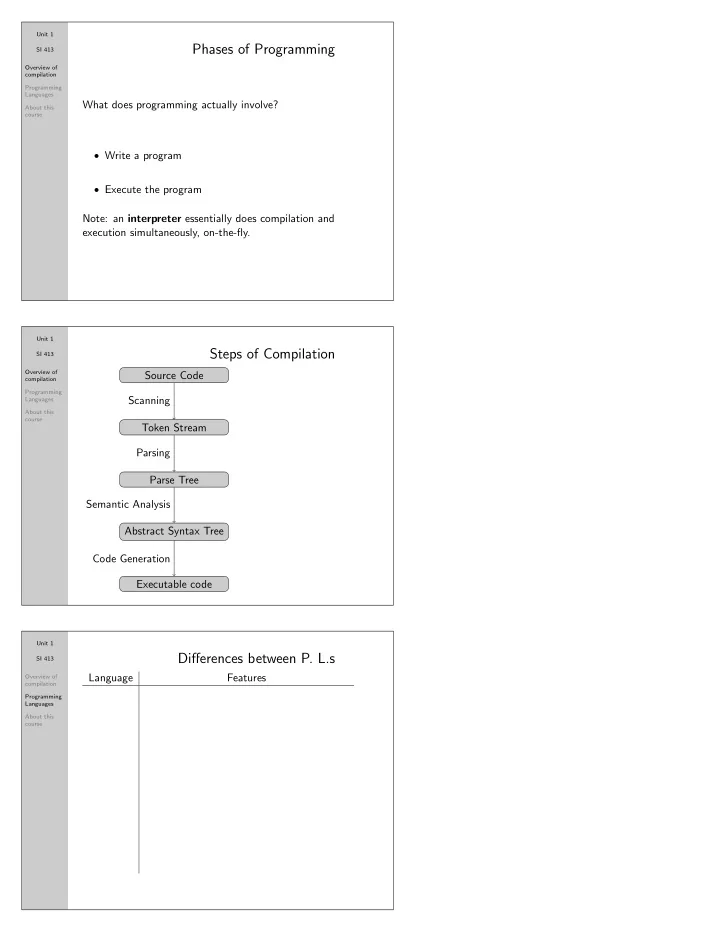
Steps of Compilation

Source Code Token Stream Parse Tree Abstract Syntax Tree Executable code Scanning Parsing Semantic Analysis Code Generation

Unit 1 SI 413 Overview of compilation Programming Languages About this course

Differences between P. L.s

Language Features

slide-2
SLIDE 2

Unit 1 SI 413 Overview of compilation Programming Languages About this course

Vocabulary for PLs

Excerpt from the R6RS standard

Scheme is a statically scoped and properly tail-recursive dialect

  • f the Lisp programming language invented by Guy Lewis

Steele Jr. and Gerald Jay Sussman. It was designed to have an exceptionally clear and simple semantics and few different ways to form expressions. A wide variety of programming paradigms, including functional, imperative, and message passing styles, find convenient expression in Scheme. Reading this should give you a good overview of what Scheme is about. But first we have to learn what the terms mean!

Unit 1 SI 413 Overview of compilation Programming Languages About this course

Programming Language Paradigms

Most popular PLs fall into at least one of six classes:

  • Imperative/procedural

C, Fortran, Cobol

  • Functional

Lisp, Scheme, ML, Haskell

  • Object-oriented

C++, Java, Smalltalk

  • Scripting

Perl, PHP, Javascript

  • Logic Programming (Prolog et al)
  • Esoteric Languages (brainfuck, INTERCAL, befunge, Chef)

Unit 1 SI 413 Overview of compilation Programming Languages About this course

Imperative Programming Languages

Consider the following code fragment from C++: int x = 0; x = 3; x = x + 1;

  • Each statement is a command.
  • Code specifies actions and a specific ordering.
  • Expressions may produce values (these do),

but side effects are often more important.

slide-3
SLIDE 3

Unit 1 SI 413 Overview of compilation Programming Languages About this course

Functional Programming

Functional programming is declarative: the output is a mathematical function of the input. Emphasizes describing what is computed rather than how. Key features:

  • Referential transparency

The value of an expression does not depend on its context.

  • Functions are first-class

Functions can be passed as arguments, created on-the-fly, and returned from other functions. Functions are data!

  • Types are first-class

This is not true in Scheme (there are no types), but is in

  • ther functional PLs.

Unit 1 SI 413 Overview of compilation Programming Languages About this course

Other common properties of functional PLs

  • Garbage collection
  • Built-in list types and operators
  • Interpreters rather than compilers
  • Extensive polymporphism

(again, not applicable to Scheme)

Unit 1 SI 413 Overview of compilation Programming Languages About this course

Skill outcomes of SI 413

There are other goals on the course policy, but here’s what you will be able to do in a few months:

1 Choose a programming language well-suited for a

particular task.

2 Learn a new programming language quickly and with

relative ease.

3 Understand the inner workings of compilers and

interpreters and become a better user of both.

slide-4
SLIDE 4

Unit 1 SI 413 Overview of compilation Programming Languages About this course

Major Course Components

Labs: 30%

  • Will be done in pairs (which must change)
  • Due most Tuesday mornings
  • Do not expect to complete during lab time!

Homeworks: 10%

  • Due most Friday mornings
  • Collaborate! You will have to take notes and read!

Project: 15% (next page. . . ) Scheme Practicum: 5% (take-home, due Friday, Sept. 21) Midterm Exam: 10% (on Friday, Nov. 2) Final Exam: 30%

Unit 1 SI 413 Overview of compilation Programming Languages About this course

Course Project

The course project will involve you learning different programming languages (in pairs), writing some programs and becoming mini-experts on the language. Part 0 (due Sept. 10): Choose partners & languages Part 1 (20%; due Oct. 12): Very simple program Part 2 (50%; due Nov. 13): More involved program Part 3 (30%; last week): In-class presentations