CSE 501: Compiler Construction Course outline Main focus: program - - PDF document

cse 501 compiler construction course outline
SMART_READER_LITE
LIVE PREVIEW

CSE 501: Compiler Construction Course outline Main focus: program - - PDF document

CSE 501: Compiler Construction Course outline Main focus: program analysis and transformation Models of compilation how to represent programs? how to analyze programs? what to analyze? Standard transformations how to transform


slide-1
SLIDE 1

Craig Chambers 1 CSE 501

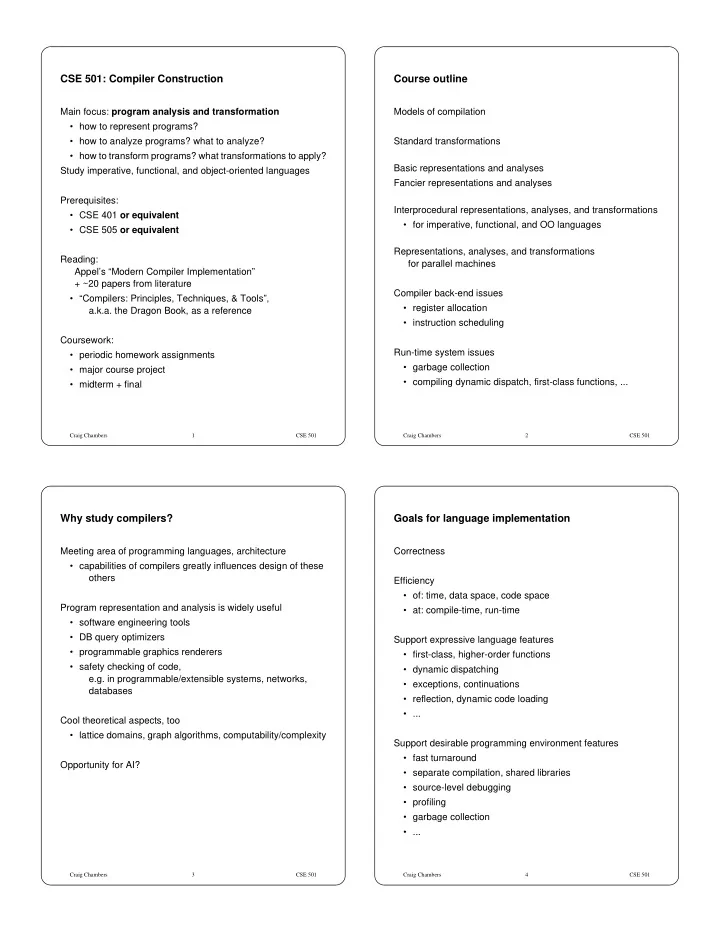
CSE 501: Compiler Construction

Main focus: program analysis and transformation

  • how to represent programs?
  • how to analyze programs? what to analyze?
  • how to transform programs? what transformations to apply?

Study imperative, functional, and object-oriented languages Prerequisites:

  • CSE 401 or equivalent
  • CSE 505 or equivalent

Reading: Appel’s “Modern Compiler Implementation” + ~20 papers from literature

  • “Compilers: Principles, Techniques, & Tools”,

a.k.a. the Dragon Book, as a reference Coursework:

  • periodic homework assignments
  • major course project
  • midterm + final

Craig Chambers 2 CSE 501

Course outline

Models of compilation Standard transformations Basic representations and analyses Fancier representations and analyses Interprocedural representations, analyses, and transformations

  • for imperative, functional, and OO languages

Representations, analyses, and transformations for parallel machines Compiler back-end issues

  • register allocation
  • instruction scheduling

Run-time system issues

  • garbage collection
  • compiling dynamic dispatch, first-class functions, ...

Craig Chambers 3 CSE 501

Why study compilers?

Meeting area of programming languages, architecture

  • capabilities of compilers greatly influences design of these
  • thers

Program representation and analysis is widely useful

  • software engineering tools
  • DB query optimizers
  • programmable graphics renderers
  • safety checking of code,

e.g. in programmable/extensible systems, networks, databases Cool theoretical aspects, too

  • lattice domains, graph algorithms, computability/complexity

Opportunity for AI?

Craig Chambers 4 CSE 501

Goals for language implementation

Correctness Efficiency

  • of: time, data space, code space
  • at: compile-time, run-time

Support expressive language features

  • first-class, higher-order functions
  • dynamic dispatching
  • exceptions, continuations
  • reflection, dynamic code loading
  • ...

Support desirable programming environment features

  • fast turnaround
  • separate compilation, shared libraries
  • source-level debugging
  • profiling
  • garbage collection
  • ...
slide-2
SLIDE 2

Craig Chambers 5 CSE 501

Standard compiler organization

intermediate form Optimization intermediate form Code Generation target language intermediate form Intermediate Interpreter Code Generation Analysis

  • f input program

Synthesis

  • f output program

(front-end) (back-end) Lexical Analysis Syntactic Analysis Semantic Analysis character stream token stream abstract syntax tree annotated AST Interpreter

Craig Chambers 6 CSE 501

Compiling to a portable intermediate language

Define “portable” intermediate language (e.g. Java bytecode, MSIL, SUIF, WIL, C, ...) Compile multiple languages into it

  • each such compiler may not be much more than a front-end

Compile to multiple targets from it

  • may not be much more than back-end

Maybe interpret/execute directly Advantages:

  • reuse of front-ends and back-ends
  • portable “compiled” code

Design of portable intermediate language is hard

  • how universal?

across input language models? target machine models?

  • fast interpretation and simple compilation at odds

Craig Chambers 7 CSE 501

Key questions

How are programs represented in the compiler? How are analyses organized/structured? Over what region of the program are analyses performed? What analysis algorithms are used? What kinds of optimizations can be performed? Which are profitable in practice? How should analyses/optimizations be sequenced/combined? How best to compile in face of:

  • pointers, arrays
  • first-class functions
  • inheritance & message passing
  • parallel target machines

Other issues:

  • speeding compilation
  • making compilers portable, table-driven
  • supporting tools like debuggers, profilers, garbage collect’rs

Craig Chambers 8 CSE 501

Overview of optimizations

First analyze program to learn things about it Then transform the program based on info Repeat... Requirement: don’t change the semantics!

  • transform input program into

semantically equivalent but better output program Analysis determines when transformations are:

  • legal
  • profitable

Caveat: “optimize” a misnomer

  • almost never optimal
  • sometimes slow down some programs on some inputs

(although hope to speed up most programs on most inputs)

slide-3
SLIDE 3

Craig Chambers 9 CSE 501

Semantics

Exactly what are the semantics that are to be preserved? Subtleties:

  • evaluation order
  • arithmetic properties like associativity, commutativity
  • behavior in “error” cases

Some languages very precise

  • programmers always know what they’re getting

Others weaker

  • allow better performance (but how much?)

Semantics selected by compiler option?

Craig Chambers 10 CSE 501

Scope of analysis

Peephole: across a small number of “adjacent” instructions [adjacent in space or time]

  • trivial analysis

Local: within a basic block

  • simple analysis

Intraprocedural (a.k.a. global): across basic blocks, within a procedure

  • analysis more complex:

branches, merges, loops Interprocedural: across procedures, within a whole program

  • analysis even more complex:

calls, returns

  • sometimes useful
  • more useful for higher-level languages
  • hard with separate compilation

Whole-program: analysis examines whole program in order to prove safety

Craig Chambers 11 CSE 501

Catalog of optimizations/transformations

arithmetic simplifications:

  • constant folding

x := 3 + 4 ⇒ x := 7

  • strength reduction

x := y * 4 ⇒ x := y << 2 constant propagation x := 5 ⇒ x := 5 ⇒ x := 5 y := x + 2 y := 5 + 2 y := 7 copy propagation x := y ⇒ x := y w := w + x w := w + y

Craig Chambers 12 CSE 501

common subexpression elimination (CSE) x := a + b ⇒ x := a + b ... ... y := a + b y := x

  • can also eliminate redundant memory references,

branch tests partial redundancy elimination (PRE)

  • like CSE, but with earlier expression only available along

subset of possible paths if ... then ⇒ if ... then ... ... x := a + b t := a + b; x := t end else t := a + b end ... ... y := a + b y := x pointer/alias analysis p := &x ⇒ p := &x ⇒ p := &x *p := 5 *p := 5 *p := 5 y := x + 1 y := 5 + 1 y := 6

slide-4
SLIDE 4

Craig Chambers 13 CSE 501

dead (unused) assignment elimination x := y ** z ... // no use of x x := 6 partial dead assignment elimination

  • like DAE, except assignment only used on some later paths

dead (unreachable) code elimination if false goto _else ... goto _done _else: ... _done: integer range analysis

  • fold comparisons based on range analysis
  • eliminate unreachable code

for(index = 0; index < 10; index ++) { if index >= 10 goto _error a[index] := 0 }

Craig Chambers 14 CSE 501

Loop optimizations

loop-invariant code motion for j := 1 to 10 ⇒ for j := 1 to 10 for i := 1 to 10 t := b[j] a[i] := a[i] + b[j] for i := 1 to 10 a[i] := a[i] + t induction variable elimination for i := 1 to 10 ⇒ for p := &a[1] to &a[10] a[i] := a[i] + 1 *p := *p + 1

  • a[i] is several instructions, *p is one

loop unrolling for i := 1 to N ⇒ for i := 1 to N by 4 a[i] := a[i] + 1 a[i] := a[i] + 1 a[i+1] := a[i+1] + 1 a[i+2] := a[i+2] + 1 a[i+3] := a[i+3] + 1

Craig Chambers 15 CSE 501

parallelization for i := 1 to 1000 ⇒ forall i := 1 to 1000 a[i] := a[i] + 1 a[i] := a[i] + 1 loop interchange, skewing, reversal, ... blocking/tiling

  • restructuring loops for better data cache locality

Craig Chambers 16 CSE 501

Call optimizations

inlining l := ... ⇒ l := ... ⇒ l := ... w := 4 w := 4 w := 4 a := area(l,w) a := l * w a := l << 2

  • lots of “silly” optimizations become important after inlining

interprocedural constant propagation, alias analysis, etc. static binding of dynamic calls

  • in imperative languages, for call of a function pointer:

if can compute unique target of pointer, can replace with direct call

  • in functional languages, for call of a computed function:

if can compute unique value of function expression, can replace with direct call

  • in OO languages, for dynamically dispatched message:

if can deduce class of receiver, can replace with direct call

  • other possible optimizations even if several possible targets

procedure specialization

  • more generally, partial evaluation
slide-5
SLIDE 5

Craig Chambers 17 CSE 501

Machine-dependent optimizations

register allocation instruction selection p1 := p + 4 ⇒ ld %g3, [%g1 + 4] x := *p1

  • particularly important on CISCs

instruction scheduling ld %g2, [%g1 + 0] ⇒ ld %g2, [%g1 + 0] add %g3, %g2, 1 ld %g5, [%g1 + 4] ld %g2, [%g1 + 4] add %g3, %g2, 1 add %g4, %g2, 1 add %g4, %g5, 1

  • particularly important with instructions that have delayed

results, and on wide-issue machines

  • vs. dynamically scheduled machines?

Craig Chambers 18 CSE 501

The phase ordering problem

Typically, want to perform a number of optimizations; in what order should the transformations be performed? some optimizations create opportunities for other optimizations ⇒ order optimizations using this dependence

  • some optimizations simplified

if can assume another opt will run later & “clean up” but what about cyclic dependencies?

  • e.g. constant folding ⇔ constant propagation

what about adverse interactions?

  • e.g.

common subexpression elimination ⇔ register allocation

  • e.g. register allocation ⇔ instruction scheduling

Craig Chambers 19 CSE 501

Compilation models

Separate compilation

  • compile source files independently
  • trivial link, load, run stages

+ quick recompilation after program changes − poor interprocedural optimization Link-time compilation

  • delay bulk of compilation until link-time
  • then perform whole-program optimizations

+ allow interprocedural & whole-program optimizations − quick recompilation? shared precompiled libraries? Examples: Vortex, some research optimizers/parallelizers, ...

Craig Chambers 20 CSE 501

Run-time compilation (a.k.a. dynamic, just-in-time compilation)

  • delay bulk of compilation until run-time
  • can perform whole-program optimizations + optimizations

based on run-time program state, execution environment + best optimization potential + can handle run-time changes/extensions to the program − severe pressure to limit run-time compilation overhead Examples: Java JITs, Dynamo, FX-32, Transmeta Selective run-time compilation

  • choose what part of compilation to delay to run-time

+ can balance compile-time/benefit trade-offs Examples: DyC, ... Hybrids of all the above

  • spread compilation arbitrarily across stages

+ all the advantages, and none of the disadvantages!! Example: Whirlwind

slide-6
SLIDE 6

Craig Chambers 21 CSE 501

Engineering

Building a compiler is an engineering activity

  • balance

complexity of implementation, speed-up of “typical” programs, compilation speed, ... Near infinite number of special cases for optimization can be identified

  • can’t implement them all

Good compiler design, like good language design, seeks small set of powerful, general analyses and transformations, to minimize implementation complexity while maximizing effectiveness

  • reality isn’t always this pure...