
SLIDE 1
“ ”
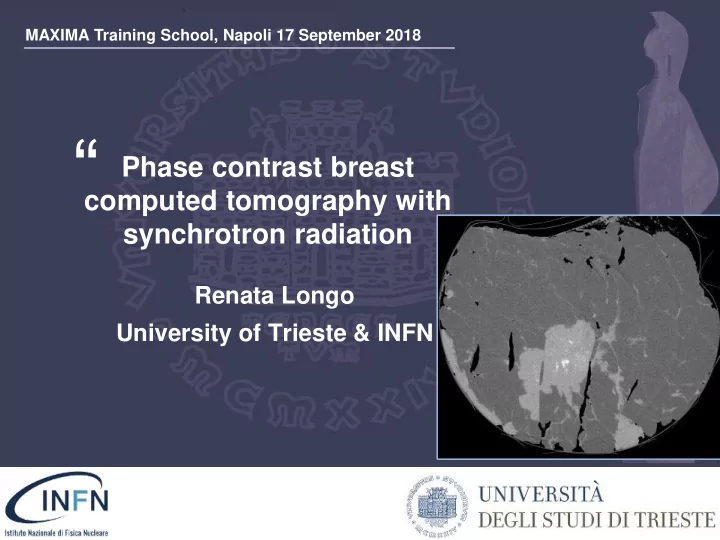
Phase contrast breast computed tomography with synchrotron radiation
Renata Longo University of Trieste & INFN
MAXIMA Training School, Napoli 17 September 2018
Phase contrast breast computed tomography with synchrotron - - PowerPoint PPT Presentation
MAXIMA Training School, Napoli 17 September 2018 Phase contrast breast computed tomography with synchrotron radiation Renata Longo University of Trieste & INFN MAXIMA Training School, Napoli 17 September 2018 Phase contrast
Phase contrast breast computed tomography with synchrotron radiation
Renata Longo University of Trieste & INFN
MAXIMA Training School, Napoli 17 September 2018
Phase contrast breast computed tomography with synchrotron radiation
Renata Longo University of Trieste & INFN
MAXIMA Training School, Napoli 17 September 2018
Trieste, 24 September, 2018 - 3
Characteristics of synchrotron radiation
High X-ray intensity on a broad energy range
– Tunable monochromatic beam
Laminar beam geometry: the beam is naturally collimated
– Images are acquired by scanning the object through the fan beam
Small source size and large source-to-sample distance
– High degree of lateral coherence
Optimal X-rays source for phase contrast imaging
Trieste, 24 September, 2018 - 4
Characteristics of synchrotron radiation
Di EPSIM 3D/JF Santarelli, Synchrotron Soleil - Synchrotron Soleil, Attribution, https://commons.wikimedia.org/w/index.php?curid=376907
The SYRMEP Beamline (I) at Elettra
Bending Magnet Source Source size ~ 1.1 (horizontal) x 0.1 (vertical) mm2 Monochromatic beam with tuneable energy (8.5 - 38 keV) Bandwidth: Dl/l ~ 2 x 10⁻³ Divergence: ~ 7 mrad (horizontal) x 0.2 mrad (vertical)
source
bending magnet
slit systems monochromator filters patient detector sample detector
experimental hutch patient room
The SYRMEP Beamline (II)
sample source slit systems monochromator filters detector patient detector
experimental hutch patient room Source-to-Sample distance: ~ 23 m ~32 m Laminar beam cross section: 4 x 150 mm2 4 x 210 mm2 Flux available at 17 keV (Elettra operated at 2.4 GeV, 140 mA ring current): 6 108 ph/mm2/s 2 108 ph/mm2/s Transverse coherence length 8 µm 11 µm
Phase contrast breast computed tomography with synchrotron radiation
Renata Longo University of Trieste & INFN
MAXIMA Training School, Napoli 17 september 2018
Credits Ioannis Sechopoulos Radboudumc
Breast CT
1 cm
http://www.auntminnie.com credits J. Boone
Breast CT
http://koninghealth.com/en/kbct/
1 cm
Bushberg et al, The essential physics of medical imaging
Breast CT @ SYRMEP
Trieste, 24 September, 2018 - 11
Breast CT @ SYRMEP Single Photon Counting Detector
direct conversion
module architecture (3 pixel gap between modules)
dependent charge trapping effects
PROS CONS
Large area CdTe single photon counting detector (PIXIRAD-8)
A dedicated pre- processing has been implemented!
Bellazzini, R., et al. JINST 8.02 (2013): C02028. Delogu, P., et al. JINST 11.01 (2016): P01015. Delogu, P., et al. JINST 12.11 (2017): C11014.
Courtesy of Luca Brombal
Brombal L. et al JSR (2018)
Preprocessing effectiveness
Luca Brombal
1 cm
WITHOUT PREPROCESSING WITH PREPROCESSING
1 cm
Brombal L et al JSR 2018
FisMat 2017, Trieste, 1-5 October 2017
Preprocessing effectiveness
Luca Brombal
1 cm 1 cm
12
WITHOUT PREPROCESSING WITH PREPROCESSING
Brombal L et al JSR 2018
Optimization of the threshold
CdTe sensor E=26 KeV Pixirad I/ Pixie-III
Di Trapani et al JINST-proceedings IWORID 2018
Optimization of the threshold
CdTe sensor E=33 KeV Pixirad I/ Pixie-III
Di Trapani V. et al JINST-proceedings IWORID 2018
Delogu P. et al 2016 JINST 11 P01015
Linearity and threshold
Phase contrast breast computed tomography with synchrotron radiation
Renata Longo University of Trieste & INFN
MAXIMA Training School, Napoli 17 september 2018
The principle is the phase shift f(x,y) of the X-ray wave
A family of techniques has been developed to transform phase shift into intensity modulation on the detector
Phase-Sensitive Imaging Techniques
n =1-d +ib
absorption phase shift
Zhou, S.-A. and Brahme, A. (2008).
Absorption imaging and Propagation-based Phase-Contrast Imaging
Absorption
Incoming Transmitted Intensity Position a
Intensity Position Incoming Transmitted 10<a<100mrad
PCI
CONV
A clinical study in phase contrast mammography
71 patients
Trieste, 24 September, 2018 - 21
proportional to the second derivative of the phase shift (∇2Φ(x,y)) → edge enhancement Need for a (partially) coherent source (e.g., the synchrotron)
100 1000 10000 0.1 1 10 100 1000d / b
energy [eV]𝒐 = 𝟐 − 𝜺 + 𝒋𝜸
phase shift absorption
phase effects >> absorption
Synchrotron radiation for medical imaging
An exercise: the shell
What are acquired at high energy? What are acquired in phase contrast ?
Trieste, 24 September, 2018 - 23
phase contrast image using a phase retrieval algorithm (and suitable approximations) A phase-retrieved image is obtained
the homogeneous Transport of Intensity Equation (TIE-Hom) and 𝜺, 𝜸 are assumed to be proportional
retrieval is a low-pass filter in 2D Fourier domain applied to the projections λ = is the wavelength, w = (u,v) = spatial frequency d = the propagation distance
Phase contrast Phase retrieved
Paganin, D. et al. Journal of microscopy 206.1 (2002): 33-40.
From phase contrast to phase retrieval
Trieste, 24 September, 2018 - 24
spatial resolution improves (i.e., high spatial frequencies are enhanced)
upon TIE-Hom retrieval (low pass filter), back to the level it had in the contact plane.
Gureyev, T.E., et al. JOSA A 34.12 (2017): 2251-2260.
… More on the phase retrieval …
HERE THE MAGIC HAPPENS!
The net effect is that the ratio of CNR and spatial resolution increases in TIE-HOM imaging
Trieste, 24 September, 2018 - 25
@32 KeV 20 mGy MGD
1 cm
An exercise: a breast CT Before or after phase-retrieval ????
Trieste, 24 September, 2018 - 26
CNR Spatial Resolution
Single and double materials approaches
PhR is:
Single material Double material
Burvall, Anna, et al. Optics express 19.11 (2011)
From a signal processing perspective higher 𝜺/𝜸 narrower the filter in the Fourier domain
𝜺/𝜸
869 2302
(𝜺𝟐 − 𝜺𝟑)/(𝜸𝟐 − 𝜸2)
@32 keV
Trieste, 24 September, 2018 - 27
@32 KeV 20 mGy MGD
NO PHASE RETRIEVAL 1 cm
FWHM~120µm CNR ~ 0.7
PHASE RETRIEVED (DOUBLE MATERIAL)
FWHM~190µm CNR ~ 3.5 Brombal L et al SPIE Medical Imaging 2018
Trieste, 24 September, 2018 - 28
Is phase-retrieval useful ?
MGD 170 mGy 20 mGy 5 mGy
NO PHASE RETRIEVAL PHASE RETRIEVED
2 mm
@32 keV
Trieste, 24 September, 2018 - 29
Optimization
9 m 3 m 1.6 m
Higher the propagation distance better the image
Gureyev, T.E., et al. JOSA A 3(2017), Brombal L. et al PMB (submitted)
propagation distance
5 minutes break ?
SYRMA-3D collaboration
To develop methods and the facility to perform in phase-contrast (PhC) breast computed tomography (breast-CT) exploiting the monochromatic beam available at Elettra synchrotron radiation (SR) laboratory in Trieste in Italy Completed the first SR mammography clinical study: in our 71 patients PhC SR mammography outperforms conventional digital mammography (DM)
Fedon, C. et al.
Trieste, 24 September, 2018 - 32
Clinical exam requirements
DOSIMETRY
High resolution High CNR Large Scanned volume
Low Delivered dose Strict exam protocol
Comfortable patient table Reasonable exam duration
Fast reconstruction Well established data workflow Safe data storage
Methods and Materials
Images large breast specimens were acquired at the SR facility used for the clinical study of PhC mammography and up-dated for breast-CT
Longo R. et al Phys Med Biol (2016)
The monochromatic x-ray beam was set in the energy range 30-38 keV and the delivered mean glandular dose (MGD) was in the range 5-20 mGy
Mettivier G. et al Phys Med Biol (2016)
The propagation-based PhC imaging technique was used and the phase-retrieval algorithm was applied before the FBP reconstruction
Paganin D. et al. Journal of microscopy (2002)
Trieste, 24 September, 2018 - 34
Low-dose 3D images
E = 32 keV MGD= 5 mGy
Courtesy of Sandro Donato
Trieste, 24 September, 2018 - 35
PHASE RETRIEVED BREAST-CT IN-VIVO CLINICAL MAMMOGAPHY
1 cm Courtesy of Luca Brombal
Low-dose 3D images and in-vivo mammography
summary
A program devoted to perform clinical breast-CT with synchrotron radiation is ongoing at the Italian synchrotron facility (ELETTRA, Trieste) Large-Volume, 3D, low-dose phase-contrast CT
Phase-retrieval pre-processing is required to increase soft details visibility Increasing the distance greatly improves image quality Measurements of linear attenuation coefficients are feasible from phase-retrieved images
Conclusions
After the clinical mammography study the SYRMA-3D collaboration is moving towards the phase-contrast breast CT clinical study Why clinical studies with synchrotron radiation?
translation
yield clinical advantages
SYRMA-CT collaboration
INFN & Universities of Cagliari, Ferrara, Napoli, Pisa, Sassari, Trieste F Arfelli, U Bottigli, L Brombal, A Contillo, P Delogu, F Di Lillo, V. Di Trapani, S. Donato, D Dreossi, C Fedon, B Golosio, R Longo, G Mettivier, P Oliva, L Rigon, P Russo, A Sarno, A Taibi Elettra – Sincrotrone Trieste D Dreossi, G Tromba University Hospital of Trieste MA Cova, D Bonazza, M Tonutti, F Zanconati