
SLIDE 1
Personal Protective Equipment (PPE): An Overview
June 18, 2020 Susan DeRagon Senior Technical Consultant
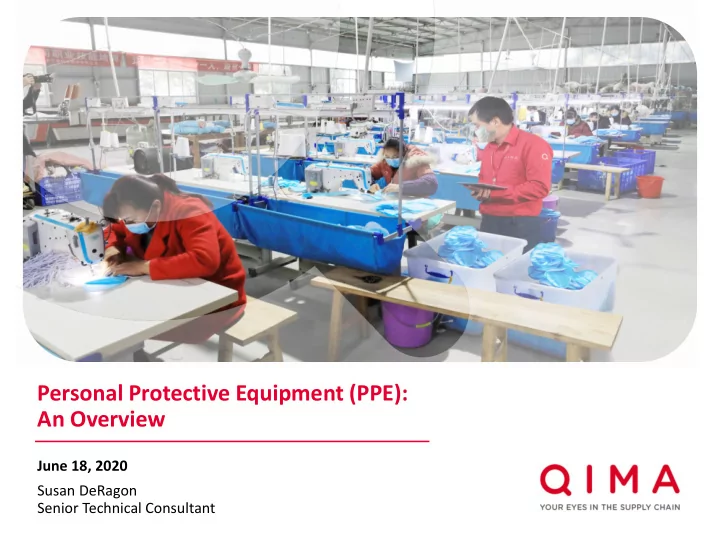
Personal Protective Equipment (PPE): An Overview June 18, 2020 - - PowerPoint PPT Presentation
Personal Protective Equipment (PPE): An Overview June 18, 2020 Susan DeRagon Senior Technical Consultant Agenda Types of PPE Requirements & Recommendations 1 2 Face masks Medical grade Face shields/goggles Non-medical grade Gowns
June 18, 2020 Susan DeRagon Senior Technical Consultant
info@qima.com
2
info@qima.com
2
3
info@qima.com
info@qima.com
3
4
info@qima.com
Uses Cloth Mask Surgical Mask N95 Respirator
CDC recommended for general public X Necessary for medical facilities & first responders X X Protects against droplets X X X Protects against aerosol X Custom fit X Loose fit X X
5
info@qima.com
6
info@qima.com
7
info@qima.com
8
info@qima.com
9
info@qima.com
10
info@qima.com
CF = Colorfastness CP = Children’s Product Labeling Testing (Safety) Quality/Performance Tests
Country of Origin Flammability CF to Crocking Producer Markings/UPLR CPSIA/Prop 65 – Lead CF to Laundering Textile Fiber Identification Prop 65 – Phthalates CF to Perspiration Care Instructions Prop 65 – Cadmium Appearance after Laundering Emergency Use Authorization Fiber Content Analysis Dimensional Stability Tracking Label (if CP) Mechanical (if CP) Dimensions pH value Workmanship Formaldehyde Attachment Strength
ASTM F2100-19-Surgical Face Mask- Differential Pressure (Delta P)
Abnormal Odor
11
info@qima.com
Labeling Testing (Safety) Quality/Performance Tests
Country of Origin PAH – REACH CF to Crocking Producer Markings SVHC – REACH CF to Laundering Textile Fiber Identification Phthalates – REACH CF to Perspiration Care Instructions Cadmium – REACH Appearance after Laundering Fiber Content Analysis Dimensional Stability AZO Dyes – REACH Dimensions Formaldehyde Workmanship pH value Attachment Strength Organotin - REACH Abnormal Odor
12
info@qima.com
13
info@qima.com
A) Authorized face masks (including cloth face masks) labeling
Labeled accurately to describe the product and include a list of the body contacting materials; Not claim to be intended for use as a surgical mask or to provide liquid barrier protection; Not recommend for use in clinical setting; Not labeled in a manner that would misrepresent the product's intended use Not labeled as a respiratory protective device and not labeled to be used for particulate filtration; Not labeled for use in high risk aerosol generating procedures
B) Conditions related to advertising and promotion
All printed matter, including advertising and promotional materials, relating to the use of the authorized face mask shall be consistent with the labeling elements listed in part A; No printed matter, including advertising or promotional materials, relating to the use of the authorized face mask may represent or suggest that such product is safe or effective for the prevention or treatment of patients during the COVID-19 pandemic. All advertising/promotional descriptive printed matter relating to the use of the product shall clearly and conspicuously state that The product has not been FDA cleared or approved The product has been authorized by FDA under an EUA for use as source control by the general public as well as by HCP in healthcare settings as to help prevent the spread of infection or illness during the COVID-19 pandemic
14
info@qima.com
info@qima.com
14
15
info@qima.com
16
info@qima.com
17
info@qima.com
18
info@qima.com
A) Authorized face shields labeling
Labeled accurately to describe the product as a face shield for medical purposes and include a list of the body contacting materials; Not integrated with any other article of PPE such as face mask but rather is for use as a standalone face shield; Intended for either a single user, single use, or for multiple uses by the same user; Includes instructions for recommended cleaning and/or disinfection materials and processes, if applicable; Must not contain any materials that will cause flammability; Not intended for any use that would create an undue risk in light of the public health emergency
B) Conditions related to advertising and promotion
All printed matter, including advertising and promotional materials, relating to the use of the authorized face shield shall be consistent with the labeling elements listed in part A above; No printed matter, including advertising or promotional materials, relating to the use of the authorized face shield may represent or suggest that such product is safe or effective for the prevention or treatment of patients during the COVID-19 pandemic. All advertising/promotional descriptive printed matter relating to the use of the product shall clearly and conspicuously state that The product has not been FDA cleared or approved The product has been authorized by FDA under an EUA for use by healthcare providers as personal protective equipment
19
info@qima.com
info@qima.com
19
20
info@qima.com
21
info@qima.com
22
info@qima.com
CF = Colorfastness Labeling Testing (Safety) Quality/Performance Tests
Country of Origin Flammability CF to Crocking Producer Markings/UPLR Prop 65 – Lead CF to Laundering Textile Fiber Identification Prop 65 – Phthalates CF to Perspiration Care Instructions Prop 65 – Cadmium Appearance after Laundering Fiber Content Analysis Dimensional Stability Sharp Points/Sharp Edges Dimensions Formaldehyde Workmanship Attachment Strength CF to Water
23
info@qima.com
24
info@qima.com
info@qima.com
24
25
info@qima.com
26
info@qima.com
Gloves Definition Advantage Protection Level
Latex Gloves Made of natural rubber Highest comfort, flexibility, fit and tactile sensitivity Bacteria, viruses Nitrile Gloves Made of synthetic material Stretchy, durable Chemicals, viruses Vinyl Gloves Made of synthetic material, sometimes referred to as synthetic Cost-efficient synthetic
Chemical
27
info@qima.com
28
info@qima.com
AG Number Date Chemicals Source
2013-00309 03/25/2013 Di(2-ethylhexyl)phthalate (DEHP), Lead
Suction Cup Hooks, Safety Googles, Placemats, Gripper Pads, Liners, Turkey Lifters, Show Curtains, Garlands
2017-01305 05/11/2017 Di(2-ethylhexyl)phthalate (DEHP)
ESM Terry Cloth Thermal Gripper Construction Gloves
2016-00682 07/06/2016 Di(2-ethylhexyl)phthalate (DEHP)
LBD Protective Clothing PVC Rain Suite, Style No. 9835
2018-00807 05/22/2018 Di(2-ethylhexyl)phthalate (DEHP) 4mil Clear Protective Sleeve 2019-00653 04/05/2019 Di(2-ethylhexyl)phthalate (DEHP) Kids protective gear 2019-00654 04/05/2019 Diisononyl phthalate (DINP) Kids protective gear
29
info@qima.com
https://www.fda.gov/emergency-preparedness-and- response/coronavirus-disease-2019-covid-19/covid-19-related- guidance-documents-industry-fda-staff-and-other-stakeholders https://www.who.int/publications/i/item/advice-on-the-use-of- masks-the-community-during-home-care-and-in-health-care- settings-in-the-context-of-the-novel-coronavirus-(2019-ncov)-
https://www.cdc.gov/coronavirus/2019-ncov/index.html https://www.astm.org/COVID-19/