Periodic Behaviour MCR3U: Functions Consider the graph below. What - - PDF document

periodic behaviour
SMART_READER_LITE
LIVE PREVIEW

Periodic Behaviour MCR3U: Functions Consider the graph below. What - - PDF document

t r i g o n o m e t r i c f u n c t i o n s t r i g o n o m e t r i c f u n c t i o n s Periodic Behaviour MCR3U: Functions Consider the graph below. What are some properties of the graph? Periodic Functions J. Garvin J. Garvin Periodic


slide-1
SLIDE 1

t r i g o n o m e t r i c f u n c t i o n s

MCR3U: Functions

Periodic Functions

  • J. Garvin

Slide 1/15

t r i g o n o m e t r i c f u n c t i o n s

Periodic Behaviour

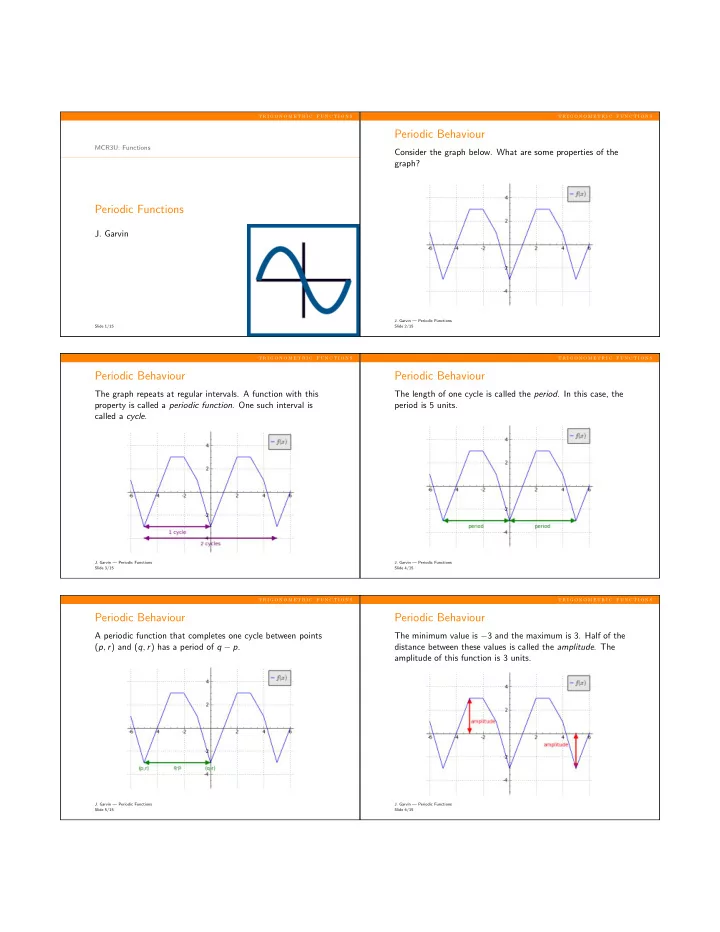
Consider the graph below. What are some properties of the graph?

  • J. Garvin — Periodic Functions

Slide 2/15

t r i g o n o m e t r i c f u n c t i o n s

Periodic Behaviour

The graph repeats at regular intervals. A function with this property is called a periodic function. One such interval is called a cycle.

  • J. Garvin — Periodic Functions

Slide 3/15

t r i g o n o m e t r i c f u n c t i o n s

Periodic Behaviour

The length of one cycle is called the period. In this case, the period is 5 units.

  • J. Garvin — Periodic Functions

Slide 4/15

t r i g o n o m e t r i c f u n c t i o n s

Periodic Behaviour

A periodic function that completes one cycle between points (p, r) and (q, r) has a period of q − p.

  • J. Garvin — Periodic Functions

Slide 5/15

t r i g o n o m e t r i c f u n c t i o n s

Periodic Behaviour

The minimum value is −3 and the maximum is 3. Half of the distance between these values is called the amplitude. The amplitude of this function is 3 units.

  • J. Garvin — Periodic Functions

Slide 6/15

slide-2
SLIDE 2

t r i g o n o m e t r i c f u n c t i o n s

Periodic Behaviour

A periodic function with minimum value (a, b) and maximum value (c, d) has an amplitude of

  • b−d

2

  • .
  • J. Garvin — Periodic Functions

Slide 7/15

t r i g o n o m e t r i c f u n c t i o n s

Periodic Behaviour

Example

For the function below, state the period and amplitude.

  • J. Garvin — Periodic Functions

Slide 8/15

t r i g o n o m e t r i c f u n c t i o n s

Periodic Behaviour

The function has a minimum value at (−3, −4) and again at (3, −4). Since the function repeats after every minimum value, the period is 3 − (−3) = 6 units. Alternatively, the maximum values could be used instead. There is a maximum value at (−4, 2) and another at (1, 2). The point at (1, 2), however, is not the point after which the function repeats. There is a small horizontal section that

  • ccurs first.

Instead, use the point (2, 2). This yields the same period of 2 − (−4) = 6 units.

  • J. Garvin — Periodic Functions

Slide 9/15

t r i g o n o m e t r i c f u n c t i o n s

Periodic Behaviour

The diagram below shows the period using both the minimum and maximum values.

  • J. Garvin — Periodic Functions

Slide 10/15

t r i g o n o m e t r i c f u n c t i o n s

Periodic Behaviour

Since the minimum value of the function is −4 and the maximum is 2, the amplitude is

  • −4−2

2

  • = 3.
  • J. Garvin — Periodic Functions

Slide 11/15

t r i g o n o m e t r i c f u n c t i o n s

Predictions Using Periodic Behaviour

Since a periodic function repeats regularly, it is possible to predict values that may occur earlier or later. For example, if a function had a period of 5 units, then f (0) = f (5) = f (10) = . . . = f (5n). Similarly, f (1) = f (−4) = f (−9) = . . . = f (1 − 5n). In each of these cases, the value of the period is repeatedly added or subtracted from a known value of the function.

  • J. Garvin — Periodic Functions

Slide 12/15

slide-3
SLIDE 3

t r i g o n o m e t r i c f u n c t i o n s

Predictions Using Periodic Behaviour

Example

For the function below, determine f (14), f (−19) and f (600).

  • J. Garvin — Periodic Functions

Slide 13/15

t r i g o n o m e t r i c f u n c t i o n s

Predictions Using Periodic Behaviour

The period is 6, so we must add or subtract 6 until we reach a known value on the graph. f (14) = f (6 + 6 + 2) = f (2) = 2. f (−19) = f (−1 − 6 − 6 − 6) = f (−1) = −2. f (600) = f (6 × 100) = f (0 + 6 + 6 + . . . + 6

  • 100 times

) = f (0) = 0.

  • J. Garvin — Periodic Functions

Slide 14/15

t r i g o n o m e t r i c f u n c t i o n s

Questions?

  • J. Garvin — Periodic Functions

Slide 15/15