SLIDE 1
Periodic and non-periodic aspects of the heat kernel asymptotics on Sierpi´ nski carpets Naotaka Kajino (Universit¨ at Bielefeld)
http://www.math.uni-bielefeld.de/~nkajino/
Advances on Fractals and Related Topics @ Chinese Univ. Hong Kong December 11, 2012 16:25 –16:45
SLIDE 2 1/11
Main Question
Given a “Laplacian” ∆, let pt(x, y) be the heat kernel (transition density of the diffusion): et∆f(x) = ∫ pt(x, y)f(y)dy.
- Question. How does pt(x, x) behave as t ↓ 0?
- cf. Md: Riem. mfd
= ⇒ pM
t (x, x) t↓0
= (4πt)−d/2` 1 + SM (x)
6
t + O(t2) ´ ,
M cpt ⇒ ZM (t) := P
ne−λM n t =
R
M pM t (x, x) t↓0
∼ vold(M) (4πt)d/2 .
- Q. What happens for the heat kernels on fractals?
SLIDE 3 1/11
Main Question
Given a “Laplacian” ∆, let pt(x, y) be the heat kernel (transition density of the diffusion): et∆f(x) = ∫ pt(x, y)f(y)dy.
- Question. How does pt(x, x) behave as t ↓ 0?
- cf. Md: Riem. mfd
= ⇒ pM
t (x, x) t↓0
= (4πt)−d/2` 1 + SM (x)
6
t + O(t2) ´ ,
M cpt ⇒ ZM (t) := P
ne−λM n t =
R
M pM t (x, x) t↓0
∼ vold(M) (4πt)d/2 .
- Q. What happens for the heat kernels on fractals?
SLIDE 4 1/11
Main Question
Given a “Laplacian” ∆, let pt(x, y) be the heat kernel (transition density of the diffusion): et∆f(x) = ∫ pt(x, y)f(y)dy.
- Question. How does pt(x, x) behave as t ↓ 0?
- cf. Md: Riem. mfd
= ⇒ pM
t (x, x) t↓0
= (4πt)−d/2` 1 + SM (x)
6
t + O(t2) ´ ,
M cpt ⇒ ZM (t) := P
ne−λM n t =
R
M pM t (x, x) t↓0
∼ vold(M) (4πt)d/2 .
- Q. What happens for the heat kernels on fractals?
SLIDE 5 1/11
Main Question
Given a “Laplacian” ∆, let pt(x, y) be the heat kernel (transition density of the diffusion): et∆f(x) = ∫ pt(x, y)f(y)dy.
- Question. How does pt(x, x) behave as t ↓ 0?
- cf. Md: Riem. mfd
= ⇒ pM
t (x, x) t↓0
= (4πt)−d/2` 1 + SM (x)
6
t + O(t2) ´ ,
M cpt ⇒ ZM (t) := P
ne−λM n t =
R
M pM t (x, x) t↓0
∼ vold(M) (4πt)d/2 .
- Q. What happens for the heat kernels on fractals?
SLIDE 6 1/11
Main Question
Given a “Laplacian” ∆, let pt(x, y) be the heat kernel (transition density of the diffusion): et∆f(x) = ∫ pt(x, y)f(y)dy.
- Question. How does pt(x, x) behave as t ↓ 0?
- cf. Md: Riem. mfd
= ⇒ pM
t (x, x) t↓0
= (4πt)−d/2` 1 + SM (x)
6
t + O(t2) ´ ,
M cpt ⇒ ZM (t) := P
ne−λM n t =
R
M pM t (x, x) t↓0
∼ vold(M) (4πt)d/2 .
- Q. What happens for the heat kernels on fractals?
SLIDE 7
2/11
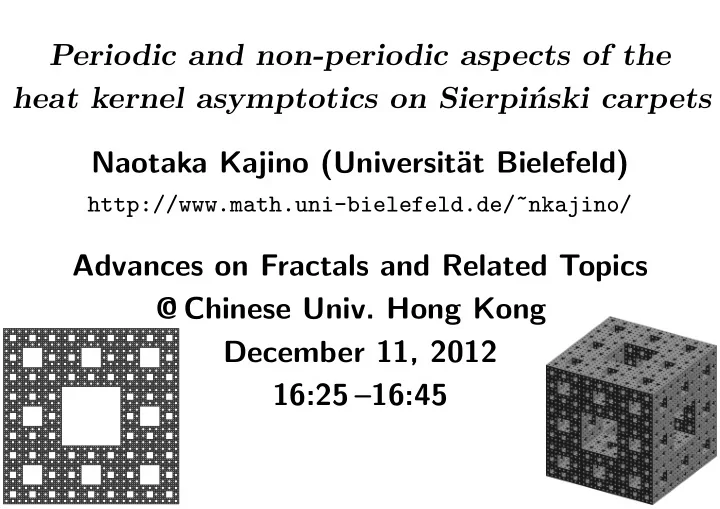
the Sierpi´ nski carpet ∂(SC) = ∂R2[0, 1]2!
SLIDE 8
2/11
the Sierpi´ nski carpet ∂(SC) = ∂R2[0, 1]2! generalized SCs
SLIDE 9 3/11
r r r r Examples of nested fractals Solid circles:“Boundary”V0
SLIDE 10
4/11
1 Dirichlet form and B.M. on Sierpi´
nski carpets ⊲µ : Self-similar measure
with weight ` 1
N , . . . , 1 N
´
K
1
K1 K2 K3 K4 K5 K6 K7 K8
1/N each 1/N 2 each
⊲∃1(E, F): canonical self-sim. Dirich. form on L2(K, µ)
Ttf(x) = Ex[f(Xt)]
X =({Xt}t≥0, {Px}x∈K ): µ-symm. conservative diffusion
SLIDE 11
4/11
1 Dirichlet form and B.M. on Sierpi´
nski carpets ⊲µ : Self-similar measure
with weight ` 1
N , . . . , 1 N
´
K
1
K1 K2 K3 K4 K5 K6 K7 K8
1/N each 1/N 2 each
⊲∃1(E, F): canonical self-sim. Dirich. form on L2(K, µ)
“E(u, v) = R
Rd∇u,∇vdx”
Existence: Barlow-Bass ’89, ’99, Kusuoka-Zhou ’92 Uniqueness: Barlow-Bass-Kumagai-Teplyaev ’10
Ttf(x) = Ex[f(Xt)]
X =({Xt}t≥0, {Px}x∈K ): µ-symm. conservative diffusion
SLIDE 12 4/11
1 Dirichlet form and B.M. on Sierpi´
nski carpets ⊲µ : Self-similar measure
with weight ` 1
N , . . . , 1 N
´
K
1
K1 K2 K3 K4 K5 K6 K7 K8
1/N each 1/N 2 each
⊲∃1(E, F): canonical self-sim. Dirich. form on L2(K, µ) (E, F)
Dirichlet form
E(u,v )=− Au,v µ
− − − − − − − − − − − − → ← − − − − − − − − − − − − −
E(√ −Au,√ −Av )
A
selfad, ≤ 0 “Laplacian”
Tt=etA
− − − − − − − − → ← − − − − − − − −
A=lim
t↓0 Tt−I t
{Tt}t
Markov semigr.
Ttf(x) = Ex[f(Xt)]
X =({Xt}t≥0, {Px}x∈K ): µ-symm. conservative diffusion
SLIDE 13 4/11
1 Dirichlet form and B.M. on Sierpi´
nski carpets ⊲µ : Self-similar measure
with weight ` 1
N , . . . , 1 N
´
K
1
K1 K2 K3 K4 K5 K6 K7 K8
1/N each 1/N 2 each
⊲∃1(E, F): canonical self-sim. Dirich. form on L2(K, µ) (E, F)
Dirichlet form
E(u,v )=− Au,v µ
− − − − − − − − − − − − → ← − − − − − − − − − − − − −
E(√ −Au,√ −Av )
A
selfad, ≤ 0 “Laplacian”
Tt=etA
− − − − − − − − → ← − − − − − − − −
A=lim
t↓0 Tt−I t
{Tt}t
Markov semigr.
Ttf(x) = Ex[f(Xt)]
X =({Xt}t≥0, {Px}x∈K ): µ-symm. conservative diffusion (the “Brownian motion” on K)
SLIDE 14 5/11
⊲µ : Self-similar measure
with weight ` 1
N , . . . , 1 N
´
K
1
K1 K2 K3 K4 K5 K6 K7 K8
1/N each 1/N 2 each
⊲∃1(E, F): canonical self-sim. Dirich. form on L2(K, µ) (E, F)
Dirichlet form
E(u,v )=− Au,v µ
− − − − − − − − − − − − → ← − − − − − − − − − − − − −
E(√ −Au,√ −Av )
A
selfad, ≤ 0 “Laplacian”
Tt=etA
− − − − − − − − → ← − − − − − − − −
A=lim
t↓0 Tt−I t
{Tt}t
Markov semigr.
Ttf(x) = Ex[f(Xt)]
X =({Xt}t≥0, {Px}x∈K ): µ-symm. conservative diffusion (the “Brownian motion” on K)
SLIDE 15 5/11
⊲µ : Self-similar measure
with weight ` 1
N , . . . , 1 N
´
K
1
K1 K2 K3 K4 K5 K6 K7 K8
1/N each 1/N 2 each
⊲∃1(E, F): canonical self-sim. Dirich. form on L2(K, µ) (E, F)
Dirichlet form
E(u,v )=− Au,v µ
− − − − − − − − − − − − → ← − − − − − − − − − − − − −
E(√ −Au,√ −Av )
A
selfad, ≤ 0 “Laplacian”
Tt=etA
− − − − − − − − → ← − − − − − − − −
A=lim
t↓0 Tt−I t
{Tt}t
Markov semigr.
Ttf(x) = Ex[f(Xt)]
X =({Xt}t≥0, {Px}x∈K ): µ-symm. conservative diffusion
⊲ pt(x, y): Heat kernel
Ttf(x) = Ex[f(Xt)] = R
K pt(x, y)f(y)dµ(y)
SLIDE 16 6/11
Sub-Gaussian bound of pt(x, y) Thm(Barlow-Bass ’92, ’99). For t ∈ (0, 1], x, y ∈ K, pt(x, y) ≍ c1 tds/2 exp ( −c2 (|x − y|dw t )
1 dw−1
) .
df := dimH,Euc K
- dw > 2 (Barlow-Bass ’90, ’92, ’99)
⇒ c3 ≤ tds/2pt(x, x) ≤ c4, t ∈ (0, 1], x ∈ K.
t↓0 tds/2pt(x, x)? If not, HOW it oscillates?
- cf. Md: Riem. mfd ⇒ limt↓0 td/2pM
t (x, x) = (4π)−d/2.
SLIDE 17 6/11
Sub-Gaussian bound of pt(x, y) Thm(Barlow-Bass ’92, ’99). For t ∈ (0, 1], x, y ∈ K, pt(x, y) ≍ c1 tds/2 exp ( −c2 (|x − y|dw t )
1 dw−1
) .
df := dimH,Euc K
- dw > 2 (Barlow-Bass ’90, ’92, ’99)
⇒ c3 ≤ tds/2pt(x, x) ≤ c4, t ∈ (0, 1], x ∈ K.
t↓0 tds/2pt(x, x)? If not, HOW it oscillates?
- cf. Md: Riem. mfd ⇒ limt↓0 td/2pM
t (x, x) = (4π)−d/2.
SLIDE 18 6/11
Sub-Gaussian bound of pt(x, y) Thm(Barlow-Bass ’92, ’99). For t ∈ (0, 1], x, y ∈ K, pt(x, y) ≍ c1 tds/2 exp ( −c2 (|x − y|dw t )
1 dw−1
) .
df := dimH,Euc K
- dw > 2 (Barlow-Bass ’90, ’92, ’99)
⇒ c3 ≤ tds/2pt(x, x) ≤ c4, t ∈ (0, 1], x ∈ K.
t↓0 tds/2pt(x, x)? If not, HOW it oscillates?
- cf. Md: Riem. mfd ⇒ limt↓0 td/2pM
t (x, x) = (4π)−d/2.
SLIDE 19 6/11
Sub-Gaussian bound of pt(x, y) Thm(Barlow-Bass ’92, ’99). For t ∈ (0, 1], x, y ∈ K, pt(x, y) ≍ c1 tds/2 exp ( −c2 (|x − y|dw t )
1 dw−1
) .
df := dimH,Euc K
- dw > 2 (Barlow-Bass ’90, ’92, ’99)
⇒ c3 ≤ tds/2pt(x, x) ≤ c4, t ∈ (0, 1], x ∈ K.
t↓0 tds/2pt(x, x)? If not, HOW it oscillates?
- cf. Md: Riem. mfd ⇒ limt↓0 td/2pM
t (x, x) = (4π)−d/2.
SLIDE 20 7/11
2 Thm 1. pt(x, x) NOT vary reg. & non-periodic
Thm (K.). ∃c5 ∈ (0, ∞), ∃N ⊂ K Borel, νq(N) = 0
for any self-similar measure νq, and ∀x ∈ K \N:
(NRV) p(·)(x, x) does NOT vary regularly at 0 , and hence ∃ limt↓0 tds/2pt(x, x). ⊲ νq : Self-similar measure
with weight q = (qi)N
i=1
(qi > 0, PN
i=1 qi = 1)
1
1 on K
q1 q2 q3 q4 q5 q6 q7 q8
qi on Ki
qiqj on Kij
SLIDE 21
7/11
2 Thm 1. pt(x, x) NOT vary reg. & non-periodic
Thm (K.). ∃c5 ∈ (0, ∞), ∃N ⊂ K Borel, νq(N) = 0
for any self-similar measure νq, and ∀x ∈ K \N:
(NRV) p(·)(x, x) does NOT vary regularly at 0 , and hence ∃ limt↓0 tds/2pt(x, x).
SLIDE 22 7/11
2 Thm 1. pt(x, x) NOT vary reg. & non-periodic
Thm (K.). ∃c5 ∈ (0, ∞), ∃N ⊂ K Borel, νq(N) = 0
for any self-similar measure νq, and ∀x ∈ K \N:
(NRV) p(·)(x, x) does NOT vary regularly at 0 , and hence ∃ limt↓0 tds/2pt(x, x).
- f : (0, ∞) → (0, ∞) varies regularly at 0
def
⇐ ⇒ ∀α ∈ (0, ∞), ∃ lim
t↓0 f(αt)/f(t) ∈ (0, ∞).
SLIDE 23 7/11
2 Thm 1. pt(x, x) NOT vary reg. & non-periodic
Thm (K.). ∃c5 ∈ (0, ∞), ∃N ⊂ K Borel, νq(N) = 0
for any self-similar measure νq, and ∀x ∈ K \N:
(NRV) p(·)(x, x) does NOT vary regularly at 0 , and hence ∃ limt↓0 tds/2pt(x, x). (NP) lim supt↓0
- tds/2pt(x, x)− G(− log t)
- ≥c5
for any periodic G : R → R.
SLIDE 24 8/11
Key to the proof of Thm 1
t
y
t
z
❄
y, z ∈ K \ ∂K, lim
t↓0
pt(y, y) pt(z, z) = 2!
- Valid for most nested fractals (might not for S.G.!)
SLIDE 25 8/11
Key to the proof of Thm 1
t
y
t
z
❄
y, z ∈ K \ ∂K, lim
t↓0
pt(y, y) pt(z, z) = 2!
- Valid for most nested fractals (might not for S.G.!)
SLIDE 26 9/11
3 Thm 2. Periodic asymp. expansion of ZK(t)
⊲ ZK(t) := ∑∞
n=1 e−λK
n t =
∫
K pt(x, x)dµ(x)
⊲τ ∈ (1, ∞): the time scaling factor for {Xt}t≥0 Thm (K.). ∃Gk : R → R continuous log τ-periodic for 0 ≤ k ≤ d, G0, G1 > 0 and, as t ↓ 0, ZK(t)=
d
∑
k=0
t−dk/dwGk(− log t)+O ( e−ct
− 1 dw−1)
.
- dk := dimH(K ∩ {x1 = · · · = xk = 0})
(d0 = dimH K, d1 = dimH ∂K, dd−1 = 1 and dd = 0)
SLIDE 27 9/11
3 Thm 2. Periodic asymp. expansion of ZK(t)
⊲ ZK(t) := ∑∞
n=1 e−λK
n t =
∫
K pt(x, x)dµ(x)
⊲τ ∈ (1, ∞): the time scaling factor for {Xt}t≥0 Thm (K.). ∃Gk : R → R continuous log τ-periodic for 0 ≤ k ≤ d, G0, G1 > 0 and, as t ↓ 0, ZK(t)=
d
∑
k=0
t−dk/dwGk(− log t)+O ( e−ct
− 1 dw−1)
.
- dk := dimH(K ∩ {x1 = · · · = xk = 0})
(d0 = dimH K, d1 = dimH ∂K, dd−1 = 1 and dd = 0)
SLIDE 28 9/11
3 Thm 2. Periodic asymp. expansion of ZK(t)
⊲ ZK(t) := ∑∞
n=1 e−λK
n t =
∫
K pt(x, x)dµ(x)
⊲τ ∈ (1, ∞): the time scaling factor for {Xt}t≥0 Thm (K.). ∃Gk : R → R continuous log τ-periodic for 0 ≤ k ≤ d, G0, G1 > 0 and, as t ↓ 0, ZK(t)=
d
∑
k=0
t−dk/dwGk(− log t)+O ( e−ct
− 1 dw−1)
.
- dk := dimH(K ∩ {x1 = · · · = xk = 0})
(d0 = dimH K, d1 = dimH ∂K, dd−1 = 1 and dd = 0)
SLIDE 29 9/11
3 Thm 2. Periodic asymp. expansion of ZK(t)
⊲ ZK(t) := ∑∞
n=1 e−λK
n t =
∫
K pt(x, x)dµ(x)
⊲τ ∈ (1, ∞): the time scaling factor for {Xt}t≥0 Thm (K.). ∃Gk : R → R continuous log τ-periodic for 0 ≤ k ≤ d, G0, G1 > 0 and, as t ↓ 0, ZK(t)=
d
∑
k=0
t−dk/dwGk(− log t)+O ( e−ct
− 1 dw−1)
.
- dk := dimH(K ∩ {x1 = · · · = xk = 0})
(d0 = dimH K, d1 = dimH ∂K, dd−1 = 1 and dd = 0)
SLIDE 30 10/11
Thm (K.). ∃Gk : R → R continuous log τ-periodic for 0 ≤ k ≤ d, G0, G1 > 0 and, as t ↓ 0, ZK(t)=
d
∑
k=0
t−dk/dwGk(− log t)+O ( e−ct
− 1 dw−1)
.
Remarks on Thm 2
- ∃G0 : R → (0, ∞) is due to Hambly ’11
- Valid also for ZK\∂K with G0 the same, G1 < 0
- NOT known whether G0 and Gk are non-const.
SLIDE 31 10/11
Thm (K.). ∃Gk : R → R continuous log τ-periodic for 0 ≤ k ≤ d, G0, G1 > 0 and, as t ↓ 0, ZK(t)=
d
∑
k=0
t−dk/dwGk(− log t)+O ( e−ct
− 1 dw−1)
.
Remarks on Thm 2
- ∃G0 : R → (0, ∞) is due to Hambly ’11
- Valid also for ZK\∂K with G0 the same, G1 < 0
- NOT known whether G0 and Gk are non-const.
SLIDE 32 10/11
Thm (K.). ∃Gk : R → R continuous log τ-periodic for 0 ≤ k ≤ d, G0, G1 > 0 and, as t ↓ 0, ZK(t)=
d
∑
k=0
t−dk/dwGk(− log t)+O ( e−ct
− 1 dw−1)
.
Remarks on Thm 2
- ∃G0 : R → (0, ∞) is due to Hambly ’11
- Valid also for ZK\∂K with G0 the same, G1 < 0
- NOT known whether G0 and Gk are non-const.
SLIDE 33 11/11
Extension of Thm 2 for nested fractals ⊲ K := the standard Sierpi´ nski gasket ⊲ I := the bottom line of K
I
⊲ df := log2 3, dw := log2 5
Thm (K.). ∃G0, G1, GI : R → (0, ∞) continuous log 5- periodic (∃G0: Kigami-Lapidus ’93), as t ↓ 0, ZK (t) = t−df /dwG0(−log t) + 3 G1(−log t) + O “ exp ` −ct
−
1 dw−1 ´”
, ZK\I(t) = t−df /dwG0(−log t)−t−1/dwGI(−log t) + G1(−log t) + O “ exp ` −ct
−
1 dw−1 ´”
.
SLIDE 34 11/11
Extension of Thm 2 for nested fractals ⊲ K := the standard Sierpi´ nski gasket ⊲ I := the bottom line of K
I
⊲ df := log2 3, dw := log2 5
Thm (K.). ∃G0, G1, GI : R → (0, ∞) continuous log 5- periodic (∃G0: Kigami-Lapidus ’93), as t ↓ 0, ZK (t) = t−df /dwG0(−log t) + 3 G1(−log t) + O “ exp ` −ct
−
1 dw−1 ´”
, ZK\I(t) = t−df /dwG0(−log t)−t−1/dwGI(−log t) + G1(−log t) + O “ exp ` −ct
−
1 dw−1 ´”
.
SLIDE 35 11/11
Extension of Thm 2 for nested fractals ⊲ K := the standard Sierpi´ nski gasket ⊲ I := the bottom line of K
I
⊲ df := log2 3, dw := log2 5
Thm (K.). ∃G0, G1, GI : R → (0, ∞) continuous log 5- periodic (∃G0: Kigami-Lapidus ’93), as t ↓ 0, ZK (t) = t−df /dwG0(−log t) + 3 G1(−log t) + O “ exp ` −ct
−
1 dw−1 ´”
, ZK\I(t) = t−df /dwG0(−log t)−t−1/dwGI(−log t) + G1(−log t) + O “ exp ` −ct
−
1 dw−1 ´”
.