PEDIATRIC FOIE GRAS: New insights into NAFLD and NASH - - PDF document

pediatric foie gras
SMART_READER_LITE
LIVE PREVIEW

PEDIATRIC FOIE GRAS: New insights into NAFLD and NASH - - PDF document

4/18/2013 Updates on PEDIATRIC FOIE GRAS: New insights into NAFLD and NASH pathophysiology NON-ALCOHOLIC FATTY New AASLD/AGA/ACG guidelines for NAFLD and NASH, as pertains to pediatrics LIVER DISEASE Evidence-based


slide-1
SLIDE 1

4/18/2013 1

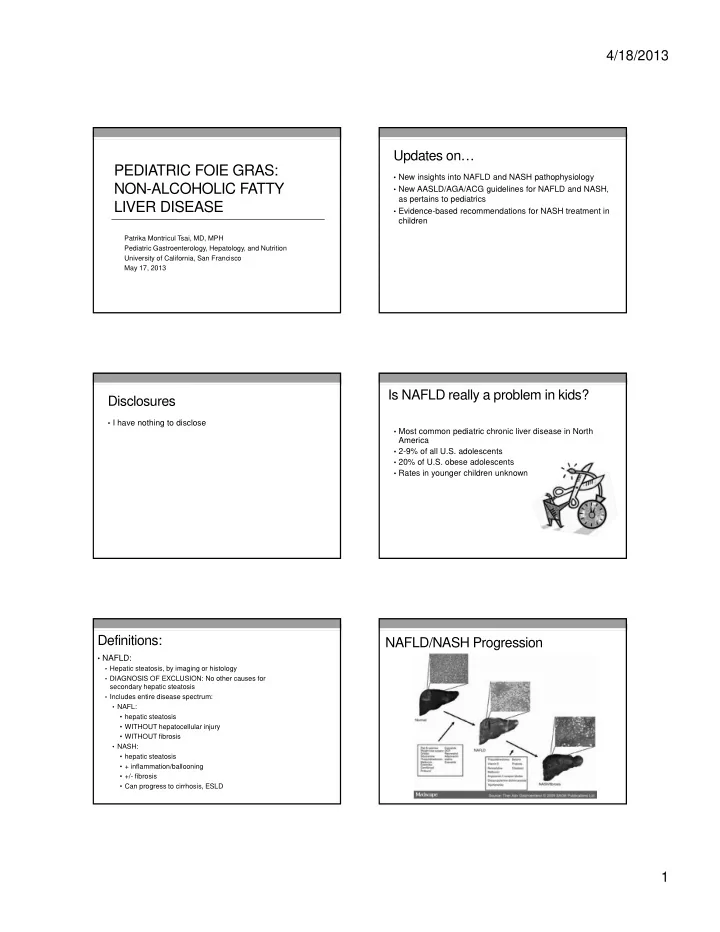
PEDIATRIC FOIE GRAS: NON-ALCOHOLIC FATTY LIVER DISEASE

Patrika Montricul Tsai, MD, MPH Pediatric Gastroenterology, Hepatology, and Nutrition University of California, San Francisco May 17, 2013

Updates on…

  • New insights into NAFLD and NASH pathophysiology
  • New AASLD/AGA/ACG guidelines for NAFLD and NASH,

as pertains to pediatrics

  • Evidence-based recommendations for NASH treatment in

children

Disclosures

  • I have nothing to disclose

Is NAFLD really a problem in kids?

  • Most common pediatric chronic liver disease in North

America

  • 2-9% of all U.S. adolescents
  • 20% of U.S. obese adolescents
  • Rates in younger children unknown

Definitions:

  • NAFLD:
  • Hepatic steatosis, by imaging or histology
  • DIAGNOSIS OF EXCLUSION: No other causes for

secondary hepatic steatosis

  • Includes entire disease spectrum:
  • NAFL:
  • hepatic steatosis
  • WITHOUT hepatocellular injury
  • WITHOUT fibrosis
  • NASH:
  • hepatic steatosis
  • + inflammation/ballooning
  • +/- fibrosis
  • Can progress to cirrhosis, ESLD

NAFLD/NASH Progression

slide-2
SLIDE 2

4/18/2013 2 Histology of NASH Pediatric NAFLD: Type 1 vs. Type 2

  • Type 1 NAFLD:
  • “Adult-type”
  • Zone 3 steatosis
  • Ballooning
  • Perisinusoidal fibrosis
  • Type 2 NAFLD:
  • ?Unique to children
  • Zone 1 steatosis
  • No ballooning
  • Portal inflammation/fibrosis

Loomba et al. HEPATOLOGY 2009;50:1282-1293

NAFLD Pathogenesis

Mantena SK et al. 2008 Bass NM. Hepatology 2010.

Two-hit hypothesis Lipotoxicity hypothesis

Natural history of NAFLD

  • Not well understood
  • In adults, NASH associated with:
  • Increased overall mortality risk
  • Leading cause of death: cardiovascular disease
  • Increased liver-mortality rate
  • NASH cirrhosis: Increased HCC risk (but lower than

Hep C cirrhosis)

  • In children: 1 retrospective single center study
  • 66 children
  • 5 with serial biopsies, 4 with fibrosis progression

Which of the following groups is protected from NAFLD?

  • A) African Americans
  • B) Asian Americans
  • C) Hispanic Americans
  • D) None of the above

Demographic Predictors of NAFLD

  • Overweight/obesity
  • Adolescents
  • Males > Females:
  • Estrogen protective?
  • Ethnicity:
  • Hispanics, Asians AT RISK
  • African Americans PROTECTED
  • Family history: obesity, insulin resistance/DM, NAFLD

Loomba R et al. Advances in Pediatric NAFLD. Hepatology. 2009; 50(4): 1282–1293.

slide-3
SLIDE 3

4/18/2013 3 New NAFLD guidelines: June 2012

Grading of recommendations, evidence

  • Strength of Recommendation: factors include evidence

quality, importance to patient outcomes, and cost

1.

STRONG

2.

WEAK

  • Quality of Evidence
  • High (A): Further research unlikely to change confidence in the

estimate of the clinical effect

  • Moderate (B): Further research may change confidence in estimate
  • f the clinical effect
  • Low (C): Further research very likely to impact confidence on the

estimate of clinical effect

AASLD: NAFLD screening?

  • Not recommended in adult primary care clinics or

high-risk specialty clinics (diabetes, obesity) (1, B)

  • Not recommended in overweight/obese children:
  • “Due to a paucity of evidence, a formal recommendation cannot be

made with regards to screening for NAFLD in overweight and

  • bese children despite a recent expert committee recommendation

for biannual screening.” (1, B)

  • Not recommended for family members of people with

NAFLD or NASH (1, B)

  • 18% of NASH patients have a first degree relative with NASH

AAP Guidelines for NAFLD Screening

  • Starting at 10 years of age, every 2 years
  • AST/ALT in pediatric patients with:
  • BMI>85th percentile for age/gender WITH risk factors OR
  • BMI>95th percentile for age/gender, regardless of risk factors
  • Risk factors:
  • Family history of obesity-related diseases, including hypertension,

early cardiovascular deaths, and strokes

  • Patient history of elevated blood pressure, hyperlipidemia, or

tobacco use.

  • Pediatrics. December 2007, pp. S164-S192, S193-S228

What are “normal” LFTS?

  • Screening ALT for Elevation in Today’s Youth (SAFETY)
  • U.S. children’s hospitals:
  • Median ALT (range):
  • ALL: 53 (30-90)
  • BOYS: 50 (30-70)
  • GIRLS: 40 (29-65)
  • NHANES: 12-17 yrs w/o liver disease
  • 95th percentile ALT:
  • BOYS: 25.8 U/L
  • GIRLS: 22.1 U/L

Schwimmer JB et al. Gastroenterology 2010.

Initial evaluation

  • AST/ALT
  • Does NOT correlate well with presence or severity of NASH
  • Medication history
  • Family history
  • Alcohol screen for adolescents

AND Viral hepatitis:

  • Hep A total Ab
  • Hep B Sag, Cab,

SAb,

  • Hep C Ab
slide-4
SLIDE 4

4/18/2013 4

Evaluation of incidental hepatic steatosis

  • History, clinical exam, LFTs
  • Signs/symptoms liver disease and/or abnormal LFTs:
  • Suspected NAFLD,  further workup (1, A)
  • NO signs/symptoms liver disease AND normal LFTs:
  • Assess for metabolic risk factors (obesity, DM,

dyslipidemia) (1, A)

  • NO liver biopsy recommended (1, B)

Ultrasound for hepatic steatosis

Bohte AE et al. Radiology 2012; 262 (1): 327-334.

MRI steatosis “color mapping”

Qayyum A et

  • al. AJR,

March 2012.

When to biopsy adults for NAFLD?

  • “Should be considered in patients with NAFLD who are at

increased risk to have steatohepatitis and advanced fibrosis” (1, B)

  • Metabolic syndrome
  • NAFLD Fibrosis Score
  • “Patients with suspected NAFLD in whom competing

etiologies for hepatic steatosis and co-existing chronic liver diseases cannot be excluded” (1, B)

When to biopsy children for NAFLD?

  • AASLD:
  • “where the diagnosis of NAFLD is unclear”
  • “where there is possibility of multiple diagnoses”
  • “before starting potentially hepatotoxic medications”
  • “prior to starting pharmacologic therapy for NASH”
  • ESPGHAN:
  • “no present consensus or evidence base to formulate guidelines”
  • “to exclude other treatable disease”
  • “in cases of clinically suspected advanced liver disease”
  • “before pharmacologic/surgical treatment”
  • “as part of a structured intervention protocol or clinical research trial”

Approach to NAFLD workup and biopsy

slide-5
SLIDE 5

4/18/2013 5

Which of the following is not an effective treatment for NAFLD?

  • A) Weight loss
  • B) Exercise
  • C) Vitamin E
  • D) Metformin

Lifestyle modification to treat NAFLD:

  • Weight loss through lifestyle modification:
  • 3-5%: reduced hepatic steatosis (1, B)
  • 10%: reduced necro-inflammation (1, B)
  • Improved steatosis, lobular inflammation, ballooning,

and NAFLD activity score

  • Exercise alone, even without weight loss
  • Can significantly decrease hepatic steatosis (1, B)
  • 2-3 sessions/week, 30-60 minutes, 6-12 weeks
  • In children and adults, no evidence to definitively

recommend a specific diet or exercise plan

Pediatric NAFLD

  • Treatment:
  • Lifestyle modification (2, B)
  • Vitamin E:
  • TONIC trial (NASH CRN): RCT of Vitamin E vs. metformin
  • vs. placebo x 96 weeks
  • NO difference between groups in primary outcome:

sustained ALT reduction

  • Vitamin E did significantly decrease NAS and improve

NASH resolution

  • Recommendation: 800 IU rrr alpha-tocopherol daily for

children with biopsy-proven NASH or borderline NASH (1, B)

Vitamin E in adults:

  • Vitamin E: Recommended at 800 IU/day for biopsy-proven,

non-diabetic ADULTS as first line therapy (1, B)

  • Anti-oxidant
  • Improves steatosis, inflammation, ballooning, NASH resolution
  • Does NOT improve fibrosis
  • NASH CRN trials (PIVENS, TONIC) suggest that rrr alpha-tocopherol

at 800IU/day helpful

  • Recommended daily allowance: 30 IU/day
  • 2 previous meta-analyses failed to show histologic benefits
  • ?Increases all-cause mortality
  • Conflicting data from meta-analyses
  • Recent trial of 400 IU/day associated with increased prostate cancer risk
  • NOT recommended in NASH + DM, NAFLD w/o liver biopsy, NASH

cirrhosis, cryptogenic cirrhosis, (1, C) NAFLD/NASH with other chronic liver disease co-existing (1, B)

Medications for NAFLD/NASH:

  • Metformin: Not recommended (1, A)
  • RCT data for both adults and children
  • No effect on AST/ALT or liver histology
  • No effect regardless of diabetes as co-morbidity
  • Rosiglitazone: Not recommended
  • Increased risk coronary events
  • Less data than for pioglitazone, but does not seem to improve

inflammation or fibrosis (maybe AST/ALT, steatosis?)

  • Pioglitazone: Recommended in biopsy-proven, non-

diabetic ADULTS (1, B)

  • Meta-analysis (Vernon G et al, 2011):
  • Improves steatosis: OR 4.05, 95% CI 2.58-6.35
  • Improves inflammation: OR 3.53, 95% CI 2.21-5.64
  • Does NOT improve fibrosis: OR 1.40, 95% CI 0.87-2.24
  • Causes weight gain

Medications for NAFLD/NASH:

  • UDCA: Not recommended (1, B)
  • Several small studies, 1 large RCT: no benefit
  • Omega-3 fatty acids: Use to treat hypertriglyceridemia in

NASH patients, but not specifically to treat NAFLD/NASH (1, B)

  • Large multicenter study ongoing: eicosapentoic acid
  • Other studies small, flawed
  • Statins: Use to treat dyslipidemia in NAFLD/NASH

patients (1, B), but NOT as specific treatment for NAFLD/NASH (1, B)

slide-6
SLIDE 6

4/18/2013 6 Bariatric surgery and NASH:

  • NAFLD/NASH not a contraindication (1, A)
  • No RCTs evaluate bariatric surgery as a treatment for

NAFLD/NASH

  • In cohort studies, availability of histologic outcomes variable, BUT
  • 2 meta-analyses:
  • Mummadi et al: bariatric surgery improves steatosis,

steatohepatitis, fibrosis

  • Cochrane Review: lack of RCT data prevents definitive

assessment of bariatric surgery as NASH treatment

  • Safety and utility in NASH cirrhosis not established (1, B)
  • No recommendations on specific types of bariatric surgery for

NAFLD/NASH population

CyNCH trial

  • Cysteamine bitartrate delayed-release for treatment of

NASH

  • Children 8-17 years of age with histologically proven NASH
  • Double-blind, placebo-controlled RCT
  • 52 weeks of treatment, 24 week post-treatment follow-up
  • 6 follow-up visits
  • Post-treatment liver biopsy

Charlton MR et al. Gastro 2011: 1249-1253

Liver transplant: 2001-2009 indications Summary

  • NAFLD is the most common pediatric chronic liver

disease in North America

  • NAFLD can progress to fibrosis and ultimately require

liver transplant

  • Initial evaluation consists of AST and ALT
  • Further evaluation may include liver biopsy
  • Weight loss and exercise even without weight loss reduce

NAFLD

  • Vitamin E is recommended for biopsy-proven NASH

References

  • Chalasani N, Younossi Z, Lavine JE, et al. The diagnosis and

management of nonalcoholic fatty liver disease: practice guideline by the American Association for the Study of Liver Diseases, American College of Gastroenterology, and the American Gastroenterological

  • Association. Hepatology. 2012 Jun;55(6):2005-23.
  • Schwimmer JB, Dunn W, Norman GJ, et al. SAFETY study: alanine

aminotransferase cutoff values are set too high for reliable detection

  • f pediatric chronic liver disease. Gastroenterology. 2010

Apr;138(4):1357-64.

  • Vajro P, Lenta S, Socha P, et al. Diagnosis of nonalcoholic fatty liver

disease in children and adolescents: position paper of the ESPGHAN Hepatology Committee. J Pediatr Gastroenterol Nutr. 2012 May;54(5):700-13.

UCSF Pediatric Gastroenterology, Hepatology, and Nutrition

  • Laura Cooke
  • Alex Green
  • Betsy Haas-Beckert
  • Mel Heyman
  • Sue Rhee
  • Phil Rosenthal
  • Susan Stritzel-Diaz
  • Patrika Tsai
  • Elizabeth Yen