Pedestrian and Bicycle Master Plan Update Ad Hoc Advisory Committee - - PowerPoint PPT Presentation

pedestrian and bicycle master plan update
SMART_READER_LITE
LIVE PREVIEW

Pedestrian and Bicycle Master Plan Update Ad Hoc Advisory Committee - - PowerPoint PPT Presentation

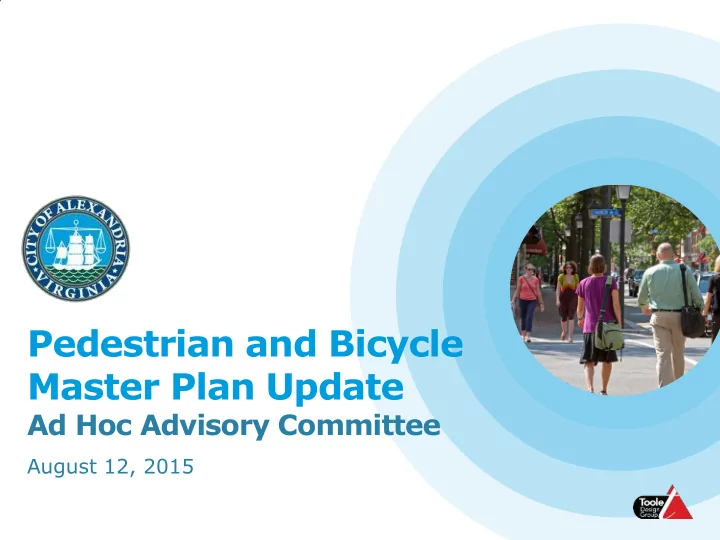
Pedestrian and Bicycle Master Plan Update Ad Hoc Advisory Committee August 12, 2015 Agenda Introductions Meeting Goals and Schedule Draft Program and Policy Strategies Public Comment Committee Member Updates Next Steps 2


slide-1
SLIDE 1

Pedestrian and Bicycle Master Plan Update

Ad Hoc Advisory Committee

August 12, 2015
slide-2
SLIDE 2

Agenda

2

  • Introductions
  • Meeting Goals and Schedule
  • Draft Program and Policy Strategies
  • Public Comment
  • Committee Member Updates
  • Next Steps
slide-3
SLIDE 3

Project Milestones/Tasks

Pedestrian Case Study Analysis

Data Collection Existing Conditions Issues/Needs Policy Review Connectivity Analysis Develop Networks Bike Share Analysis Pedestrian Case Studies Project evaluation criteria Identify projects Develop strategies

Prioritize projects/strategies

Develop costs/funding strategy

Update Master Plan chapters Ad Hoc Discussion, 8/12

slide-4
SLIDE 4

Key Themes from Last Meeting

  • Pedestrian Case Studies
  • Safety should be top priority
  • Address conflicts between pedestrians & bicyclists
  • Balancing the needs of different modes in constrained

rights of way

  • Consider sight lines in recommendations
  • Pedestrian Engineering Strategies
  • Accommodating all modes (including acquiring right of

way in constrained areas – e.g. West End Transitway)

  • Manage/mitigate conflicts between pedestrians and

bicyclists, esp. in Old Town. Make on-street bicycling the most desirable option.

4

slide-5
SLIDE 5

Planning Process

5

Vision

Performance Measures

Goal

Strategies Objectives

slide-6
SLIDE 6

Draft Strategies

  • Strategies were developed based on:
  • 2008 Transportation Master Plan
  • Ad Hoc Committee and Public input
  • City staff input
  • Case Study Area field work
  • Pedestrian
  • Engineering
  • Program and Policy
  • Bicycle
  • Engineering
  • Program and Policy

Tonight’s discussion Discussed at June Ad Hoc meeting

slide-7
SLIDE 7

Key Strategies for Discussion

7

1. Maintenance and snow removal of pedestrian and bicycle facilities 2. Improved access and safety for all users on trails; particularly at entrance/exit points 3. Open Streets event pilot 4. Pursue funding to oversee education and outreach for pedestrian/multimodal transportation safety initiatives citywide 5. Partnerships with local bike organizations to reach under- represented groups 6. Partnerships with Health Department and schools 7. Vision Zero 8. Gold Walk Friendly Community/Bicycle Friendly Community designation

slide-8
SLIDE 8

Prioritize ongoing maintenance and repair of the bicycle and pedestrian network

  • Promote Call-Click-Connect as a means for

residents to report maintenance and safety concerns.

  • Improve snow removal practices on trails,

prioritizing popular commuter trails.

  • Work with National Parks Service to

formalize a partnership on snow removal of

  • Mt. Vernon Trail.

Pedestrian Strategy: E6 Bicycle Strategy: E6

slide-9
SLIDE 9

Improve access and safety for trail users, particularly at entrance and exit points

  • Use signage, pavement

markings and surface treatments to clarify travel paths at access points

  • Remove obstructions that

create choke points at trail heads

  • Widen access points that

carry higher volumes of pedestrian and bicycle traffic

  • Wayfinding at access points

and key junctions to aid navigation

Pedestrian Strategy: E7 Bicycle Strategy: E3

slide-10
SLIDE 10

Explore a pilot Open Streets Event to encourage active transportation and lifestyles

1. Increase education about Complete Streets, health benefits, transportation

  • ptions and programs in

Alexandria 2. Temporarily demonstrate innovative facility designs and let people experience them

Pedestrian Strategy: P4 Bicycle Strategy: P5

slide-11
SLIDE 11

Pursue funding to oversee education and

  • utreach for multimodal transportation safety

initiatives citywide

  • Grants for safety

campaigns, staffing and coordination

  • VA Highway Safety Office

(402 Grants)

  • DMV Safety Grants
  • VA Safe Routes to School
  • Transportation

Alternatives

14

Norfolk “We Roll Together” Campaign

  • Safety
  • Encouragement
  • Branding
  • Videos
  • Swag
  • Billboards
  • Bus ads
  • Events

Pedestrian Strategy: P1

slide-12
SLIDE 12

Partner with local groups to support bicycle education, outreach and promotion for underrepresented groups

Possible target groups might include:

  • Women
  • Non-English speaking populations
  • Lower income populations

Example program: WABA Woman & Bicycles

In DC, less than 26% of bicyclists are female.

Program includes:

  • Workshops
  • Rides
  • Coffee Clubs
  • Mentorship
  • Facebook Forum

Bicycle Strategy: P12

slide-13
SLIDE 13

Example programs:

Kansas City Earn-a-Bike Latino Outreach

  • Targeted education and engagement

in Latino communities

  • “The first 100 participants from the

Latino community get a free helmet, headlight, tail light and lock!”

FHWA Outreach Materials

Partner with local groups to support bicycle education, outreach and promotion for underrepresented groups

slide-14
SLIDE 14

1. Promote active transportation to address obesity 2. Alexandria Healthy Workplace Program 3. Alexandria Childhood Obesity Action Network

0.0% 5.0% 10.0% 15.0% 20.0% 25.0% 30.0% 35.0% 40.0% 45.0% 50.0% 2-5 6-10 11-14 15-18

Age Range

ALEXANDRIA CHILDHOOD OBESITY RATE Northern VA Average (26.4%)

Partner with health department and schools to identify funding and prioritize programs related to active transportation and lifestyles

Pedestrian Strategy: P7 Bicycle Strategy: P9

slide-15
SLIDE 15

1. Promote active transportation to improve student health, classroom behavior, and academic performance 2. Improve safety and reduce congestion 3. Promote Safe Routes to Schools at schools of all grade levels 4. Support bicycle and walking safety skills training

Partner with health department and schools to identify funding and prioritize programs related to active transportation and lifestyles

slide-16
SLIDE 16

Evaluate traffic fatalities and develop a Vision Zero program

  • Program should outline framework, budget and staffing

needs

  • Goal is to eliminate pedestrian and bicycle related

deaths in Alexandria

Pedestrian Strategy: P11

slide-17
SLIDE 17
  • New approach to the way we think about safety on our

streets

  • Origin: 1997 policy in Sweden
  • Goal = zero deaths/serious injuries by a given date
  • 3 main differences from previous approaches:
  • 1. All traffic fatalities are preventable
  • 2. Interagency collaboration
  • 3. Data-based approach

What is Vision Zero?

slide-18
SLIDE 18

Vision Zero: Public Opinion

A 2014 survey of almost 10,000 drivers

found that 86% supported their state adopting Vision Zero policies.

Image: SDOT Flickr

slide-19
SLIDE 19

Vision Zero: Larger Cities

  • NYC – Bill deBlasio committed to VZ

during campaign, adopted 2014

  • No commitment on deadline
  • 25 mph citywide speed limit
  • Borough Pedestrian Safety Action Plans
  • $25M TIGER grant for 13 projects
  • San Francisco – adopted 2014
  • Zero traffic deaths by 2024
  • 24 capital projects by Jan. 2016
  • Ped safety initiatives first
  • Other cities following suit: Seattle,

Boston, Chicago, Portland, LA, Austin, etc.

slide-20
SLIDE 20

Vision Zero in Small to Medium Sized Cities

San Mateo, CA (pop. 101,000)

  • Sustainable Streets Plan (2015)

“Eliminate pedestrian- and bicycle-related fatalities and reduce the number of non-fatal pedestrian- and bicycle- related collisions by 50% from 2010 levels by 2020.”

Boulder, CO (pop. 103,000)

  • Transportation Master Plan (2014)
  • “Vision Zero Lite”

“The city’s ultimate goal is to strive toward zero serious injury and fatal accidents.”

Santa Barbara, CA (pop. 90,000)

  • City Council approved in May 2015
  • Plan being drafted by 2016
  • Nonprofit collaboration/leadership (Vision Zero SB)
slide-21
SLIDE 21

Strive for GOLD Walk Friendly/Bicycle Friendly Community Designation

  • Walk Friendly Community Program

sponsored by the Pedestrian and Bicycle Information Center

  • Bicycle Friendly Community Program

sponsored by the League of American Bicyclists

  • Why?
  • Demonstration of commitment
  • National/regional competitiveness
  • Supports transportation choice for

residents, workers and visitors

Pedestrian Strategy: P12 Bicycle Strategy: P15

slide-22
SLIDE 22

What does it take?

Walk Friendly Communities

  • 1 Platinum (Seattle)
  • 15 Gold (inc. Arlington,

Charlottesville, DC)

  • 14 Silver
  • 25 Bronze
  • Excellent pedestrian networks
  • Maintenance practices
  • Mode share goals
  • Supportive laws and policies
  • Education/encouragement

programs

  • Pedestrian advocacy
  • rganization and committee
  • Enforcement programs

28

Bike Friendly Communities

  • 4 Platinum (Fort Collins, Portland)
  • 21 Gold (inc. Madison, Seattle,

Durango)

  • 73 Silver
  • 250 Bronze
  • Excellent bicycle infrastructure
  • Education programs - learn to

ride, safety, rules of the road

  • Incentives and programs that

encourage bicycling

  • Supportive laws and policies
  • Process to evaluate progress and

inform future improvements

slide-23
SLIDE 23

Committee Discussion

Are there any key engineering, program and policy issues that have not been addressed through the draft strategies?

29

slide-24
SLIDE 24

Public Comment

30

slide-25
SLIDE 25

Committee Member Updates

31

slide-26
SLIDE 26

Next Steps

32

Late May 2014: Project Launch June - Sept: Existing Conditions Analysis, Public Meeting #1 Early Spring 2015: Ad Hoc Meeting #5 Early Fall 2015: Public Meeting #2 Spring 2016: Completion Sept - Dec: Needs Assessment, Goals & Objectives Jan – June 2015: Strategies, Network, Focus Areas Winter 2015: Draft Plan and Guidelines Mid Spring 2015: Ad Hoc Meeting #6 Fall 2015: Ad Hoc Meeting #9 Summer 2015: Ad Hoc Meeting #7 / #8 Winter 2015: Ad Hoc Meeting #10

slide-27
SLIDE 27

Upcoming Outreach (Tentative)

  • August
  • Outreach at community events (e.g. First Thursday)
  • Ad Hoc Meeting #8
  • September
  • Public Meeting (September 24)
  • October
  • Planning/Transportation Commission
  • November
  • ACPS – School Board
  • BPAC
  • Environmental Policy Commission/Park and Recreation Commission
  • Ad Hoc Meeting # 9
  • January
  • Draft Plan Published
  • Alexandria Engage
  • Ad Hoc Meeting # 10
  • March
  • Revised Plan
  • Planning/Transportation Commission
  • April
  • City Council Approval

33

slide-28
SLIDE 28

34

Thank You!

www.alexandriava.gov/pedbikeplan