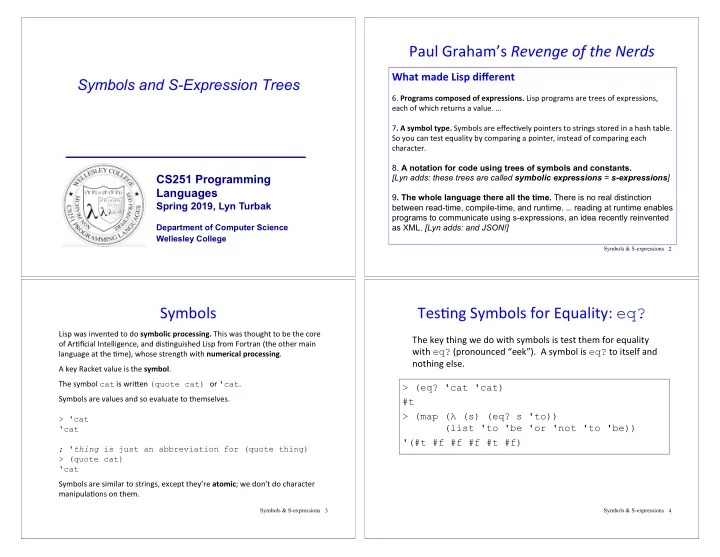
Paul Grahams Revenge of the Nerds What made Lisp different Symbols - - PowerPoint PPT Presentation

paul graham s revenge of the nerds
SMART_READER_LITE
LIVE PREVIEW

Paul Grahams Revenge of the Nerds What made Lisp different Symbols - - PowerPoint PPT Presentation

Paul Grahams Revenge of the Nerds What made Lisp different Symbols and S-Expression Trees 6. Programs composed of expressions. Lisp programs are trees of expressions, each of which returns a value. 7 . A symbol type. Symbols are effecBvely


slide-1
SLIDE 1

Symbols and S-Expression Trees

CS251 Programming Languages

Spring 2019, Lyn Turbak

Department of Computer Science Wellesley College

Paul Graham’s Revenge of the Nerds

What made Lisp different

  • 6. Programs composed of expressions. Lisp programs are trees of expressions,

each of which returns a value. …

  • 7. A symbol type. Symbols are effecBvely pointers to strings stored in a hash table.

So you can test equality by comparing a pointer, instead of comparing each character.

  • 8. A notation for code using trees of symbols and constants.

[Lyn adds: these trees are called symbolic expressions = s-expressions]

  • 9. The whole language there all the time. There is no real distinction

between read-time, compile-time, and runtime. … reading at runtime enables programs to communicate using s-expressions, an idea recently reinvented as XML. [Lyn adds: and JSON!]

2 Symbols & S-expressions

Symbols

Lisp was invented to do symbolic processing. This was thought to be the core

  • f ArBficial Intelligence, and disBnguished Lisp from Fortran (the other main

language at the Bme), whose strength with numerical processing. A key Racket value is the symbol. The symbol cat is wriNen (quote cat) or 'cat. Symbols are values and so evaluate to themselves. > 'cat 'cat ; 'thing is just an abbreviation for (quote thing) > (quote cat) 'cat Symbols are similar to strings, except they’re atomic; we don’t do character manipulaBons on them.

3 Symbols & S-expressions

TesBng Symbols for Equality: eq?

> (eq? 'cat 'cat) #t > (map (λ (s) (eq? s 'to)) (list 'to 'be 'or 'not 'to 'be)) '(#t #f #f #f #t #f)

4 Symbols & S-expressions

The key thing we do with symbols is test them for equality with eq? (pronounced “eek”). A symbol is eq? to itself and nothing else.

slide-2
SLIDE 2

eq? on Symbols and Lists

> (eq? (first L) (second L)) #f > (eq? (first L) (first (third LOL))) #t > (eq? (first LOL) (second LOL)) #t > (eq? (first LOL) (third LOL)) #f > (equal? (first LOL) (third LOL)) #t

5 Symbols & S-expressions

eq? can be used on any Racket values. It is used to test if two values are the same object in memory. In contrast, equal? tests structural equality of two values.

(define L (list 'a 'b)) (define LOL (list L L (list 'a 'b)))

LOL L 'a 'b

More eq? examples

> (eq? "cat" "cat") #t ; Happens to be true, but not guaranteed > (eq? "cat" (string-append "c" "at")) #f ; Two strings with the same chars not guaranteed eq? > (equal? "cat" (string-append "c" "at")) #t ; Two strings with the same chars guaranteed equal? > (eq? (fact 5) (fact 5)) #t ; For “small” numbers, eq? is same as = > (eq? (fact 1000) (fact 1000)) #f ; = bignums are not guaranteed eq?, but are equal? > (eq? 'cat (string->symbol "cat")) #t ; string->symbol returns unique symbol for a string > (eq? (string->symbol "cat") (string->symbol (string-append "c" "at"))) #t ; only one symbol in memory with a given name

6 Symbols & S-expressions

QuotaBon with Lists

As you’ve seen, a single quote can be used with parenthesized structures to denote lists. You can think of '(to be or not to be) as a sugared form of (list 'to 'be 'or 'not 'to 'be). (Not quite true, but useful.) A quoted parenthesized structure (quote (...))(abbreviated '(...)) denotes a list, according to the following desugaring: (quote (thing_1 … thing_n)) desugars to (list (quote thing_1) … (quote thing_n))

7 Symbols & S-expressions

Quoted Atoms

Atomic (indivisible) elements that can appear in list structures are called atoms. In Racket, atoms include numbers, booleans, and strings in addiBon to symbols.

(define (atom? x) (or (number? x) (boolean? x) (string? x) (symbol? x)))) A quoted atom (quote atom) (abbreviated 'atom) denotes the atom. For atoms that are not symbols, (quote atom) desugars to atom. For example:

  • (quote 251) desugars to 251
  • (quote #t) desugars to #t
  • (quote "Hi there!") desugars to "Hi there!”

Example: '(5 #f "cat" dog) desugars to (list 5 #f "cat" 'dog)

8 Symbols & S-expressions

slide-3
SLIDE 3

QuotaBon Exercise

  • 1. Give the desugaring of the following quoted expression

'((17 foo #f) "bar" (list + (quote quux))) (list (list 17 'foo #f) "bar" (list 'list '+ (list 'quote 'quux))) 2. Draw the box-and-pointer list structure of the value of this expression.

9 Symbols & S-expressions

'quote 'quux 'list '+ 'foo "bar" 17 #f

Lisp pioneered symbolic expressions, a.k.a. s-expressions, a parenthesized notaBon for represenBng trees as nested lists (compare to other tree notaBons, like XML or JSON). In these trees, nodes can have any number of children. Such trees are called rose trees (“rhododendron”, in Greek). An s-expression is just a quoted structure that represents a tree of intermediate nodes (lists) with leaves that are atoms. Example: '((this is (a nested)) list (that (represents a) tree))

S-Expressions

10 Symbols & S-expressions

this list is a nested that tree represents a

A sample s-expression

We will do some exercises with this sample s-expression: (define tr '((a (b c) d) e (((f) g h) i j k))) Draw the tree (not list structure) associated with this s-expression.

11 Symbols & S-expressions

FuncBons on s-expression trees

Define the following funcBons that take an s-expression tree as their only arg:

  • 1. (sexp-num-atoms sexp) returns the number of atoms (leaves) in the s-

expression tree sexp > (sexp-num-atoms tr) 11

  • 2. (sexp-atoms sexp) returns a list of the atoms (leaves) encountered in a

leb-to-right depth first search of the s-expression tree sexp. > (sexp-atoms tr) '(a b c d e f g h i j k)

  • 3. (sexp-height sexp) returns the height of the s-expression tree sexp.

> (sexp-height tr) 4

12 Symbols & S-expressions

slide-4
SLIDE 4

An s-expression Read-Eval-Print Loop (REPL)

(define (sexp-repl) (begin (display "Please enter an s-expression:") (let {[(sexp (read)]} ; read prompts user for sexp (if (eq? sexp 'quit) 'done (begin (display (list 'sexp-num-atoms: (sexp-num-atoms sexp))) (newline) (display (list 'sexp-atoms: (sexp-atoms sexp))) (newline) (display (list 'sexp-height: (sexp-height sexp))) (newline) (sexp-repl))))))

13 Symbols & S-expressions

On to Metaprogramming

A metaprogram is a program that manipulates another program, such as an interpreter, compiler, type checker, assembler, etc. Q: In a metaprogram, how could we represent a Racket definiBon like this? (define avg (lambda (a b) (/ (+ a b) 2))) A: By adding a single quote mark! '(define avg (lambda (a b) (/ (+ a b) 2))) Does this give you a new appreciaBon for Lisp and what Paul Graham said about it?

14 Symbols & S-expressions

Metaprogramming Example 1

Define an is-valid-lambda funcBon that takes an sexp and returns #t iff it is a valid Racket lambda expression. Assume parameters *must* be a list of idenBfiers, and that there is a single body expression. (Racket is actually more flexible than this.) > (is-valid-lambda? '(lambda (a b) (/ (+ a b) 2))) #t > (is-valid-lambda? '(lamdba (a b) (/ (+ a b) 2))) #f > (is-valid-lambda? '(lambda foo (/ (+ a b) 2))) #f > (is-valid-lambda? '(lambda (a b) a b) #f

15 Symbols & S-expressions

Metaprogramming Example 2

Define a desugar-let funcBon that takes an sexp that is a valid Racket let expression and transforms it to the applicaBon of a lambda.

> (desugar-let '(let ((a (* 2 3)) (b (+ 4 5))) (- (* 10 a) b))) '((lambda (a b) (- (* 10 a) b)) (* 2 3) (+ 4 5))

16 Symbols & S-expressions