
SLIDE 1
Pattern matching algorithms
Vineet Bafna ∗ April 23, 2004
1 Algorithms for keyword search
These are meant to supplement your class notes, but do not substitute for class lectures. Try these algorithms
- n examples and make sure that you understand how they work. The first algorithm (see Figure 1) describes
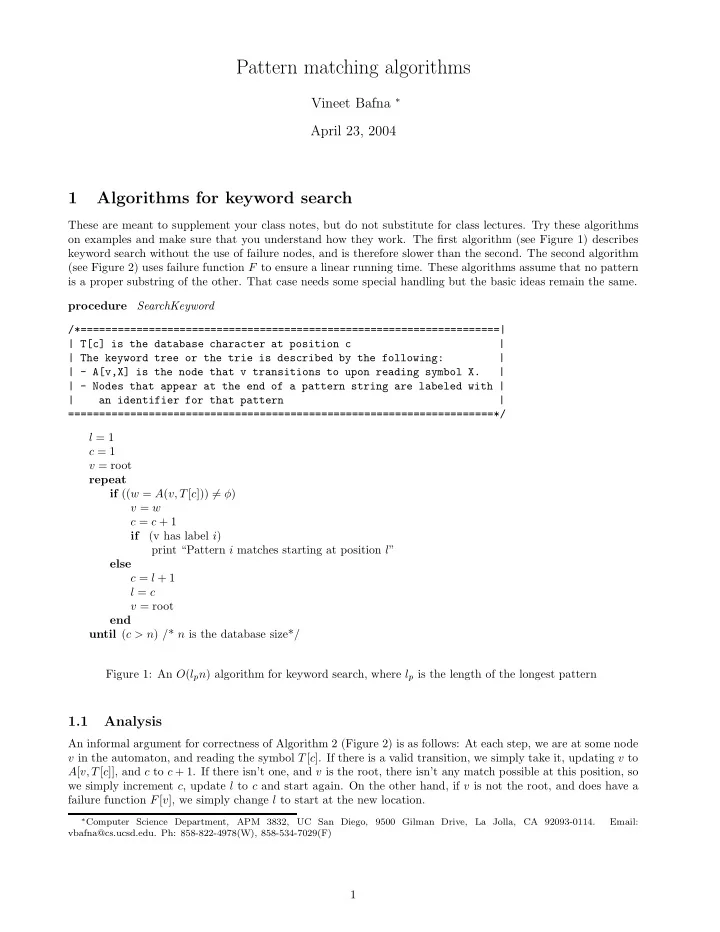
keyword search without the use of failure nodes, and is therefore slower than the second. The second algorithm (see Figure 2) uses failure function F to ensure a linear running time. These algorithms assume that no pattern is a proper substring of the other. That case needs some special handling but the basic ideas remain the same. procedure SearchKeyword /*====================================================================| | T[c] is the database character at position c | | The keyword tree or the trie is described by the following: | | - A[v,X] is the node that v transitions to upon reading symbol X. | | - Nodes that appear at the end of a pattern string are labeled with | | an identifier for that pattern | =====================================================================*/ l = 1 c = 1 v = root repeat if ((w = A(v, T[c])) = φ) v = w c = c + 1 if (v has label i) print “Pattern i matches starting at position l” else c = l + 1 l = c v = root end until (c > n) /* n is the database size*/ Figure 1: An O(lpn) algorithm for keyword search, where lp is the length of the longest pattern
1.1 Analysis
An informal argument for correctness of Algorithm 2 (Figure 2) is as follows: At each step, we are at some node v in the automaton, and reading the symbol T [c]. If there is a valid transition, we simply take it, updating v to A[v, T[c]], and c to c + 1. If there isn’t one, and v is the root, there isn’t any match possible at this position, so we simply increment c, update l to c and start again. On the other hand, if v is not the root, and does have a failure function F[v], we simply change l to start at the new location.
∗Computer Science Department,
APM 3832, UC San Diego, 9500 Gilman Drive, La Jolla, CA 92093-0114. Email: vbafna@cs.ucsd.edu. Ph: 858-822-4978(W), 858-534-7029(F)