Path Planning: Bugs, Wavefront Robert Platt Northeastern University - - PowerPoint PPT Presentation

path planning bugs wavefront
SMART_READER_LITE
LIVE PREVIEW

Path Planning: Bugs, Wavefront Robert Platt Northeastern University - - PowerPoint PPT Presentation

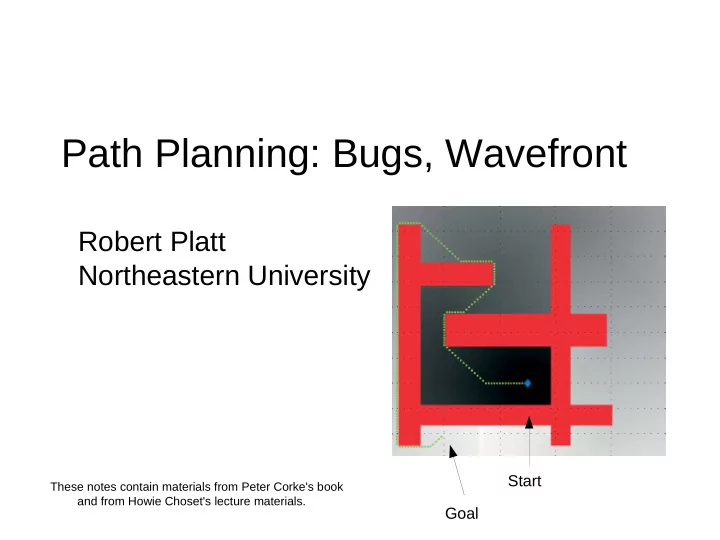
Path Planning: Bugs, Wavefront Robert Platt Northeastern University Start These notes contain materials from Peter Corke's book and from Howie Choset's lecture materials. Goal Problem we want to solve Given: a point-robot (robot is a


slide-1
SLIDE 1

Path Planning: Bugs, Wavefront

Robert Platt Northeastern University

Start Goal

These notes contain materials from Peter Corke's book and from Howie Choset's lecture materials.
slide-2
SLIDE 2

Problem we want to solve

Starting configuration Goal configuration Given: – a point-robot (robot is a point in space) – a start and goal configuration Find: – path from start to goal that does not result in a collision

slide-3
SLIDE 3

Problem we want to solve

Given: – a point-robot (robot is a point in space) – a start and goal configuration Find: – path from start to goal that does not result in a collision Assumptions: – the position of the robot can always be measured perfectly – the motion of the robot can always be controlled perfectly – the robot can move in any directly instantaneously

slide-4
SLIDE 4

First attempt: BUGs!

Bug algorithms: – assume only local knowledge of the environment is available – simple behaviors: follow a wall; follow straight line toward goal What the heck?

slide-5
SLIDE 5

First attempt: BUG 0

BUG 0:

  • 1. head toward goal
  • 2. if hit a wall, turn left
  • 3. follow wall until a line toward goal will move you away from wall.

(assume we only have local sensing – we cannot sense position

  • f walls we are not touching)

assume a left- turning robot The turning direction might be decided beforehand…

slide-6
SLIDE 6

Question

What does BUG0 do here?

start goal

slide-7
SLIDE 7

Second attempt: BUG 1

BUG 1:

  • 1. move on straight line toward goal
  • 2. if obstacle encountered, circumnavigate entire obstacle and remember how

close bug got to goal

  • 3. return to closest point and continue on a straight line toward goal
slide-8
SLIDE 8

Second attempt: BUG 1

BUG 1:

  • 1. move on straight line toward goal
  • 2. if obstacle encountered, circumnavigate entire obstacle and remember how

close bug got to goal

  • 3. return to closest point and continue on a straight line toward goal
slide-9
SLIDE 9

Question

What does BUG1 do here?

start goal

slide-10
SLIDE 10

BUG 1 Performance Analysis

How far does BUG 1 travel before reaching goal? Best case scenario (lower bound): Worst case scenario (upper bound): Where – D denotes distance from start to goal and – P_i denotes perimeter of ith obstacle

slide-11
SLIDE 11

Questions

Is BUG 1 complete? Prove completeness or incompleteness.

slide-12
SLIDE 12

Another bug: BUG 2

m-line

  • 1. head toward goal on m-line
slide-13
SLIDE 13

Another bug: BUG 2

m-line

  • 1. head toward goal on m-line
  • 2. if you encounter obstacle, follow it

until you encounter m-line again at a point closer to goal

slide-14
SLIDE 14

Another bug: BUG 2

m-line

  • 1. head toward goal on m-line
  • 2. if you encounter obstacle, follow it

until you encounter m-line again at a point closer to goal

  • 3. leave line and head toward goal again
slide-15
SLIDE 15

Another bug: BUG 2

Is BUG 2 complete? – Why? Why not?

slide-16
SLIDE 16

Another bug: BUG 2

slide-17
SLIDE 17

Another bug: BUG 2

How bad can it get? Lower bound: Upper bound: where n_i is the number of s-line intersections In the ith obstacle.

slide-18
SLIDE 18

Wavefront planner (distance transform)

– intensity of a point denotes its (obstacle-respecting) distance from the goal

slide-19
SLIDE 19

Algorithm:

  • 1. L={goal state}, d(goal state) = 2, d(obstacle states) = 1, d(rest of states) = 0
  • 2. while L != null
  • 3. pop item i from L
  • 4. for all neighbors j of i such that d(j)==0
  • 5. d(j) = d(i)+1
  • 6. push j onto L

L: list of nodes in wave front; initially just the goal state d: distance function over nodes; initially zero everywhere except goal state

Wavefront planner (distance transform)

slide-20
SLIDE 20

Algorithm:

  • 1. L={goal state}, d(goal state) = 2, d(obstacle states) = 1, d(rest of states) = 0
  • 2. while L != null
  • 3. pop item i from L
  • 4. for all neighbors j of i such that d(j)==0
  • 5. d(j) = d(i)+1
  • 6. push j onto L

Wavefront planner (distance transform)

slide-21
SLIDE 21

Algorithm:

  • 1. L={goal state}, d(goal state) = 2, d(obstacle states) = 1, d(rest of states) = 0
  • 2. while L != null
  • 3. pop item i from L
  • 4. for all neighbors j of i such that d(j)==0
  • 5. d(j) = d(i)+1
  • 6. push j onto L

Wavefront planner (distance transform)

slide-22
SLIDE 22

Algorithm:

  • 1. L={goal state}, d(goal state) = 2, d(obstacle states) = 1, d(rest of states) = 0
  • 2. while L != null
  • 3. pop item i from L
  • 4. for all neighbors j of i such that d(j)==0
  • 5. d(j) = d(i)+1
  • 6. push j onto L

Wavefront planner (distance transform)

slide-23
SLIDE 23

Algorithm:

  • 1. L={goal state}, d(goal state) = 2, d(obstacle states) = 1, d(rest of states) = 0
  • 2. while L != null
  • 3. pop item i from L
  • 4. for all neighbors j of i such that d(j)==0
  • 5. d(j) = d(i)+1
  • 6. push j onto L

Wavefront planner (distance transform)

slide-24
SLIDE 24

Algorithm:

  • 1. L={goal state}, d(goal state) = 2, d(obstacle states) = 1, d(rest of states) = 0
  • 2. while L != null
  • 3. pop item i from L
  • 4. for all neighbors j of i such that d(j)==0
  • 5. d(j) = d(i)+1
  • 6. push j onto L

Wavefront planner (distance transform)

slide-25
SLIDE 25

Algorithm:

  • 1. L={goal state}, d(goal state) = 2, d(obstacle states) = 1, d(rest of states) = 0
  • 2. while L != null
  • 3. pop item i from L
  • 4. for all neighbors j of i such that d(j)==0
  • 5. d(j) = d(i)+1
  • 6. push j onto L

Wavefront planner (distance transform)

slide-26
SLIDE 26

Algorithm:

  • 1. L={goal state}, d(goal state) = 2, d(obstacle states) = 1, d(rest of states) = 0
  • 2. while L != null
  • 3. pop item i from L
  • 4. for all neighbors j of i such that d(j)==0
  • 5. d(j) = d(i)+1
  • 6. push j onto L

Wavefront planner (distance transform)

slide-27
SLIDE 27

Algorithm:

  • 1. L={goal state}, d(goal state) = 2, d(obstacle states) = 1, d(rest of states) = 0
  • 2. while L != null
  • 3. pop item i from L
  • 4. for all neighbors j of i such that d(j)==0
  • 5. d(j) = d(i)+1
  • 6. push j onto L

Wavefront planner (distance transform)

c

slide-28
SLIDE 28

Algorithm:

  • 1. L={goal state}, d(goal state) = 2, d(obstacle states) = 1, d(rest of states) = 0
  • 2. while L != null
  • 3. pop item i from L
  • 4. for all neighbors j of i such that d(j)==0
  • 5. d(j) = d(i)+1
  • 6. push j onto L

Wavefront planner (distance transform)

c For node j, how many steps to goal state in terms of d(j)?

slide-29
SLIDE 29

Complete? Optimal? Prove completeness/optimality or incompletness/non-optimality

Questions

c

slide-30
SLIDE 30

Algorithm:

  • 1. L={goal state}, d(goal state) = 2, d(obstacle states) = 1, d(rest of states) = 0
  • 2. while L != null
  • 3. pop item i from L
  • 4. for all neighbors j of i such that d(j)==0
  • 5. d(j) = d(i)+1
  • 6. push j onto L

c L: list of nodes in wave front; initially just the goal state d: distance function over nodes; initially zero everywhere except goal state

Wavefront planner (distance transform)