Patent Reexamination: Effective Strategy gy for Litigating - - PowerPoint PPT Presentation

patent reexamination effective strategy gy for litigating
SMART_READER_LITE
LIVE PREVIEW

Patent Reexamination: Effective Strategy gy for Litigating - - PowerPoint PPT Presentation

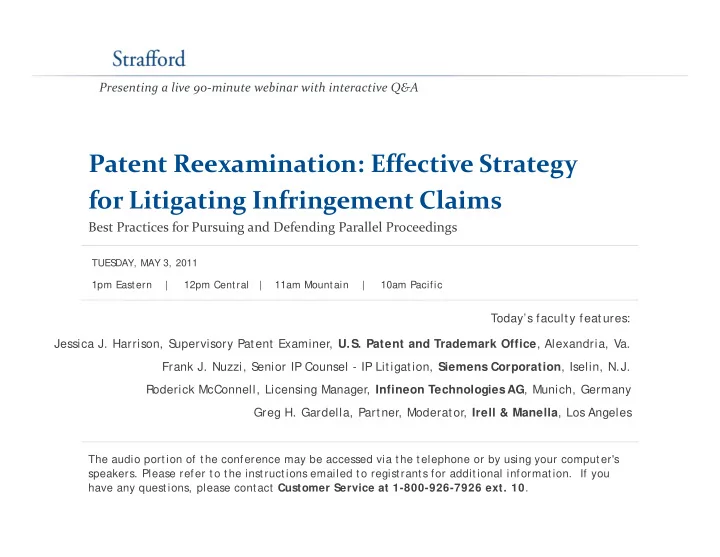
Presenting a live 90 minute webinar with interactive Q&A Patent Reexamination: Effective Strategy gy for Litigating Infringement Claims Best Practices for Pursuing and Defending Parallel Proceedings TUES DAY, MAY 3, 2011 1pm Eastern |


slide-1
SLIDE 1

Presenting a live 90‐minute webinar with interactive Q&A

Patent Reexamination: Effective Strategy gy for Litigating Infringement Claims

Best Practices for Pursuing and Defending Parallel Proceedings

T d ’ f l f

1pm Eastern | 12pm Central | 11am Mountain | 10am Pacific TUES DAY, MAY 3, 2011

Today’s faculty features: Jessica J. Harrison, S upervisory Patent Examiner, U.S. Patent and Trademark Office, Alexandria, Va. Frank J. Nuzzi, S enior IP Counsel - IP Litigation, Siemens Corporation, Iselin, N.J. Roderick McConnell, Licensing Manager, Infineon Technologies AG, Munich, Germany Greg H. Gardella, Partner, Moderator, Irell & Manella, Los Angeles

The audio portion of the conference may be accessed via the telephone or by using your computer's

  • speakers. Please refer to the instructions emailed to registrants for additional information. If you

have any questions, please contact Customer Service at 1-800-926-7926 ext. 10.

slide-2
SLIDE 2

Conference Materials

If you have not printed the conference materials for this program, please complete the following steps:

  • Click on the + sign next to “ Conference Materials” in the middle of the left-

hand column on your screen hand column on your screen.

  • Click on the tab labeled “ Handouts” that appears, and there you will see a

PDF of the slides for today's program.

  • Double click on the PDF and a separate page will open.

Double click on the PDF and a separate page will open.

  • Print the slides by clicking on the printer icon.
slide-3
SLIDE 3

Continuing Education Credits

FOR LIVE EVENT ONLY

For CLE purposes, please let us know how many people are listening at your location by completing each of the following steps:

  • Close the notification box
  • In the chat box, type (1) your company name and (2) the number of

attendees at your location

  • Click the blue icon beside the box to send
slide-4
SLIDE 4

Tips for Optimal Quality

S d Q lit S

  • und Quality

If you are listening via your computer speakers, please note that the quality of your sound will vary depending on the speed and quality of your internet connection. If the sound quality is not satisfactory and you are listening via your computer speakers, you may listen via the phone: dial 1-866-869-6667 and enter your PIN when prompted Otherwise please send us a chat or e mail when prompted. Otherwise, please send us a chat or e-mail sound@ straffordpub.com immediately so we can address the problem. If you dialed in and have any difficulties during the call, press *0 for assistance.

Viewing Qualit y

To maximize your screen, press the F11 key on your keyboard. To exit full screen, press the F11 key again press the F11 key again.

slide-5
SLIDE 5

Reexamination at the USPTO Reexamination at the USPTO

Jessica Harrison Jessica Harrison SPE AU 3992 Central Reexamination Unit SPE AU 3992 Central Reexamination Unit USPTO USPTO

slide-6
SLIDE 6

Filing Trends - Overall Filing Trends - Overall

FY Q1 Q2 Q3 Q4 TOTAL % Change

2008 210 202 203 233 848 2009 222 219 235 240 916

+ 8.0 %

2010 242 228 258 333 1061

+15 8 %

2010 242 228 258 333 1061

+15.8 %

2011 288

+19.0%* *based on Q1 data only

4/26/2011 6

slide-7
SLIDE 7

Filing Trends –Ex parte and IP percentages Filing Trends –Ex parte and IP percentages

FY % EP % IP 2007 83.6 16.4 2008 80.2 19.8 2009 71.8 28.2 2010 73.5 26.5 2011 65.3* 34.7*

*based on Q1 data only

4/26/2011 7

slide-8
SLIDE 8

Filing Trends – IP filings Filing Trends – IP filings

FY Q1 Q2 Q3 Q4 TOTAL % Change

2007 126 2008 45 37 46 40 168

+33 3%

2008 45 37 46 40 168

+33.3%

2009 68 65 62 63 258

+53.6%

2010 74 52 63 92 281

+11.9%

2011 100

+35%

*based on Q1 data only

4/26/2011 8

based on Q1 data only

slide-9
SLIDE 9

Agency Goals Agency Goals

  • Improve time from filing to Notice of Intent to Issue

Reexamination Certificate (NIRC) Reexamination Certificate (NIRC)

  • Shorten time in USPTO examination queue: less than

2 months 2 months

  • Improve time from mailing of Office actions to

availability in Patent Application Image and Retrieval availability in Patent Application Image and Retrieval (PAIR) system

  • Reduce burden of unnecessary petitions

Reduce burden of unnecessary petitions

  • Adopt e-certificate

4/26/2011 9

slide-10
SLIDE 10

Three phases to improve performance Three phases to improve performance

  • As announced in the notice titled, “Pilot Program for Waiver
  • f Patent Owner’s Statement in Ex Parte Reexamination
  • f Patent Owner s Statement in Ex Parte Reexamination

Proceedings” 75 Fed. Reg. 47269 (August 5, 2010), the USPTO is proceeding with a phased approach to improve i ti i reexamination processing:

  • In phase I, the USPTO will implement streamlined procedures and optional

programs in which patent owners and third party requesters may elect to i i i d i h b fi f h d participate in order to gain the benefit of shorter pendency.

  • In phases II and III, the USPTO will consider the data gathered from phase

I and the feedback from the patent owners and other stakeholders, and i l h h h i l d l h l implement process changes through internal procedural changes, rule making that includes opportunities for the public to comment, and/or administrative proposals for statutory changes to enhance reexamination proceedings

4/26/2011 10

proceedings.

slide-11
SLIDE 11

Phase I Phase I

  • 1. Pilot Program for Waiver of Patent Owner’s

Statement in Ex Parte Reexamination Proceedings Statement in Ex Parte Reexamination Proceedings -

  • 75 FR 47269 (Aug. 5, 2010)

 This pilot allows the Central Reexamination Unit (CRU)  This pilot allows the Central Reexamination Unit (CRU) to mail a decision on the merits, together with the Order Granting Reexamination, rather than having to wait 2 th f th P t t O t fil ti l t t t months for the Patent Owner to file an optional statement responding to the Order (when most Patent Owners never file this statement).

4/26/2011 11

slide-12
SLIDE 12

Phase I Phase I

  • 2. Streamlined Procedure for Appeal Brief Review in

Ex Parte Reexamination Proceedings 75 FR 29321 Ex Parte Reexamination Proceedings, 75 FR 29321 (May 25, 2010), and Streamlined Procedure for Appeal Brief Review in Inter Partes Reexamination Appeal Brief Review in Inter Partes Reexamination Proceedings, 75 FR 50750 (Aug. 17, 2010).

 These changes eliminate the triple review of appeal briefs in reexaminations. Now, only the Board may reject an appeal brief as non-compliant.

4/26/2011 12

slide-13
SLIDE 13

Phase I Phase I

  • 3. Memo to CRU: Streamlined Procedure for Appeal

Brief Review and Examiner’s Answers in Inter Brief Review and Examiner’s Answers in Inter Partes Reexamination Proceedings (Aug. 17, 2010)

 If all the issues are fully briefed on both sides by the  If all the issues are fully briefed on both sides by the Patent Owner and Third Party Requester in an IP reexamination proceeding, then the Examiner does not d t d il E i ’ A th need to prepare and mail an Examiner’s Answer other than to adopt the position taken in the RAN.

4 Hire more CRU examiners

  • 4. Hire more CRU examiners.

 18 Examiners added to the CRU. An additional round of hiring is contemplated.

4/26/2011 13

slide-14
SLIDE 14

Phase I’s Promising Results Phase I’s Promising Results

  • Goal: Reduce average internal queue time to an outgoing

action being mailed to 2 months measured from when the action being mailed to 2 months measured from when the proceeding is before the USPTO.

  • Average time to first Office action reduced to 6 months in EP

and slightly more than 3 months in IP.

  • Average time from reply to first Office action to second Office

action reduced to 2 5 months in EP and 3 months in IP (typically action reduced to 2.5 months in EP and 3 months in IP (typically measured from Patent Owner’s response, so built in 30-day Third Party Requester comment period).

  • Average time from reply to second Office action to third Office

action reduced slightly less than 2 months in EP, but 6 months in IP.

4/26/2011 14

IP.

slide-15
SLIDE 15

Phase I’s Promising Results Phase I’s Promising Results

  • Pilot Program for Waiver of Patent Owner’s Statement in Ex

Parte Reexamination Proceeding Parte Reexamination Proceeding

 We are holding steady at 19-20% waiver rate.  Of those where a waiver has been received as a result of a call seeking waiver and a First Office Action on the Merits (FAOM) has been waiver and a First Office Action on the Merits (FAOM) has been mailed (includes NIRCs); the average time from filing date to action has been about 2.1 months as compared to the 5.5 months reported for the 1st quarter of this FY the 1st quarter of this FY.  6 proceedings have already received a NIRC, and in three of them the certificates have issued. In addition, two have already received final rejections rejections.

4/26/2011 15

slide-16
SLIDE 16

Additional Phase I actions under consideration Additional Phase I actions under consideration

  • Provide for expedited same-day scanning into PAIR for
  • utgoing Office communication in reexamination
  • utgoing Office communication in reexamination
  • Publish reexamination certificates without reference citation

information on their face

  • Use reexamination proceedings as the test bed for the end-to-

end reengineering process. This would result in a smart-text- based file wrapper for examination use which would permit: based file wrapper for examination use which would permit:

 Examination efficiencies, particularly when large numbers of claims and IDS citations are filed  F id ( t d ) tifi t bli ti  For rapid (next day) certificate publication

4/26/2011 16

slide-17
SLIDE 17

Phase II & III Phase II & III

  • The proposed regulatory and statutory initiatives are

not yet fully vetted and therefore are not part of this not yet fully vetted and therefore are not part of this presentation.

4/26/2011 17

slide-18
SLIDE 18

Reexamination Statistics Reexamination Statistics

4/26/2011 18 Data through 1/31/2011

slide-19
SLIDE 19

Reexamination Statistics Reexamination Statistics

4/26/2011 19 Data through 1/31/2011

slide-20
SLIDE 20

Reexamination Statistics Reexamination Statistics

4/26/2011 20 Data through 1/31/2011

slide-21
SLIDE 21

Reexamination Statistics Reexamination Statistics

4/26/2011 21 Data through 1/31/2011

slide-22
SLIDE 22

Reexamination Statistics Reexamination Statistics

4/26/2011 22 Data through 1/31/2011

slide-23
SLIDE 23

Reexamination Statistics Reexamination Statistics

4/26/2011 23 Data through 1/31/2011

slide-24
SLIDE 24

Reexamination Statistics Reexamination Statistics

4/26/2011 24 Data through 1/31/2011

slide-25
SLIDE 25

Reexamination Statistics Reexamination Statistics

4/26/2011 25 Data through 1/31/2011

slide-26
SLIDE 26

Reexamination Statistics Reexamination Statistics

4/26/2011 26 Data through 1/31/2011

slide-27
SLIDE 27

Reexamination Statistics Reexamination Statistics

4/26/2011 27 Data through 1/31/2011

slide-28
SLIDE 28

Reexamination Statistics Reexamination Statistics

4/26/2011 28 Data through 1/31/2011

slide-29
SLIDE 29

Reexamination Statistics Reexamination Statistics

4/26/2011 29 Data through 1/31/2011

slide-30
SLIDE 30

Reexamination Statistics Reexamination Statistics

4/26/2011 30 Data through 1/31/2011

slide-31
SLIDE 31

Reexamination Statistics Reexamination Statistics

4/26/2011 31 Data through 1/31/2011

slide-32
SLIDE 32

Reexamination Statistics Reexamination Statistics

4/26/2011 32 Data through 1/31/2011

slide-33
SLIDE 33

Reexamination Statistics Reexamination Statistics

4/26/2011 33 Data through 1/31/2011

slide-34
SLIDE 34

Reexamination Statistics Reexamination Statistics

4/26/2011 34 Data through 1/31/2011

slide-35
SLIDE 35

Thank You Thank You

Jessica Harrison, SPE AU 3992 Jessica Harrison, SPE AU 3992 Jessica Harrison, SPE AU 3992 Central Reexamination Unit Jessica.Harrison@USPTO.gov (571) 272 4449 Jessica Harrison, SPE AU 3992 Central Reexamination Unit Jessica.Harrison@USPTO.gov (571) 272 4449 (571) 272-4449 (571) 272-4449

slide-36
SLIDE 36

Potential Benefits Of Reexamination

May 3, 2011 Teleconference Program Teleconference Program

Frank J Nuzzi 36

slide-37
SLIDE 37

Disclaimer Disclaimer

  • This presentation is informational and not

This presentation is informational and not legal advice

  • Any opinions are mine and not my

employer’s employer s

Frank J Nuzzi 37

slide-38
SLIDE 38

Potential Benefits To Patent Ch ll Challenger

  • May invalidate patent claims

y p

  • May eliminate pre-amendment damages under

intervening rights (see slide)

  • May stay litigation (see slide)
  • May encourage patentee to take position that is contrary

to litigation position (e g estoppel claim const art) to litigation position (e.g., estoppel, claim const., art)

  • Some believe that USPTO will dig deeper into the

technology than a jury would

  • May put cloud of invalidity over patent during

reexamination

Frank J Nuzzi 38

slide-39
SLIDE 39

Potential Benefits To Patentee Potential Benefits To Patentee

  • Strengthen patent before litigation by clearing

g p g y g patentability in view of new, previously uncited art

  • Obtain new claims targeting others’ products
  • Obtain new claims targeting others products
  • Potential estoppel effect against inter partes reexam

requester

  • Persuasive impact on jury even for ex parte reexam
  • Persuasive impact on jury even for ex parte reexam

(e.g., Juror: “the PTO approved the patent twice and so it must be valid”)

Frank J Nuzzi 39

slide-40
SLIDE 40

Intervening Rights Intervening Rights

Absolute: Pre-certificate damages unavailable Absolute: Pre certificate damages unavailable Equitable: Ct can reduce post-certificate damages Equitable: Ct can reduce post-certificate damages (e.g., new claims newly ensnare product that required costly investment) q y ) Both IRs require amended (or added) claims that

  • t

s equ e a e ded (o added) c a s t at differ from (are not “substantially identical” to)

  • riginal claims

Frank J Nuzzi 40

slide-41
SLIDE 41

Litigation Stays Litigation Stays

  • Stay is up to court’s discretion
  • Stay is up to court s discretion
  • Factors often considered:

–prejudice to non-movant? prejudice to non-movant? –simplify issues/trial? di l t d? T i l d t t? –discovery completed? Trial date set?

Frank J Nuzzi 41

slide-42
SLIDE 42

Frank J Nuzzi 732 321-3002 frank.nuzzi@siemens.com

42

slide-43
SLIDE 43

Patent Reexamination

Roderick McConnell I fi T h l i AG Infineon Technologies AG

slide-44
SLIDE 44

Disclaimer

 Any opinions presented are mine and not my employer’s  This presentation is for information not to give legal advice  This presentation is for information, not to give legal advice

44

slide-45
SLIDE 45

Choosing between Inter-Partes and Ex-Partes Reexam

 Inter-partes reexam has higher „success“ rates for requestor  e g for 2010: ex parte inter partes  e.g. for 2010: ex-parte inter-partes Claims unchanged 15% 13% Claims changed 73% 47% Claims cancelled 12% 40% Claims cancelled 12% 40%

  • > often a changed claim is of little use to requestor

 Problem of estoppel, issues which requestor pp , q „raised or could have raised”  Cost Comparison  Ex-parte: 10´ s of thousands  Inter-partes: 100´ s of thousands  Liti ti illi  Litigation: millions

45

slide-46
SLIDE 46

Other Strategy Considerations

 In multinational situations, often the same art and arguments can be re-used (with adaptation) in different countries ( p )  The patent owner is forced to make statements to defend his patent

  • > may yield useful limitations

> may yield useful limitations

  • > often not as helpful as requestor would hope

 Reexam against your own patent to present potentially relevant prior art to examiner prior art to examiner  Afterwards, prior art will already have been considered by examiner

46

slide-47
SLIDE 47

Use of Reexamination Outside of Litigation

1. Pro-active rather than reactive approach 2 Low hanging fruit: material available which puts validity of 2. Low-hanging fruit: material available which puts validity of patent in doubt  Often problematic if it is not printed publications (e.g. a „chip“) 3. Third-party attacks on problematic patents of competitors 4 Show engagement towards customers 4. Show engagement towards customers  „We‘ll take care of your problem with that patent“

47

slide-48
SLIDE 48

Serial Reexams

 It often takes time to find good prior art  Obviousness arguments are a typical case:  Obviousness arguments are a typical case:  more time-consuming  pieces of a puzzle“  „pieces of a puzzle  must be overwhelmingly convincing to work  If the patent is problematic and the first try doesn‘t succeed, p p y , then there is a motivation to try again

  • The patent claims may have changed due to reexam,

new arguments and prior art are needed new arguments and prior art are needed

48

slide-49
SLIDE 49

Comparison to EP Opposition

 Reexam at any time:

"any time during the period of enforceability of a patent “ (MPEP)

 Opposition during first 9 months after issue

enforceability of a patent.“ (MPEP)

 Patents, printed material  Any material prejudicial to patentability  "Any person at any time”

Inter-partes: other than the patent

  • wner or its privies

 Requestor may be „any person“ except owner  Evaluated by U.S.P.T.O.  Duty of candor  Evaluated by European Patent Office  Duty of candor  100‘s of k US$   50-100‘s of k€

49

slide-50
SLIDE 50

Roderick McConnell Infineon Technologies AG Infineon Technologies AG + 49-89-234-24914 Roderick McConnell@infineon com Roderick.McConnell@infineon.com

50

slide-51
SLIDE 51

Patent Reexamination: Effective Strategy f Liti ti I f i t Cl i for Litigating Infringement Claims

Best Practices for Pursuing and Defending Parallel Proceedings

Greg Gardella

slide-52
SLIDE 52

Interplay Between Reexam and Litigation

  • When to File Reexam?
  • Race to Judgment
  • Admissions
  • Admissions
  • Collateral Estoppel

52

slide-53
SLIDE 53

When to File Reexam: Before the Lawsuit Before the Lawsuit

  • In conjunction with declaratory judgment

j y j g action?

  • Provides a strong argument for the court to

Provides a strong argument for the court to grant a stay if litigation is later filed

  • Less costly to contest patent via reexam
  • Less costly to contest patent via reexam

versus litigation

  • Can cast later suit as retaliatory
  • Can cast later suit as retaliatory
  • Caveat: might provoke a lawsuit

53

slide-54
SLIDE 54

When to File Reexam: Beginning of Lawsuit

  • To maximize the chance of stay of litigation

Beginning of Lawsuit

To maximize the chance of stay of litigation

– Status of discovery and trial schedule often a key factor in decision to stay litigation factor in decision to stay litigation

  • To minimize the chance of preliminary

injunction/TRO injunction/TRO

  • The first OA or ACP is likely to issue before

trial trial

54

slide-55
SLIDE 55

When to File Reexam: L t i th L it

  • Reexam request may be easier to prepare after

Later in the Lawsuit

q y p p arguments are developed and prior art is searched during litigation

  • The grant of a reexam may influence the trier of fact
  • A pending reexam may be influential in post‐trial

proceedings, including permanent injunction motion p g , g p j

55

slide-56
SLIDE 56

When to File Reexam: After Lawsuit; Multiple Staggered Requests

Aft th l it

After Lawsuit; Multiple, Staggered Requests

  • After the lawsuit

– May serve to terminate injunction, royalty obligation

  • Multiple, staggered ex parte reexams

– Each new reexam request can attempt to address alleged shortcomings of prior art considered in prior reexam reexam – Tightening standards at the Central Reexamination Unit – Merger of co‐pending reexaminations

56

Merger of co pending reexaminations

slide-57
SLIDE 57

Delay in Filing Reexam Requests May Have Consequences Have Consequences

  • Denial of relief from judgment on basis of disclaimer

by plaintiff during reexamination of patent filed by defendant D f d d l d i fili i d

  • Defendant delayed in filing reexam request, waited

till after trial to file reexam request

“Microsoft was not faultless in the delay [in filing – Microsoft was not faultless in the delay [in filing reexamination petition] and justice does not require

  • verturning a jury verdict at this late stage based on

statements made to the PTO.” Amado v. Microsoft

517 F.3d 1353 (Fed. Cir. 2008)

57

slide-58
SLIDE 58

Interplay Between Reexam and Litigation

  • When to File Reexam
  • Race to Judgment
  • Admissions
  • Admissions
  • Collateral Estoppel

58

slide-59
SLIDE 59

Horse Race?

“A party can choose to run horses in both races, but the conclusion of one race automatically ends the other; a party cannot ride both horses to conclusion.”

Sony v. Jon W. Dudas, No. 1:05CV1447, 2006 WL 1472462, at *6

59

Sony v. Jon W. Dudas, No. 1:05CV1447, 2006 WL 1472462, at 6 (E.D. Va. May 22, 2006)

slide-60
SLIDE 60

In re Translogic g

DATE LITIGATION REEXAM

March 1999 Patentee sues June 1999 – Sept. 2002 Accused infringer files multiple reexam requests 2002 reexam requests

  • Oct. 2003

Jury upholds patent validity M h 2004 PTO j l i March 2004 PTO rejects claims May 2005 Jury finds $86.5 million in damages g July 2005 BPAI affirms rejections December 2005 District Court enters

60

judgment

slide-61
SLIDE 61

In re Translogic: Federal Circuit g

  • Jury verdict nullified by reexamination:

– Fed. Cir. affirms rejection in reexamination, holding patent claims as obvious (504 F.3d 1249) g p ( ) – Same day, the Fed. Cir. “vacates the district court's decision and remands this case to the court s decision and remands this case to the district court for dismissal.” (250 Fed. Appx. 988)

  • What if reexam decision occur after? May
  • What if reexam decision occur after? May

work to overturn permanent injunction. See, e g FRCP 60(b)(5)

61

e.g., FRCP 60(b)(5)

slide-62
SLIDE 62

Interplay Between Reexam and Litigation

  • When to File Reexam
  • Race to Judgment
  • Admissions
  • Admissions
  • Collateral Estoppel

62

slide-63
SLIDE 63

Interplay Among Proceedings – A L C H

Actions During Proceedings

Litigation Inter Partes Reexamination

A Lot Can Happen

“Admission” by Patent Owner Examiner may rely on admissions

Litigation Inter Partes Reexamination

“Fact” determined in Requester may be estopped Ongoing prosecution history: Patentee argues distinction over prior art May impact claim interpretation or provide basis for non-infringement position Non-Final Holding of Invalidity or Validity “Not controlling” in reexam “Fact” determined in reexamination from challenging fact in litigation Non-final rejection Persuasive authority for invalidity Claim amendments May limit damages or create intervening rights

63

intervening rights

slide-64
SLIDE 64

Interplay Among Proceedings – A L C H

Final Holdings

A Lot Can Happen

A decision is “final” only after all appeals. Litigation Inter Partes Reexamination Final decision holding patent:

Invalid Reexam is vacated (as moot) Reexam is vacated if the

Final decision holding patent:

“Valid” Reexam is vacated if the requester was a litigant

Final decision holding patent:

Requester estopped from asserting invalidity in litigation Case dismissed Invalid “Valid”

64

g y g based on reexam prior art

slide-65
SLIDE 65

Interplay Between Reexam and Litigation

  • When to File Reexam
  • Race to Judgment
  • Admissions
  • Admissions
  • Collateral Estoppel

65

slide-66
SLIDE 66

Estoppel In Ex Parte Reexam: Vi C t O d Via Court Order

  • Some orders staying litigation are expressly
  • Some orders staying litigation are expressly

conditioned on an estoppel provision:

“[S]t ld b t d l th diti – “[S]tay would be granted only on the condition that each Defendant agree not to challenge the ‘961 patent based on any prior art printed 961 patent based on any prior art printed publications that were considered during the reexamination process.” Antor Media Corp. v. Nokia,

2:05CV186 (E.D. Tex., Oct. 23, 2006) (J. Folsom)

66

slide-67
SLIDE 67

“Practical” Collateral Estoppel pp

  • When patent survives reexamination the trier
  • When patent survives reexamination the trier
  • f fact is likely to indulge a strong

presumption that the patent is in fact valid presumption that the patent is in fact valid

  • This bias can apply even when defenses could

t h b i d d i i ti not have been raised during reexamination

– Offers for sale – Prior invention

67

slide-68
SLIDE 68

Patent Reexamination: Effective Strategy f Liti ti I f i t Cl i for Litigating Infringement Claims

Best Practices for Pursuing and Defending Parallel Proceedings

Greg Gardella (310) 203-7915 GGardella@irell.com