Past 10-15 kya of human evolution -Transition: from hunter-gatherers - - PowerPoint PPT Presentation

past 10 15 kya of human evolution
SMART_READER_LITE
LIVE PREVIEW

Past 10-15 kya of human evolution -Transition: from hunter-gatherers - - PowerPoint PPT Presentation

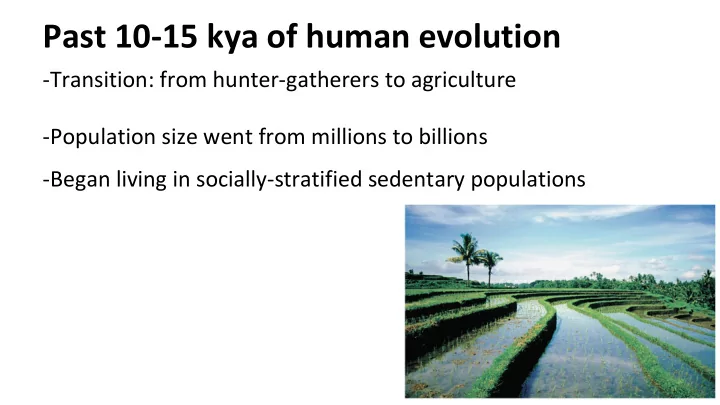
Past 10-15 kya of human evolution -Transition: from hunter-gatherers to agriculture -Population size went from millions to billions -Began living in socially-stratified sedentary populations 1 Past 10-15 kya of human evolution Sedentism: living


slide-1
SLIDE 1
  • Transition: from hunter-gatherers to agriculture
  • Population size went from millions to billions
  • Began living in socially-stratified sedentary populations

1

Past 10-15 kya of human evolution

slide-2
SLIDE 2

Sedentism: living in large, stationary communities Domestication: converting wild plants/animals into forms humans can cultivate

2

Past 10-15 kya of human evolution

slide-3
SLIDE 3

Modern humans: highly-generalized; behaviorally flexible Maladaptations: adaptations benefitting our ancestors create health, diet, and lifestyle challenges today

  • Ex. Ability to store fat

3

Our evolutionary history affects us today

slide-4
SLIDE 4

Nutritional adaptations: drastic changes to diet in the last 10 ky Preagricultural diet

  • More variation in foods but uncertain access
  • High: animal protein, complex carbs, and calcium
  • Low: saturated fat and salt

4

Our evolutionary history affects us today

slide-5
SLIDE 5

Modern diet

  • Stable access to food but reduced variety of food types
  • High: saturated fat, simple carbs, sugar, and sodium

Nutritional deficiency diseases

  • Disorders associated with obesity
  • Ex. Type II diabetes
  • Reduced/poor diet combined with infrequent exercise make

past nutritional adaptations maladaptive

5

Our evolutionary history affects us today

slide-6
SLIDE 6
  • Human life cycle stages = nonhuman primates but with added

complexity

  • Stages are marked by biological transitions
  • Ex. Birth and puberty

6

Life cycle stages

slide-7
SLIDE 7

Senescence: decline in physiological functioning (aging)

  • Relatively longer lifespan
  • Humans living longer today due to

increased standards of living

7

Aging

slide-8
SLIDE 8
  • Marked by ritual/celebration
  • Change in social status
  • Ex. Menarche: girl's first menstruation
  • Ex. Menopause: end of menstruation in women over 50

8

Biological transitions between stages are culturally marked

slide-9
SLIDE 9
  • Only humans have childhood and postreproductive stage

9

Life-cycle stages in humans

slide-10
SLIDE 10

Childhood: stage between weaning and puberty

  • Uniquely long in humans
  • Key to learning in humans
  • Brain develops in stimulating cultural context

Post-reproductive stage Grandmother hypothesis: postmenopausal females provide high-quality care for grandchildren

10

Life-cycle stages in unique to humans

slide-11
SLIDE 11

Question: What will humans look like in a thousand years? Answer: Probably the same… Question: What will humans look like in a million years? Answer: I do not know. Do know:

  • Biological constraints
  • History of all life on Earth...

11

Can we predict future human evolution?

slide-12
SLIDE 12
  • Our increasing population impacts the planet the most

12

Human population growth

slide-13
SLIDE 13

13

  • Ch. 14
slide-14
SLIDE 14

14

The future of human evolution?

slide-15
SLIDE 15
  • Dramatic climatic changes caused by increased greenhouse

gases in the atmosphere heat up the Earth Fossil fuels release CO2 which traps heat Acidification of oceans from excess CO2 decreases pH levels Deforestation reduces excess CO2 absorption

15

Global warming impact sourced to humans

slide-16
SLIDE 16

Scientific consensus

  • Global warming occurs
  • Human activity contributes to it

Human increasing population size

  • Most important reason our impact on the planet

has been so great

16

Climate change and humans

slide-17
SLIDE 17
  • Our increasing populations impacts the planet the most

17

Human population growth

slide-18
SLIDE 18
  • Rising sea levels
  • Extinction of plants and animals
  • Infectious diseases increase (malaria, dengue, and yellow

fever)

  • Ex. temperature increase results in mosquito population

increase

18

Effects of global climate change

slide-19
SLIDE 19

19

Solutions to global warming

  • Adopt more fuel-efficient technologies
  • International cooperation

Conservation

  • Ex. Ecotourism in Costa Rica = generates income

and preserves forests reducing negative impact

  • n environments