Partnerships for Civic Engagement Alison Handy Twang Center for - - PowerPoint PPT Presentation

partnerships for civic engagement
SMART_READER_LITE
LIVE PREVIEW

Partnerships for Civic Engagement Alison Handy Twang Center for - - PowerPoint PPT Presentation

Partnerships for Civic Engagement Alison Handy Twang Center for Civic Engagement, Binghamton University Katherine Dillon Partnership Specialist, U.S. Census Bureau UNITED WAY OF BROOME COUNTY: PARTNERING FOR A PURPOSE NOVEMBER 1, 2019 1 C e


slide-1
SLIDE 1

1

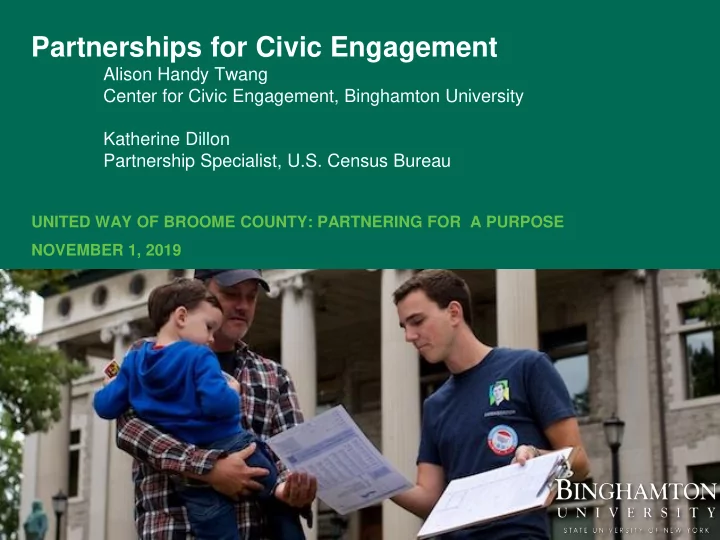
Partnerships for Civic Engagement

Alison Handy Twang Center for Civic Engagement, Binghamton University Katherine Dillon Partnership Specialist, U.S. Census Bureau

UNITED WAY OF BROOME COUNTY: PARTNERING FOR A PURPOSE NOVEMBER 1, 2019

slide-2
SLIDE 2

2

C e n t e r f o r C i v i c E n g a g e m e n t

Center for Civic Engagement

The Center for Civic Engagement (CCE) cultivates partnerships that strengthen communities and develop active and engaged citizens.

 Promote community service opportunities to students  Manage community-based programming  Support faculty teaching courses with a community

component

 Voter registration, voter engagement and democratic

participation

 Support students in developing community-based

projects/initiatives or taking action on community issues

10/31/2019 BINGHAMTON UNIVERSITY
slide-3
SLIDE 3

3

C e n t e r f o r C i v i c E n g a g e m e n t

Voter Engagement at Binghamton University

  • Voter Registration
  • 1,000+ students registered at

new student orientation

  • 60 class presentations

reaching 3,000+ students in 2018

  • Student organization outreach
  • Regular tabling
  • Pre-populated on-campus

forms

  • Mass communications
  • Forms included in welcome

packets at off-campus apartments

  • Voter Turnout
  • On-campus polling place
  • Election Day party
  • Off-campus assistance table

and referral slips for polling places

  • Candidate questionnaires

printed in the Pipe Dream

  • Mass communications
  • Targeted messages to off-

campus students

  • Stamps and envelopes for

absentee ballots

  • Candidate events and debate

viewing parties

10/31/2019 BINGHAMTON UNIVERSITY

slide-4
SLIDE 4

4

C e n t e r f o r C i v i c E n g a g e m e n t

Voter Engagement at Binghamton University

  • Our work is making a difference!
  • Student voting rate has increased in every local,

state and federal election since 2012

  • 10.2 percentage point increase in 2016
  • 23.2 percentage point increase in 2018
  • 315% increase in on-campus turnout in 2018

10/31/2019

slide-5
SLIDE 5

5

C e n t e r f o r C i v i c E n g a g e m e n t

Why does voting matter?

  • Elected officials pay more attention to people who vote,

so if you don’t vote you are taking your voice and the issues you care about off the table

  • Local elected officials have responsibility for policing,

education, housing, transportation and more

  • Local elections have lower turnout so a single vote (or

the votes of friends you get to the polls) have greater impact

  • Cities and states can take action when there is gridlock

at the federal level (climate change, marriage equality, gun control, etc.)

10/31/2019 BINGHAMTON UNIVERSITY

slide-6
SLIDE 6

6

C e n t e r f o r C i v i c E n g a g e m e n t

Why should your organization be civically engaged?

  • The communities you serve may face additional barriers

to making their voice heard

  • You can raise awareness of your mission and purpose
  • We need all voices at the table to make our democracy

work

  • Voting is habit forming

10/31/2019 BINGHAMTON UNIVERSITY

slide-7
SLIDE 7

7

C e n t e r f o r C i v i c E n g a g e m e n t

Rules for 501(c)(3) Organizations

“…prohibited from directly or indirectly participating in - or intervening in – any political campaign on behalf of or in

  • pposition to any candidate for elective public office.”

You May Not:

  • Endorse candidates
  • Make campaign contributions
  • Rate or rank candidates
  • Allow unequal use of your facilities or resources to

candidates

10/31/2019 BINGHAMTON UNIVERSITY

slide-8
SLIDE 8

8

C e n t e r f o r C i v i c E n g a g e m e n t

There is a lot you can do!

501(c)(3)s may participate in voter engagement and education activities and talk to candidates about the issues:

  • Voter registration
  • Provide information on voting processes
  • Host a candidate forum
  • Publish candidate questionnaires

10/31/2019 BINGHAMTON UNIVERSITY

slide-9
SLIDE 9

9

C e n t e r f o r C i v i c E n g a g e m e n t

Organizations May Also

  • Support or oppose ballot measures (this is considered

lobbying)

  • Continue advocacy or lobbying activities
  • Especially on issues you have a history of advocating/lobbying

for

  • Be careful about the perception of using issue advocacy to

influence how people vote

  • Remember to track lobbying expenses and report as

required by law

10/31/2019 BINGHAMTON UNIVERSITY

slide-10
SLIDE 10

10

C e n t e r f o r C i v i c E n g a g e m e n t

Other Notes

  • Offer equal time to all candidates
  • Voter engagement should be carried out not to support

a candidate but to encourage all people to participate and have voice

  • Be careful about perception
  • 501(c)(4)s can participate in political campaign activity

and have more leeway in lobbying activities

10/31/2019 BINGHAMTON UNIVERSITY

slide-11
SLIDE 11

11

C e n t e r f o r C i v i c E n g a g e m e n t

Tips for Success

  • Start small—maybe include voter registration forms as

part of your intake process

  • Take advantage of existing resources and partner with
  • ther organizations—share candidate guides from the

League of Women Voters or transport your clients to candidate forums

  • Stay informed! Make sure you provide accurate, up to

date information

  • Remember that there are no “off” election years and

civic engagement is a year-round activity

10/31/2019 BINGHAMTON UNIVERSITY

slide-12
SLIDE 12

U.S. Census Bureau

Largest statistical agency in the U.S. Leading source of quality data about the nation’s people, places and economy conducting more than 130 Census Bureau Surveys and Programs

  • Demographic Programs
  • Decennial Census
  • American Community Survey
  • Current Population Survey
  • American Housing Survey
  • Economic Programs
  • Economic Census (Years ending in 2 & 7)
  • Census of Governments (Years ending in 2 & 7)
slide-13
SLIDE 13

The 2020 Census

Count everyone once, only once and in the right place.

  • Increasingly diverse and growing population
  • 330 million people
  • Over 140 million housing units
  • Mandated by Article 1, Section 2 of the U.S. Constitution
  • Conducted every 10 years ending in zero since 1790
  • Representation and Funding

The Census is Safe, Easy, & Important!

slide-14
SLIDE 14

2020 Census – It Is Important

  • Determines the number of seats each state has in the U.S. House of

Representatives

  • Defines congressional and state legislative districts, school districts

and voting precincts

  • Determines the annual allocation of $675 billion dollars in federal

funding

  • Medicaid, SNAP, Hwy Planning, Section 8 Housing, Special Education

Grants, S-CHIP, Title I Grants, National School Lunch Program, WIC, Head Start, Foster Care, Health Center Programs

  • Provides insight to governments, business and community planning

groups for planning purposes

Provides population benchmarks for nearly every other United States survey

slide-15
SLIDE 15

2020 Census – It Is Safe

  • Private information is never published, including names,

addresses (including GPS coordinates) and telephone numbers.

  • The Census Bureau collects information to produce statistics.

Personal information collected by the Census Bureau cannot be used against respondents by any government agency or court.

  • Census Bureau employees are sworn to protect confidentiality

for life.

  • Violating Title 13 is a serious federal crime. Violators are subject

to severe penalties, including a federal prison sentence of up to five years, a fine of up to $250,000, or both.

slide-16
SLIDE 16

2020 Census – It Is Easy

  • Four ways to respond in 2020
  • Online
  • Phone
  • Paper
  • Personal Visit by Census Employee
  • Name, sex, age and DOB, race, Hispanic origin, stay elsewhere,

relationship, household questions (pop count, undercount, housing tenure, phone number)

  • Language Support
  • Internet and phone self-response in 12 languages
  • Language guides and glossaries in 59 languages

We will never ask for:

  • Your social security number.
  • Money or donations.
  • Anything on behalf of a political party.
  • Your bank or credit card account numbers.
slide-17
SLIDE 17

Hard To Count Populations & Geographies

www.census.gov/roam

  • Developed to identify

hard-to-survey areas

  • Provides a demographic

and socioeconomic characteristic profile using American Community Survey (ACS) estimates

  • Low Response Score

(LRS) is a metric to predict the percentage

  • f households who will

not self-respond to the Decennial Census

  • Darker census tracts are

harder to survey than lighter census tracts

slide-18
SLIDE 18

Overcoming Obstacles through Partnerships

  • Your Trusted Voice to encourage everyone’s participation
  • Local knowledge and insight of the community to reach

everyone with the Census Bureau’s messaging — The impact of a complete count for the community — 2020 Census will count every person living in the U.S. — Privacy; Confidentiality of responses — Employment Opportunities Our Partners:

  • Elected Officials
  • College and Universities
  • School Districts and BOCES
  • Libraries
  • Local Government Offices
  • Not For Profits
  • Service Providers
  • Advocacy Groups
  • Community Organizations
  • Faith-Based Groups
  • Media Outlets
  • Local Businesses
slide-19
SLIDE 19

Partnering in Support of the 2020 Census

How WE support Partners

  • Promotional Materials
  • Flyers (general and targeted)
  • Posters
  • In-language
  • Content
  • Sample message for email or blog
  • Drop in articles
  • Social media content and links
  • Graphics

www.census.gov/partners/2020- materials

  • Partnership presence
  • Connecting Partners with other

partners

What YOU can do now!

  • Share job recruitment

information

  • Start the Census conversation

Safe, Easy & Important

  • Start or join a Complete Count

Committee (CCC)

  • Identify opportunities to include

Census messaging, materials, or staff in your activities, programming and events

slide-20
SLIDE 20

Data Dissemination Program

  • Free Resource to YOU
  • Opportunities to teach the public how to access our data
  • Data Presentations
  • Data Access Workshops and Training Sessions
  • Webinars
  • Data and Survey Inquiries
  • All tools and data available at www.census.gov
  • American FactFinder
  • Census Business Builder
  • My Congressional District
  • OnTheMap

1-844-ASK-DATA census.askdata@census.gov www.census.gov/academy

slide-21
SLIDE 21

Thank You!

Katherine (Kate) Dillon Partnership Specialist U.S. Census Bureau New York Regional Census Center (518) 951-9873 katherine.d.dillon@2020census.gov Broome, Tioga, Tompkins, Cortland & Chenango Counties Partnership Program Outreach Materials & CCC Resources www.2020census.gov/partners Alison Handy Twang Associate Director Center for Civic Engagement Binghamton University (607) 777-3083 atwang@binghamton.edu binghamton.edu/cce