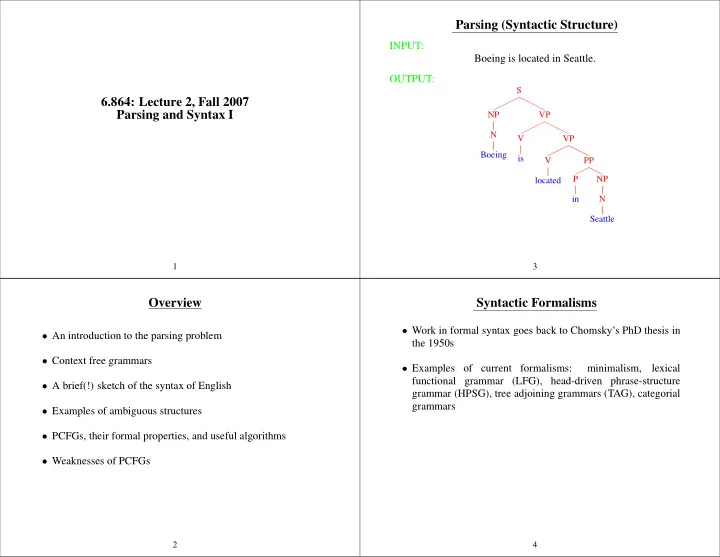
Parsing (Syntactic Structure) INPUT: Boeing is located in Seattle. - - PowerPoint PPT Presentation

parsing syntactic structure
SMART_READER_LITE
LIVE PREVIEW

Parsing (Syntactic Structure) INPUT: Boeing is located in Seattle. - - PowerPoint PPT Presentation

Parsing (Syntactic Structure) INPUT: Boeing is located in Seattle. OUTPUT: S 6.864: Lecture 2, Fall 2007 Parsing and Syntax I NP VP N V VP Boeing is V PP P NP located in N Seattle 1 3 Overview Syntactic Formalisms Work


slide-1
SLIDE 1

6.864: Lecture 2, Fall 2007 Parsing and Syntax I

1

Overview

  • An introduction to the parsing problem
  • Context free grammars
  • A brief(!) sketch of the syntax of English
  • Examples of ambiguous structures
  • PCFGs, their formal properties, and useful algorithms
  • Weaknesses of PCFGs

2

Parsing (Syntactic Structure)

INPUT: Boeing is located in Seattle. OUTPUT:

S NP N Boeing VP V is VP V located PP P in NP N Seattle 3

Syntactic Formalisms

  • Work in formal syntax goes back to Chomsky’s PhD thesis in

the 1950s

  • Examples of current formalisms:

minimalism, lexical functional grammar (LFG), head-driven phrase-structure grammar (HPSG), tree adjoining grammars (TAG), categorial grammars

4

slide-2
SLIDE 2

Data for Parsing Experiments

  • Penn WSJ Treebank = 50,000 sentences with associated trees
  • Usual set-up: 40,000 training sentences, 2400 test sentences

An example tree:

Canadian NNP Utilities NNPS NP had VBD 1988 CD revenue NN NP

  • f

IN C$ $ 1.16 CD billion CD , PUNC, QP NP PP NP mainly RB ADVP from IN its PRP$ natural JJ gas NN and CC electric JJ utility NN businesses NNS NP in IN Alberta NNP , PUNC, NP where WRB WHADVP the DT company NN NP serves VBZ about RB 800,000 CD QP customers NNS . PUNC. NP VP S SBAR NP PP NP PP VP S TOP

Canadian Utilities had 1988 revenue of C$ 1.16 billion , mainly from its natural gas and electric utility businesses in Alberta , where the company serves about 800,000 customers .

5

The Information Conveyed by Parse Trees

1) Part of speech for each word (N = noun, V = verb, D = determiner) S NP D the N burglar VP V robbed NP D the N apartment

6

2) Phrases S NP DT the N burglar VP V robbed NP DT the N apartment Noun Phrases (NP): “the burglar”, “the apartment” Verb Phrases (VP): “robbed the apartment” Sentences (S): “the burglar robbed the apartment”

7

3) Useful Relationships S NP subject VP V verb S NP DT the N burglar VP V robbed NP DT the N apartment ⇒ “the burglar” is the subject of “robbed”

8

slide-3
SLIDE 3

An Example Application: Machine Translation

  • English word order is

subject – verb – object

  • Japanese word order is

subject – object – verb English: IBM bought Lotus Japanese: IBM Lotus bought English: Sources said that IBM bought Lotus yesterday Japanese: Sources yesterday IBM Lotus bought that said

9

Syntax and Compositional Semantics

S:bought(IBM, Lotus) NP:IBM IBM VP:λy bought(y, Lotus) V:λx, y bought(y, x) bought NP:Lotus Lotus

  • Each syntactic non-terminal now has an associated semantic

expression

10

Overview

  • An introduction to the parsing problem
  • Context free grammars
  • A brief(!) sketch of the syntax of English
  • Examples of ambiguous structures
  • PCFGs, their formal properties, and useful algorithms
  • Weaknesses of PCFGs

11

Context-Free Grammars

[Hopcroft and Ullman 1979] A context free grammar G = (N, Σ, R, S) where:

  • N is a set of non-terminal symbols
  • Σ is a set of terminal symbols
  • R is a set of rules of the form X → Y1Y2 . . . Yn

for n ≥ 0, X ∈ N, Yi ∈ (N ∪ Σ)

  • S ∈ N is a distinguished start symbol

12

slide-4
SLIDE 4

A Context-Free Grammar for English

N = {S, NP, VP, PP, DT, Vi, Vt, NN, IN} S = S Σ = {sleeps, saw, man, woman, telescope, the, with, in} R = S ⇒ NP VP VP ⇒ Vi VP ⇒ Vt NP VP ⇒ VP PP NP ⇒ DT NN NP ⇒ NP PP PP ⇒ IN NP Vi ⇒ sleeps Vt ⇒ saw NN ⇒ man NN ⇒ woman NN ⇒ telescope DT ⇒ the IN ⇒ with IN ⇒ in

Note: S=sentence, VP=verb phrase, NP=noun phrase, PP=prepositional phrase, DT=determiner, Vi=intransitive verb, Vt=transitive verb, NN=noun, IN=preposition 13

Left-Most Derivations

A left-most derivation is a sequence of strings s1 . . . sn, where

  • s1 = S, the start symbol
  • sn ∈ Σ∗, i.e. sn is made up of terminal symbols only
  • Each si for i = 2 . . . n is derived from si−1 by picking the left-

most non-terminal X in si−1 and replacing it by some β where X → β is a rule in R For example: [S], [NP VP], [D N VP], [the N VP], [the man VP], [the man Vi], [the man sleeps] Representation of a derivation as a tree:

S NP D the N man VP Vi sleeps

14

DERIVATION RULES USED S S → NP VP NP VP NP → DT N DT N VP DT → the the N VP N → dog the dog VP VP → VB the dog VB VB → laughs the dog laughs

S NP DT the N dog VP VB laughs 15

Properties of CFGs

  • A CFG defines a set of possible derivations
  • A string s ∈ Σ∗ is in the language defined by the CFG if there

is at least one derivation which yields s

  • Each string in the language generated by the CFG may have

more than one derivation (“ambiguity”)

16

slide-5
SLIDE 5

DERIVATION RULES USED S S → NP VP NP VP NP → he he VP VP → VP PP he VP PP VP → VB PP he VB PP PP VB→ drove he drove PP PP PP→ down the street he drove down the street PP PP→ in the car he drove down the street in the car

S NP he VP VP VB drove PP down the street PP in the car

17 DERIVATION RULES USED S S → NP VP NP VP NP → he he VP VP → VB PP he VB PP VB → drove he drove PP PP → down NP he drove down NP NP → NP PP he drove down NP PP NP → the street he drove down the street PP PP → in the car he drove down the street in the car

S NP he VP VB drove PP down NP NP the street PP in the car

18

The Problem with Parsing: Ambiguity

INPUT: She announced a program to promote safety in trucks and vans ⇓ POSSIBLE OUTPUTS:

S NP She VP announced NP NP a program VP to promote NP safety PP in NP trucks and vans S NP She VP announced NP NP NP a program VP to promote NP safety PP in NP trucks and NP vans S NP She VP announced NP NP a program VP to promote NP NP safety PP in NP trucks and NP vans S NP She VP announced NP NP a program VP to promote NP safety PP in NP trucks and vans S NP She VP announced NP NP NP a program VP to promote NP safety PP in NP trucks and NP vans S NP She VP announced NP NP NP a program VP to promote NP safety PP in NP trucks and vans

And there are more...

19

Overview

  • An introduction to the parsing problem
  • Context free grammars
  • A brief(!) sketch of the syntax of English
  • Examples of ambiguous structures
  • PCFGs, their formal properties, and useful algorithms
  • Weaknesses of PCFGs

20

slide-6
SLIDE 6

Amazon.com: Books: A Comprehensive Grammar of the English ... http://www.amazon.com/exec/obidos/tg/detail/-/0582517346/qid=... Your Gold Box Books Books buying info customer reviews I dislike it I love it! 1 2 3 4 5 Edit your ratings Favorite Magazines! Explore our new Magazine Subscriptions store. Calphalon Sale Save 20% on Calphalon open-stock cookware. So You’d Like to... Sign in to turn on 1-Click

  • rdering.

9 used & new from $131.99 Have one to sell? Don’t have one? We’ll set one up for you. A Comprehensive Grammar of the English Language by Randolph Quirk, Jan Svartvik (Contributor), Geoffry Leech (Contributor), Sidney Greenbaum see larger photo List Price: $272.20 Price: $272.20 Availability: Usually ships within 24 hours Only 3 left in stock--order soon (more on the way). 9 used & new from $131.99 Edition: Hardcover See more product details Special Shipping Information: This item is not eligible for FREE Super Saver Shipping. This product will incur a shipping surcharge of $1.40 in addition to the standard shipping fees. Better Together Buy this book with Hardcover, Longman Grammar of Spoken and Written English by Douglas Biber (Author), et al today! 21 Amazon.com: Books: A Comprehensive Grammar of the English ... http://www.amazon.com/exec/obidos/tg/detail/-/0582517346/qid=... Learn about the English langua...: A guide by Benjamin Lukoff, B.A. (Washington), English language & literature;... Create your guide Buy Together Today: $372.15 Customers who bought this book also bought: The Cambridge Grammar of the English Language by Rodney D. Huddleston (Author), Geoffrey K. Pullum (Author) (Hardcover) The Oxford Dictionary of English Grammar by Sylvia Chalker (Editor), Edmund Weiner (Editor) (Hardcover) The Oxford English Grammar by Sidney Greenbaum (Hardcover) A Student’s Grammar of the English Language by Sidney Greenbaum, Randolph Quirk (Contributor) (Paperback) The Grammar Book: An Esl/Efl Teacher’s Course by Marianne Celce-Murcia, Diane Larsen-Freeman (Hardcover) Explore Similar Items: 20 in Books Customers interested in this title may also be interested in: Sponsored Links (What’s this?) Feedback English Grammar Software Download your free copy Now! Learning Software - All Levels www.gramster.com Advanced English Learn English Language Skills with Executive Vocabulary www.executive-vocabulary.com Product Details Hardcover: 1779 pages ; Dimensions (in inches): 3.29 x 11.92 x 8.25 Publisher: Addison-Wesley Pub Co; (February 1989) ISBN: 0582517346 Average Customer Review: Based on 10 reviews. Write a review. Amazon.com Sales Rank: 114,478 Shipping: Due to this item’s unusual size or weight, it requires special handling and will ship separately from other items in your order. Read More. What’s Your Advice? Is there an item you’d recommend instead of or in addition to this one? Let the world know! Enter the item’s ASIN (what’s an ASIN?) in the box below, select advice type, then click Submit. I recommend: in addition to this product instead of this product Spotlight Reviews (What’s this?) Write an online review and share your thoughts with other customers. 16 of 16 people found the following review helpful: Still Useful, but..., March 11, 2003 Reviewer: metrist (see more about me) from Glendale, Ca. USA As the title and price suggest, this is a reference grammar of English, not a textbook. It’s written for people who already have a grasp of basic grammatical principles. This is the sort of book that you pick up when you want to look up patterns of verb complementation, etc. Only a masochist would try to read it straight through, or to learn grammar from it. The _Comprehensive Grammar_ is an expanded and revised version of a series of grammars

22

A Brief Overview of English Syntax

Parts of Speech (tags from the Brown corpus):

  • Nouns

NN = singular noun e.g., man, dog, park NNS = plural noun e.g., telescopes, houses, buildings NNP = proper noun e.g., Smith, Gates, IBM

  • Determiners

DT = determiner e.g., the, a, some, every

  • Adjectives

JJ = adjective e.g., red, green, large, idealistic

23

A Fragment of a Noun Phrase Grammar

¯ N ⇒ NN ¯ N ⇒ NN ¯ N ¯ N ⇒ JJ ¯ N ¯ N ⇒ ¯ N ¯ N NP ⇒ DT ¯ N NN ⇒ box NN ⇒ car NN ⇒ mechanic NN ⇒ pigeon DT ⇒ the DT ⇒ a JJ ⇒ fast JJ ⇒ metal JJ ⇒ idealistic JJ ⇒ clay

Generates: a box, the box, the metal box, the fast car mechanic, . . .

24
slide-7
SLIDE 7

Prepositions, and Prepositional Phrases

  • Prepositions

IN = preposition e.g., of, in, out, beside, as

25

An Extended Grammar

¯ N ⇒ NN ¯ N ⇒ NN ¯ N ¯ N ⇒ JJ ¯ N ¯ N ⇒ ¯ N ¯ N NP ⇒ DT ¯ N PP ⇒ IN NP ¯ N ⇒ ¯ N PP NN ⇒ box NN ⇒ car NN ⇒ mechanic NN ⇒ pigeon DT ⇒ the DT ⇒ a JJ ⇒ fast JJ ⇒ metal JJ ⇒ idealistic JJ ⇒ clay IN ⇒ in IN ⇒ under IN ⇒

  • f

IN ⇒

  • n

IN ⇒ with IN ⇒ as Generates: in a box, under the box, the fast car mechanic under the pigeon in the box, . . . 26

Verbs, Verb Phrases, and Sentences

  • Basic Verb Types

Vi = Intransitive verb e.g., sleeps, walks, laughs Vt = Transitive verb e.g., sees, saw, likes Vd = Ditransitive verb e.g., gave

  • Basic VP Rules

VP → Vi VP → Vt NP VP → Vd NP NP

  • Basic S Rule

S → NP VP Examples of VP: sleeps, walks, likes the mechanic, gave the mechanic the fast car, gave the fast car mechanic the pigeon in the box, . . .

27

Examples of S: the man sleeps, the dog walks, the dog likes the mechanic, the dog in the box gave the mechanic the fast car,. . .

28

slide-8
SLIDE 8

PPs Modifying Verb Phrases

A new rule: VP → VP PP New examples of VP: sleeps in the car, walks like the mechanic, gave the mechanic the fast car on Tuesday, . . .

29

Complementizers, and SBARs

  • Complementizers

COMP = complementizer e.g., that

  • SBAR

SBAR → COMP S Examples: that the man sleeps, that the mechanic saw the dog . . .

30

More Verbs

  • New Verb Types

V[5] e.g., said, reported V[6] e.g., told, informed V[7] e.g., bet

  • New VP Rules

VP → V[5] SBAR VP → V[6] NP SBAR VP → V[7] NP NP SBAR Examples of New VPs: said that the man sleeps told the dog that the mechanic likes the pigeon bet the pigeon $50 that the mechanic owns a fast car

31

Coordination

  • A New Part-of-Speech:

CC = Coordinator e.g., and, or, but

  • New Rules

NP → NP CC NP ¯ N → ¯ N CC ¯ N VP → VP CC VP S → S CC S SBAR → SBAR CC SBAR

32

slide-9
SLIDE 9

Overview

  • An introduction to the parsing problem
  • Context free grammars
  • A brief(!) sketch of the syntax of English
  • Examples of ambiguous structures
  • PCFGs, their formal properties, and useful algorithms
  • Weaknesses of PCFGs

33

Sources of Ambiguity

  • Part-of-Speech ambiguity

NNS → walks Vi → walks

  • Prepositional Phrase Attachment

the fast car mechanic under the pigeon in the box

34 35 NP D the ¯ N ¯ N JJ fast ¯ N NN car ¯ N NN mechanic PP IN under NP D the ¯ N ¯ N NN pigeon PP IN in NP D the ¯ N NN box 36

slide-10
SLIDE 10

37 NP D the ¯ N ¯ N ¯ N JJ fast ¯ N NN car ¯ N NN mechanic PP IN under NP D the ¯ N ¯ N NN pigeon PP IN in NP D the ¯ N NN box 38

VP VP Vt drove PP down the street PP in the car VP Vt drove PP down NP the ¯ N street PP in the car

39

Two analyses for: John was believed to have been shot by Bill

40

slide-11
SLIDE 11

Sources of Ambiguity: Noun Premodifiers

  • Noun premodifiers:

NP D the ¯ N JJ fast ¯ N NN car ¯ N NN mechanic NP D the ¯ N ¯ N JJ fast ¯ N NN car ¯ N NN mechanic 41

A Funny Thing about the Penn Treebank

Leaves NP premodifier structure flat, or underspecified:

NP DT the JJ fast NN car NN mechanic NP NP DT the JJ fast NN car NN mechanic PP IN under NP DT the NN pigeon 42

Overview

  • An introduction to the parsing problem
  • Context free grammars
  • A brief(!) sketch of the syntax of English
  • Examples of ambiguous structures
  • PCFGs, their formal properties, and useful algorithms
  • Weaknesses of PCFGs

43

A Probabilistic Context-Free Grammar (PCFG)

S ⇒ NP VP 1.0 VP ⇒ Vi 0.4 VP ⇒ Vt NP 0.4 VP ⇒ VP PP 0.2 NP ⇒ DT NN 0.3 NP ⇒ NP PP 0.7 PP ⇒ P NP 1.0 Vi ⇒ sleeps 1.0 Vt ⇒ saw 1.0 NN ⇒ man 0.7 NN ⇒ woman 0.2 NN ⇒ telescope 0.1 DT ⇒ the 1.0 IN ⇒ with 0.5 IN ⇒ in 0.5

  • Probability of a tree with rules αi → βi is

i P(αi → βi|αi)

44

slide-12
SLIDE 12

DERIVATION RULES USED PROBABILITY S S → NP VP 1.0 NP VP NP → DT N 0.3 DT N VP DT → the 1.0 the N VP N → dog 0.1 the dog VP VP → VB 0.4 the dog VB VB → laughs 0.5 the dog laughs

TOTAL PROBABILITY = 1.0 × 0.3 × 1.0 × 0.1 × 0.4 × 0.5

45

Properties of PCFGs

  • Assigns a probability to each left-most derivation, or parse-

tree, allowed by the underlying CFG

  • Say we have a sentence S, set of derivations for that sentence

is T (S). Then a PCFG assigns a probability to each member

  • f T (S). i.e., we now have a ranking in order of probability.
  • The probability of a string S is
  • T∈T (S)

P(T, S)

46

Deriving a PCFG from a Corpus

  • Given a set of example trees, the underlying CFG can simply be all rules

seen in the corpus

  • Maximum Likelihood estimates:

PML(α → β | α) = Count(α → β) Count(α) where the counts are taken from a training set of example trees.

  • If the training data is generated by a PCFG, then as the training data

size goes to infi nity, the maximum-likelihood PCFG will converge to the same distribution as the “ true”PCFG. 47

PCFGs

[Booth and Thompson 73] showed that a CFG with rule probabilities correctly defines a distribution over the set of derivations provided that:

  • 1. The rule probabilities define conditional distributions over the

different ways of rewriting each non-terminal.

  • 2. A technical condition on the rule probabilities ensuring that

the probability of the derivation terminating in a finite number

  • f steps is 1. (This condition is not really a practical concern.)

48

slide-13
SLIDE 13

Algorithms for PCFGs

  • Given a PCFG and a sentence S, defi ne T (S) to be

the set of trees with S as the yield.

  • Given a PCFG and a sentence S, how do we fi nd

arg max

T∈T (S) P(T, S)

  • Given a PCFG and a sentence S, how do we fi nd

P(S) =

  • T∈T (S)

P(T, S)

49

Chomsky Normal Form

A context free grammar G = (N, Σ, R, S) in Chomsky Normal Form is as follows

  • N is a set of non-terminal symbols
  • Σ is a set of terminal symbols
  • R is a set of rules which take one of two forms:

– X → Y1Y2 for X ∈ N, and Y1, Y2 ∈ N – X → Y for X ∈ N, and Y ∈ Σ

  • S ∈ N is a distinguished start symbol

50

A Dynamic Programming Algorithm

  • Given a PCFG and a sentence S, how do we fi nd

max

T ∈T (S) P(T, S)

  • Notation:

n = number of words in the sentence Nk for k = 1 . . . K is k’th non-terminal N1 = S (the start symbol)

  • Defi ne a dynamic programming table

π[i, j, k] = maximum probability of a constituent with non-terminal Nk spanning words i . . . j inclusive

  • Our goal is to calculate maxT ∈T (S) P(T, S) = π[1, n, 1]

51

A Dynamic Programming Algorithm

  • Base case defi nition: for all i = 1 . . . n, for k = 1 . . . K

π[i, i, k] = P(Nk → wi | Nk) (note: defi ne P(N

k → wi | Nk) = 0 if Nk → wi is not in the grammar)

  • Recursive defi nition: for all i = 1 . . . n, j = (i + 1) . . . n, k = 1 . . . K,

π[i, j, k] = max i ≤ s < j 1 ≤ l ≤ K 1 ≤ m ≤ K {P(Nk → NlNm | Nk) × π[i, s, l] × π[s + 1, j, m]} (note: defi ne P(N

k → NlNm | Nk) = 0 if Nk → NlNm is not in the

grammar) 52

slide-14
SLIDE 14

Initialization: For i = 1 ... n, k = 1 ... K π[i, i, k] = P(Nk → wi|Nk) Main Loop: For length = 1 . . . (n − 1), i = 1 . . . (n − 1ength), k = 1 . . . K j ← i + length max ← 0 For s = i . . . (j − 1), For Nl, Nm such that Nk → NlNm is in the grammar prob ← P(Nk → NlNm) × π[i, s, l] × π[s + 1, j, m] If prob > max max ← prob //Store backpointers which imply the best parse Split(i, j, k) = {s, l, m} π[i, j, k] = max

53

A Dynamic Programming Algorithm for the Sum

  • Given a PCFG and a sentence S, how do we fi nd
  • T ∈T (S)

P(T, S)

  • Notation:

n = number of words in the sentence Nk for k = 1 . . . K is k’th non-terminal N1 = S (the start symbol)

  • Defi ne a dynamic programming table

π[i, j, k] = sum of probability of parses with root label Nk spanning words i . . . j inclusive

  • Our goal is to calculate

T ∈T (S) P(T, S) = π[1, n, 1]

54

A Dynamic Programming Algorithm for the Sum

  • Base case defi nition: for all i = 1 . . . n, for k = 1 . . . K

π[i, i, k] = P(Nk → wi | Nk) (note: defi ne P(N

k → wi | Nk) = 0 if Nk → wi is not in the grammar)

  • Recursive defi nition: for all i = 1 . . . n, j = (i + 1) . . . n, k = 1 . . . K,

π[i, j, k] =

  • i ≤ s < j

1 ≤ l ≤ K 1 ≤ m ≤ K {P(Nk → NlNm | Nk) × π[i, s, l] × π[s + 1, j, m]} (note: defi ne P(N

k → NlNm | Nk) = 0 if Nk → NlNm is not in the

grammar) 55

Initialization: For i = 1 ... n, k = 1 ... K π[i, i, k] = P(Nk → wi|Nk) Main Loop: For length = 1 . . . (n − 1), i = 1 . . . (n − 1ength), k = 1 . . . K j ← i + length sum ← 0 For s = i . . . (j − 1), For Nl, Nm such that Nk → NlNm is in the grammar prob ← P(Nk → NlNm) × π[i, s, l] × π[s + 1, j, m] sum ← sum + prob π[i, j, k] = sum

56

slide-15
SLIDE 15

Overview

  • An introduction to the parsing problem
  • Context free grammars
  • A brief(!) sketch of the syntax of English
  • Examples of ambiguous structures
  • PCFGs, their formal properties, and useful algorithms
  • Weaknesses of PCFGs

57

Overview

  • An introduction to the parsing problem
  • Context free grammars
  • A brief(!) sketch of the syntax of English
  • Examples of ambiguous structures
  • PCFGs, their formal properties, and useful algorithms
  • Weaknesses of PCFGs

58

Weaknesses of PCFGs

  • Lack of sensitivity to lexical information
  • Lack of sensitivity to structural frequencies

59 S NP NNP IBM VP Vt bought NP NNP Lotus

PROB = P(S → NP VP | S) ×P(NNP → IBM | NNP) ×P(VP → V NP | VP) ×P(Vt → bought | Vt) ×P(NP → NNP | NP) ×P(NNP → Lotus | NNP) ×P(NP → NNP | NP)

60

slide-16
SLIDE 16

Another Case of PP Attachment Ambiguity

(a) S NP NNS workers VP VP VBD dumped NP NNS sacks PP IN into NP DT a NN bin 61 (b) S NP NNS workers VP VBD dumped NP NP NNS sacks PP IN into NP DT a NN bin 62

(a)

Rules S → NP VP NP → NNS VP → VP PP VP → VBD NP NP → NNS PP → IN NP NP → DT NN NNS → workers VBD → dumped NNS → sacks IN → into DT → a NN → bin

(b)

Rules S → NP VP NP → NNS NP → NP PP VP → VBD NP NP → NNS PP → IN NP NP → DT NN NNS → workers VBD → dumped NNS → sacks IN → into DT → a NN → bin

If P(NP → NP PP | NP) > P(VP → VP PP | VP) then (b) is more probable, else (a) is more probable. Attachment decision is completely independent of the words

63

A Case of Coordination Ambiguity

(a) NP NP NP NNS dogs PP IN in NP NNS houses CC and NP NNS cats 64

slide-17
SLIDE 17

(b) NP NP NNS dogs PP IN in NP NP NNS houses CC and NP NNS cats 65 (a)

Rules NP → NP CC NP NP → NP PP NP → NNS PP → IN NP NP → NNS NP → NNS NNS → dogs IN → in NNS → houses CC → and NNS → cats

(b)

Rules NP → NP CC NP NP → NP PP NP → NNS PP → IN NP NP → NNS NP → NNS NNS → dogs IN → in NNS → houses CC → and NNS → cats

Here the two parses have identical rules, and therefore have identical probability under any assignment of PCFG rule probabilities

66

Structural Preferences: Close Attachment

(a) NP NP NN PP IN NP NP NN PP IN NP NN (b) NP NP NP NN PP IN NP NN PP IN NP NN

  • Example: president of a company in Africa
  • Both parses have the same rules, therefore receive same

probability under a PCFG

  • “Close attachment” (structure (a)) is twice as likely in Wall

Street Journal text.

67

Structural Preferences: Close Attachment

Previous example: John was believed to have been shot by Bill Here the low attachment analysis (Bill does the shooting) contains same rules as the high attachment analysis (Bill does the believing), so the two analyses receive same probability.

68

slide-18
SLIDE 18

References

[Booth and Thompson 73] Booth, T., and Thompson, R. 1973. Applying probability measures to abstract languages. IEEE Transactions on Computers, C-22(5), pages 442–450. [Hopcroft and Ullman 1979] Hopcroft, J. E., and Ullman, J. D. 1979. Introduction to automata theory, languages, and computation. Reading, Mass.: Addison–Wesley.

69