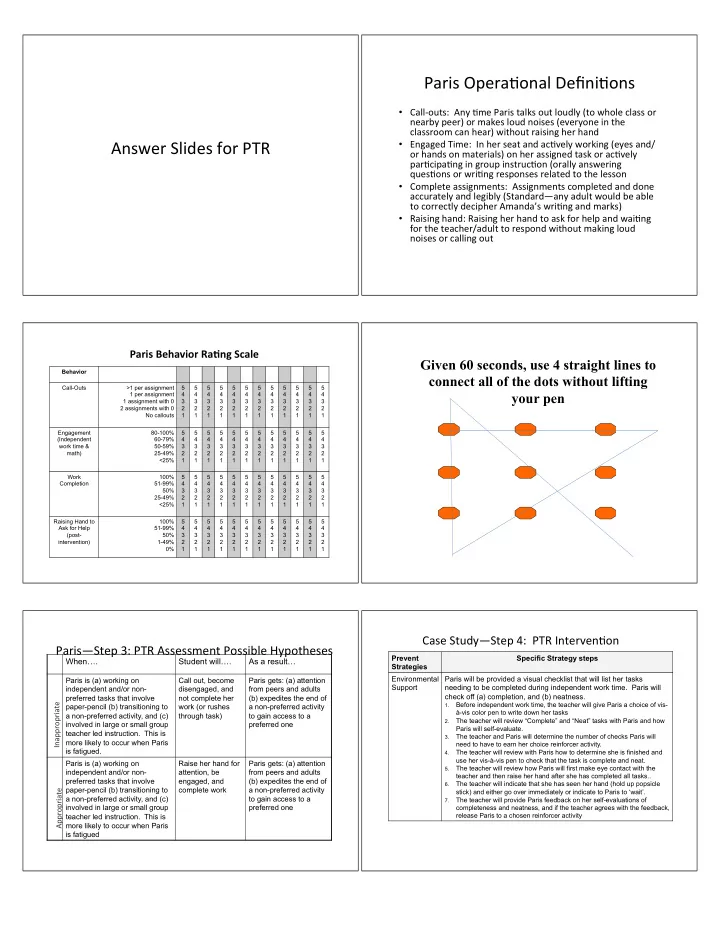
Paris Opera4onal Defini4ons Call-outs: Any 4me Paris talks out - - PDF document

paris opera4onal defini4ons
SMART_READER_LITE
LIVE PREVIEW

Paris Opera4onal Defini4ons Call-outs: Any 4me Paris talks out - - PDF document

Paris Opera4onal Defini4ons Call-outs: Any 4me Paris talks out loudly (to whole class or nearby peer) or makes loud noises (everyone in the classroom can hear) without raising her hand Answer Slides for PTR Engaged Time: In her seat and


slide-1
SLIDE 1

Answer Slides for PTR Paris Opera4onal Defini4ons

  • Call-outs: Any 4me Paris talks out loudly (to whole class or

nearby peer) or makes loud noises (everyone in the classroom can hear) without raising her hand

  • Engaged Time: In her seat and ac4vely working (eyes and/
  • r hands on materials) on her assigned task or ac4vely

par4cipa4ng in group instruc4on (orally answering ques4ons or wri4ng responses related to the lesson

  • Complete assignments: Assignments completed and done

accurately and legibly (Standard—any adult would be able to correctly decipher Amanda’s wri4ng and marks)

  • Raising hand: Raising her hand to ask for help and wai4ng

for the teacher/adult to respond without making loud noises or calling out

Paris Behavior Ra-ng Scale

Behavior Call-Outs >1 per assignment 1 per assignment 1 assignment with 0 2 assignments with 0 No callouts 5 4 3 2 1 5 4 3 2 1 5 4 3 2 1 5 4 3 2 1 5 4 3 2 1 5 4 3 2 1 5 4 3 2 1 5 4 3 2 1 5 4 3 2 1 5 4 3 2 1 5 4 3 2 1 5 4 3 2 1 Engagement (Independent work time & math) 80-100% 60-79% 50-59% 25-49% <25% 5 4 3 2 1 5 4 3 2 1 5 4 3 2 1 5 4 3 2 1 5 4 3 2 1 5 4 3 2 1 5 4 3 2 1 5 4 3 2 1 5 4 3 2 1 5 4 3 2 1 5 4 3 2 1 5 4 3 2 1 Work Completion 100% 51-99% 50% 25-49% <25% 5 4 3 2 1 5 4 3 2 1 5 4 3 2 1 5 4 3 2 1 5 4 3 2 1 5 4 3 2 1 5 4 3 2 1 5 4 3 2 1 5 4 3 2 1 5 4 3 2 1 5 4 3 2 1 5 4 3 2 1 Raising Hand to Ask for Help (post- intervention) 100% 51-99% 50% 1-49% 0% 5 4 3 2 1 5 4 3 2 1 5 4 3 2 1 5 4 3 2 1 5 4 3 2 1 5 4 3 2 1 5 4 3 2 1 5 4 3 2 1 5 4 3 2 1 5 4 3 2 1 5 4 3 2 1 5 4 3 2 1

Given 60 seconds, use 4 straight lines to connect all of the dots without lifting your pen

Paris—Step 3: PTR Assessment Possible Hypotheses

When…. Student will…. As a result…

Paris is (a) working on independent and/or non- preferred tasks that involve paper-pencil (b) transitioning to a non-preferred activity, and (c) involved in large or small group teacher led instruction. This is more likely to occur when Paris is fatigued. Call out, become disengaged, and not complete her work (or rushes through task) Paris gets: (a) attention from peers and adults (b) expedites the end of a non-preferred activity to gain access to a preferred one Paris is (a) working on independent and/or non- preferred tasks that involve paper-pencil (b) transitioning to a non-preferred activity, and (c) involved in large or small group teacher led instruction. This is more likely to occur when Paris is fatigued Raise her hand for attention, be engaged, and complete work Paris gets: (a) attention from peers and adults (b) expedites the end of a non-preferred activity to gain access to a preferred one

Inappropriate Appropriate

Prevent Strategies Specific Strategy steps Environmental Support Paris will be provided a visual checklist that will list her tasks needing to be completed during independent work time. Paris will check off (a) completion, and (b) neatness.

1.

Before independent work time, the teacher will give Paris a choice of vis- à-vis color pen to write down her tasks

2.

The teacher will review “Complete” and “Neat” tasks with Paris and how Paris will self-evaluate.

3.

The teacher and Paris will determine the number of checks Paris will need to have to earn her choice reinforcer activity.

4.

The teacher will review with Paris how to determine she is finished and use her vis-à-vis pen to check that the task is complete and neat.

5.

The teacher will review how Paris will first make eye contact with the teacher and then raise her hand after she has completed all tasks..

6.

The teacher will indicate that she has seen her hand (hold up popsicle stick) and either go over immediately or indicate to Paris to ‘wait’.

7.

The teacher will provide Paris feedback on her self-evaluations of completeness and neatness, and if the teacher agrees with the feedback, release Paris to a chosen reinforcer activity

Case Study—Step 4: PTR Interven4on

slide-2
SLIDE 2

Prevent Strategies Specific Strategy steps Choice- making Paris will be provided choices of reinforcers to work toward and choice

  • f vis-à-vis pen for writing down her tasks.

1.

A choice-board will be made from which Paris will select her preferred reinforcing activities.

2.

Each morning, upon entering the room, The teacher will show Paris pictures

  • f five preferred activities: (a) Computer in Mrs. S’s room; (b) Listening

center; (c) Reading or helping the kindergarten class; (d) Visit the office; (e) Play literacy game with peer

3.

The teacher will ask Paris to select the 2 activities that she would like to have placed on her personal choice board kept near her desk-”Which two do you like today?”

4.

Before independent work time, the teacher will ask Paris “Which color vis-à- vis pen do you want?”.

5.

The teacher will give Paris her checklist and ask Paris to write her tasks down on the checklist using the vis-à-vis pen.

6.

After Paris writes her tasks, the teacher will present the two activities Paris selected earlier and ask, “Which one do you want to earn for doing complete and neat work?”

7.

The teacher will prompt Paris to place the picture on her check-sheet and remind her that this will take the place of one non-preferred activity for 20 minutes, “Show me where you will put your picture. You can do this instead

  • f ____.”

Teach Strategies Specific Strategy Steps Replacement Behavior: Alternate Skill-Raising Hand Replacement behavior: Raising hand to ask for help or attention Paris will be taught how and when to raise her hand. The teacher will visually scan the room once every 10 seconds to make sure she notices when Paris raises her hand.

  • A. Independent Work Time—Pre-implementation (Pre-teaching)

1.

Initially (first couple of days implementing the intervention), the teacher will review with Paris when and how to raise her hand during independent work

  • time. The teacher will instruct Paris how to determine she needs help and

how to raise her hand to get help. “Paris, when you come to a problem that you are not sure how to do or you need help to find the answer, you will first look to see where I am and look in my direction being very quiet. Let me show you how I do it. (model). Now you practice.” (have Paris practice and verbally praise accurate performance or provide another change to model and practice if Paris does not do it correctly). “I am going to be looking over around the room a lot so that I will see you. As soon as you see me looking your way, you will raise your hand straight up in the air and no sounds/ words-like this (model). “Let me see you do it.” (Have Paris demonstrate- praise for correct performance. If Paris does it incorrectly, model again and provide another practice opportunity). **This step can be gradually faded after the first few days.

Teach Strategies Specific Strategy Steps Replacement Behavior: Alternate Skill-Raising Hand Replacement behavior: Raising hand to ask for help or attention Paris will be taught how and when to raise her hand. The teacher will visually scan the room once every 10 seconds to make sure she notices when Paris raises her hand.

A.

Independent Work Time—Pre-implementation (Pre-teaching)

2.

When pre-teaching, explain to Paris when to raise her hand, how she will raise her hand, and what will happen when she raises her hand.

3.

The teacher will explain/demonstrate to Paris what will happen immediately after Paris raises her hand. “When I see your hand is raised, I will let you know how long it will be until I can get over to you. If it is one minute, I will raise one finger up like this. If it is 2 minutes, I will raise 2 fingers up like this. Let’s

  • practice. Show me again how you will look over at me and raise your hand. (let

Paris demonstrate). Respond with one or two fingers up in the air. “How much time does that mean?” Wait for Paris to respond. Provide a positive comment if Paris responds correctly, “That’s right. What can you do quietly for one minute/two minutes until I get over to you?” If Paris does not provide an acceptable response, give her choices (e.g., “Could you sit quietly or draw something while you were waiting?”

4.

Provide one more opportunity to practice using the checklist and choices. Tell Paris, “We’re going to pretend it is really class time. Let’s practice doing all of

  • this. You can earn X (choice) today!”

Teach Strategies Specific Strategy Steps Replacement Behavior: Alternate Skill-Raising Hand Replacement behavior: Raising hand to ask for help or attention Paris will be taught how and when to raise her hand. The teacher will visually scan the room once every 10 seconds to make sure she notices when Paris raises her hand.

  • B. Small Group Instruction—Pre-implementation/pre-teaching

1.

During Pre-teaching, the teacher will say, “When we are in reading or math group, let’s practice how you will raise your hand. When I ask a question, you will raise your hand like this (model hand raised straight in air, no sounds). Your turn. (have Paris practice & provide positive comment or model and practice again if an error is seen).

  • 2. After practicing how to raise her hand, the teacher will say, “When you raise

your hand, I may not always call on you. Raising your hand is very important even if I don’t call on you. This is what we will do. Each time you raise your hand, I will either call on you or I will let you know that I see your hand by moving a popsicle stick from one pocket to another in my apron, like this. Let’s practice. I’m going to ask a question. Show me how you will raise your hand.” As soon as Paris raises her hand, call on her and wait for her to answer the question. Next say, “Let’s do it again. I’m going to ask you a

  • question. Show me how you will raise your hand.” AS soon as Paris raises

her hand, move a popsicle stick from one pocket to another and call on another student (pretend student).

slide-3
SLIDE 3

Teach Strategies Specific Strategy Steps Replacement Behavior: Alternate Skill-Raising Hand Replacement behavior: Raising hand to ask for help or attention Paris will be taught how and when to raise her hand. The teacher will visually scan the room once every 10 seconds to make sure she notices when Paris raises her hand. Implementation-Independent Work Time

1.

The first couple of days, at the beginning of the day go over to Paris and review hand raising behavior.

2.

Tell Paris that you will help her remember to raise her hand. If she calls out or makes a noise, you will hold up a popsicle

  • stick. You won’t say anything.

3.

Tell Paris that when she sees you hold up the popsicle stick, she will show that she saw it by raising her hand.

4.

Tell her that the next time she raises her hand without having to remind her with a popsicle stick, she will earn that popsicle stick.

5.

Continuously scan the room (every 10 seconds) to make sure that Paris’ hand raising will be seen. Teach Strategies Specific Strategy Steps Self- Management Paris will be taught to monitor her hand-raising behaviors.

  • 1. A bar chart will be given to Paris to keep in a folder.
  • 2. The teacher and Paris will talk about Paris’ hand-raising goal

that will earn her a reinforcer. Initially, it will be set at 25 hand raises.

  • 3. Explain to Paris that at certain times of the day, the teacher

and Paris will count her popsicle sticks. (This can be faded to the teacher giving Paris a prompt-verbal/gesture/picture-to count and graph her popsicle sticks independently).

  • 3. After counting the popsicle sticks, the teacher will help Paris

(initially) graph the number of popsicle sticks she has earned.

  • 4. At the end of the day, the teacher and Paris will review the

final number of hand raises and determine whether Paris met her daily goal. Reinforce Strategies Specific Strategy Steps Replacement Behavior: Raising Hand

  • 1. When Paris raises her hand, the teacher will either recognize

Paris and have her ask her question, answer a question, or make her comment.

  • 2. If the teacher is teaching a group, she will indicate with her one
  • r two fingers how long it will be before she gets over to Paris.
  • 3. Each time Paris raises her hand, she will get a popsicle stick

and verbal praise or positive gesture from the teacher.

  • 4. The teacher will wear an apron (and Paris’ job will be to remind

her to wear the apron). Popsicle sticks will be kept in one

  • pocket. Each time Paris raises her hand and the teacher is

unable to get to Paris or have her make a comment, the teacher will move one popsicle stick out of the holding pocket over to another pocket in which the ‘earned’ popsicle sticks will be kept.

  • 5. At the end of instructional blocks, the teacher will have Paris

count her popsicle sticks and arrange for Paris to trade them for

  • range cones (magnets) to be put on the board. Each 5

popsicle sticks will earn Paris a cone.

Reinforce Strategies Specific Strategy Steps Group Contingency

  • 1. For each 5 popsicle sticks earned, the teacher will ask Paris to trade

them in for an orange cone symbol that will be placed on the white board visible for the entire class.

  • 2. After 5 cones get on the board (indicating 25 hand raises), the entire

class will earn free time at the end of the day. They can go outside, see a movie, go to the library or play games.

  • 3. The class will be prompted to praise Paris for helping them earn free

time. Self-Management

  • 1. At the end of the day, Paris will record the number of popsicle sticks she

earned for her hand raising behavior.

  • 2. If she meets her goal (25), a good note will go home to her

grandmother. Environmental Support (completing task)

  • 1. After Paris raises her hand indicating her work is completed and her

checklist is filled in, the teacher will walk over to Paris’ desk.

  • 2. The teacher will praise Paris for completing her checklist.
  • 3. The teacher will provide feedback on Paris’ self-evaluation.
  • 4. If Paris meets her goal, she will be praised and released to her selected

reinforcing activity.

  • 5. If Paris did not meet her goal, the teacher will verbally praise her for

trying and have Paris say how she could meet her goal the next day.

Reinforce Strategies Specific Strategy Steps Discontinue Reinforcement

  • f Problem

Behavior If Paris calls out, the teacher will:

1.

If Paris is looking at the teacher, the teacher will hold up a popsicle stick as a visual cue to remind her of her hand raising behavior. No verbal redirects will be given.

2.

If Paris is not looking at the teacher, the teacher will say “Paris” in a flat affect. When Paris looks at the teacher, the teacher will hold up a popsicle stick as a cue.

3.

The popsicle stick being held up moves into the ‘oops I forgot’ apron pocket. Initially, Paris will be allowed 10 oops popsicle sticks before they are subtracted from her total earned.

4.

If during the next opportunity, Paris raises her hand unprompted after getting the oops stick, the teacher will move the oops stick into the ‘earned’ popsicle pocket.