Parent District The District will guarantee Place a high premium - - PowerPoint PPT Presentation

parent district
SMART_READER_LITE
LIVE PREVIEW

Parent District The District will guarantee Place a high premium - - PowerPoint PPT Presentation

Parent District The District will guarantee Place a high premium on education pathways to opportunity that will Make sure your child goes to lead to achievement and success in school and to all classes every day exchange for hard work,


slide-1
SLIDE 1

District

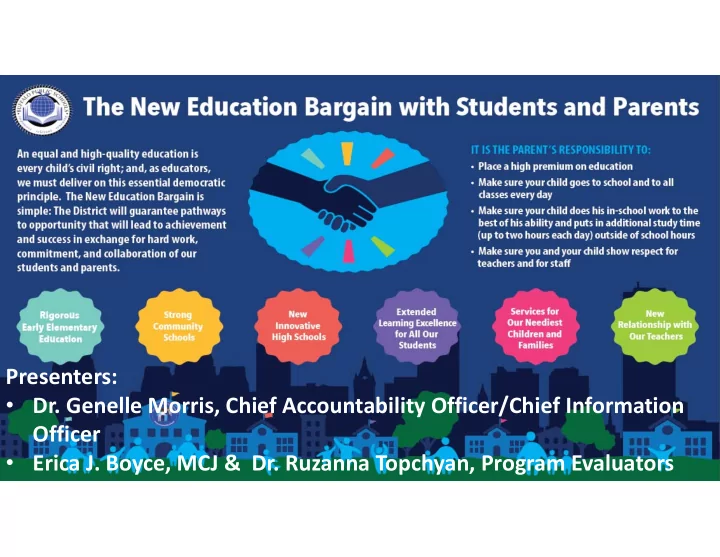
The District will guarantee pathways to opportunity that will lead to achievement and success in exchange for hard work, commitment, and collaboration of

  • ur students and

parents.

Parent

  • Place a high premium on education
  • Make sure your child goes to

school and to all classes every day

  • Make sure your child does his in‐

school work to the best of his ability and puts in additional study time (up to 2 hours each day)

  • utside of school hours
  • Make sure you and your child

show respect for teachers and for staff

Presenters:

  • Dr. Genelle Morris, Chief Accountability Officer/Chief Information

Officer

  • Erica J. Boyce, MCJ & Dr. Ruzanna Topchyan, Program Evaluators
slide-2
SLIDE 2

Outline

  • Introduction & summary of school evaluation models
  • OSA program evaluation and research projects
  • Lessons learned
  • What do we expect to accomplish in SY2018?
  • Discussion, questions & comments
slide-3
SLIDE 3

TIMELINE OF DISTRICT RESEARCH

To determine effectiveness of the NEB implementation, the Superintendent supported a new Research division within the Office of Shared Accountability. As NEB is a new district‐wide initiative, the division is beginning to evaluate emergent efficacy data.

  • Program Evaluation: No
  • ngoing research

performed/published regarding the effectiveness of the NEB and certain grants (Title I, etc.)

  • Sum ‘16: Hired 2 Program Evaluators
  • Ongoing: Monthly Research capsules

published to district and web to supplement insights into NEB

  • Ongoing: Program evaluation of

effectiveness of NEB planks and grants

  • Continue to publish

research; increase publications to peer reviewed publications; increase number of national conference presentations.

Where were we? Where are we? What’s next?

slide-4
SLIDE 4

FRAMEWORK OF DOMINANT RESEARCH THEMES

Evaluation Systems Effectiveness Research State and Federal Policy

Standards‐based evaluation models

  • Methodologies of

measurement

  • Connection to student

achievement

Standards‐based evaluation models

  • Methodologies of

measurement

  • Connection to student

achievement

Examination of the history

  • Implications for

educational evaluation Examination of the history

  • Implications for

educational evaluation Educational Accountability

  • NCLB, RTTT, ESEA

Waiver Educational Accountability

  • NCLB, RTTT, ESEA

Waiver

slide-5
SLIDE 5

OSA EVALUATION & RESEARCH PROJECTS ‐ SY2017

  • Community Schools – Plank 2
  • School Climate Transformation Grant – Plank 5
  • Evaluation of ELA Reading Intervention (Title I) ‐ Plank 1
  • Grade 9 Student Transfer Survey ‐ Plank 3
  • Virtual Pathway Program Evaluation ‐ Plank 3
  • Teacher Support by Coaches (Title I) ‐ Plank 6
  • Teacher Data Use Survey ‐ Plank 6
  • Research Capsules
slide-6
SLIDE 6

COMMUNITY SCHOOLS

  • Community School Implementation – Plank 2
  • Research Question: Is there a significant difference between

students’ academic performance if they attend Community Schools vs. non‐Community Schools?

  • Secondary
  • Participation
  • Surveys
  • Mapping

Data Sources

slide-7
SLIDE 7

FINDINGS

  • Over 22,000 attendees (6,874 unique individuals)
  • 149 Saturday Academies
  • Approximately 110 Adult Classes
  • 50% of Saturday Academy attendees were students

17,247 5,412

Evening Adult Classes/Parent Centers Saturday Academies

NORTHEAST ZONE EASTSIDE ZONE WESTSIDE ZONE SOUTH BUFFALO ZONE 676 1,199 919 402 1,340 2,550 3,916 750 442 1,734 2,249 1,070

Parent Student Not Identified/Grandparents etc.

slide-8
SLIDE 8

FINDINGS

7% 6% 40% 47% 0% 20% 40% 60% 80% 100% Strongly Disagree Disagree Agree Strongly Agree 87% agreed it would help them be a better parent

“It was another day of learning and time well spent with family.” “This is a great idea. I as a parent love that my daughter goes to such an amazing school.”

Approximately 950 students within walking distance

slide-9
SLIDE 9

SCHOOL CLIMATE TRANSFORMATION GRANT

  • Services for the Neediest Children – Plank 5
  • Research Question: Is there a reduction in the number of

suspensions in schools receiving coaching and professional development on a multi‐tiered behavior framework?

  • Secondary
  • Surveys
  • Fidelity Assessment
  • Participation

Data Sources

slide-10
SLIDE 10

FINDINGS

208 234 25 213 218 106 379 493 75 200 400 600 800 1,000 #18 #27 #37 #72 #76 #91 #97 #197 #204 15‐16 16‐17

Suspensions

95 74 61 74 80 63 98 87 66 #18 #27 #37 #72 #76 #91 #97 #197 #204

Coaching Hours

83% 17% The large majority (83%) of coaching survey respondents agreed that

coaching helped or maintained a positive culture in their schools.

slide-11
SLIDE 11

EVALUATION OF ELA READING INTERVENTION (TITLE I) – PLANK 1

Areas Explored:

  • Exploration of positive change
  • n DIBELS MOY vs. BOY by

subgroups

  • Positive change in Title I vs.

non‐Title I students in Title I schools

  • Positive change in Title I

afterschool vs. non‐ afterschool students

  • Significance of MOY‐BOY

Score Difference Samples: 12,134 students with scores on BOY & MOY Positive change was noticed in 1,565 (12.9%) students

9.7 18.1 12.7 14.8 15.5 18.7 10.6 42.6 15.9 9.9 8.7 8.3 8.1 6.5 K 1 2 3 4 5 6

Positive Change Title I vs. non‐Title I

Title I Non‐Title I 12.9% 12.0% 9.1% 13.0% 12.3% 9.7% 13.0% 10.0% Males Females Asian Black Hispanic ENL FARMS SPED

Positive Change by Subgroups

13.1 13.8 13.8 15.2 23.7 11.5 8.8 20.0 12.2 15.1 15.6 16.8 10.3 10.1 K 1 2 3 4 5 6

Positive Change – Afterschool vs. Non‐ Afterschool

AfterSchool Non‐AfterSchool

Course Name BOY MOY Score Difference Rtl Benchmark Reading 209 261 52* Rtl Strategic Reading 212 257 45* Rtl Intensive Reading 129 169 40*

BOY – MOY Scale Score Difference

slide-12
SLIDE 12

9TH GRADE TRANSFER – PLANK 3

Areas explored:

  • Student Belonging
  • Student Engagement
  • Learning
  • Student‐Student

Relationships

  • Teacher‐Student

Relationships Population: 3,512 9th grade students Responded: 568 9th grade students (16.1%)

9.6% 45.3% 45.1%

Felt did not belong & still do Felt did not belong but now OK Felt at home on day

  • ne

Belonging

4.5 4.3 4.2 4.4 4.8 Attending classes Paying attention in class Doing homework Getting good grades Finishing high school

Engagement (scale 1‐5)

4.1 3.6 3.6 3.4 3.5 Learning a lot Understand what I learn Remember what I learn Topics are interesting Things learned will be useful later

Learning (scale 1-5)

70.9% 76.4% 79.3% 91.8% Students respectfully listen to one another during class discussions Students are kind & supportive Students make friends easily Students from different social classess & races get along well

Student‐Student Relationships

66.5% 74.9% 77.0% 82.1% Teachers praise students more

  • ften than criticize

Teachers take the time to help students work out their differences Teachers treat students fairly Teachers treat students with respect

Teacher‐Student Relationships

slide-13
SLIDE 13

VIRTUAL PATHWAYS PROGRAM EVALUATION – PLANK 3

Purpose:

  • Perceptions about

learning environment

  • Reactions to the

Program

  • Perceptions about self‐

efficacy

  • Future academic

intentions Population: Around 100 students Responded: 27 students (27%)

51.9% 56.0% 62.4% 76.9% 79.2% 88.5% Students care about one another Feel connected to others Feel confident that others will support Feel belong in Program community Feel Program promotes a desire to learn Feel part of the Program

Perceptions about Learning Environment

76.9% 84.0% 87.5% 88.0% 88.0% Conviced not to drop out of school Need to continue studies year after year I have options for the future Able to do well in education Have sense of hope for the future

Future Academic Intentions

76.9% 77.8% 80.8% 88.5% 88.5% In VPP I remember that I am just as smart as others I am doing well in VPP In VPP I remember things that I learn In VPP I understand what I learn In VPP I feel that I can figure

  • ut answers

Perceptions of Self‐Efficacy

72.0% 80.8% 80.8% 84.6% 84.6% 88.5% 92.3% Understand my strengths and weaknesses VPP meets my learning needs and interests VPP gives me flexibility in learning Understand what I need to work on Have to put effort in learning VPP makes me realize that education is important Appropriate amount of individualized attention

Reaction to the Program

slide-14
SLIDE 14

TEACHER DATA USE SURVEY – PLANK 6

Areas explored:

  • Attitudes towards data

use

  • Frequency of Discussing

Data

  • Technology for Data Use
  • Leadership support for

data use Population: 2,910 teachers Responded: 199 teachers (6.8%)

69.5% 69.5% 71.9% 74.0% 76.8% 77.5% 78.1% 80.9% Like using data for instructional decisions Using data helps be better teacher Data helps identify student learning goals Data informed instruction beneficial Data informs about concepts students are learning Data helps uncover information Important to use data to inform educational practices Data help teachers plan instruction

Attitudes Towards Data Use

16.2 29.1 12.6 11.5 31.8 16.6 16.6 18.9 28.4 21.2 23.2 23.0 23.7 33.1 47.7 46.6 With parent or guardian With a specialist (e.g. data coach) With other teachers With students

Frequency of Discussing Data

Never A few times a year Monthly Weekly or Several Times a Week

50.3% 53.3% 57.5% 64.9% 67.1% The computer systems in my school area easy to use The computer systems in my school generate data displays that are useful to me The computer systems in my school allow me to examine various types of data at once The computer systems in my school provide me access to lots of data I have proper technology to efficiently examine data

Technology for Data Use

44.8% 50.6% 51.2% 51.8% 60.5% 79.8% Leadership makes sure there is plenty

  • f training for data use

Leadership is a good example of effective data user Leadership creates protected time for discussing data use with teachers Leadership creates many opportunities for teachers to use data Leadership discusses data with me Leadership encourages data use as a tool to support effective teaching

Leadership Support in Data Use

slide-15
SLIDE 15

TEACHER SUPPORT BY TITLE I FUNDED COACHES – PLANK 6

Areas Explored:

  • Types of coaches

being supported

  • Number of coaches

being supported by teacher length of experience

  • Frequency of meeting

with a coach

  • Reasons for not being

supported by a coach Population: 2,910 teachers Responded: 130 teachers (4.5%)

3.2% 13.9% 18.2% 20.4% 32.2% 52.6% 61.2% Special Education coach Other type of coach Support reading teacher ENL coach Math coach Literacy coach Instructional coach

Types of Coaches Worked With

26.9% 30.8% 19.2% 15.4% 3.9% 3.9% 28.9% 33.7% 18.3% 9.6% 3.9% 5.8% None 1 2 3 4 5

Number of Coaches by Teachers Length of Service

0‐3 Years 3+ Years

2.2% 10.8% 10.8% 15.1% 17.2% 19.4% 24.7% As needed (when a building administrator requested the support on my behalf) Less than once a month Once a month Twice a month More than once a week Once a week As needed (when I requested the support)

Frequency of Meeting with Coaches

Reasons %

I wanted the support of a coach, but s/he did not have time for all teachers 20.0% I was not offered coaching support 62.9% I did not need the coach's help, so I declined the services 17.1%

slide-16
SLIDE 16

RESEARCH CAPSULES

Volume 1: October 2016 "Lead Exposure and Impact on Children" Volume 2: November 2016 "Class Size Reduction" Volume 3: December 2016 "Focus on Learning 21st Century Skills" Volume 4: January 2017 "Community Schools" Volume 5: February 2017 "Problem‐Based Learning" Volume 6: May 2017 "Parental Involvement" Volume 7: “After school Programs” (upcoming) Volume 8: “Differentiated Instruction” (upcoming)

slide-17
SLIDE 17

LESSONS LEARNED

  • Include stakeholders in the discussion of

evaluation projects

  • Make sure to check the accuracy of

databases

  • Coordinate surveys across district
  • When developing survey items make sure

to minimize the number of type‐ins

slide-18
SLIDE 18

“The mind is not a vessel to be filled, but a fire to be kindled.”

‐ Plutarch

WHAT DO WE EXPECT TO ACCOMPLISH IN SY 2018?

  • Strategic Evaluative Plan by

identifying internal evaluation priorities (also working with the grants department)

  • Refinement of data validation

processes to ensure higher accuracy

slide-19
SLIDE 19

DISCUSSION, QUESTIONS & COMMENTS

slide-20
SLIDE 20

CONTACT INFORMATION

  • Dr. Genelle Morris: GMorris@buffaloschools.org
  • Erica J. Boyce: ejboyce@buffaloschools.org
  • Dr. Ruzanna Topchyan: RTopchyan@buffaloschools.org

Thank you!