Paradiso Presentation November 2010 David Dickinson PARADISO (major - - PDF document

paradiso presentation november 2010 david dickinson
SMART_READER_LITE
LIVE PREVIEW

Paradiso Presentation November 2010 David Dickinson PARADISO (major - - PDF document

Paradiso Presentation November 2010 David Dickinson PARADISO (major societal PARADigm shift and the future Information SOciety) First of all, thank you to the organisers of Paradiso for giving me the opportunity to speak to this discerning and


slide-1
SLIDE 1

Paradiso Presentation November 2010 David Dickinson

PARADISO (major societal PARADigm shift and the future Information SOciety)

First of all, thank you to the

  • rganisers of Paradiso for giving me

the opportunity to speak to this discerning and knowledgeable audience. We have agreed that my contri- bution will not be to offer opinions on the “World Problematique” or suggest technical refinements on the Future Internet programme. I will of course make reference to global trends, EU and Government programmes, but only as a context for what we are experiencing in our day-to-day activities within our

  • rganisation, Unlike Minds. By the

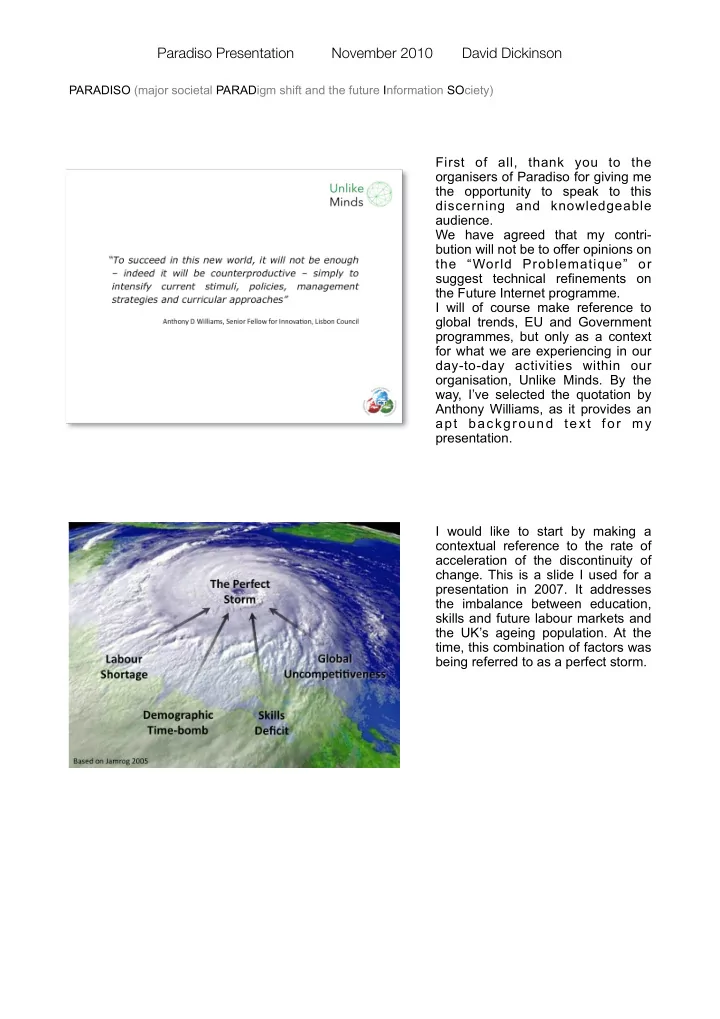
way, I’ve selected the quotation by Anthony Williams, as it provides an apt background text for my presentation. I would like to start by making a contextual reference to the rate of acceleration of the discontinuity of

  • change. This is a slide I used for a

presentation in 2007. It addresses the imbalance between education, skills and future labour markets and the UK’s ageing population. At the time, this combination of factors was being referred to as a perfect storm.

slide-2
SLIDE 2

Paradiso Presentation November 2010 David Dickinson

Just four years and three months later and in retrospect that “perfect storm” looks like little more than an April Shower. My presentation did not anticipate:

  • the Global Financial Crisis;
  • the deepening conflict and fear
  • f breaches in national security;
  • the recognition that many

western economic models and lifestyles are looking distinctly unsustainable. So it is against this backdrop of unprecedented change that we have to respond to the immediate needs of today as we plan developments for the future. With that in mind, I want to share three key concepts underpinning our own current activities:

  • information entitlement and Personal relevance
  • well-being and how we can use Information Society Technologies to support it
  • and breakthrough performance environments

First, I will speak to Information e n t i t l e m e n t a n d p e r s o n a l

  • relevance. If we assume that

every person on the planet has an entitlement to access digital information, then the challenge is to enable them to do so in a way that is relevant to the flow of their

  • lives. I would like to see Paradiso

consider a series of conventions and standards for interaction with personal information. We are using a fundamental cycle of

  • rientation, navigation and

engagement to help people derive

  • relevance. In our work we are

concentrating on the right hand side of this diagram, specifically, what we call the i-Space Navigator, referred to in the diagram as the SatNav. Just like a Satellite Navigator in a car, we are proposing that the i-Space Navigator will know where you are in both your information space AND personal context, where you wish to travel to, and also suggest possible routes and points of interest along the way.

slide-3
SLIDE 3

Paradiso Presentation November 2010 David Dickinson

My second key concept is well- b e i n g a n d h o w w e u s e technology to support it. One of life’s paradoxes is that the less able a person is to manage the complexities of their lives, the more complex their lives often

  • are. Service users in greatest

n e e d , o f t e n s t r u g g l e t o understand the relationship b e t w e e n e n t i t l e m e n t combinations and exclusions. They then try to make sense of information gleaned from multiple stovepipes using pencil and paper. Personal sense- making is a key factor in well-

  • being. The technology to

resolve this is relatively simple: well within the scope of the Future Internet Core Infrastructure. But well-being is a loaded term and it is too easy for the tabloid press to trivialise it as a happiness index. The reality is “What you measure is what you get.” Could Paradiso have a voice in ensuring that we are more careful about what we measure. If this thinking is relevant to you you may wish to read the Report by the Stiglitz Commission on the Measurement

  • f Economic Performance and Social Progress.

But the current environment and growing complexity of the “World Problematique” is all pervasive. Reorganisations, funding cuts etc all cause institutional thinking to revert to type, conspiring to frustrate our

  • ambitions. So to my third

c o n c e p t : B r e a k t h r o u g h Performance Environments (an area in which my business partner David Oliver is an acknowledged expert). David cites the Neurosciences Institute at La Jolla, California as one of the best examples of a breakthrough performance

  • environment. Nobel Laureate

Gerald Edelman established this nexus centre, taking people away from the institutional straitjackets and the dominant logic of their own organisations in universities, government and commercial laboratories. Once someone is working at La Jolla, their commitment and dedication is total. They cannot be called away for academic meetings, sales reviews, conferences etc. Everyone must do lunch at which Edelman sets the topic of conversation. Although I don’t have time to explain now, if you are interested, ask me later to explain how topic “do fruit flies dream?” led to the greatest ever breakthrough in anaesthesia.

slide-4
SLIDE 4

Paradiso Presentation November 2010 David Dickinson

So this is our La Jolla. The Manchester Monastery is a deconsecrated Franciscan friary in a disadvantaged ward in inner city Manchester. It too is an i c o n i c b u i l d i n g , b u i l t b y Franciscan friars and the local community of Gorton in the 1 8 6 0 s . T h e M o n a s t e r y ’s management team shares our vision of continuing personal well-being and sustainable

  • living. They share our values.

Together, we are realising our ambitions for a refuge for thinking differently across and between the public, private and third sectors, the universities, politics and religion. We are in the final stages of getting the Monastery accredited as a UNESCO Regional Centre of Expertise in Education for Sustainable

  • Development. And, over the last month we have had approaches relating to China, Brazil,

Bangladesh and to how we might help to develop and support a network of similar centres. So in closing a few thoughts about FP8 and Paradiso2’s potential contribution. I have been involved in Framework bids since the FP3 Delta Programme in 1993 and believe that while there have been major advancements in technology, thinking about the people and society using it, has been rather slower to evolve. I appreciate that where public money is concerned, there needs to be accountability with clear

  • deliverables. But we must get

beyond bounded projects and find ways to support and research ecosystems and more comprehensive solutions, to complement the scale of The Future Internet PPP. We need to support a better understanding of fluidity of supply and demand, challenging the dominant logic of economies of scale and seeking to balance it with a growing appreciation of economies of focus and personal relevance. I would like to finish with a challenge to industry that I made to the ELANET Information Society conference in 2003. “… to provide affordable, demand-led tools and environments, helping all people and their communities to engage with learning, capacity-building and regeneration-agenda

  • n their own terms.”

Seven years on and that challenge remains.