PA PARTNERSHIP TNERSHIPS S WI WITH TH EA EAP P ST STUDENTS - - PowerPoint PPT Presentation

pa partnership tnerships s wi with th ea eap p st
SMART_READER_LITE
LIVE PREVIEW

PA PARTNERSHIP TNERSHIPS S WI WITH TH EA EAP P ST STUDENTS - - PowerPoint PPT Presentation

DEVELOPING ELOPING DIG IGITAL ITAL LI LITERACY ACY PA PARTNERSHIP TNERSHIPS S WI WITH TH EA EAP P ST STUDENTS ENTS image from GregFalken.com Edward Bressan and Lisa Hale, Technology and EAP. BALEAP PIM, University of Southampton,


slide-1
SLIDE 1

DEVELOPING ELOPING DIG IGITAL ITAL LI LITERACY ACY PA PARTNERSHIP TNERSHIPS S WI WITH TH EA EAP P ST STUDENTS ENTS

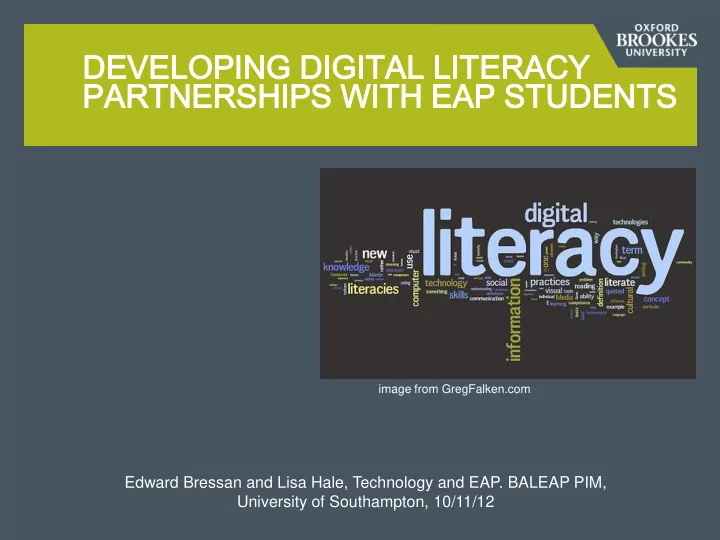
image from GregFalken.com

Edward Bressan and Lisa Hale, Technology and EAP. BALEAP PIM, University of Southampton, 10/11/12

slide-2
SLIDE 2

OVERVIEW VERVIEW

  • Digital and Information Literacy
  • OBI’s graduate mapping experience
  • Discussion questions
  • Literature
  • InStePP Project
  • Partnership approach
  • Oxford Brookes International, Pre-sessional course: University English

Level 4 & Issues to explore

  • Oxford Brookes International, Pre-sessional course: University English

Level 1 & Blog

  • What have we learnt so far?
  • What next?
  • References
slide-3
SLIDE 3

DIGIT ITAL AL AN AND INFO FORMAT ATION ON LITE TERAC ACY

The functional access, skills and practices necessary to become a confident, agile adopter of a range of technologies for personal, academic and professional

  • use. To be able to use appropriate technology to

search for high-quality information; critically to evaluate and engage with the information obtained; reflect on and record learning, and professional and personal development; and engage productively in relevant online communities (SESE, 2010).

slide-4
SLIDE 4

OBI’S GRADUATE ATTRIBUTES MAP APPI PING EX EXPE PERIEN ENCE

  • Digital and Information Literacy Attribute
  • Terminology outdated
  • References in module learning outcomes vague and usually (at best)

made reference to (digital) information search in the library

  • Move to Moodle: A number of modules still had no VLE baseline

presence

OBI’s Graduate Attributes Mapping Experience

slide-5
SLIDE 5

Discuss the digital literacy skills of your

  • wn international students.
  • What are their strengths and

weaknesses?

  • What difficulties do you / they face?

DIS ISCU CUSSION SSION QUESTIO TIONS NS

slide-6
SLIDE 6

LITE TERAT ATURE

University of Wolverhampton (Brett & Cousin, 2011) Similarities noted:

  • ‘Locus of responsibility’ (p 3) – shift in traditional T ~ ST roles – Ts and

STs can work together on supporting other sts

  • Transform quality of current learning – making it more meaningful for

increasingly wider type of international st

  • Generation of sts totally involved with technology – ‘digital natives’ (p 3) –

we need to take full advantage of this knowledge of technologies and ways of learning

  • Influence on multitasking (CERI report, 2008, cited in Brett & Cousin,

2011)

  • Sts more interested in non-institutionally owned technology than Moodle
slide-7
SLIDE 7

LITE TERAT ATURE

Problems noted:

  • Question of ethics – who should be involved in the project?
  • Privacy concerns
  • ‘Digital divide’ (p 15) – sts on sponsorships from less developed and

poorer countries; as a pre-sessional, many older PG sts who may not have these skills or be interested Differences of opinions:

  • Sts don’t need to be given an incentive to be involved – not really

volunteering if this is the case

slide-8
SLIDE 8

INST STEP EPP P PR PROJEC ECT

IInStePP Development and Support Wheel, v2 October 2012, K Tillyer, N Langton, R Francis

slide-9
SLIDE 9

PA PARTN TNER ERSH SHIP P AP APPR PROAC ACH

slide-10
SLIDE 10

OXFORD FORD BRO ROOKES KES INT NTERN RNATI ATIONA ONAL, L, PRE PRE-SESS SESSIONAL IONAL CO COUR URSE: E: UN UNIVERSI RSITY TY ENG NGLISH LISH LEVEL 4

slide-11
SLIDE 11

UNIVE VERSI SITY TY EN ENGLISH SH LEV EVEL EL 4 – ISS SSUES ES TO TO EX EXPL PLORE

Ref: Wolverhampton: International Student and Education Partnerships (In-Step) 1: The digital divide 2: Prior Experience of students’ IT patchy 3: Accessing information versus evaluating and interpreting it 4: IT literacy versus issues of communication and collaboration on-line 5: Social Networking (Facebook and non-Facebook); privacy and access 6: Netiquette 7: Ethics

slide-12
SLIDE 12

OXF XFORD BR BROOKE KES S INTE TERNAT ATIO IONAL NAL, , PR PRE-SE SESS SSIONAL AL COURSE SE: UNIVE VERSI SITY TY EN ENGLISH SH LEV EVEL EL 1

IELTS 4.5 – 5.0 (some skills 4.0). Grammar and Vocabulary module Problems: recruitment, low language level of sts, concerns about possible distraction from high-stake course Initial needs analysis interview to establish capabilities and scope of

  • project. Task

decided in negotiation with st

Assignment: Reflective journal (10 entries over course, 100 words, topic of entry related to vocabulary and grammar covered in the class each week)

Task: Blog (Blogger)

E-pioneer: Started as ‘student as creator’ creating blog and

  • entries. Moved to

‘student as mentor’ recruiting & training fellow bloggers from

  • class. T initially

mentoring – providing soft skills; commenting on blog entries

Mid-project evaluation: ‘empowered’, ‘motivated’, ‘worried’, ‘happy’
slide-13
SLIDE 13

BL BLOG

slide-14
SLIDE 14

WHAT AT HAV AVE E WE E LEA EARNT T SO SO FA FAR?

  • ... a window into the ‘habitus’ of our students (Bourdieu & Passeron,

1977, cited in Brett & Cousin, 2011).

  • Insight into what sts can and can’t do – particular skills
  • Ways of social networking that sts are currently using
  • Leveller: different relationship with sts – not T ~ ST
  • Sts generate the content of class
  • Using brains in a different way – not just about language – about a

creating space

  • Issues that ‘digital literacy’ raise (IT is an enabler to discuss issues which

may normally be suppressed): privacy, Facebook in China, differing levels and knowledge of digital literacy STS:

  • Soft skills, e.g. mentoring and coaching skills
  • Sts improve digital and information literacy for next OBU course
slide-15
SLIDE 15

WHAT AT NEX EXT? T?

FOR US

  • Evaluate the success of the project at the end of the semester – does

model fit into short course

  • Identify core principles and skills of digital and information literacy for

each University English module to inform curriculum FOR STS

  • ‘Training’ – strongly recommend join InStePP project (may not have done

so otherwise)

  • ‘Experience’ - even if sts don’t join university wide project – useful

employability skills

slide-16
SLIDE 16

REF EFER EREN ENCES ES

Bourdieu, P. & Passeron, J.C. (1977). Reproduction in education, society and culture. Richard Nice (tr.). London: Sage Publications cited in Brett, P. & Cousin, G. (2011). Students as partners in blended learning. Journal of Learning Development in Higher Education. 3, March 2011. Accessed 7/11/12 from: http://www.aldinhe.ac.uk/ojs/index.php?journal=jldhe&page=article&op=viewFile&path%5B%5D=81&path%5B %5D=83 Brett, P. & Cousin, G. (2011). Students as partners in blended learning. Journal of Learning Development in Higher Education. 3, March 2011. Accessed 7/11/12 from: http://www.aldinhe.ac.uk/ojs/index.php?journal=jldhe&page=article&op=viewFile&path%5B%5D=81&path%5B %5D=83 Centre for Educational Research and Innovation (CERI). (2008). New Millennium Learners. Initial findings on the effects of digital technologies on school-age learners. Available at: http://www.oecd.org/dataoecd/39/51/40554230.pdf cited in Brett, P. & Cousin, G. (2011). Students as partners in blended learning. Journal of Learning Development in Higher Education. 3, March 2011. Accessed 7/11/12 from: http://www.aldinhe.ac.uk/ojs/index.php?journal=jldhe&page=article&op=viewFile&path%5B%5D=81&path%5B %5D=83

  • JISC. (2011). Developing Digital Literacies. Accessed 7/11/12 from:

http://www.jisc.ac.uk/whatwedo/programmes/elearning/developingdigitalliteracies.aspx

  • JISC. (2011). Institutional Student ePioneer Partnerships (InStePP). Accessed 7/11/12 from:

http://www.jisc.ac.uk/whatwedo/programmes/elearning/developingdigitalliteracies/InStePP.aspx JISC, The Design Studio (2012). InStePP Project. Accessed 7/11/12 from: http://jiscdesignstudio.pbworks.com/w/page/50732755/InStePP%20project

slide-17
SLIDE 17

Kroes, N. (2010). Working together for digital literacy. Blog of Neelie Kroes, Vice-President of the European

  • Commission. Accessed 7/11/12 from: http://blogs.ec.europa.eu/neelie-kroes/digital-literacy/

Langton, N. (2012). Preferred student e-Pioneer partnership models, v1. Accessed on 7/11/12 from: https://wiki.brookes.ac.uk/display/instepp/Preferred+partnership Oxford Brookes University. (2010). Strategy for Enhancing the Student Experience (SESE) 2010-2015. Accessed 7/11/12 from: http://www.brookes.ac.uk/about/strategy/development/docs/sese2010-15.pdf Tillyer, K. , Langton, N. & Francis, R. (2012). InStePP Development and Support Wheel, v2. Accessed 7/11/12 from: https://wiki.brookes.ac.uk/download/attachments/87396132/InStePP-wheel- v2.pdf?version=1&modificationDate=1349096671000 University of Wolverhampton (2012) International Student and Education Partnerships (In-STEP) In Institute for Learning Enhancement Accessed on 9 November 2012 from https://www.wlv.ac.uk/default.aspx?page=29110