Overview Topics Kinds of errors Preconditions, postconditions, and - - PowerPoint PPT Presentation

overview
SMART_READER_LITE
LIVE PREVIEW

Overview Topics Kinds of errors Preconditions, postconditions, and - - PowerPoint PPT Presentation

Overview Topics Kinds of errors Preconditions, postconditions, and invariants CSE 143 Java Specification as a contract Throwing Exceptions Assertions Software Quality Programming by Contract Reading: Ch. 5 7/6/2004 (c)


slide-1
SLIDE 1

CSE143 Sp04 10-1

7/6/2004 (c) 2001-4, University of Washington 10-1

CSE 143 Java

Software Quality Programming by Contract Reading: Ch. 5

7/6/2004 (c) 2001-4, University of Washington 10-2

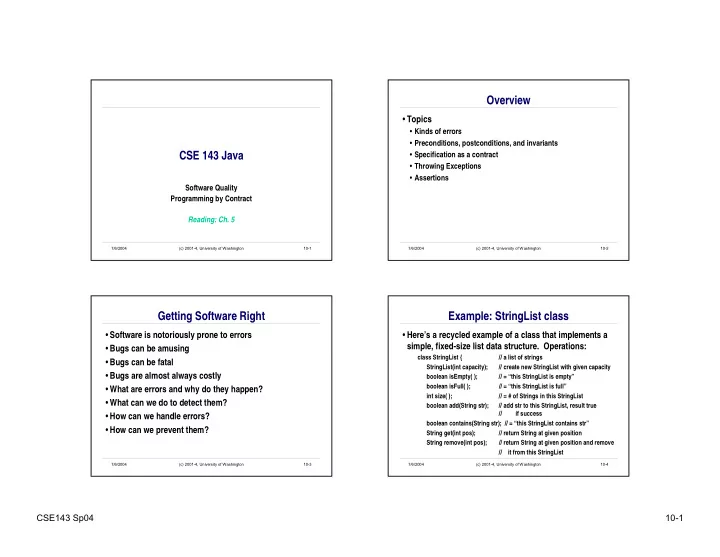
Overview

  • Topics
  • Kinds of errors
  • Preconditions, postconditions, and invariants
  • Specification as a contract
  • Throwing Exceptions
  • Assertions

7/6/2004 (c) 2001-4, University of Washington 10-3

Getting Software Right

  • Software is notoriously prone to errors
  • Bugs can be amusing
  • Bugs can be fatal
  • Bugs are almost always costly
  • What are errors and why do they happen?
  • What can we do to detect them?
  • How can we handle errors?
  • How can we prevent them?

7/6/2004 (c) 2001-4, University of Washington 10-4

Example: StringList class

  • Here’s a recycled example of a class that implements a

simple, fixed-size list data structure. Operations:

class StringList { // a list of strings StringList(int capacity); // create new StringList with given capacity boolean isEmpty( ); // = “this StringList is empty” boolean isFull( ); // = “this StringList is full” int size( ); // = # of Strings in this StringList boolean add(String str); // add str to this StringList, result true // if success boolean contains(String str); // = “this StringList contains str” String get(int pos); // return String at given position String remove(int pos); // return String at given position and remove // it from this StringList

slide-2
SLIDE 2

CSE143 Sp04 10-2

7/6/2004 (c) 2001-4, University of Washington 10-5

StringList Instance Variables

  • Representation is an array whose length is fixed when

the StringList is created, plus a count of the current number of strings stored in the list

class StringList { // a list of strings // instance variables private String[ ] strings; // Strings in this StringList are stored in private int size; // strings[0] through strings[size-1] … }

7/6/2004 (c) 2001-4, University of Washington 10-6

StringList: What Could Go Wrong?

  • What kinds of errors could occur in either the

implementation or use of StringList

  • This is a different question from how would one test for these

problems

  • For each possible error
  • What could go wrong?
  • How should we deal with it?

7/6/2004 (c) 2001-4, University of Washington 10-7

Error Handling

  • Software failures fall into two broad categories
  • Internal programming errors (“bugs”)
  • Failures because of interaction with external resources or

users (out of memory, file not found, etc.)

  • Incorrectly formatted data and similar problems also

need to be handled, but that is part of normal processing

  • For now, focus on software failures
  • Principle: If a method detects it is going to fail, it must

do something appropriate to report the failure; it is never acceptable to return to the caller as if nothing happened

7/6/2004 (c) 2001-4, University of Washington 10-8

Preconditions and Postconditions

  • Methods typically make assumptions about the state of

the world before, during, and after they are executed

  • Typically logical formulas: 0<=size<capacity; the array is

sorted; etc.

  • Two key kinds of assumptions
  • Precondition: Something that must be true before a method can

be called; a requirement

  • Postcondition: Something that is guaranteed to be true after a

method terminates execution (provided the precondition was true when it was called)

slide-3
SLIDE 3

CSE143 Sp04 10-3

7/6/2004 (c) 2001-4, University of Washington 10-9

Preconditions & Postconditions

  • What would be reasonable preconditions for

a square root function? a method to insert new item into a list object?

  • What would be reasonable postconditions for

a sort routine? the constructor for a list object?

7/6/2004 (c) 2001-4, University of Washington 10-10

Class Invariants

  • An invariant is a condition that is always true
  • Special case: a class invariant –an invariant about

properties of class instances; often a relationship between instance variables (state)

  • Examples

0 <= size <= capacity The list data is stored in items[0..size-1]

  • Note: a class invariant might be false for a moment while a

method is updating related variables, but it must always be true by the time a constructor or method terminates

7/6/2004 (c) 2001-4, University of Washington 10-11

Writing Bug-Free Software

  • Preconditions, postconditions, and invariants are

incredibly useful

  • Include all non-trivial ones as comments in the code
  • These are essential parts of the design and a reader must

understand them to understand the code

  • If you don’t write them down, the reader (who may be you) will

have to reconstruct them as best he/she can

  • Whenever you update a variable, check any invariants

that mention it to be sure the invariant still holds

  • May need to update related variables to make this happen

7/6/2004 (c) 2001-4, University of Washington 10-12

Design by Contract

  • The preconditions and postconditions of a method can

be viewed as a contract between the implementer of the method and the client code that uses it

  • Clearly specifies the responsibilities of both parties
  • Client must ensure all preconditions are true before calling the

method

  • Implementation must guarantee that postconditions are true,

provided the preconditions were true when the method was called

slide-4
SLIDE 4

CSE143 Sp04 10-4

7/6/2004 (c) 2001-4, University of Washington 10-13

Precondition Failures

  • Principle: Crash early!
  • The sooner a precondition failure is detected the better
  • Who is responsible for checking?
  • Most logical place is at the beginning of the called method
  • How aggressive should we be about checking?
  • Can overdo it

Actual normal-case code becomes hard to find Expensive checks can hurt performance Can’t always check everything

7/6/2004 (c) 2001-4, University of Washington 10-14

What if a precondition is not true?

  • Suppose this method is called with pos < 0 or

pos >=size()?

/** Return list element at given position. Precondition: 0<=pos<size() */ String get (int pos) { … }

  • What should we do?

7/6/2004 (c) 2001-4, University of Washington 10-15

What if a precondition is not true?

  • One solution

/** Return list element at given position. Precondition: 0<=pos<size() String get (int pos) { if (pos < 0 || pos >= size) { System.out.println(“naughty user – pos has bad value in get”); return null; } else { return strings[pos]; } }

  • Helpful error message, returns something user can check
  • Good idea or not?

7/6/2004 (c) 2001-4, University of Washington 10-16

Critique

  • Not a good idea for at least two reasons
  • Should never have extra output in a method that is not

intended to produce output

  • (bad cohesion; also, unexpected output might panic end user)
  • Null as an error code (and error codes in general)
  • Can it get confused with a legitimate return value?
  • Will the programmer always remember to check?

(What do you think?)

slide-5
SLIDE 5

CSE143 Sp04 10-5

7/6/2004 (c) 2001-4, University of Washington 10-17

Throwing Exceptions

  • One good solution: throw an exception
  • Basic idea: generate a runtime error, exactly as done for

things like out-of-bounds array subscripts or null references

/** Return list element at given position. Precondition: 0<=pos<size * @throws IndexOutOfBoundsException if pos is invalid */ String get (int pos) { if (pos < 0 || pos >= size) { throw new IndexOutOfBoundsException( ); } return strings[pos]; }

7/6/2004 (c) 2001-4, University of Washington 10-18

Details

  • The statement

`throw new IndexOutOfBoundsException( );

creates a new exception object and uses it to signal a particular kind of error

  • Normally halts execution with a suitable error message
  • Not the same as a regular return statement – can terminate

many active methods at once if nobody catches and recovers from the problem (coming next lecture)

We’ll also see how to define new kinds of exceptions (errors)

7/6/2004 (c) 2001-4, University of Washington 10-19

Some common standard Java exceptions

  • IllegalArgumentException

Parameter value is inappropriate

  • NullPointerException

Parameter value is null when it should not be Use this instead of less specific IllegalArgumentException if it applies

  • IndexOutOfBoundsException

Array or list index is out of range Use this instead of IllegalArgumentException if it applies

7/6/2004 (c) 2001-4, University of Washington 10-20

How much checking should we do?

  • Can overdo it
  • Error checking code can overwhelm normal code

Harder to read, understand, modify

  • Checking takes time; can have unacceptable performance

penalty

  • Distinguish two cases
  • Public methods: can’t trust the caller

Need to check parameters and signal errors whenever possible

  • Non-public methods: programmer controls circumstances

under which method is called

Programmer has no one else to blame if something is wrong Still, worth some sort of check during development to catch bugs early

slide-6
SLIDE 6

CSE143 Sp04 10-6

7/6/2004 (c) 2001-4, University of Washington 10-21

Assertions – New in Java 1.4

  • Long-time feature of C/C++
  • Idea: at any point in the code where some condition

should hold, we can write

assert <boolean-expression>;

  • If <boolean-expression> is true, execution continues normally
  • If false, execution stops with an error, or drops into a debugger
  • Variation: can include a message in an assertion

assert <boolean-expression> : “error message written if assert fails”

7/6/2004 (c) 2001-4, University of Washington 10-22

Enabling Assertions

  • Default: asserts are off in Java 1.4 – need to tell the

compiler to allow them & tell Java runtime to check them

  • Set option in drjava preferences panel
  • javac –language 1.4 option for command-line compiler
  • “-ea” option in java command line and Eclipse project settings

7/6/2004 (c) 2001-4, University of Washington 10-23

Using Assert

  • Class loader options can control whether assertions are

checked

  • Guideline: use aggressively for consistency checking

during debugging

  • Powerful development tool; helps code to crash early
  • Use to check preconditions, but also postconditions,

invariants, and other conditions that should be true at particular points in the code;

  • Can be disabled during normal production use if overhead is

too high

  • Is this a good idea?

7/6/2004 (c) 2001-4, University of Washington 10-24

Assert vs Exceptions

  • Main guideline
  • Use assert to check for programming errors (bugs)
  • Use exceptions to signal unanticipated errors during execution

(network connection fails, all object memory used up, …)

  • What about checking preconditions?
  • These are programming bugs, so use asserts, except that…
  • … if asserts are disabled these will be missed with disastrous

results during execution

  • Best practice: use asserts for internal checking, throw an

exception to signal precondition errors due to external client code

slide-7
SLIDE 7

CSE143 Sp04 10-7

7/6/2004 (c) 2001-4, University of Washington 10-25

Summary

  • Use assertions and exceptions for disciplined error

handling

  • Assert to catch bugs in your code; exceptions for dealing with

the outside world

  • General principle: it is much better to fail early instead of

continuing execution in a buggy state

  • Coming attraction: exception handling – reacting to and

recovering from errors

  • Then on to streams and files