01/04/2009 1
Overview of the Hungary-Croatia IPA Cross-Border Co-operation - - PowerPoint PPT Presentation
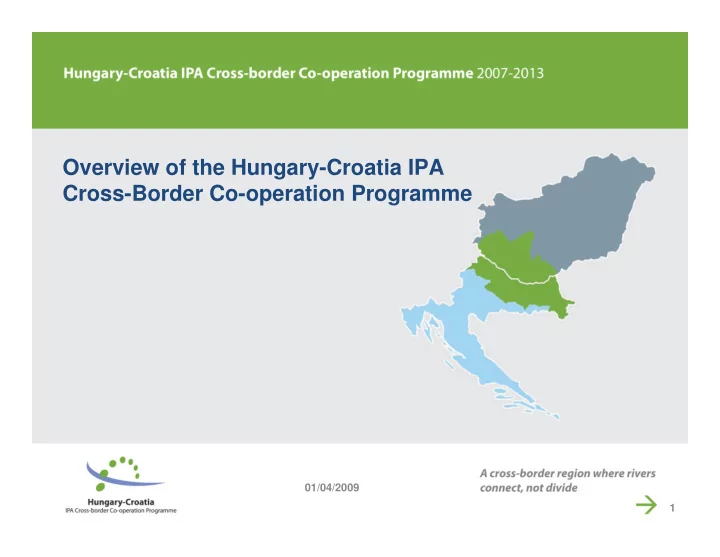
Overview of the Hungary-Croatia IPA Cross-Border Co-operation Programme 01/04/2009 1 Instrument for Pre-Accession An integrated Pre-Accession Instrument to assist candidate (CC) and potential candidate countries (PCC) to adopt and
01/04/2009 2
Instrument for Pre-Accession
- An integrated Pre-Accession Instrument to
assist candidate (CC) and potential candidate countries (PCC) to adopt and implement the „acquis” and to prepare for EU funds on accession– non Member State is focused in cross-border IPA Programmes!
- Structural Funds rules for cross-border co-
- peration at EU internal borders to apply at EU
external borders with CC-s and PCC-s
01/04/2009 3
Specific characteristics of the Programme (1)
- Single budget chapter
– funding coming in a balanced way from IPA and ERDF – single pot of money, to be spent on both sides of the border under one set of rules
- Programme budget validity
– Programme is drafted as a 7-year strategic document (2007- 2013), but the financial resources cover only 3 years, 2007- 2009 – Rolling method: Programme could be modified every year after 2009
01/04/2009 4
Specific characteristics of the Programme (2)
- 2-step Programme approval process
– Commission decision approving Programme: addressed to Member State (13 March 2008) – Financing Agreement with non-Member State – costs are only eligible in Croatia from the signature (1 December 2008)
- Shared management between Member State and
non Member State
– single set of management structures, where both countries are represented – single set of rules for implementation
- Beneficiary country (non MS)
– has to prepare the necessary structures and documents so that the Programme can be operational
01/04/2009 5
Single set of management structures
Information Point (IP)
- contracted by Ministry for Regional
Development, Forestry and Water Management (MRDFWM), set up in Osijek
Support to JTS in Croatia Joint Technical Secretariat (JTS)
- set up in VÁTI Kht, Budapest
Support to Programme bodies and day-to- day management of Programme implementation Audit Authority (AA)
- Government Audit Office, Budapest
Verification of the functioning of Programme bodies Certifying Authority (CA)
- Ministry of Finance, Budapest
Certificate and statement of expenditure and application for payment, receipt of payments from EC Managing Authority (MA)
- National Development Agency, Budapest
Responsibility for the management and implementation of the Programme Joint Monitoring Committee (JMC) Programme monitoring and project selection
Programme body Task
01/04/2009 6
Singe set of rules for implementation
- Contracting: one subsidy contract from
Community funding for the whole project
- Single set of rules for validation of
expenditure (control of invoices) for Control Bodies in both countries
- Single set of rules for project
implementation: reporting periods, eligible expenditure, information and publicity, public procurement
01/04/2009 7
Lead Beneficiary principle (1)
– One Lead Beneficiary represents the project and bears overall responsibility in the frame of one partnership agreement for all project partners
1) Signing partnership agreement for relations with partners in the project 2) Ensuring project development, submission of project proposal to JTS and project implementation 3) Ensuring that expenditure presented by partners has been paid during implementation (corresponding to the activities) and has been validated by Control Bodies
01/04/2009 8
Lead Beneficiary principle (2)
– One Lead Beneficiary represents the project and bears overall responsibility in the frame of one partnership agreement for all project partners
4) Collecting declarations of validation of expenditure from partners, submitting project progress report and application for reimbursement to JTS 5) Upon receipt of Community funding, transferring funding to partners
01/04/2009 9
Reporting procedure
- 4-month reporting periods
- 3-month submission period for project progress
report and application for reimbursement
1) Each Project Partner submits partner report to Control Body 2) Control Body checks partner report and issues declaration on validation of expenditure based on the invoices (on-the-spot checks carried out if needed) 3) Lead Beneficiary collects declarations on validation of expenditure from each partner and prepares application for reimbursement 4) Lead Beneficiary prepares project progress report and hands it in with the application for reimbursement to the JTS
01/04/2009 10
Payment procedure
- Payment procedure
1) JTS-MA-CA: approval of application of reimbursement and transfer of community funding to VÁTI Kht 2) Functionally independent unit of VÁTI Kht transfers community funding to the Lead Beneficiary
01/04/2009 11
Lead Beneficiary - Project Partner (1)
- For HR PP: if relevant,
state contribution contract concluded with MRDFWM
- For HU PP: state
contribution contract concluded with VÁTI Kht on behalf of NDA Subsidy contract for Community funding with MA Contract type for the awarded subsidy
- For HR PP: Control Body
in Croatia (MRDFWM)
- For HU PP: Control Body
in Hungary (VÁTI Kht) JTS Programme body to contact Project Partner (PP) Lead Beneficiary (LB)
01/04/2009 12
Lead Beneficiary - Project Partner (2)
Project Partner (PP) Lead Beneficiary (LB) Between LB and PP-s: partnership agreement Between MA and LB: subsidy contract Contractual liability Declaration on verification
- f expenditure – Control
Body Application for reimbursement – JTS Financial documentation Partner report to Control Body Project progress report to JTS Report type Given project part Whole project Responsibility
01/04/2009 13
Partnership
- Role of the Lead Beneficiary
- Number of partners
- Reliability of Project Partners
01/04/2009 14
Financial considerations
- Financial liquidity of Project Partners due to the
timeframe needed for reimbursement of costs
- Advance payment only in Hungary for the
amount of state contribution per partner
- Differences in minimum amount of own
contribution – HU: 5% for each Project Partner – HR: 15% for public entities, private entities do not have obligation for own contribution
- Contracts will be stipulated in EUR
01/04/2009 15
Human resources
- Elaboration of a proper partnership
agreement
- Managing procurements according to
PraG
01/04/2009 16