Outline Motivation 1 Decaying Gravitino Dark Matter 2 Neutrino - - PowerPoint PPT Presentation

outline
SMART_READER_LITE
LIVE PREVIEW

Outline Motivation 1 Decaying Gravitino Dark Matter 2 Neutrino - - PowerPoint PPT Presentation

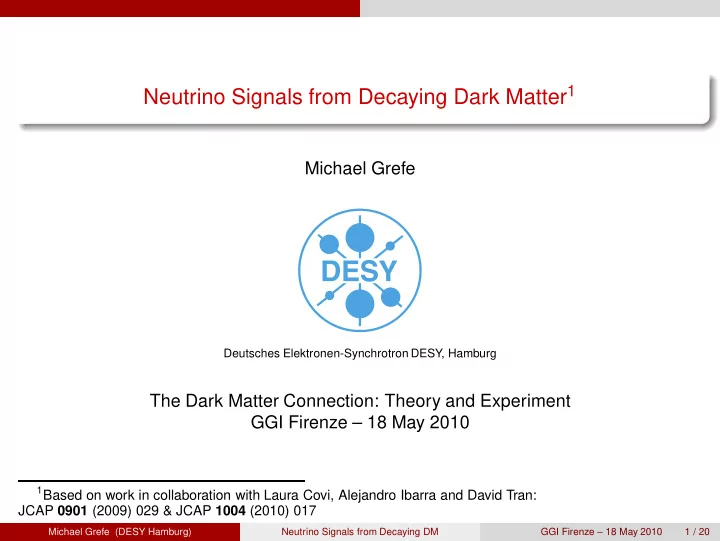
Neutrino Signals from Decaying Dark Matter 1 Michael Grefe Deutsches Elektronen-Synchrotron DESY, Hamburg The Dark Matter Connection: Theory and Experiment GGI Firenze 18 May 2010 1 Based on work in collaboration with Laura Covi, Alejandro


slide-1
SLIDE 1

Neutrino Signals from Decaying Dark Matter1

Michael Grefe

Deutsches Elektronen-Synchrotron DESY, Hamburg

The Dark Matter Connection: Theory and Experiment GGI Firenze – 18 May 2010

1Based on work in collaboration with Laura Covi, Alejandro Ibarra and David Tran:

JCAP 0901 (2009) 029 & JCAP 1004 (2010) 017

Michael Grefe (DESY Hamburg) Neutrino Signals from Decaying DM GGI Firenze – 18 May 2010 1 / 20

slide-2
SLIDE 2

Outline

1

Motivation

2

Decaying Gravitino Dark Matter

3

Neutrino Detection

4

Neutrino Constraints on Decaying Dark Matter

Michael Grefe (DESY Hamburg) Neutrino Signals from Decaying DM GGI Firenze – 18 May 2010 2 / 20

slide-3
SLIDE 3

Motivation

The Quest for Dark Matter I

Cosmological Evidence

Assuming standard general relativity, the existence dark matter is firmly established from gravitational observations on various scales Dark Matter Properties:

  • Weak-scale (or smaller) interactions
  • Cold (maybe warm)
  • Very long-lived (not necessarily stable!)

Particle dark matter can be a (super)WIMP with lifetime ≫ age of the Universe!

Michael Grefe (DESY Hamburg) Neutrino Signals from Decaying DM GGI Firenze – 18 May 2010 3 / 20

slide-4
SLIDE 4

Motivation

The Quest for Dark Matter II

Why are we interested in Cosmic-Ray Signatures?

Complementary method to direct dark matter searches and searches at colliders Recent observations:

  • PAMELA:

Steep rise in the positron fraction above 10 GeV

  • Fermi LAT:

Hardening of the electron spectrum around 100 GeV

  • H.E.S.S.:

Change of slope in the electron spectrum at 1 TeV

In conflict with expectations from secondary production and standard propagation models Could be explained by nearby astrophysical sources (pulsars are a source for e+e−-pairs) Signature of dark matter annihilation/decay? Further observations in different cosmic-ray channels needed to discriminate possibilities

Energy (GeV)

1 10 100

))

  • (e

φ )+

+

(e φ ) / (

+

(e φ Positron fraction

0.01 0.02 0.1 0.2 0.3

PAMELA

[Adriani et al. (2008)]

Energy (GeV)

2

10

3

10 )

  • 1

sr

  • 1

s

  • 2

m

2

dN/dE (GeV

3

E

2

10 15% ± E ∆

E ∆

  • 10%

+ 5% ATIC PPB-BETS Kobayashi Fermi H.E.S.S. H.E.S.S. - low-energy analysis Systematic error Systematic error - low-energy analysis Broken power-law fit

[Aharonian et al. (2009)]

Michael Grefe (DESY Hamburg) Neutrino Signals from Decaying DM GGI Firenze – 18 May 2010 4 / 20

slide-5
SLIDE 5

Motivation

Annihilating vs Decaying Dark Matter

Why are we interested in Decaying Dark Matter?

Flux from the galactic halo: Dark Matter Annihilation dJhalo dE = σvDM 8π m2

DM

dN dE

  • l.o.s.

ρ2

halo(

  • l) d

l

particle physics astrophysics

Dark Matter Decay dJhalo dE = 1 4π τDM mDM dN dE

  • l.o.s.

ρhalo(

  • l) d

l

particle physics astrophysics

0.5 1 1.5 2 2.5 3 3.5 4 4.5 30 60 90 120 150 180 σ = S/√B compared to full sky cone half angle towards galactic center (°) NFW decay NFW annihilation Einasto decay Einasto annihilation Isothermal decay Isothermal annihilation

Annihilation:

  • Strong signal from peaked structures
  • Enhancement of cross section needed
  • Best statistical significance for small

cone around galactic centre

Decay:

  • Milder angular dependence
  • Less constrained and less studied
  • Best statistical significance for full-sky
  • bservation

Annihilating and decaying dark matter require different strategies for observation!

Michael Grefe (DESY Hamburg) Neutrino Signals from Decaying DM GGI Firenze – 18 May 2010 5 / 20

slide-6
SLIDE 6

Decaying Gravitino Dark Matter

Outline

1

Motivation

2

Decaying Gravitino Dark Matter

3

Neutrino Detection

4

Neutrino Constraints on Decaying Dark Matter

Michael Grefe (DESY Hamburg) Neutrino Signals from Decaying DM GGI Firenze – 18 May 2010 6 / 20

slide-7
SLIDE 7

Decaying Gravitino Dark Matter

Decaying Gravitino Dark Matter I

Motivation from the early Universe

Gravitino arises naturally as the spin-3/2 superpartner of the graviton Thermal production: Ω3/2h2 ≃ 0.27

  • TR

1010 GeV 100 GeV m3/2

g

1 TeV

2

[Bolz et al. (2001)]

Thermal leptogenesis: TR 109 GeV ⇒ m3/2 O(10) GeV favored Correct relic density for typical leptogenesis and supergravity parameters Problem: Late gravitino decays are in conflict with BBN predictions! Gravitino LSP is a natural candidate for cold dark matter Problem: Late NLSP decays usually spoil BBN predictions!

Michael Grefe (DESY Hamburg) Neutrino Signals from Decaying DM GGI Firenze – 18 May 2010 7 / 20

slide-8
SLIDE 8

Decaying Gravitino Dark Matter

Decaying Gravitino Dark Matter I

Motivation from the early Universe

Gravitino arises naturally as the spin-3/2 superpartner of the graviton Thermal production: Ω3/2h2 ≃ 0.27

  • TR

1010 GeV 100 GeV m3/2

g

1 TeV

2

[Bolz et al. (2001)]

Thermal leptogenesis: TR 109 GeV ⇒ m3/2 O(10) GeV favored Correct relic density for typical leptogenesis and supergravity parameters Problem: Late gravitino decays are in conflict with BBN predictions! Gravitino LSP is a natural candidate for cold dark matter Problem: Late NLSP decays usually spoil BBN predictions! Possible solution: R-parity not exactly conserved!

Michael Grefe (DESY Hamburg) Neutrino Signals from Decaying DM GGI Firenze – 18 May 2010 7 / 20

slide-9
SLIDE 9

Decaying Gravitino Dark Matter

Decaying Gravitino Dark Matter II

Bilinear R-Parity Violation

Renormalisable R-parity violating terms in the superpotential: W/

Rp = µiLiHu + λLLEc + λ′LQDc + λ′′UcDcDc

Proton stability guaranteed if λ′′ vanishes We concentrate on bilinear R-parity breaking:

  • µi, λ, λ′ related by field redefinitions
  • λ′′ remains absent

Bounds on / Rp-couplings:

  • NLSP decays before BBN: Lower bound on /

Rp-couplings

  • Lepton/baryon asymmetry not washed out: Upper bound on /

Rp-couplings

Gravitino couplings suppressed by the Planck mass and the small / Rp-couplings Gravitino unstable but very long-lived: τ3/2 ≈ O(1023 − 1037) s

Michael Grefe (DESY Hamburg) Neutrino Signals from Decaying DM GGI Firenze – 18 May 2010 8 / 20

slide-10
SLIDE 10

Decaying Gravitino Dark Matter

Decaying Gravitino Dark Matter II

Bilinear R-Parity Violation

Renormalisable R-parity violating terms in the superpotential: W/

Rp = µiLiHu + λLLEc + λ′LQDc + λ′′UcDcDc

Proton stability guaranteed if λ′′ vanishes We concentrate on bilinear R-parity breaking:

  • µi, λ, λ′ related by field redefinitions
  • λ′′ remains absent

Bounds on / Rp-couplings:

  • NLSP decays before BBN: Lower bound on /

Rp-couplings

  • Lepton/baryon asymmetry not washed out: Upper bound on /

Rp-couplings

Gravitino couplings suppressed by the Planck mass and the small / Rp-couplings Gravitino unstable but very long-lived: τ3/2 ≈ O(1023 − 1037) s The gravitino is a viable decaying dark matter candidate!

Michael Grefe (DESY Hamburg) Neutrino Signals from Decaying DM GGI Firenze – 18 May 2010 8 / 20

slide-11
SLIDE 11

Decaying Gravitino Dark Matter

Decaying Gravitino Dark Matter III

Gravitino Decay Channels

R-parity breaking treated in terms of a non-vanishing sneutrino VEV ψ3/2 ˜ νl νl, l∓ γ, Z 0, W ± ˜ χ0, ˜ χ∓ + ψ3/2 νl, l∓ ˜ νl Z 0, W ± + ψ3/2 νl h ˜ ν∗

l

+ ψ3/2 ˜ νl νl h ˜ χ0 Observable cosmic rays are created from direct production, gauge/Higgs boson fragmentation and lepton decays

Michael Grefe (DESY Hamburg) Neutrino Signals from Decaying DM GGI Firenze – 18 May 2010 9 / 20

slide-12
SLIDE 12

Decaying Gravitino Dark Matter

Decaying Gravitino Dark Matter IV

Indirect Detection

Gravitino branching ratios:

  • Independent of sneutrino VEV
  • Dominant dependence on gravitino mass
  • Large branching ratio into a neutrino line

Smoking gun signature in neutrinos!

10-3 10-2 10-1 100 100 1000

Branching Ratio m3/2 (GeV)

γντ hντ Z0ντ Wτ

Gravitino parameters constrained by antiproton observations due to hadronic decays Gravitino decays cannot fit PAMELA and Fermi LAT with these parameters

[Buchmüller et al. (2009)]

Decaying gravitino dark matter cannot account for the PAMELA and Fermi LAT excesses without additional astrophysical sources

Michael Grefe (DESY Hamburg) Neutrino Signals from Decaying DM GGI Firenze – 18 May 2010 10 / 20

slide-13
SLIDE 13

Neutrino Detection

Outline

1

Motivation

2

Decaying Gravitino Dark Matter

3

Neutrino Detection

4

Neutrino Constraints on Decaying Dark Matter

Michael Grefe (DESY Hamburg) Neutrino Signals from Decaying DM GGI Firenze – 18 May 2010 11 / 20

slide-14
SLIDE 14

Neutrino Detection

Neutrino Flux and Atmospheric Background I

Scalar Dark Matter Candidate

Scalar dark matter decay channels:

  • DM → νν: two-body decay with monoenergetic line at E = mDM/2
  • DM → ℓ+ℓ−: soft spectrum from lepton decay (no neutrinos for e+e−)
  • DM → Z 0Z 0/W +W −: low-energy tail from gauge boson fragmentation

Triangular tail from extragalactic dark matter decays Neutrino oscillations distribute the flux equally into all neutrino flavours Atmospheric neutrinos are dominant background for TeV scale decaying DM

10-8 10-7 10-6 10-5 10-4 10-3 10-2 10-1 100 101 102 103 104 105

2 × dJ/dEν (GeV cm-2 s-1 sr-1)

Eν (GeV)

νe νµ ντ

atmospheric neutrinos mDM = 1 TeV , τDM = 1026 s

DM → νν DM → µµ/ττ DM → ZZ/WW Super-K νµ Amanda-II νµ Frejus νe Frejus νµ Amanda-II νµ IceCube-22 νµ Michael Grefe (DESY Hamburg) Neutrino Signals from Decaying DM GGI Firenze – 18 May 2010 12 / 20

slide-15
SLIDE 15

Neutrino Detection

Neutrino Flux and Atmospheric Background II

Fermionic Dark Matter Candidate

Fermionic dark matter decay channels:

  • DM → Z 0ν: narrow line near E = mDM/2 and tail from Z 0 fragmentation
  • DM → ℓ+ℓ−ν: hard prompt neutrino spectrum and soft spectrum from lepton decay
  • DM → W ±ℓ∓: soft spectrum from W ± fragmentation and lepton decay

Triangular tail from extragalactic dark matter decays Neutrino oscillations distribute the flux equally into all neutrino flavours Atmospheric neutrinos are dominant background for TeV scale decaying DM

10-8 10-7 10-6 10-5 10-4 10-3 10-2 10-1 100 101 102 103 104 105

2 × dJ/dEν (GeV cm-2 s-1 sr-1)

Eν (GeV)

νe νµ ντ

atmospheric neutrinos mDM = 1 TeV , τDM = 1026 s

DM → Zν DM → eeν/µµν/ττν DM → We/Wµ/Wτ Super-K νµ Amanda-II νµ Frejus νe Frejus νµ Amanda-II νµ IceCube-22 νµ Michael Grefe (DESY Hamburg) Neutrino Signals from Decaying DM GGI Firenze – 18 May 2010 13 / 20

slide-16
SLIDE 16

Neutrino Detection

Neutrino Signals I

Upward Through-going Muons

Muon track from charged-current deep inelastic scattering of a muon neutrino off a nucleon outside the detector Deep inelastic neutrino–nucleon scattering and propagation energy loss shifts muon spectrum to lower energies Bad energy resolution (0.3 in log10 E) smears out cutoff energy Muon track reconstruction is the best-understood method at neutrino telescopes

10-3 10-2 10-1 100 101 102 103 104 105 200 400 600 dφ/dEµ (GeV-1 km-2 yr-1) Eµ (GeV) through-going muons mDM = 1 TeV , τDM = 1026 s DM → νν DM → Zν DM → eeν (µµν/ττν) DM → µµ (ττ) DM → ZZ (WW) DM → We DM → Wµ (Wτ) atmospheric 100 101 102 103 104 105 106 1 10 100 1000 10000 φ (km-2 yr-1) Eµ (GeV) through-going muons mDM = 1 TeV , τDM = 1026 s DM → νν DM → µµ (ττ) DM → ZZ (WW) atmospheric

Michael Grefe (DESY Hamburg) Neutrino Signals from Decaying DM GGI Firenze – 18 May 2010 14 / 20

slide-17
SLIDE 17

Neutrino Detection

Neutrino Signals II

Contained Muons

Muon track and hadronic shower from charged-current deep inelastic scattering of a muon neutrino off a nucleon inside the detector Deep inelastic neutrino–nucleon scattering shifts muon spectrum to lower energies Bad energy resolution (0.3 in log10 E) smears out cutoff energy If the shower can be used for analysis, reconstruction of initial neutrino energy possible

10-1 100 101 102 103 104 200 400 600 dN/dEµdVdt (GeV-1 km-3 yr-1) Eµ (GeV) contained muons mDM = 1 TeV , τDM = 1026 s DM → νν DM → Zν DM → eeν (µµν/ττν) DM → µµ (ττ) DM → ZZ (WW) DM → We DM → Wµ (Wτ) atmospheric 100 101 102 103 104 105 106 107 1 10 100 1000 10000 dN/dVdt (km-3 yr-1) Eµ (GeV) contained muons mDM = 1 TeV , τDM = 1026 s DM → νν DM → µµ (ττ) DM → ZZ (WW) atmospheric

Michael Grefe (DESY Hamburg) Neutrino Signals from Decaying DM GGI Firenze – 18 May 2010 15 / 20

slide-18
SLIDE 18

Neutrino Detection

Neutrino Signals III

Showers

Hadronic and electromagnetic showers from charged-current deep inelastic scattering of electron and tau neutrinos and neutral-current interactions of all neutrino flavours inside the detector Potentially best channel for dark matter searches:

  • Better energy resolution (0.18 in log10 E) helps to distinguish spectral features
  • 3× larger signal and 3× lower background compared to other channels

Problem: TeV-scale shower reconstruction is not yet well understood

100 101 102 103 104 105 200 400 600 dN/dEshowerdVdt (GeV-1 km-3 yr-1) Eshower (GeV) shower events mDM = 1 TeV , τDM = 1026 s DM → νν DM → Zν DM → eeν (µµν/ττν) DM → µµ (ττ) DM → ZZ (WW) DM → We DM → Wµ (Wτ) atmospheric 100 101 102 103 104 105 106 1 10 100 1000 10000 dN/dVdt (km-3 yr-1) Eshower (GeV) shower events mDM = 1 TeV , τDM = 1026 s DM → νν DM → µµ (ττ) DM → ZZ (WW) atmospheric

Michael Grefe (DESY Hamburg) Neutrino Signals from Decaying DM GGI Firenze – 18 May 2010 16 / 20

slide-19
SLIDE 19

Neutrino Constraints on Decaying Dark Matter

Outline

1

Motivation

2

Decaying Gravitino Dark Matter

3

Neutrino Detection

4

Neutrino Constraints on Decaying Dark Matter

Michael Grefe (DESY Hamburg) Neutrino Signals from Decaying DM GGI Firenze – 18 May 2010 17 / 20

slide-20
SLIDE 20

Neutrino Constraints on Decaying Dark Matter

Limits on the Dark Matter Parameter Space I

Limits from Super-Kamiokande

Limit on integrated upward through-going muon flux from the Super-Kamiokande collaboration

  • As expected, strongest limit from the largest cone around the galactic centre
  • Stronger limits for larger dark matter masses due to increasing neutrino–nucleon cross

section and increasing muon range although the neutrino flux decreases with increasing dark matter mass

  • Stronger limits for harder spectra

Super-Kamiokande does not constrain the parameter region that fits PAMELA and Fermi LAT

Baksan Limit IMB Limit Kamiokande Limit MACRO Limits Super-K Limits Cone Half Angle From Galactic Center (Degrees) Flux Limit (cm-2 sec-1 )

0.02 0.04 0.06 0.08 0.1 0.12 x 10

  • 12

0-5 0-10 0-15 0-20 0-25 0-30 1023 1024 1025 1026 101 102 103 104

τDM (s) mDM (GeV) Super-Kamiokande exclusion region DM → νν DM → Zν DM → eeν DM → µµν (ττν) DM → µµ (ττ) DM → ZZ (WW) DM → We DM → Wµ (Wτ)

[Desai et al. (2004)]

Michael Grefe (DESY Hamburg) Neutrino Signals from Decaying DM GGI Firenze – 18 May 2010 18 / 20
slide-21
SLIDE 21

Neutrino Constraints on Decaying Dark Matter

Limits on the Dark Matter Parameter Space II

Sensitivity of IceCube

Many orders of magnitude larger than Super-Kamiokande Larger volume gives higher events rates and more sensitivity to small fluxes DeepCore extension allows to set stronger constraints at lower masses Use of spectral information will greatly improve the limits Use of different detection channels allows additional improvement PAMELA and Fermi LAT preferred regions will be tested

1023 1024 1025 1026 1027 1028 101 102 103 104 τDM (s) mDM (GeV) exclusion from through-going muons after 1 year at IceCube DM → νν DM → Zν DM → eeν DM → µµν (ττν) DM → µµ (ττ) DM → ZZ (WW) DM → We DM → Wµ (Wτ) 1023 1024 1025 1026 1027 1028 101 102 103 104 τDM (s) mDM (GeV) exclusion from through-going muons after 1 year at IceCube + DeepCore DM → νν DM → Zν DM → eeν DM → µµν (ττν) DM → µµ (ττ) DM → ZZ (WW) DM → We DM → Wµ (Wτ)

Michael Grefe (DESY Hamburg) Neutrino Signals from Decaying DM GGI Firenze – 18 May 2010 19 / 20

slide-22
SLIDE 22

Conclusion

Conclusion

In contrast to the concentration on peaked structures in the case of annihilation it will be a better strategy to look at spectral features in full-sky observations for a first signal of decaying dark matter Directional observation with gamma rays and neutrinos will allow to decide between annihilating and decaying dark matter or astrophysical sources Decaying gravitino dark matter is a well-motivated candidate but probably cannot accomodate the Fermi results without astrophysical sources Neutrinos are an important complementary channel for indirect dark matter searches

  • Neutrino telescopes will provide strong constraints on the dark matter parameters, in

particular at large masses

  • In case of detection the neutrino channel will give additional information about dark

matter decay modes and branching ratios

Michael Grefe (DESY Hamburg) Neutrino Signals from Decaying DM GGI Firenze – 18 May 2010 20 / 20

slide-23
SLIDE 23

Conclusion

Conclusion

In contrast to the concentration on peaked structures in the case of annihilation it will be a better strategy to look at spectral features in full-sky observations for a first signal of decaying dark matter Directional observation with gamma rays and neutrinos will allow to decide between annihilating and decaying dark matter or astrophysical sources Decaying gravitino dark matter is a well-motivated candidate but probably cannot accomodate the Fermi results without astrophysical sources Neutrinos are an important complementary channel for indirect dark matter searches

  • Neutrino telescopes will provide strong constraints on the dark matter parameters, in

particular at large masses

  • In case of detection the neutrino channel will give additional information about dark

matter decay modes and branching ratios

Thanks for your attention!

Michael Grefe (DESY Hamburg) Neutrino Signals from Decaying DM GGI Firenze – 18 May 2010 20 / 20