Outline CSE 527 What is it Lecture 17, 11/24/04 How is it - - PowerPoint PPT Presentation

outline
SMART_READER_LITE
LIVE PREVIEW

Outline CSE 527 What is it Lecture 17, 11/24/04 How is it - - PowerPoint PPT Presentation

Outline CSE 527 What is it Lecture 17, 11/24/04 How is it Represented Why is it important RNA Secondary Structure Prediction Examples Approaches RNA Structure RNA Pairing Watson-Crick Pairing Primary Structure:


slide-1
SLIDE 1

1

CSE 527 Lecture 17, 11/24/04

RNA Secondary Structure Prediction

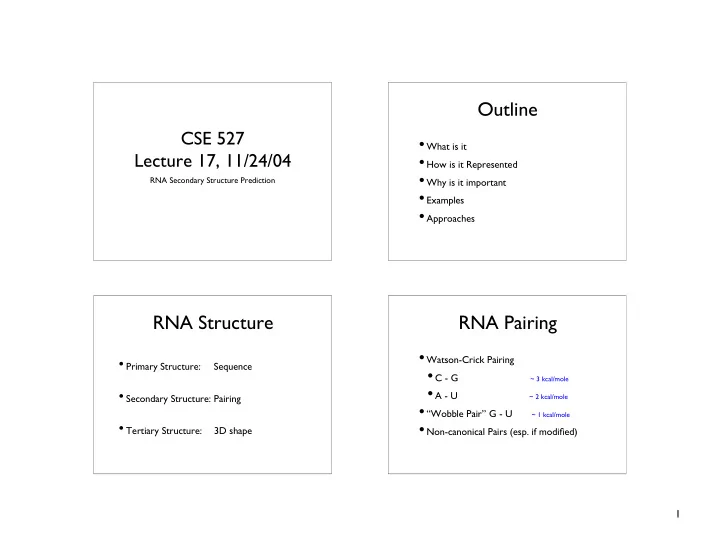
Outline

  • What is it
  • How is it Represented
  • Why is it important
  • Examples
  • Approaches

RNA Structure

  • Primary Structure:

Sequence

  • Secondary Structure: Pairing
  • Tertiary Structure:

3D shape

RNA Pairing

  • Watson-Crick Pairing
  • C - G ~ 3 kcal/mole
  • A - U ~ 2 kcal/mole
  • “Wobble Pair” G - U ~ 1 kcal/mole
  • Non-canonical Pairs (esp. if modified)
slide-2
SLIDE 2

2

A tRNA 3d Structure tRNA - Alt. Representations A “Mountain” diagram Why?

  • RNA’s fold,

and function

  • Nature uses

what works

slide-3
SLIDE 3

3

Importance

  • Ribozymes (RNA Enzymes)
  • Retroviruses
  • Effects on transcription, translation,

splicing...

  • Functional RNAs: rRNA, tRNA, snRNA,

snoRNA, micro RNA, RNAi, riboswitches, regulatory elements in 3’ & 5’ UTRs, ...

A C U G C A G G G A G C A A G C G A G G C C U C U G C A A U G A C G G U G C A U G A G A G C G U C U U U U C A A C A C U G U U A U G G A A G U U U G G C U A G C G U U C U A G A G C U G U G A C A C U G C C G C G A C G G G A A A G U A A C G G G C G G C G A G U A A A C C C G A U C C C G G U G A A U A G C C U G A A A A A C A A A G U A C A C G G G A U A C G

Definitions

  • Sequence 5’ r1 r2 r3 ... rn 3’ in {A, C, G, T}
  • A Secondary Structure is a set of pairs i•j s.t.

1.i < j-4 2.if i•j & i’•j’ are two pairs with i ≤ i’, then A.i = i’ & j = j’, or

  • B. j < i’, or

C.i < i’ < j’ < j

First pair precedes 2nd,

  • r is nested within it.

No “pseudoknots.”

}

Nested Precedes Pseudoknot

slide-4
SLIDE 4

4

A Pseudoknot Approaches to Structure Prediction

  • Maximum Pairing

+ simple

  • too inaccurate
  • Minimum Energy

+ Works on single sequences

  • Ignores pseudoknots
  • Only finds “optimal” fold
  • Partition Function

+ Finds all folds

  • Ignores pseudoknots

Approaches, II

  • Comparative sequence analysis

+ handles all pairings (incl. pseudoknots)

  • requires several (many?) aligned,

appropriately diverged

  • Stochastic Context-free Grammars

Roughly combines min energy & comparative, but no pseudoknots

  • Physical experiments (x-ray crystalography, NMR)

Nussinov: Max Pairing

  • B(i,j) = # pairs in optimal pairing of ri ... rj
  • B(i,j) = 0 for all i, j with i ≥ j-4; otherwise
  • B(i,j) = max of:
  • 1. B(i+1,j)
  • 2. B(i,j-1)
  • 3. B(i+1,j-1) +(if ri pairs with rj then 1 else 0)
  • 4. max { B(i,k)+B(k+1,j) | i < k < j }

Time: O(n3)

slide-5
SLIDE 5

5

Pair-based Energy Minimization

  • E(i,j) = energy of pairs in optimal pairing of ri ... rj
  • E(i,j) = ∞ for all i, j with i ≥ j-4; otherwise
  • E(i,j) = min of:
  • 1. E(i+1,j)
  • 2. E(i,j-1)
  • 3. E(i+1,j-1) + e(ri,rj)
  • 4. min { E(i,k)+E(k+1,j) | i < k < j }

Time: O(n3) energy of one pair

Loop-based Energy Minimization

  • Detailed experiments show that it’s more

accurate to model based on loops, rather than just pairs

  • Loop types
  • Stack
  • Hairpin loop
  • Bulge
  • Interior loop

Loop Examples Zuker: Loop-based Energy, I

  • W(i,j) = energy of optimal pairing of ri ... rj
  • V(i,j) = as above, but forcing pair i•j
  • W(i,j) = V(i,j) = ∞ for all i, j with i ≥ j-4
  • W(i,j) = min(W(i+1,j), W(i,j-1), V(i+1,j-1),

min { E(i,k)+E(k+1,j) | i < k < j } )

slide-6
SLIDE 6

6

Zuker: Loop-based Energy, II

  • V(i,j) =min(eh(i,j), es(i,j)+V(i+1,j-1), VBI(i,j),

VM(i,j))

  • VM(i,j) = min { W(i,k)+W(k+1,j) | i < k < j } )
  • VBI(i,j) = min { ebi(i,j,i’,j’) + V(i’, j’) |

i < i’ < j’ < j & i’-i+j-j’ > 2 }

hairpin stack bulge/ interior multi- loop

Time: O(n4) O(n3) possible if ebi(.) is “nice”

Suboptimal Energy

  • There are always alternate folds with near-optimal
  • energies. Thermodynamics predicts that

populations of identical molecules will exist in different folds; individual molecules even flicker among different folds

  • Zuker’s algorithm can be modified to find

suboptimal folds

  • McCaskill gives a more elaborate dynamic

programming algorithm calculating the “partition function,” which defines the probability distribution over all these states.

Two competing secondary structures for the Leptomonas collosoma spliced leader mRNA.

Example

  • f

suboptimal folding

Black dots: pairs in opt fold Colored dots: pairs in folds 2-5% worse than

  • ptimal fold