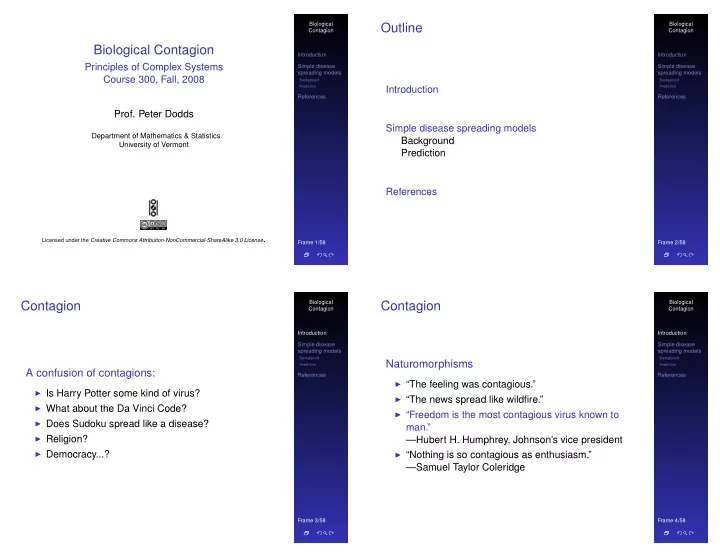
Outline Contagion Contagion Biological Contagion Introduction - - PowerPoint PPT Presentation

outline
SMART_READER_LITE
LIVE PREVIEW

Outline Contagion Contagion Biological Contagion Introduction - - PowerPoint PPT Presentation

Biological Biological Outline Contagion Contagion Biological Contagion Introduction Introduction Principles of Complex Systems Simple disease Simple disease spreading models spreading models Course 300, Fall, 2008 Background


slide-1
SLIDE 1

Biological Contagion Introduction Simple disease spreading models

Background Prediction

References Frame 1/58

Biological Contagion

Principles of Complex Systems Course 300, Fall, 2008

  • Prof. Peter Dodds

Department of Mathematics & Statistics University of Vermont

Licensed under the Creative Commons Attribution-NonCommercial-ShareAlike 3.0 License. Biological Contagion Introduction Simple disease spreading models

Background Prediction

References Frame 2/58

Outline

Introduction Simple disease spreading models Background Prediction References

Biological Contagion Introduction Simple disease spreading models

Background Prediction

References Frame 3/58

Contagion

A confusion of contagions:

◮ Is Harry Potter some kind of virus? ◮ What about the Da Vinci Code? ◮ Does Sudoku spread like a disease? ◮ Religion? ◮ Democracy...?

Biological Contagion Introduction Simple disease spreading models

Background Prediction

References Frame 4/58

Contagion

Naturomorphisms

◮ “The feeling was contagious.” ◮ “The news spread like wildfire.” ◮ “Freedom is the most contagious virus known to

man.” —Hubert H. Humphrey, Johnson’s vice president

◮ “Nothing is so contagious as enthusiasm.”

—Samuel Taylor Coleridge

slide-2
SLIDE 2

Biological Contagion Introduction Simple disease spreading models

Background Prediction

References Frame 5/58

Social contagion

Optimism according to Ambrose Bierce: (⊞)

The doctrine that everything is beautiful, including what is ugly, everything good, especially the bad, and everything right that is wrong. ... It is hereditary, but fortunately not contagious.

Biological Contagion Introduction Simple disease spreading models

Background Prediction

References Frame 6/58

Social contagion

Eric Hoffer, 1902–1983

There is a grandeur in the uniformity of the mass. When a fashion, a dance, a song, a slogan or a joke sweeps like wildfire from one end of the continent to the other, and a hundred million people roar with laughter, sway their bodies in unison, hum one song or break forth in anger and denunciation, there is the overpowering feeling that in this country we have come nearer the brotherhood of man than ever before.

◮ Hoffer (⊞) was an interesting fellow...

Biological Contagion Introduction Simple disease spreading models

Background Prediction

References Frame 7/58

The spread of fanaticism

Hoffer’s acclaimed work: “The True Believer: Thoughts On The Nature Of Mass Movements” (1951) [3]

Quotes-aplenty:

◮ “We can be absolutely certain only about things we

do not understand.”

◮ “Mass movements can rise and spread without belief

in a God, but never without belief in a devil.”

◮ “Where freedom is real, equality is the passion of the

  • masses. Where equality is real, freedom is the

passion of a small minority.”

Biological Contagion Introduction Simple disease spreading models

Background Prediction

References Frame 8/58

Imitation

despair.com

“When people are free to do as they please, they usually imitate each other.” —Eric Hoffer “The Passionate State

  • f Mind” [4]
slide-3
SLIDE 3

Biological Contagion Introduction Simple disease spreading models

Background Prediction

References Frame 9/58

The collective...

despair.com

“Never Underestimate the Power of Stupid People in Large Groups.”

Biological Contagion Introduction Simple disease spreading models

Background Prediction

References Frame 10/58

Contagion

Definitions

◮ (1) The spreading of a quality or quantity between

individuals in a population.

◮ (2) A disease itself:

the plague, a blight, the dreaded lurgi, ...

◮ from Latin: con = ‘together with’ + tangere ‘to touch.’ ◮ Contagion has unpleasant overtones... ◮ Just Spreading might be a more neutral word ◮ But contagion is kind of exciting...

Biological Contagion Introduction Simple disease spreading models

Background Prediction

References Frame 11/58

Examples of non-disease spreading:

Interesting infections:

◮ Spreading of buildings in the US. (⊞) ◮ Spreading of spreading (⊞). ◮ Viral get-out-the-vote video. (⊞)

Biological Contagion Introduction Simple disease spreading models

Background Prediction

References Frame 12/58

Contagions

Two main classes of contagion

  • 1. Infectious diseases:

tuberculosis, HIV, ebola, SARS, influenza, ...

  • 2. Social contagion:

fashion, word usage, rumors, riots, religion, ...

slide-4
SLIDE 4

Biological Contagion Introduction Simple disease spreading models

Background Prediction

References Frame 14/58

Mathematical Epidemiology

The standard SIR model [8]

◮ The basic model of disesase contagion ◮ Three states:

  • 1. S = Susceptible
  • 2. I = Infective/Infectious
  • 3. R = Recovered or Removed or Refractory

◮ S(t) + I(t) + R(t) = 1 ◮ Presumes random interactions (mass-action

principle)

◮ Interactions are independent (no memory) ◮ Discrete and continuous time versions

Biological Contagion Introduction Simple disease spreading models

Background Prediction

References Frame 15/58

Mathematical Epidemiology

Discrete time automata example:

I R S

βI 1 − ρ ρ 1 − βI r 1 − r

Transition Probabilities: β for being infected given contact with infected r for recovery ρ for loss of immunity

Biological Contagion Introduction Simple disease spreading models

Background Prediction

References Frame 16/58

Mathematical Epidemiology

Original models attributed to

◮ 1920’s: Reed and Frost ◮ 1920’s/1930’s: Kermack and McKendrick [5, 7, 6] ◮ Coupled differential equations with a mass-action

principle

Biological Contagion Introduction Simple disease spreading models

Background Prediction

References Frame 17/58

Independent Interaction models

Differential equations for continuous model

d dt S = −βIS + ρR d dt I = βIS − rI d dt R = rI − ρR β, r, and ρ are now rates.

Reproduction Number R0:

◮ R0 = expected number of infected individuals

resulting from a single initial infective

◮ Epidemic threshold: If R0 > 1, ‘epidemic’ occurs.

slide-5
SLIDE 5

Biological Contagion Introduction Simple disease spreading models

Background Prediction

References Frame 18/58

Reproduction Number R0

Discrete version:

◮ Set up: One Infective in a randomly mixing

population of Susceptibles

◮ At time t = 0, single infective random bumps into a

Susceptible

◮ Probability of transmission = β ◮ At time t = 1, single Infective remains infected with

probability 1 − r

◮ At time t = k, single Infective remains infected with

probability (1 − r)k

Biological Contagion Introduction Simple disease spreading models

Background Prediction

References Frame 19/58

Reproduction Number R0

Discrete version:

◮ Expected number infected by original Infective:

R0 = β + (1 − r)β + (1 − r)2β + (1 − r)3β + . . . = β

  • 1 + (1 − r) + (1 − r)2 + (1 − r)3 + . . .
  • = β

1 1 − (1 − r) = β/r For S0 initial infectives (1 − S0 = R0 immune): R0 = S0β/r

Biological Contagion Introduction Simple disease spreading models

Background Prediction

References Frame 20/58

Independent Interaction models

For the continuous version

◮ Second equation:

d dt I = βSI − rI d dt I = (βS − r)I

◮ Number of infectives grows initially if

βS(0) − r > 0 ⇒ βS(0) > r ⇒ βS(0)/r > 1

◮ Same story as for discrete model.

Biological Contagion Introduction Simple disease spreading models

Background Prediction

References Frame 21/58

Independent Interaction models

Example of epidemic threshold:

1 2 3 4 0.2 0.4 0.6 0.8 1

R0 Fraction infected

◮ Continuous phase transition. ◮ Fine idea from a simple model.

slide-6
SLIDE 6

Biological Contagion Introduction Simple disease spreading models

Background Prediction

References Frame 22/58

Independent Interaction models

Many variants of the SIR model:

◮ SIS: susceptible-infective-susceptible ◮ SIRS: susceptible-infective-recovered-susceptible ◮ compartment models (age or gender partitions) ◮ more categories such as ‘exposed’ (SEIRS) ◮ recruitment (migration, birth)

Biological Contagion Introduction Simple disease spreading models

Background Prediction

References Frame 24/58

Disease spreading models

For novel diseases:

  • 1. Can we predict the size of an epidemic?
  • 2. How important is the reproduction number R0?

Biological Contagion Introduction Simple disease spreading models

Background Prediction

References Frame 25/58

R0 and variation in epidemic sizes

R0 approximately same for all of the following:

◮ 1918-19 “Spanish Flu” ∼ 500,000 deaths in US ◮ 1957-58 “Asian Flu” ∼ 70,000 deaths in US ◮ 1968-69 “Hong Kong Flu” ∼ 34,000 deaths in US ◮ 2003 “SARS Epidemic” ∼ 800 deaths world-wide

Biological Contagion Introduction Simple disease spreading models

Background Prediction

References Frame 26/58

Size distributions

Size distributions are important elsewhere:

◮ earthquakes (Gutenberg-Richter law) ◮ city sizes, forest fires, war fatalities ◮ wealth distributions ◮ ‘popularity’ (books, music, websites, ideas) ◮ Epidemics?

Power laws distributions are common but not obligatory...

slide-7
SLIDE 7

Biological Contagion Introduction Simple disease spreading models

Background Prediction

References Frame 27/58

Size distributions

Really, what about epidemics?

◮ Simply hasn’t attracted much attention. ◮ Data not as clean as for other phenomena.

Biological Contagion Introduction Simple disease spreading models

Background Prediction

References Frame 28/58

Feeling Ill in Iceland

Caseload recorded monthly for range of diseases in Iceland, 1888-1890

1890 1900 1910 1920 1930 1940 1950 1960 1970 1980 1990 0.01 0.02 0.03 Date Frequency

Iceland: measles normalized count

Treat outbreaks separated in time as ‘novel’ diseases.

Biological Contagion Introduction Simple disease spreading models

Background Prediction

References Frame 29/58

Really not so good at all in Iceland

Epidemic size distributions N(S) for Measles, Rubella, and Whooping Cough.

0.025 0.05 0.075 0.1 1 2 3 4 5 75

N(S) S

A

0.02 0.04 0.06 1 2 3 4 5 105

S

B

0.025 0.05 0.075 1 2 3 4 5 75

S

C

Spike near S = 0, relatively flat otherwise.

Biological Contagion Introduction Simple disease spreading models

Background Prediction

References Frame 30/58

Measles & Pertussis

0.025 0.05 0.075 0.1 1 2 3 4 5 75

N (ψ) ψ

A

10

−5

10

−4

10

−3

10

−2

10

−1

10 10

1

10

2

ψ N>(ψ) 0.025 0.05 0.075 1 2 3 4 5 75

ψ

B

10

−5

10

−4

10

−3

10

−2

10

−1

10 10

1

10

2

ψ N>(ψ)

Insert plots: Complementary cumulative frequency distributions: N(Ψ′ > Ψ) ∝ Ψ−γ+1 Limited scaling with a possible break.

slide-8
SLIDE 8

Biological Contagion Introduction Simple disease spreading models

Background Prediction

References Frame 31/58

Power law distributions

Measured values of γ:

◮ measles: 1.40 (low Ψ) and 1.13 (high Ψ) ◮ pertussis: 1.39 (low Ψ) and 1.16 (high Ψ) ◮ Expect 2 ≤ γ < 3 (finite mean, infinite variance) ◮ When γ < 1, can’t normalize ◮ Distribution is quite flat.

Biological Contagion Introduction Simple disease spreading models

Background Prediction

References Frame 32/58

Resurgence—example of SARS

D

Date of onset # New cases

Nov 16, ’02 Dec 16, ’02 Jan 15, ’03 Feb 14, ’03 Mar 16, ’03 Apr 15, ’03 May 15, ’03 Jun 14, ’03 160 120 80 40

◮ Epidemic slows...

then an infective moves to a new context.

◮ Epidemic discovers new ‘pools’ of susceptibles:

Resurgence.

◮ Importance of rare, stochastic events.

Biological Contagion Introduction Simple disease spreading models

Background Prediction

References Frame 33/58

The challenge

So... can a simple model produce

  • 1. broad epidemic distributions

and

  • 2. resurgence ?

Biological Contagion Introduction Simple disease spreading models

Background Prediction

References Frame 34/58

Size distributions

0.25 0.5 0.75 1 500 1000 1500 2000 A

ψ N(ψ)

R0=3

Simple models typically produce bimodal or unimodal size distributions.

◮ This includes network models:

random, small-world, scale-free, ...

◮ Exceptions:

  • 1. Forest fire models
  • 2. Sophisticated metapopulation models
slide-9
SLIDE 9

Biological Contagion Introduction Simple disease spreading models

Background Prediction

References Frame 35/58

Burning through the population

Forest fire models: [9]

◮ Rhodes & Anderson, 1996 ◮ The physicist’s approach:

“if it works for magnets, it’ll work for people...”

A bit of a stretch:

  • 1. Epidemics ≡ forest fires

spreading on 3-d and 5-d lattices.

  • 2. Claim Iceland and Faroe Islands exhibit power law

distributions for outbreaks.

  • 3. Original forest fire model not completely understood.

Biological Contagion Introduction Simple disease spreading models

Background Prediction

References Frame 36/58

Size distributions

From Rhodes and Anderson, 1996.

Biological Contagion Introduction Simple disease spreading models

Background Prediction

References Frame 37/58

Sophisticated metapopulation models

◮ Community based mixing: Longini (two scales). ◮ Eubank et al.’s EpiSims/TRANSIMS—city

simulations.

◮ Spreading through countries—Airlines: Germann et

al., Corlizza et al.

◮ Vital work but perhaps hard to generalize from... ◮ ⇒ Create a simple model involving multiscale travel ◮ Multiscale models suggested by others but not

formalized (Bailey, Cliff and Haggett, Ferguson et al.)

Biological Contagion Introduction Simple disease spreading models

Background Prediction

References Frame 38/58

Size distributions

◮ Very big question: What is N? ◮ Should we model SARS in Hong Kong as spreading ◮ For simple models, we need to know the final size

beforehand...

slide-10
SLIDE 10

Biological Contagion Introduction Simple disease spreading models

Background Prediction

References Frame 39/58

Improving simple models

Contexts and Identities—Bipartite networks

c d e a b 2 3 4 1 a b c d e contexts individuals unipartite network

◮ boards of directors ◮ movies ◮ transportation modes (subway)

Biological Contagion Introduction Simple disease spreading models

Background Prediction

References Frame 40/58

Improving simple models

Idea for social networks: incorporate identity.

Identity is formed from attributes such as:

◮ Geographic location ◮ Type of employment ◮ Age ◮ Recreational activities

Groups are crucial...

◮ formed by people with at least one similar attribute ◮ Attributes ⇔ Contexts ⇔ Interactions ⇔

  • Networks. [11]

Biological Contagion Introduction Simple disease spreading models

Background Prediction

References Frame 41/58

Infer interactions/network from identities

e c a high school teacher

  • ccupation

health care education nurse doctor teacher kindergarten d b

Distance makes sense in identity/context space.

Biological Contagion Introduction Simple disease spreading models

Background Prediction

References Frame 42/58

Generalized context space

100

e c a b d geography

  • ccupation

age

(Blau & Schwartz [1], Simmel [10], Breiger [2])

slide-11
SLIDE 11

Biological Contagion Introduction Simple disease spreading models

Background Prediction

References Frame 43/58

A toy agent-based model

Geography—allow people to move between contexts:

◮ Locally: standard SIR model with random mixing ◮ discrete time simulation ◮ β = infection probability ◮ γ = recovery probability ◮ P = probability of travel ◮ Movement distance: Pr(d) ∝ exp(−d/ξ) ◮ ξ = typical travel distance

Biological Contagion Introduction Simple disease spreading models

Background Prediction

References Frame 44/58

A toy agent-based model

Schematic:

b=2 i j xij =2 l=3 n=8

Biological Contagion Introduction Simple disease spreading models

Background Prediction

References Frame 45/58

Model output

◮ Define P0 = Expected number of infected individuals

leaving initially infected context.

◮ Need P0 > 1 for disease to spread (independent of

R0).

◮ Limit epidemic size by restricting frequency of travel

and/or range

Biological Contagion Introduction Simple disease spreading models

Background Prediction

References Frame 46/58

Model output

Varying ξ:

◮ Transition in expected final size based on typical

movement distance (sensible)

slide-12
SLIDE 12

Biological Contagion Introduction Simple disease spreading models

Background Prediction

References Frame 47/58

Model output

Varying P0:

◮ Transition in expected final size based on typical

number of infectives leaving first group (also sensible)

◮ Travel advisories: ξ has larger effect than P0.

Biological Contagion Introduction Simple disease spreading models

Background Prediction

References Frame 48/58

Example model output: size distributions

0.25 0.5 0.75 1 100 200 300 400 1942

ψ N(ψ)

R0=3 0.25 0.5 0.75 1 100 200 300 400 683

ψ N(ψ)

R0=12

◮ Flat distributions are possible for certain ξ and P. ◮ Different R0’s may produce similar distributions ◮ Same epidemic sizes may arise from different R0’s

Biological Contagion Introduction Simple disease spreading models

Background Prediction

References Frame 49/58

Model output—resurgence

Standard model:

500 1000 1500 2000 4000 6000

t # New cases

D R0=3

Biological Contagion Introduction Simple disease spreading models

Background Prediction

References Frame 50/58

Model output—resurgence

Standard model with transport:

500 1000 1500 100 200

t # New cases

E R0=3 500 1000 1500 200 400

t # New cases

G R0=3

slide-13
SLIDE 13

Biological Contagion Introduction Simple disease spreading models

Background Prediction

References Frame 51/58

The upshot

Multiscale population structure + stochasticity leads to resurgence + broad epidemic size distributions

Biological Contagion Introduction Simple disease spreading models

Background Prediction

References Frame 52/58

Conclusions

◮ For this model, epidemic size is highly unpredictable ◮ Model is more complicated than SIR but still simple ◮ We haven’t even included normal social responses

such as travel bans and self-quarantine.

◮ The reproduction number R0 is not very useful. ◮ R0, however measured, is not informative about

  • 1. how likely the observed epidemic size was,
  • 2. and how likely future epidemics will be.

◮ Problem: R0 summarises one epidemic after the fact

and enfolds movement, everything.

Biological Contagion Introduction Simple disease spreading models

Background Prediction

References Frame 53/58

Conclusions

◮ Disease spread highly sensitive to population

structure

◮ Rare events may matter enormously

(e.g., an infected individual taking an international flight)

◮ More support for controlling population movement

(e.g., travel advisories, quarantine)

Biological Contagion Introduction Simple disease spreading models

Background Prediction

References Frame 54/58

Conclusions

What to do:

◮ Need to separate movement from disease ◮ R0 needs a friend or two. ◮ Need R0 > 1 and P0 > 1 and ξ sufficiently large

for disease to have a chance of spreading

More wondering:

◮ Exactly how important are rare events in disease

spreading?

◮ Again, what is N?

slide-14
SLIDE 14

Biological Contagion Introduction Simple disease spreading models

Background Prediction

References Frame 55/58

Simple disease spreading models

Attempts to use beyond disease:

◮ Adoption of ideas/beliefs (Goffman & Newell, 1964) ◮ Spread of rumors (Daley & Kendall, 1965) ◮ Diffusion of innovations (Bass, 1969) ◮ Spread of fanatical behavior (Castillo-Chávez &

Song, 2003)

Biological Contagion Introduction Simple disease spreading models

Background Prediction

References Frame 56/58

References I

P . M. Blau and J. E. Schwartz. Crosscutting Social Circles. Academic Press, Orlando, FL, 1984.

  • R. L. Breiger.

The duality of persons and groups. Social Forces, 53(2):181–190, 1974.

  • E. Hoffer.

The True Believer: On The Nature Of Mass Movements. Harper and Row, New York, 1951.

  • E. Hoffer.

The Passionate State of Mind: And Other Aphorisms. Buccaneer Books, 1954.

Biological Contagion Introduction Simple disease spreading models

Background Prediction

References Frame 57/58

References II

  • W. O. Kermack and A. G. McKendrick.

A contribution to the mathematical theory of epidemics.

  • Proc. R. Soc. Lond. A, 115:700–721, 1927. pdf (⊞)
  • W. O. Kermack and A. G. McKendrick.

A contribution to the mathematical theory of

  • epidemics. III. Further studies of the problem of

endemicity.

  • Proc. R. Soc. Lond. A, 141(843):94–122, 1927.

pdf (⊞)

  • W. O. Kermack and A. G. McKendrick.

Contributions to the mathematical theory of

  • epidemics. II. The problem of endemicity.
  • Proc. R. Soc. Lond. A, 138(834):55–83, 1927. pdf (⊞)

Biological Contagion Introduction Simple disease spreading models

Background Prediction

References Frame 58/58

References III

  • J. D. Murray.

Mathematical Biology. Springer, New York, Third edition, 2002.

  • C. J. Rhodes and R. M. Anderson.

Power laws governing epidemics in isolated populations. Nature, 381:600–602, 1996. pdf (⊞)

  • G. Simmel.

The number of members as determining the sociological form of the group. I. American Journal of Sociology, 8:1–46, 1902.

  • D. J. Watts, P

. S. Dodds, and M. E. J. Newman. Identity and search in social networks. Science, 296:1302–1305, 2002. pdf (⊞)