Outline Research Problem Research Problem Challenges Approaches - - PowerPoint PPT Presentation

outline
SMART_READER_LITE
LIVE PREVIEW

Outline Research Problem Research Problem Challenges Approaches - - PowerPoint PPT Presentation

8/7/2012 Outline Research Problem Research Problem Challenges Approaches & Gaps PHD Dissertation Proposal Defense Research Goals Research Questions & Experiments Research Questions & Experiments Wes J. Lloyd


slide-1
SLIDE 1

8/7/2012 1 PHD Dissertation Proposal Defense

Wes J. Lloyd August 7, 2012

Colorado State University, Fort Collins, Colorado USA

Outline

Research Problem

Research Problem

Challenges Approaches & Gaps Research Goals Research Questions & Experiments Research Questions & Experiments Research Contributions Preliminary Results

August 7, 2012 2 Wes J. Lloyd PHD Dissertation Proposal Defense

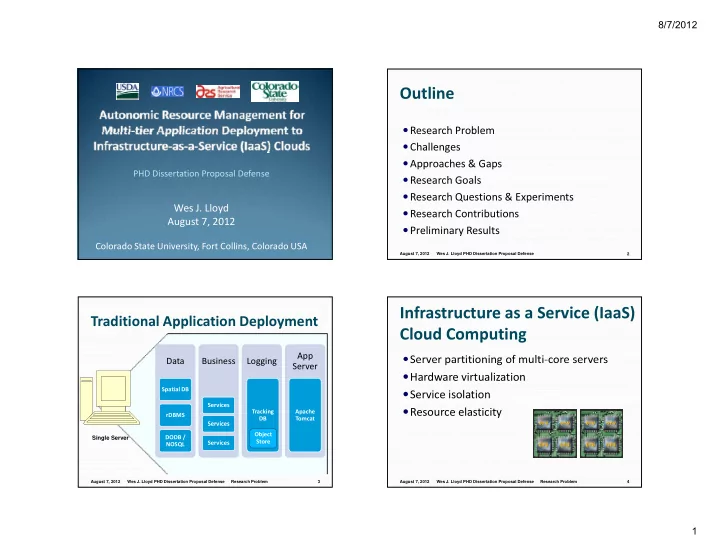
Traditional Application Deployment

Data Business Logging App Data

Spatial DB rDBMS

Business

Services Services

Logging

Tracking DB

pp Server

Apache Tomcat

Research Problem 3

DODB / NOSQL Services Services Object Store

Single Server

Wes J. Lloyd PHD Dissertation Proposal Defense August 7, 2012

Infrastructure as a Service (IaaS) Cloud Computing

Server partitioning of multi‐core servers Server partitioning of multi‐core servers Hardware virtualization Service isolation Resource elasticity

August 7, 2012 Research Problem 4 Wes J. Lloyd PHD Dissertation Proposal Defense

slide-2
SLIDE 2

8/7/2012 2

Research Problem 5 Wes J. Lloyd PHD Dissertation Proposal Defense August 7, 2012

Problem Statement

Autonomic deployment of multi‐tier Autonomic deployment of multi‐tier

applications to IaaS clouds

Component composition

 Collocation and interference of components

Scaling infrastructure to meet demand Scaling infrastructure to meet demand

August 7, 2012 Research Problem 6 Wes J. Lloyd PHD Dissertation Proposal Defense 7 Wes J. Lloyd PHD Dissertation Proposal Defense August 7, 2012

Application Component Composition

Application Components Virtual Machine (VM) App Server Component Deployment Virtual Machine (VM) Images rDBMS r/o File Server Log Server Load Balancer Image 2 rDBMS write Image 1 App Server File Server Log Server rDBMS write rDBMS r/o Load Balancer

Problems & Challenges 8

Application “Stack”

PERFORMANCE

. . .

Image n Load Balancer

  • Dist. cache

Wes J. Lloyd PHD Dissertation Proposal Defense August 7, 2012

slide-3
SLIDE 3

8/7/2012 3

Bell’s Number

n = number

  • f

application n k Model Component Deployment application components VM deployments Database File Server Log Server config 1 M D F L config 2 M F L config n M L D 1 VM : 1..n components 4 15 5 52 6 203 7 877 8 4,140 D

Problems & Challenges 9

Application “Stack”

# of Configurations

. . .

k= # of possible configs F 9 21,147 n . . .

Wes J. Lloyd PHD Dissertation Proposal Defense August 7, 2012

Provisioning Variation

Request(s) to launch VMs VMs Share PM CPU / Disk / Network VM Physical Host Physical Host Physical Host VM VM VM Ambiguous Mapping VM VM VM VM VM VM VM VM VM VM VM VM VM VM

Problems & Challenges 10

Physical Host Physical Host Physical Host VMs Reserve PM Memory Blocks

PERFORMANCE

Wes J. Lloyd PHD Dissertation Proposal Defense August 7, 2012

Service Requests

Infrastructure Management

  • Scale Services
  • Tune Application

Application Servers

Load Balancer Load Balancer

distributed cache

  • Tune Application

Parameters

  • Tune Virtualization

Parameters

noSQL data stores rDBMS

Problems & Challenges 11 Wes J. Lloyd PHD Dissertation Proposal Defense August 7, 2012 12 Wes J. Lloyd PHD Dissertation Proposal Defense August 7, 2012

slide-4
SLIDE 4

8/7/2012 4

Virtual Machine (VM) Placement as “Bin Packing Problem”

 Bins= physical machines (PMs)

Bins physical machines (PMs)

 Items= virtual machines (VMs)  Dimensions

 CPU time  VM RAM, hard disk size, # cores  Disk read/write throughput  Disk read/write throughput  Network read/write throughput

 PM capacities vary dynamically  VM resource utilization varies

Approaches & Gaps 13 Wes J. Lloyd PHD Dissertation Proposal Defense August 7, 2012

NP-Hard

Related Work

Multivariate performance models

Multivariate performance models

 Regression models  Machine learning

Feedback loop control Hybrid approaches Formal approaches

 Integer linear programming  Case based reasoning

Approaches & Gaps 14 Wes J. Lloyd PHD Dissertation Proposal Defense August 7, 2012

Gaps in Related Work

 Existing approaches do not consider

 VM image composition  VM image composition  Complementary component placements  Interference among components  Minimization of resources (# VMs)  Load balancing of physical resources

 Performance models ignore  Performance models ignore

 Disk I/O  Network I/O  VM and component location

Approaches & Gaps 15 Wes J. Lloyd PHD Dissertation Proposal Defense August 7, 2012

Why Gaps Exist

Public clouds Public clouds

 Research is cost prohibitive  Users concerned with performance not in control

Private clouds: systems still evolving Performance models (large problem space)

Performance models (large problem space)

Virtualization misunderstood or overlooked

Approaches & Gaps 16 Wes J. Lloyd PHD Dissertation Proposal Defense August 7, 2012

slide-5
SLIDE 5

8/7/2012 5

17 Wes J. Lloyd PHD Dissertation Proposal Defense August 7, 2012

Research Goals

RG1: Support VM component composition RG2: Support virtual infrastructure management

 Determine and execute VM placement  Scale infrastructure for application demand

August 7, 2012 Research Goals 18 Wes J. Lloyd PHD Dissertation Proposal Defense

Performance Objectives

Primary: Maximize application throughput Primary: Maximize application throughput Secondary: Minimize resource cost (# of VMs) Minimize modeling time Support high responsiveness to change in

application demand application demand

August 7, 2012 Research Goals 19 Wes J. Lloyd PHD Dissertation Proposal Defense 20 Wes J. Lloyd PHD Dissertation Proposal Defense August 7, 2012

slide-6
SLIDE 6

8/7/2012 6

Methodology Evaluation

CSIP: USDA‐NRCS platform for model services

p

Models as multi‐tier application surrogates

 RUSLE2 – Soil erosion model  WEPS – Wind Erosion Prediction System  Hydrology models: SWAT, AgES  Other models: STIR SCI  Other models: STIR, SCI…

Eucalyptus IaaS cloud(s)

 Amazon EC2 compatible  XEN & KVM hypervisors

Research Questions & Methodology 21 Wes J. Lloyd PHD Dissertation Proposal Defense August 7, 2012

Component Composition Infrastructure Management

RQ1 RQ3 RQ4

August 7, 2012 Wes J. Lloyd PHD Dissertation Proposal Defense Research Questions & Methodology 22

RQ2 RQ5

RQ1: Which independent variables best help model application performance (throughput) to guide autonomic component composition?

Total (all VMs) resource utilization Total (all VMs) resource utilization

 CPU time, disk I/O, network I/O, …

Individual VM and PM resource utilization Component and VM location VM Configuration: number of cores RAM VM Configuration: number of cores, RAM,

hypervisor type (KVM, XEN...)

Research Questions & Methodology 23 Wes J. Lloyd PHD Dissertation Proposal Defense August 7, 2012

RQ1: Which independent variables best help model application performance (throughput) to guide autonomic component composition?

Total (all VMs) resource utilization Methodology Exploratory performance modeling Total (all VMs) resource utilization

 CPU time, disk I/O, network I/O, …

Individual VM/PM resource utilization Component / VM location VM Configuration: number of cores RAM Exploratory performance modeling

  • Investigate independent variables
  • Investigate modeling techniques
  • Multiple linear regression (MLR)
  • Artificial neural networks (ANNs)

VM Configuration: number of cores, RAM,

hypervisor type (KVM, XEN...)

Research Questions & Methodology 24 Wes J. Lloyd PHD Dissertation Proposal Defense August 7, 2012

  • Artificial neural networks (ANNs)
  • Others
slide-7
SLIDE 7

8/7/2012 7

RQ2: Can component resource classifications and behavioral rules predict performance of component compositions?

Support simplification of the search space

n k 4 15 5 52 6 203

Support simplification of the search space Support applications with large # of

components

 Bell’s number

7 877 8 4,140 9 21,147 n . . .

Research Questions & Methodology 25 Wes J. Lloyd PHD Dissertation Proposal Defense August 7, 2012

RQ2: Can component resource classifications and behavioral rules predict performance of component compositions?

Support simplification of the search space Methodology Investigate autonomic component composition

n k 4 15 5 52 6 203

Support simplification of the search space Support applications with large # of

components

 e.g. Bell’s number:

Investigate autonomic component composition approach(es)

  • Performance modeling
  • Heuristics to classify
  • Component resource utilization

7 877 8 4,140 9 21,147 n . . .

Research Questions & Methodology 26 Wes J. Lloyd PHD Dissertation Proposal Defense August 7, 2012

  • Component resource utilization
  • Component dependencies

Evaluation Metrics: Component Composition

C i i f

Composition performance

 Average throughput of configurations

Resource packing density

 # components/# VMs for compositions

D i ti d

Derivation speed

 Average wall clock time to produce compositions

Research Questions & Methodology 27 Wes J. Lloyd PHD Dissertation Proposal Defense August 7, 2012

RQ3: Does performance of component compositions change when scaled up?

Single provisioned application VMs 

Multiply provisioned application VMs

Investigate collocation of new VMs

 Intelligent vs. ad‐hoc placement  Load balance physical resources

Research Questions & Experiments 28 Wes J. Lloyd PHD Dissertation Proposal Defense August 7, 2012

slide-8
SLIDE 8

8/7/2012 8

RQ3: Do performance rankings of component compositions change when scaled up?

Methodology Single provisioned application VMs  Multiply provisioned application VMs Investigate collocation of new VMs

 Intelligent vs. ad‐hoc placement

Methodology Scale up compositions and benchmark performance

  • Investigate impact of VM placement for

infrastructure scaling

 Load balance physical resources

Research Questions & Methodology 29 Wes J. Lloyd PHD Dissertation Proposal Defense August 7, 2012

infrastructure scaling

RQ4: How rapidly can VMs be launched in response to application demand?

Determine upper bound of VM launch speed Determine upper bound of VM launch speed Devise workarounds to improve performance

 VM prelaunch and suspension

 Reserve RAM, other resources multiplexed

 Enforced caching of VM data on PMs  Reassign duties of existing VMs  Others ?

Research Questions & Methodology 30 Wes J. Lloyd PHD Dissertation Proposal Defense August 7, 2012

RQ4: How rapidly can VMs be launched in response to application demand?

Determine upper bound of VM launch speed Determine upper bound of VM launch speed Devise workarounds to improve performance

 VM prelaunch and suspension

 Reserve RAM, other resources multiplexed

 Enforced caching of VM data on PMs

Methodology Benchmark VM launch performance and investigate potential improvements

 Reassign duties of existing VMs  Others ?

Research Questions & Methodology 31 Wes J. Lloyd PHD Dissertation Proposal Defense August 7, 2012

RQ5: Which independent variables best support application performance modeling for autonomic infrastructure management?

Virtual infrastructure Virtual infrastructure

 Number of VMs (1 to n) per application VM  VM RAM, # cores  VM location data

Application specific parameters

pp p p

 Number of worker threads  Number of database connections  Number of app server concurrent connections

Research Questions & Methodology 32 Wes J. Lloyd PHD Dissertation Proposal Defense August 7, 2012
slide-9
SLIDE 9

8/7/2012 9

RQ5: Which independent variables best support application performance modeling for autonomic infrastructure management?

 When resources are scaled ↑↓

Methodology

↑↓

 Virtual infrastructure

 Number of VMs (1 to n) per application VM  VM RAM allocation  VM core allocation  Location of VMs

l f

Explore autonomic infrastructure management approach(es)

  • Performance model based
  • Feedback control

 Application specific parameters

 Number of worker threads  Number of database connections  Number of app server concurrent connections

Research Questions & Methodology 33 Wes J. Lloyd PHD Dissertation Proposal Defense August 7, 2012

  • Hybrid approach

Evaluation Metrics: Infrastructure Management

Percentage of service requests completed Percentage of service requests completed Responsiveness

 Max supported load acceleration without

dropping requests

Adaptation time

Adaptation time

 Time window with dropped requests

Failure recovery time

Research Questions & Methodology 34 Wes J. Lloyd PHD Dissertation Proposal Defense August 7, 2012 35 Wes J. Lloyd PHD Dissertation Proposal Defense August 7, 2012

Expected Contributions (1/2)

Novel intelligent approaches for IaaS cloud Novel, intelligent approaches for IaaS cloud

 Application deployment  Infrastructure management

Move IaaS infrastructure management

beyond simple management of VM pools beyond simple management of VM pools

August 7, 2012 Contributions 36 Wes J. Lloyd PHD Dissertation Proposal Defense

slide-10
SLIDE 10

8/7/2012 10

Expected Contributions (2/2)

 Autonomic component composition

(RQ1, RQ2)

 Autonomic infrastructure management

(RQ3, RQ4, RQ5)

 Improve application performance modeling

 For component composition (RQ1)  New independent variables (RQ1)  Heuristics (RQ2)  For infrastructure management (RQ5)

 Support load balancing of physical resources

Contributions 37 Wes J. Lloyd PHD Dissertation Proposal Defense August 7, 2012

Non‐goals

Support for stochastic applications Support for stochastic applications

 Only applications with stable resource utilization

characteristics supported

External interference

 From non‐application VMs

Hot‐spot detection

Contributions 38 Wes J. Lloyd PHD Dissertation Proposal Defense August 7, 2012 39 Wes J. Lloyd PHD Dissertation Proposal Defense August 7, 2012

Component Compositions

SC2

M D M D F F L

SC6

M D F D F L

SC11

M F M F D L Rusle 2 Model Fastest Compositions F F Service Isolation Overhead

Preliminary Results 40

XEN KVM

Wes J. Lloyd PHD Dissertation Proposal Defense August 7, 2012

slide-11
SLIDE 11

8/7/2012 11

Component Compositions

SC2

M D M D F F L

SC6

M D F D F L

SC11

M F M F D L Rusle 2 Model Fastest Compositions

  • Determining fastest compositions

F F Service Isolation Overhead

g p

  • Not intuitive
  • Testing / prediction required
  • Service Isolation
  • Was not fastest
  • Adds overhead

Preliminary Results 41

XEN KVM

Wes J. Lloyd PHD Dissertation Proposal Defense August 7, 2012

  • Results in maximum hosting costs (# of VMs)

Component Composition Resource Utilization Diversity

Preliminary Results 42 Wes J. Lloyd PHD Dissertation Proposal Defense August 7, 2012

Component Composition Resource Utilization Diversity

  • Resource utilization varies
  • Component/VM placements
  • VM memory size allocations
  • Hypervisor type KVM/XEN
  • Testing required to identify resource utilization
  • Intuition is insufficient

Preliminary Results 43 Wes J. Lloyd PHD Dissertation Proposal Defense August 7, 2012 Preliminary Results 44 Wes J. Lloyd PHD Dissertation Proposal Defense August 7, 2012

slide-12
SLIDE 12

8/7/2012 12

August 7, 2012 Wes J. Lloyd PHD Dissertation Proposal Defense Preliminary Results 45 August 7, 2012 Wes J. Lloyd PHD Dissertation Proposal Defense Preliminary Results 46

Scaling Infrastructure requires tuning application parameters in response to available resources.

August 7, 2012 Wes J. Lloyd PHD Dissertation Proposal Defense Preliminary Results 47 48 Wes J. Lloyd PHD Dissertation Proposal Defense August 7, 2012