Outline CHRONIC KIDNEY DISEASE UPDATE: WHAT THE GENERALIST - - PowerPoint PPT Presentation

outline
SMART_READER_LITE
LIVE PREVIEW

Outline CHRONIC KIDNEY DISEASE UPDATE: WHAT THE GENERALIST - - PowerPoint PPT Presentation

8/7/2013 Outline CHRONIC KIDNEY DISEASE UPDATE: WHAT THE GENERALIST Definition and Complications NEEDS TO KNOW New CKD Staging 2013 Screening for CKD MICHAEL G. SHLIPAK, MD, MPH CHIEF-GENERAL INTERNAL MEDICINE, Treatment of CKD


slide-1
SLIDE 1

8/7/2013 1

CHRONIC KIDNEY DISEASE UPDATE: WHAT THE GENERALIST NEEDS TO KNOW

MICHAEL G. SHLIPAK, MD, MPH

CHIEF-GENERAL INTERNAL MEDICINE, SAN FRANCISCO VA MEDICAL CENTER PROFESSOR OF MEDICINE, EPIDEMIOLOGY AND BIOSTATISTICS, UCSF

August 7, 2013

Outline

Definition and Complications New CKD Staging 2013 Screening for CKD Treatment of CKD Introduction to Cystatin C When to refer to nephrologist

Outline

Definition and Complications New CKD Staging 2013 Screening for CKD Treatment of CKD Introduction to Cystatin C When to refer to nephrologist

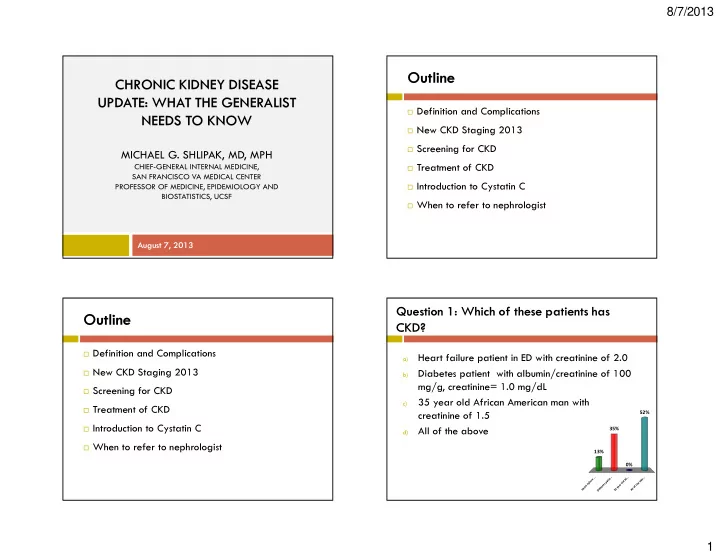
Question 1: Which of these patients has CKD?

H e a r t f a i l u r e . . . D i a b e t e s p a t i e . . . 3 5 y e a r

  • l

d A f . . . A l l

  • f

t h e a b

  • .

. .

13% 52% 0% 35%

a)

Heart failure patient in ED with creatinine of 2.0

b)

Diabetes patient with albumin/creatinine of 100 mg/g, creatinine= 1.0 mg/dL

c)

35 year old African American man with creatinine of 1.5

d)

All of the above

slide-2
SLIDE 2

8/7/2013 2

DEFINITION & CLASSIFICATION OF CHRONIC KIDNEY DISEASE

KDIGO 2012 Clinical Practice Guideline (CPG) for the Evaluation and Management of Chronic Kidney Disease

Kidney inter., Suppl. 2013; 3: 1–150

Introduction

Chronic Kidney Disease (CKD): Defined in 2002 with original CKD staging Replaced earlier terms “chronic renal insufficiency”,

“chronic renal failure”, or “high creatinine”

Previous 5 CKD stages were developed by an expert

panel

Most CKD epidemiology research has been conducted

since the 5 stages were defined

Definition and Complications

Overall CKD definition unchanged Chronic kidney disease: >3 month duration of either:

Decreased kidney function (eGFR<60) Injury/damage to the kidney (e.g. albuminuria, cysts, stones) Etiology of CKD: a)

Common diseases treated by generalists: diabetes, hypertension, cardiovascular disease, heart failure

b)

Other systemic diseases typically treated by specialists: systemic lupus erythematosus, HIV, urological diseases

c)

Primary kidney disease: polycystic kidney disease, glomerular disease

Complications of CKD

Kidney failure (end-stage renal disease) Death Other chronic disease: Atherosclerotic Cardiovascular Disease Heart failure Osteoporosis/fracture Cognitive impairment/dementia Frailty Treatment Complications: Medications Procedures

slide-3
SLIDE 3

8/7/2013 3

Question 2: A 75 yr. old White male with CAD and HF has an eGFR= 25. What is he at most risk for?

D e a t h D i a l y s i s

22% 78%

a)

Death

b)

Dialysis

CKD Complications

Keith et al., Arch Int Med, 2004

  • Design: Northwest Kaiser database
  • 5 year follow-up
  • Death and ESRD outcomes

45 24 Death (%), 5 yrs 20 1 ESRD (%), 5 yrs 74 72 Age

eGFR 15-30 N= 777 eGFR 30-60 N= 11,278

Prognosis by eGFR and Albuminuria

Key meta-analysis published in 2010 in Lancet Evaluated prognosis by eGFR and albuminuria 21 studies, 1.2 million patients Predictor:

eGFR categories Albuminuria (ACR categories)

Outcome: mortality risk

Albuminuria and eGFR grid

Chronic Kidney Disease Prognosis Consortium. Association of estimated glomerular filtration rate and albuminuria with all-cause and cardiovascular mortality : a collaborative meta-analysis. Lancet 2010 AGE, SEX, RACE and CARDIOVASCULAR RISK FACTOR ADJUSTED HAZARD RATIO for All -cause Mortality Albuminuria Classes (mg/g) <10 10-29 30-300 >300 All eGFR (mL/min/ 1.73m2) >105 1.0 1.4 2.0 4.4 1.2 90-104 1.0 1.3 1.5 3.1 1.0 75-89 0.9 1.2 1.7 2.5 1.0 60-74 0.9 1.2 1.8 3.0 1.3 45-59 1.2 1.5 1.9 3.4 2.0 30-44 1.7 2.1 3.0 4.4 4.0 15-29 4.0 3.0 4.2 6.0 3.6 All 1.0 1.3 2.0 3.6 *P<0.05

CKD Prognosis Consortium. Lancet: 2073-81. 2010

CKD by low GFR CKD by albuminuria

Conclusion: CKD staging must integrate eGFR and albuminuria together

slide-4
SLIDE 4

8/7/2013 4

Outline

Definition and Complications New CKD Staging 2013 Screening for CKD Treatment of CKD Introduction to Cystatin C When to refer to nephrologist

Q3: What is the current definition of Stage 3 CKD?

1 + p r

  • t

e i n u r i a . . . G F R 3

  • 6

G F R 4 5

  • 6

T h e r e ’ s n

  • s

u c . . .

3% 19% 19% 59% a)

1+ proteinuria or ACR > 30

b)

GFR 30-60

c)

GFR 45-60

d)

There’s no such thing

CKD Stages and Prevalence

CKD Stage Estimated GFR (mL/min per 1.73 m2) U.S. Prevalence N (1000’s) (%) CKD Stage 1 90+* 3,200 (1.6) CKD Stage 2 60-89* 6,500 (3.2) CKD Stage 3 30–59 15,500 (7.7) CKD Stage 4 15–29 700 (0.4) CKD Stage 5 <15 (or dialysis) 400 (0.2) *With evidence of kidney damage, e.g. albuminuria KDOQI Guidelines, AJKD, Feb. 2002

Problems with Old Staging

Stages 1 and 2 were the same Stage 3 (30-60) was too broad; eGFR of 30-45 is

very different from 45-60

Did not address levels of albuminuria; and only

used albuminuria for Stages 1 and 2

slide-5
SLIDE 5

8/7/2013 5

From Old to New Staging

Cause GFR (mL/min per 1.73 m 2) Albuminuria Diabetes G1 (>90) A1 (ACR< 30) Hypertension G2 (60-89) A2 (ACR 30-300) Polycystic Disease G3a (45

  • 59)

A3 (ACR > 300) GN G3b (30

  • 44)

G4 (15

  • 29)

G5 (< 15)

CGA Staging (like TMN) replaces the prior 5 stages of CKD

CKD Stage Estimated GFR (mL/min per 1.73 m2) U.S. Prevalence N (1000’s) (%) CKD Stage 1 90+* 3,200 (1.6) CKD Stage 2 60-89* 6,500 (3.2) CKD Stage 3 30–59 15,500 (7.7) CKD Stage 4 15–29 700 (0.4) CKD Stage 5 <15 (or dialysis) 400 (0.2)

  • “CKD” is an inadequate

descriptor (like diabetes)

  • Define C, G, A whenever you

mention CKD

  • Hypertensive with eGFR= 50,

ACR= 10

  • Diabetic CKD with eGFR= 75,

ACR= 500

Unknown

Classification of CKD

It is recommended that CKD be classified by:

Cause GFR category Albuminuria category

This is collectively referred to as “CGA Staging” Represents a revision of the previous KDOQI CKD

guidelines, which included staging only by level of GFR

Outline

Definition and Complications New CKD Staging 2013 Screening for CKD Treatment of CKD Introduction to Cystatin C When to refer to nephrologist

Screening for CKD

CKD guidelines do not address when or how to

screen

Other guidelines have disease-specific

recommendations (hypertension, diabetes, CVD)

The following are my suggestions.

slide-6
SLIDE 6

8/7/2013 6

Who and When to Check Creatinine?

Begin screening: Age >40 lower-risk populations Age >30 Blacks, Native Americans Diagnosis of hypertension, diabetes, cardiovascular

disease, heart failure

Frequency of creatinine monitoring (no evidence) No risk factors: 3-5 years Risk factors: 1-2 years Creatinine cost: $0.20

GFR Estimation from Creatinine

Estimated GFR: Automatic reporting by most labs Equations are rough <60 concerning for kidney disease, but not diagnostic of

kidney disease

> 60- imprecise 3 equations in current use: Cockroft-Gault (Nephron, 1976)- used by FDA and

pharmacies

MDRD (Annals, 1999)- used for most automated reporting CKD-EPI (Annals, 2009)- favored by researchers

Question 4: Which of the following is true about creatinine GFR estimates?

M

  • r

e a c c u r a t e . . . T h e y h a v e b e e n . . . T h e y a r e m

  • r

e . . . A l l

  • f

t h e a b

  • .

. .

16% 20% 62% 2% a)

More accurate in older populations than middle- aged because prevalence of kidney disease is higher

b)

They have been validated in most ethnic groups

c)

They are more likely to be accurate in healthy persons than in persons with chronic illness

d)

All of the above

Pros and Cons of Estimated GFR

Pros:

Indexes creatinine for demographic characteristics Forces us to think in terms of GFR and kidney function

Cons:

Mostly validated in younger patients with kidney

disease

Huge assumption that demographic characteristics

alone can define muscle mass

Only developed in Whites and Blacks Estimated GFR ≠ GFR

slide-7
SLIDE 7

8/7/2013 7

Who to Screen with Urine Albumin?

Primary prevention screens: Diabetes- annual Hypertension Elderly CKD Staging: Urine albumin will be important part of CKD staging Should be measured and documented in all CKD

patients

Repeat annually in diabetics every 2-3 years in non-diabetics

How to Measure Urine Albumin

Often listed as “microalbumin panel” Focus on albumin/creatinine ratio (ACR): Dipstick: “trace” is abnormal If dipstick is abnormal, quantify ACR

ACR (mg/g) OLD NEW < 30 Normal Normal or mildly elevated 30-300 Microalbuminuria Moderately elevated >300 Macroalbuminuria Severely elevated

Outline

Definition and Complications New CKD Staging 2013 Screening for CKD Treatment of CKD Introduction to Cystatin C When to refer to nephrologist

Question 5: Which of the following treatment options will not slow the progression of kidney disease?

ACE/ARB treatm... Blood pressure... Glucose contro... Statins

6% 79% 13% 2%

  • A. ACE/ARB treatments
  • B. Blood pressure control
  • C. Glucose control
  • D. Statins
slide-8
SLIDE 8

8/7/2013 8

CKD Treatment

Goals: Prevent progression to ESRD Prevent CKD complications Treatments:

  • ACE/ARB therapy
  • Blood Pressure Control
  • Glucose Control in Diabetes
  • Statins

Prevention

ACE/ARB’s in Diabetic CKD

Diabetic CKD- nearly always has albuminuria Diabetic CKD- ACE/ARB essential for: Type I or II diabetes Moderate albuminuria (ACR 30-300) Severe albuminuria (ACR > 300) ACE/ARB’s do not appear to be helpful to prevent

  • nset of albuminuria

Shlipak, Clinical Evidence 2009

ACE/ARB’s in Non-Diabetic CKD

Non-diabetic CKD- ACE benefit likely varies by

proteinuria status (Jafer TH, Ann Intern Med, 2008)

Meta-analysis- 1,860 CKD patients RCTs of ACE vs. other HTN agents Overall RR 0.67 (0.53-0.84) for kidney outcomes Subgroup analysis: No benefit in group without proteinuria (< 500 mg/g)

Are ACE/ARB’s for All CKD Patients?

ALLHAT Hypertension Trial – Subgroup analysis of CKD (eGFR< 60) Compared lisinopril, amlodipine, and chlorthalidone ACE not different from thiazides or CCB’s for kidney

decline or ESRD (Rahman, Arch Intern Med, 2005)

Low eGFR without albuminuria- choice of blood

pressure agent may not matter

slide-9
SLIDE 9

8/7/2013 9

ACE-I in Advanced CKD

Hou FF et al. NEJM 2006; 354:131-140

224 patients with creatinine 3.1-5.0 mg/dL Mean eGFR 25; mean urine prot – 1.6g/day Benazepril 20 mg daily vs. placebo Primary end point: doubling of creatinine, ESRD, death

Findings:

43% reduction in primary end point 52% reduction in proteinuria Effects independent of blood pressure Adverse events rare

ACE/ARB Combination?

Proteinuria reduction from ACE inhibitors and ARBs

is similar.

Combination of ACE/ARB has additional reductions

in proteinuria.

Meta-analysis Kunz, et al. Ann Int Med, 2008

However, ACE/ARB combination carries higher risk

  • f adverse events

Mann JF et al. Lancet, 2008

Given added risk of hyper-kalemia and uncertain

benefit, I do NOT recommend combination therapy.

Blood Pressure Target in CKD

SBP control extremely important and often requires

3-4 meds at full dose

Meta-analysis in non-diabetic CKD found SBP of

110-129 to be ideal (Jafer, Ann Intern Med, 2005).

The Challenge of Blood Pressure Control in CKD

Since CKD often in older patients with stiff arteries, an

SBP<130 rarely attainable.

In large health screening study, we found one-third of

CKD patients had SBP > 150 (Peralta CA, Arch Intern Med, 2012)

Guidelines on blood pressure control in CKD: JNC-7 target < 130 New KDIGO-CKD HTN guideline: suggests

<130 recommends <140

Evidence-based treatment: <140 for most CKD patients

slide-10
SLIDE 10

8/7/2013 10

Glycemic Control in Diabetic CKD

Type I Diabetes- tight glucose control slows kidney

disease progression: OR= 0.34 (0.20-0.58)

Type II Diabetes- ADVANCE trial (NEJM, 2008, 2560-72) Tight glucose control (HbAlc 6.5 vs. 7.3): 20% lower risk of

“new or worsening nephropathy”

RR= 0.8; 4.1 vs. 5.2% (p = 0.006) In Type II Diabetes, risks of tight glucose control

may offset kidney benefits

Tailor A1C treatment goal to the individual patient

Statins in CKD- beneficial for CVD

Meta-analysis, 26 studies, statins vs. placebos in CKD cardiovascular deaths (20 studies, 18,746 patients) RR 0.80 (95% CI: 0.70,0.90)

Navaneethan et al. Cochrane Review. April, 2009

SHARP Trial: RCT of 9,500 patients with CKD Simvastatin/ezetimide vs. placebo- RR= 0.83 (95% CI: 0.74-

0.94) for CVD

Baigent et al. The Lancet. June, 2011

No benefits of statins in patients with ESRD

Outline

Definition and Complications New CKD Staging 2013 Screening for CKD Treatment of CKD Introduction to Cystatin C When to refer to nephrologist

Cystatin C

Cystatin C is a blood test of kidney function that is

an alternative to creatinine

Because cystatin C is not related to muscle mass (or

age, sex, and race), it has major advantages over creatinine

Cystatin C is a reliable, standardized, and

inexpensive ( $4/test) measure that is available for clinical use.

slide-11
SLIDE 11

8/7/2013 11

GFR Equations using Cystatin C

2 recent studies in major journals developed GFR

equations for cystatin C

1.

CKD-EPI (NEJM July 2012)

  • eGFRcys, eGFRcys-cr
  • Best GFR by creatinine + cystatin C
  • Cystatin C has no race bias, so same eGFR formula for

Blacks and Whites

2.

Berlin Study (Ann Intern Med November 2012)

  • In elderly persons, cystatin C much better than creatinine
  • Best estimate also uses creatinine + cystatin C

“Cystatin C versus Creatinine in Determining Risk

based on Kidney Function”

Shlipak et al, In Press, New England Journal of Medicine; 2013

  • Meta-analysis of all available observational studies

and clinical trials with creatinine and cystatin C

  • Compared associations of eGFRcr, eGFRcys, and

eGFRcr-cys with death

  • Determined proportions reclassified by cystatin C in

each eGFRcr subgroup and impact on risk associations

.01 .02 .03 Kernel Density 30 60 90 120 150 180 eGFR, ml/min/1.73m

2

eGFRcr eGFRcys eGFRcr-cys

eGFR distribution in General Population Cohorts

eGFR Distributions and CKD Prevalence

Shlipak MG. et al. In Press, N Eng J Med, 2013

.0 1 K e rn e l D e n 30 60 eG CKD prevalence: 9.7% (eGFRcr) 13.7% (eGFRcys) 10.0% (eGFRcr-cys)

All-Cause Mortality

12,351 events

.9 1 1.5 2 3 4 6 Adjusted HR 15 30 45 60 75 90 105 120 eGFR, ml/min/1.73m

2

eGFRcr eGFRcys eGFRcr-cys

All-cause Mortality in General Population Cohorts

Shlipak MG. et al. In Press, N Eng J Med, 2013

88 59 83

slide-12
SLIDE 12

8/7/2013 12

= worse

Reclassification by eGFRcys and associated risk

Adjusted for age, gender, race, smoking, systolic blood pressure, total cholesterol, diabetes, history of cardiovascular disease, body mass index, and albuminuria.

1.36 (1.24, 1.48) 1.36 (1.24, 1.48) 1.57 (1.39, 1.78) 1.57 (1.39, 1.78) 1.67 (1.49, 1.88) 1.67 (1.49, 1.88) 1.72 (1.24, 2.37) 1.72 (1.24, 2.37)

Shlipak MG et al. In Press, N Eng J Med, 2013

= same = better

Mortality Associations

1.0 1.0 1.0 1.0 1.0 1.0 1.0 1.0 1.0 1.0

0.88 (0.76, 1.01) 0.88 (0.76, 1.01) 0.66 (0.57, 0.77) 0.66 (0.57, 0.77) 0.77 (0.61, 0.98) 0.77 (0.61, 0.98) 0.60 (0.27, 1.36) 0.60 (0.27, 1.36)

Mortality Associations

Guideline Statements Relevant to Cystatin C

KDIGO 2012 Clinical Practice Guideline (CPG) for the Evaluation and Management of Chronic Kidney Disease

KDIGO Suggestion #1 (2B)

  • Estimating GFR:

1.

Use creatinine eGFR

2.

Are you confident that this is accurate?

3.

If no, use either:

  • Cystatin C
  • Direct measure GFR

KDIGO Suggestions #2 (2C)

Confirming CKD:

  • Your patient’s eGFRcr is 45-60 and is not known to have

kidney disease:

1.

Measure cystatin C

2.

If eGFR <60 by cystatin C, CKD >60 by cystatin C, no CKD

slide-13
SLIDE 13

8/7/2013 13

KDIGO Suggestion #3 (2C)

  • When using cystatin C:
  • Use eGFR equation
  • Use standardized measure

KDIGO Recommendation (1C)

For medical dosing of potentially toxic agents, use

cystatin C or direct measure GFR

Outline

Definition and Complications New CKD Staging 2013 Screening for CKD Treatment of CKD Introduction to Cystatin C When to refer to nephrologist

Reasons to Consider Referral to Nephrologist

Combined hematuria and proteinuria

Indicates concern for glomerulonephritis

Estimated GFR< 30

Need to start planning for dialysis

Nephrotic proteinuria

Potential for treatable condition

Mineral metabolism management:

High phosphate/high PTH

Anemia of CKD

Hemoglobin target ~10

slide-14
SLIDE 14

8/7/2013 14

Thank you! Any Questions?