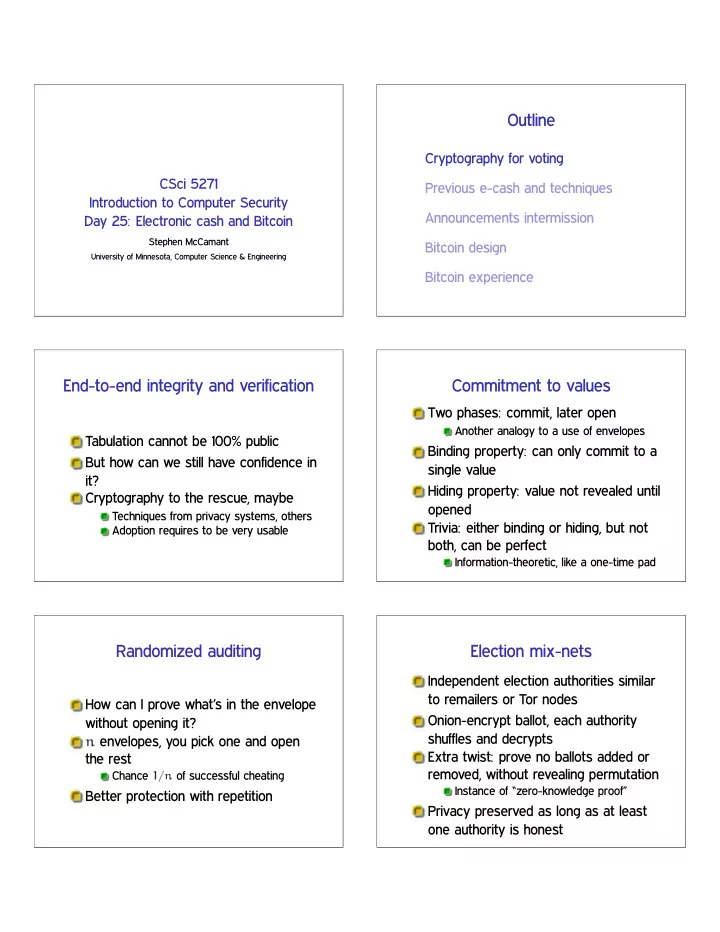
Outline Cryptography for voting CSci 5271 Previous e-cash and - - PDF document

outline
SMART_READER_LITE
LIVE PREVIEW

Outline Cryptography for voting CSci 5271 Previous e-cash and - - PDF document

Outline Cryptography for voting CSci 5271 Previous e-cash and techniques Introduction to Computer Security Announcements intermission Day 25: Electronic cash and Bitcoin Stephen McCamant Bitcoin design University of Minnesota, Computer


slide-1
SLIDE 1

CSci 5271 Introduction to Computer Security Day 25: Electronic cash and Bitcoin

Stephen McCamant

University of Minnesota, Computer Science & Engineering

Outline

Cryptography for voting Previous e-cash and techniques Announcements intermission Bitcoin design Bitcoin experience

End-to-end integrity and verification

Tabulation cannot be 100% public But how can we still have confidence in it? Cryptography to the rescue, maybe

Techniques from privacy systems, others Adoption requires to be very usable

Commitment to values

Two phases: commit, later open

Another analogy to a use of envelopes

Binding property: can only commit to a single value Hiding property: value not revealed until

  • pened

Trivia: either binding or hiding, but not both, can be perfect

Information-theoretic, like a one-time pad

Randomized auditing

How can I prove what’s in the envelope without opening it? ♥ envelopes, you pick one and open the rest

Chance ✶❂♥ of successful cheating

Better protection with repetition

Election mix-nets

Independent election authorities similar to remailers or Tor nodes Onion-encrypt ballot, each authority shuffles and decrypts Extra twist: prove no ballots added or removed, without revealing permutation

Instance of “zero-knowledge proof”

Privacy preserved as long as at least

  • ne authority is honest
slide-2
SLIDE 2

Pattern voting attack

Widely applicable against techniques that reveal whole (anonymized) ballots) Even a single race, if choices have enough entropy

3-choice IRV with 35 candidates: 15 bits

Buyer says: vote first for Bob, then 2nd and 3rd for Kenny and Xavier

Chosen so ballot is unique

Fun tricks with paper: visual crypto

Want to avoid trusted client, but voters can’t do computations by hand Analogues to crypto primitives using physical objects One-time pad using transparencies:

Scantegrity II

Designed as end-to-end add-on to

  • ptical scan system

Fun with paper 2: invisible ink Single trusted shuffle

Checked by random audits of commitments

Version used in a DC-suburb municipal election

Outline

Cryptography for voting Previous e-cash and techniques Announcements intermission Bitcoin design Bitcoin experience

Kinds of Internet payments

Credit/debit cards: most popular

Wide adoption among consumers, little consumer fraud liability Restrictive merchant procedures

PayPal

Easier to accept payments Centrally managed to deal with fraud

Ideal: electronic cash

Direct transactions without third party No transaction fees Potentially anonymous Non-revocable: buyer bears fraud risk

slide-3
SLIDE 3

Micropayments

Claim: what the web needs is small payments to support content

Too small for existing mechanisms

One idea (Peppercoin): simulate small payment with small probability of larger payment Actual market for micropayments has been small

Most buyers and sellers prefer free +

  • ther revenue

Blinded signatures

Sign something without knowing its value

Often used together with randomized auditing For RSA, multiple message by r❡, r random

Allows a bank to “mint” coins that can still be anonymous

Challenge: double spending

Any purely electronic data can be duplicated, including electronic money Can’t allow two copies to both be spent Shows ideal no-third-party e-cash can’t be possible

Puzzles / proof-of-work

Computational problem you solve to show you spent some effort Common: choose s so that ❤✭♠ ❦ s✮ starts with many 0 bits For instance, required solved puzzles can be a countermeasure against DoS

Hashcash and spam

Idea: use proof of work to solve email spam problem Puzzle based on date and recipient Legitimate users send only a few messages

Problem 1: mailing lists Problem 2: spam botnets

Never caught on

Hash trees and timestamp services

Merkle tree: parent node includes hash

  • f children

Good hash function ✦ root determines whole tree Can prove value of leaf with log-sized evidence Application: document timestamping (commitment) service

slide-4
SLIDE 4

Outline

Cryptography for voting Previous e-cash and techniques Announcements intermission Bitcoin design Bitcoin experience

HW2 due Sunday

Non-early due date: 11:55pm this Sunday Q5 performance/load issues

Avoid by not doing Q5 at the last minute, testing on yourself

Group project presentations

Start Monday, run next two weeks Plan 12 minute presentation plus 3 minutes Q&A One student per group presents Slides, BYO laptop recommended

Project progress reports Monday

Due Monday 11:55pm Progress meetings next week will mostly be after Email to start the conversation early

Outline

Cryptography for voting Previous e-cash and techniques Announcements intermission Bitcoin design Bitcoin experience

Bitcoin addresses

Address is basically a public/private signing key pair

Randomized naming, collision unlikely

At any moment, balance is a perhaps fraction number of bitcoins (BTC) Anyone one can send to an address, private key needed to spend

slide-5
SLIDE 5

Global transaction log

Basic transaction: Take ①✶ from ❛✶, ①✷ from ❛✷, . . . , put ②✶ in ❛✵

✶, ②✷ in ❛✵ ✷, . . .

Of course require P

✐ ①✐ ❂ P ❥ ②❥

Keep one big list of all transactions ever Check all balances in addresses taken from are sufficient

Bitcoin network

Use peer-to-peer network to distribute transaction log Roughly similar to BitTorrent, etc. for

  • ld data

Once a client is in sync, only updates need to be sent New transactions sent broadcast

Consistency and double-spending

If all clients always saw the same log, double-spending would be impossible But how to ensure consistency, if multiple clients update at once? Symmetric situation: me and “me” in Australia both try to spend the same $100 at the same time

Bitcoin blocks

Group ✘10 minutes of latest transactions into one “block” Use a proof of work so creating a block is very hard All clients race, winning block propagates

Bitcoin blockchains

Each block contains a pointer to the previous one Clients prefer the longest chain they know E.g., inconsistency usually resolved by next block

Regulating difficulty

Difficulty of the proof-of-work is adjusted to target the 10 minute block frequency Recomputed over two-week (2016 block) average Network adjusts to amount of computing power available

slide-6
SLIDE 6

Bitcoin mining

Where do bitcoins come from

  • riginally?

Fixed number created per block, assigned by the client that made it Incentive to compete in the block generation race Called mining by analogy with gold

Outline

Cryptography for voting Previous e-cash and techniques Announcements intermission Bitcoin design Bitcoin experience

Where Bitcoin came from

Paper and early implementation by Satoshi Nakamoto

Generally presumed to be a pseudonym

“Genesis block” created January 2009

Containing headline from The Times (of London) about a bank bailout

Current statistics

Block chain 271,000 blocks, about 14GB 12M BTC minted (many presumed lost) Theoretical value at market exchange rate ❃ $1 billion Millions of addresses, probably many fewer users Mining power: 5 petahash/sec

What can you buy with Bitcoin?

Random stuff from many small online retailers Novelty/trials of some in-person purchases Donations to like-minded non-profits Illegal drugs (Silk Road successors) Murder for hire: currently probably a fraud

Bitcoin as a currency

Can be exchanged for dollars, etc.

Currently pretty cumbersome

In some ways more like gold than fiat currencies

No central authority Price changes driven more by demand than supply

Exchange rate trend: volatile but upward

slide-7
SLIDE 7

Deflation and speculation

Some people want bitcoins to spend on purchases

Demand based on “velocity” Supply does not keep up with interest So, value of 1 BTC has to go up

Others want bitcoins because they think the price will go up in the future

Self-fulfilling prophecy But vulnerable to steep drops if expectations change

Bitcoin mining trends

Exponentially increasing rates CPU ✦ GPU ✦ FPGA ✦ ASIC Specialized hardware eclipsing general purpose

Including malware and botnets

Recent price trends suggest continuing investment

Enforcing consistency

Structure of network very resistant to protocol change

Inertia of everybody else’s code

Changes unpopular among miners will not stick Minor crisis in March: details of database lock allocation cause half of network to reject large block

Stealing bitcoins

Bitcoins are a very tempting target for malware

Private keys stored directly on client machines Theft is non-reversible Much easier than PayPal or identity theft

Standard recommendation is to keep keys mostly offline

Bitcoin (non-)anonymity

Bitcoin addresses are not directly tied to any other identity But the block chain is public, so there’s lots of information

List of largest balances on Wikipedia, academic research ❤tt♣✿✴✴❡♣r✐♥t✳✐❛❝r✳♦r❣✴✷✵✶✸✴✼✽✷

Real unlinkability is a research topic

Next time

Group project presentations